
Preferences
Privacy is important to us, so you have the option of disabling certain types of storage that may not be necessary for the basic functioning of the website. Blocking categories may impact your experience on the website. More information

Privacy is important to us, so you have the option of disabling certain types of storage that may not be necessary for the basic functioning of the website. Blocking categories may impact your experience on the website. More information

What is a landing page: clear definition, landing page vs home page, anatomy of a page that converts, SEO vs ad landing pages and a checklist.
Tools


In short
A landing page is a standalone web page designed for one audience and one action, such as signing up, booking a call or buying. Visitors usually arrive on it from an ad, an email, a social post or a search result. It differs from a home page because it removes distractions and keeps a single message from headline to button. The pages that convert share the same anatomy: a clear promise, proof, benefits, answers to objections and one call to action repeated where it matters.
Want to go further? Ask
Most people asking what is a landing page have already seen hundreds without noticing them: the page behind a Google ad, the sign-up page of a webinar, the offer page linked from a newsletter. This guide gives a precise definition, explains how a landing page differs from a home page, breaks down the structure of a page that converts, separates SEO landing pages from ad landing pages and ends with a checklist you can apply today.
A landing page is a web page built to turn one specific visitor into one specific action. The name comes from the moment a visitor "lands" after clicking a link elsewhere. In marketing, the term designates a page with a single goal, called the conversion: a form filled, a trial started, a purchase, a download, a call booked.
Three traits define it:
The two main families are lead generation pages, which collect contact details in exchange for something of value (a demo, a guide, a quote), and click-through pages, which warm the visitor up before sending them to a checkout or sign-up step.
A home page orients many visitors toward many paths, while a landing page pushes one visitor toward one path. The home page has to present the whole company, its offers, its blog and its contact details, because it receives every kind of visitor. A landing page knows who arrives and why.
| Criterion | Home page | Landing page |
|---|---|---|
| Goal | Present the brand and route visitors | Obtain one conversion |
| Audience | Everyone | One segment |
| Navigation | Full menu, many links | Minimal or none |
| Calls to action | Several, of equal weight | One, repeated |
| Traffic source | Direct, brand searches, referrals | Ads, email, social, targeted searches |
| Main metric | Engagement, clicks to inner pages | Conversion rate |
Both are needed. The home page carries brand searches; landing pages carry campaigns and commercial queries. Where they sit in the buyer's journey is detailed in our guide to the marketing funnel.
A landing page converts when the visitor understands the offer in a few seconds, believes it, and finds no reason to hesitate. The structure that achieves this has been stable for years and works in every industry:
Writing matters as much as layout: the principles of SEO copywriting (clear benefit, concrete words, short sentences) apply directly. Speed matters too, because a page that loads slowly loses visitors before they read anything; Google documents the thresholds it uses in its Core Web Vitals guidance.
An ad landing page is built to convert paid traffic quickly, while an SEO landing page is built to earn organic traffic and then convert it. The difference changes the length, the indexing and the content of the page.
| Aspect | Ad landing page | SEO landing page |
|---|---|---|
| Traffic | Paid (Google Ads, Meta, LinkedIn) | Organic search and the AIs |
| Indexing | Often noindex, many variants | Indexable, one canonical version |
| Length | Short, focused on the form | Longer, answers the questions behind the query |
| Keyword | Matches the ad group | Targets a query with commercial intent |
| Lifespan | The length of a campaign | Years, improved over time |
On the paid side, the relevance of the page to the ad and the keyword affects the cost of each click, which is why ad landing pages are often duplicated per ad group (see our guide to Google Ads). On the organic side, a landing page targeting "accounting software for freelancers" competes with other complete pages, so it needs a real explanation of the offer, comparisons, use cases and an FAQ.
The AIs cite pages that answer a question clearly, so a landing page with explicit, factual content has a better chance of being quoted than a page made only of slogans. When someone asks ChatGPT, Gemini, Perplexity or Claude which tool or provider fits a need, the assistant looks for passages that state who the offer is for, what it does and what it costs.
A few habits help:
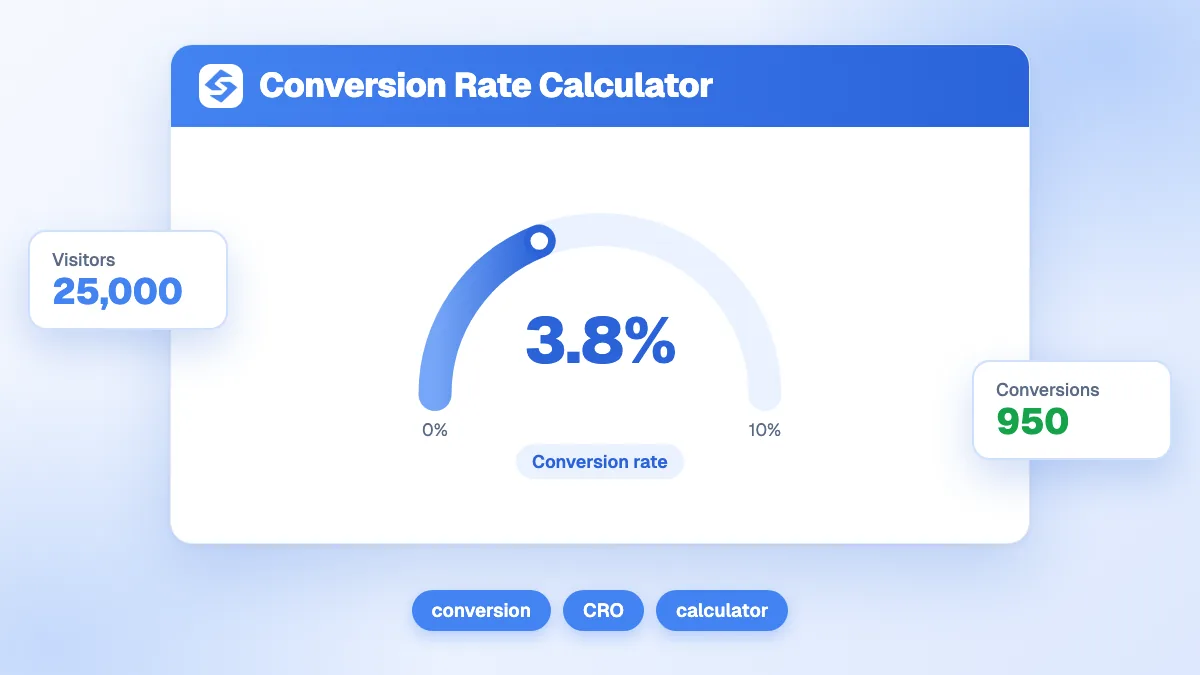
The core metric is the conversion rate: conversions divided by visitors, per traffic source. An overall rate hides the essentials, because a visitor from a brand search and a visitor from a cold social ad do not behave the same way. Compute it per source with our conversion rate calculator.
Next come the cost per conversion for paid traffic, the quality of the leads (how many become clients), the scroll depth and the form abandonment rate. Improving these numbers step by step, with tests on headline, proof and form length, is the work of conversion rate optimization. Test one element at a time and wait for enough traffic before concluding.
Before publishing, check these points one by one.
A landing page is a focused page with one audience, one promise and one action, and its performance depends on the continuity between the click and the page. Build ad pages for speed and relevance to the campaign, build SEO pages to answer the questions behind a commercial query, and measure each one per traffic source.
SEO landing pages perform better when articles bring qualified visitors to them. Sorank writes and publishes those articles in autopilot, with automatic internal links to your key pages, and tracks whether the AIs cite your brand. See the plans, with a 3-day free trial.

A website is a set of pages that serves many visitors with many intentions: discovering the brand, reading, comparing, contacting. A landing page is one page inside or outside that website, built for a single audience and a single action, such as booking a demo or downloading a guide. It usually removes navigation so nothing competes with that action.
One per offer, audience and traffic source that deserve a distinct message. A company with three services sold to two types of clients through ads and search can justify a dozen pages. The useful test is simple: if the headline you would write for a segment differs from the one on your existing page, that segment deserves its own landing page.
Yes, if it is built as an SEO landing page: indexable, aimed at a keyword with commercial intent, and rich enough to answer the questions behind that keyword. Thin ad landing pages with a form and three lines of text rarely rank, because they give Google little to evaluate. Many teams keep one indexable version for search and lighter variants for paid campaigns.
 AI Content Brief Generator
 FAQ Schema GeneratorAI Blog Post Ideas GeneratorStructured Data Validator
 Alt Text Checker
 Internal Link AnalyzerBacklink ChallengeAI Meta Description GeneratorAI Blog Title Generator
 Google Indexability CheckerAI Blog Outline GeneratorUTM Link BuilderKeyword Clustering ToolCanonical Tag Checker
 XML Sitemap GeneratorBroken Link CheckerAI SEO Title GeneratorHeadline AnalyzerSERP Preview ToolRedirect Checker
 Hreflang Tag GeneratorHeading Structure AnalyzerHTTP Headers CheckerFavicon Extractor
 SERP CTR Calculator
 SEO vs Paid Search Savings Calculator
 SEO Share of Voice Calculator
 SEO ROI Calculator
 SEO Traffic and Revenue Forecast Calculator
 SEO Budget Calculator
 SEO Break-Even Calculator
 SaaS SEO ROI Calculator
 ROAS Calculator
 Reading Time Calculator
 Ranking Gain Simulator
 Organic Traffic Value Calculator
 Organic Traffic Estimator
 LTV to CAC Ratio Calculator
 Local SEO ROI Calculator
 Link Building Cost Calculator
 Keyword Value Calculator
 Keyword Opportunity Score Calculator
 Keyword Density Calculator
 GEO ROI Calculator
 GEO Content Investment Calculator
 Ecommerce SEO ROI Calculator
 Customer Lifetime Value Calculator
 Customer Acquisition Cost Calculator
 CTR Calculator
 Cost Per Article Calculator
 Conversion Rate Calculator
 Content Marketing ROI Calculator
 ChatGPT Referral Traffic Estimator
 Bounce Rate Calculator
 Backlink ROI Calculator
 AI Visibility Score Calculator
 AI Traffic Value Calculator
 AI Share of Voice Calculator
 Cost of AI Invisibility Calculator
 AI Citation Rate Calculatorllms.txt ValidatorAI Overview CheckerRobots.txt CheckerAI SEO AuditLLM Readability CheckerSearchGPT Readiness Checker
 Structured Data LLM AuditWebsite Crawlability AI AuditWhy ChatGPT Is Not Recommending My Website
 Gemini Ranking ToolPerplexity Ranking CheckerLLM Citation CheckerAnswer Engine Optimization AuditGEO AuditAI Search Visibility TestChatGPT Visibility Checkerllms.txt Generator
 URL ExtractorWebpage to MarkdownSitemap CheckerSERP Volatility SensorPage Size Checker
 Word Counter
 Slug GeneratorSchema GeneratorRobots Generator
 OG PreviewMeta Tags Generator
 Image CompressorFavicon Generator
 On-Page SEO Audit
 Backlink Analysis Tool
 Keyword Research Tool
 Domain Authority Checker
THEY TRIED SORANK BEFORE YOU
 “I tested Sorank on a real client site and it's insane. It does everything an agency would bill you $1500 a month for. It's going into production on that client now.”

 Guillaume Guersanguersanguillaume.com“We are an Ads agency and we wanted to get our SEO back on track once and for all. Sorank gave us a clear view of our site, helped us prioritize optimizations, and properly structure our content. The tool is easy to use, well designed for a team, and very practical for centralizing tracking without having to juggle multiple platforms. A very solid foundation to start fresh with our SEO.”
 Gaspard MadouiAds Agency
 “I just let the Sorank software do its thing, and now my DR is 25 and my page is ranking higher.”
 Lucas Flandrefoundertrace.fr“I specialized in GEO thanks to Sorank. The GEO Leaderboard allows me to show my clients their position vs competitors on ChatGPT. It’s a real commercial differentiator.”
 MélanieSEO Freelance“Great service, works well for our website and helps us understand how to improve it to rank better on Google and elsewhere. Congrats, keep going, I recommend it.”
 Hugo T.E-commerce merchant























