
Preferences
Privacy is important to us, so you have the option of disabling certain types of storage that may not be necessary for the basic functioning of the website. Blocking categories may impact your experience on the website. More information

Privacy is important to us, so you have the option of disabling certain types of storage that may not be necessary for the basic functioning of the website. Blocking categories may impact your experience on the website. More information

What is a marketing funnel? The stages (top, middle, bottom of funnel), the content and metrics for each, how it maps to search intent and to the AIs.
Tools


In short
A marketing funnel is a model of the path from first contact with a brand to purchase, split into stages that narrow as prospects drop out. The classic version has three stages: top of funnel (TOFU, awareness), middle of funnel (MOFU, consideration) and bottom of funnel (BOFU, decision), often followed by retention. Each stage needs its own content, matches a type of search intent and has its own metrics. In 2026, AI assistants compress the funnel by answering discovery and comparison questions in one conversation, so being cited there matters at every stage.
Want to go further? Ask
Every buyer goes through the same broad steps: noticing a problem, looking at options, choosing one. A marketing funnel turns those steps into a plan, so that you know what to publish, where people are lost and which actions bring revenue. This guide covers the stages, the content and metrics for each, the link with search intent and what changes when buyers ask ChatGPT or Gemini instead of browsing ten sites.
A marketing funnel is a visual model of the customer journey: many people enter at the top, fewer move to consideration and a small share become customers. The shape is a funnel because each stage loses part of the audience, and the job of marketing is to bring the right people in and lose fewer of them on the way.
The idea goes back to the AIDA model (attention, interest, desire, action), usually attributed to the advertiser E. St. Elmo Lewis at the end of the 19th century. Modern versions keep the logic and adapt the stages to digital channels, where most of the journey happens on search engines, social networks, review sites and now AI assistants.
The funnel is a simplification. Real journeys loop back and skip steps, and B2B purchases involve several people. Its value lies in planning: it shows whether you have content and offers for each level of awareness, and it gives you a place to measure drop-offs.
The standard funnel has three stages, top, middle and bottom, and most teams add a post-purchase stage for retention and advocacy. The table summarizes what happens at each one.
| Stage | What the prospect thinks | Your goal | Typical content |
|---|---|---|---|
| Top of funnel (TOFU): awareness | "I have a problem or a question" | Be found and trusted | Guides, definitions, statistics, checklists, short videos |
| Middle of funnel (MOFU): consideration | "Which solutions exist and which suits me?" | Become a serious option | Comparisons, "best X" lists, case-style explainers, webinars, templates |
| Bottom of funnel (BOFU): decision | "Is this the right provider, at the right price?" | Win the choice | Product and pricing pages, demos, free trials, reviews, alternative pages |
| Post-purchase: retention and advocacy | "Am I getting value, would I recommend it?" | Keep and grow customers | Onboarding, help center, newsletters, customer community |
Some models split the funnel further (awareness, interest, evaluation, purchase, loyalty), or replace it with a loop or a flywheel where happy customers feed the top. The names change; the principle of matching content to the level of awareness stays.
Top of funnel content teaches, middle of funnel content helps compare, and bottom of funnel content removes the last doubts before buying. Mixing them up is the most common mistake: a sales pitch inside a beginner guide pushes readers away, and a vague blog post on a pricing query loses a ready buyer.
This content-first approach is the core of inbound marketing: attract people with useful content at the top, then guide them down with relevant offers.
Each funnel stage corresponds to a type of search intent, so your keyword research is also a map of the funnel. Looking at the words people use tells you how close they are to buying.
| Funnel stage | Dominant search intent | Example queries |
|---|---|---|
| Top | Informational | "what is a marketing funnel", "how to get more website traffic" |
| Middle | Commercial investigation | "best email marketing software", "HubSpot vs Mailchimp" |
| Bottom | Transactional and navigational | "Brand X pricing", "Brand X free trial", "Brand X login" |
Matching the page format to the search intent is also what Google rewards: a query like "best CRM for small business" shows lists and comparisons, while "CRM definition" shows explanations. If your page type differs from what ranks, it will struggle whatever its quality. Bottom of funnel queries have lower volumes but convert far better, which is why a balanced content plan covers all three levels instead of chasing traffic at the top only.
Measure reach at the top, engagement and lead capture in the middle, and conversions and revenue at the bottom, then follow the conversion rate between stages. The transitions often teach more than the absolute numbers.
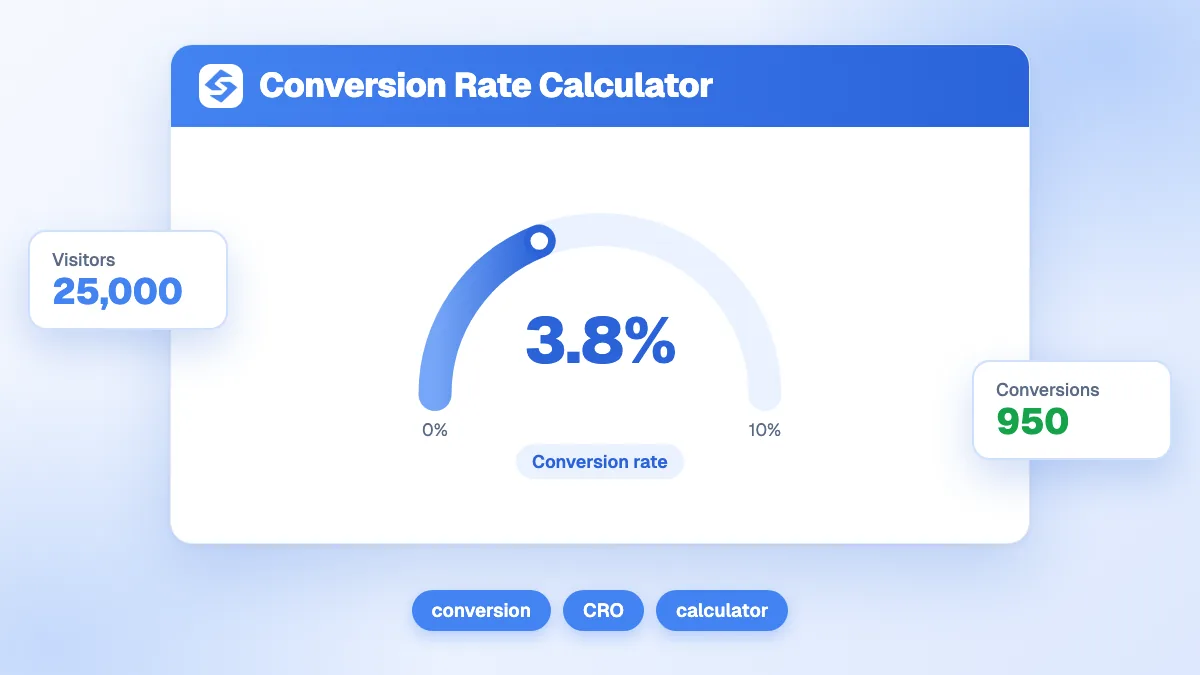
Compute the rate from one stage to the next to find the weakest point: if many visitors read your guides but few reach a product page, the internal links and calls to action between the two are the problem. The free conversion rate calculator helps for quick checks, and our guide to SEO KPIs details which indicators to report.
AI assistants compress the funnel: a buyer can go from "what is this problem" to "which three providers should I consider" in a single conversation, without visiting your site. The stages still exist, but some happen inside ChatGPT, Gemini, Perplexity, Claude or Google's AI Overviews.
Three consequences follow. First, top of funnel clicks can fall while impressions stay stable, because the answer is given on the results page; this is the rise of zero-click searches. Second, the shortlist is often built by the assistant, so being cited as a source or recommended by name becomes a middle of funnel goal in itself. Third, visitors who do click arrive later in their journey and better informed, which tends to make bottom of funnel pages more important.
To stay present, publish clear answers that an assistant can quote, keep facts about your offer consistent across your site and third-party pages, and track the prompts your buyers ask to see whether your brand appears and who appears instead.
Start from the customer, map the questions at each stage, fill the gaps with content and offers, then measure the transitions.
A marketing funnel is a simple way to plan content and measure where prospects drop off: teach at the top, help compare in the middle, make the decision easy at the bottom, and keep customers after the sale. Map each stage to search intent, track the transitions rather than vanity totals, and make sure your brand is present in the AI answers that now cover several stages at once.
Sorank fills the top and middle of the funnel on autopilot: it finds the keywords at each stage, writes and publishes one article a day with internal links, and tracks every week whether the AIs cite your brand on the prompts your buyers ask. See the plans, with a 3-day free trial.

The three classic stages are the top of the funnel (TOFU), where people discover a problem and your brand; the middle of the funnel (MOFU), where they compare solutions; and the bottom of the funnel (BOFU), where they decide and buy. Many teams add a fourth stage after the purchase, retention and advocacy, because existing customers bring repeat sales and referrals.
Top of funnel content answers the broad questions people ask before they know a solution exists: guides, definitions, checklists, statistics and educational videos. Its goal is reach and trust rather than immediate sales, so it is measured by impressions, organic visits, AI citations and the share of readers who continue to a deeper page or subscribe.
Yes, as a planning tool, even though real buyer journeys are rarely linear. People jump between stages, read reviews on several channels and increasingly ask AI assistants to shortlist options for them. The funnel remains useful to make sure you have content for every level of awareness and to measure where prospects drop off.
 AI Content Brief Generator
 FAQ Schema GeneratorAI Blog Post Ideas GeneratorStructured Data Validator
 Alt Text Checker
 Internal Link AnalyzerBacklink ChallengeAI Meta Description GeneratorAI Blog Title Generator
 Google Indexability CheckerAI Blog Outline GeneratorUTM Link BuilderKeyword Clustering ToolCanonical Tag Checker
 XML Sitemap GeneratorBroken Link CheckerAI SEO Title GeneratorHeadline AnalyzerSERP Preview ToolRedirect Checker
 Hreflang Tag GeneratorHeading Structure AnalyzerHTTP Headers CheckerFavicon Extractor
 SERP CTR Calculator
 SEO vs Paid Search Savings Calculator
 SEO Share of Voice Calculator
 SEO ROI Calculator
 SEO Traffic and Revenue Forecast Calculator
 SEO Budget Calculator
 SEO Break-Even Calculator
 SaaS SEO ROI Calculator
 ROAS Calculator
 Reading Time Calculator
 Ranking Gain Simulator
 Organic Traffic Value Calculator
 Organic Traffic Estimator
 LTV to CAC Ratio Calculator
 Local SEO ROI Calculator
 Link Building Cost Calculator
 Keyword Value Calculator
 Keyword Opportunity Score Calculator
 Keyword Density Calculator
 GEO ROI Calculator
 GEO Content Investment Calculator
 Ecommerce SEO ROI Calculator
 Customer Lifetime Value Calculator
 Customer Acquisition Cost Calculator
 CTR Calculator
 Cost Per Article Calculator
 Conversion Rate Calculator
 Content Marketing ROI Calculator
 ChatGPT Referral Traffic Estimator
 Bounce Rate Calculator
 Backlink ROI Calculator
 AI Visibility Score Calculator
 AI Traffic Value Calculator
 AI Share of Voice Calculator
 Cost of AI Invisibility Calculator
 AI Citation Rate Calculatorllms.txt ValidatorAI Overview CheckerRobots.txt CheckerAI SEO AuditLLM Readability CheckerSearchGPT Readiness Checker
 Structured Data LLM AuditWebsite Crawlability AI AuditWhy ChatGPT Is Not Recommending My Website
 Gemini Ranking ToolPerplexity Ranking CheckerLLM Citation CheckerAnswer Engine Optimization AuditGEO AuditAI Search Visibility TestChatGPT Visibility Checkerllms.txt Generator
 URL ExtractorWebpage to MarkdownSitemap CheckerSERP Volatility SensorPage Size Checker
 Word Counter
 Slug GeneratorSchema GeneratorRobots Generator
 OG PreviewMeta Tags Generator
 Image CompressorFavicon Generator
 On-Page SEO Audit
 Backlink Analysis Tool
 Keyword Research Tool
 Domain Authority Checker
THEY TRIED SORANK BEFORE YOU
 “I tested Sorank on a real client site and it's insane. It does everything an agency would bill you $1500 a month for. It's going into production on that client now.”

 Guillaume Guersanguersanguillaume.com“We are an Ads agency and we wanted to get our SEO back on track once and for all. Sorank gave us a clear view of our site, helped us prioritize optimizations, and properly structure our content. The tool is easy to use, well designed for a team, and very practical for centralizing tracking without having to juggle multiple platforms. A very solid foundation to start fresh with our SEO.”
 Gaspard MadouiAds Agency
 “I just let the Sorank software do its thing, and now my DR is 25 and my page is ranking higher.”
 Lucas Flandrefoundertrace.fr“I specialized in GEO thanks to Sorank. The GEO Leaderboard allows me to show my clients their position vs competitors on ChatGPT. It’s a real commercial differentiator.”
 MélanieSEO Freelance“Great service, works well for our website and helps us understand how to improve it to rank better on Google and elsewhere. Congrats, keep going, I recommend it.”
 Hugo T.E-commerce merchant























