Preferences
Privacy is important to us, so you have the option of disabling certain types of storage that may not be necessary for the basic functioning of the website. Blocking categories may impact your experience on the website. More information
Privacy is important to us, so you have the option of disabling certain types of storage that may not be necessary for the basic functioning of the website. Blocking categories may impact your experience on the website. More information

Learn how to write a case study step by step: choose the customer, collect the facts, structure the story, write the results and publish it safely.

In short
A case study tells one customer's story in a fixed order: who the customer is, the problem they had, what you did together, and the result, with the method used to measure it. To write one, pick a typical customer with a result you can explain, collect the facts and a baseline before you draft, and get written approval before you publish. Keep every claim exact, because the FTC's rule on testimonials and Google's review guidelines both set limits on what you can publish and how you mark it up.
Want to go further? Ask
Quick quiz
How should you run your blog?
Sorank matches your answers


Test it for 3 days on your own site and see where you stand on Google, ChatGPT and the other AIs.
Start 3-day free trial3 days free, then stop whenever you want. 90-day results guarantee, conditions apply.
A case study is a long-form story about one customer. It names the customer, describes the situation before the work, shows what changed and how, and ends with a result the reader can check. It is written for someone close to buying: a founder, a marketing lead, or an SEO who has to justify a budget to a manager.
It is not a testimonial. A testimonial is one or two sentences of praise. A case study does the job a testimonial cannot: it shows the reader the path from problem to result, so they can judge whether the same path fits their company.
Testimonial or case study?
Buyers read case studies because they are looking for a company like theirs. A good case study answers three questions for them: is this company like mine, did they start where I am, and what did they do that I could copy? Write for those questions, in that order. If the reader cannot answer the first one in the opening lines, they will leave before they reach your method.
Two things: a specific customer and a result that is hard to fake. A story about a famous brand with no numbers is an advertisement. A story about a small company with a clear baseline and a stated method is evidence. Most of the work is in the second part: finding the baseline and explaining the method in plain words. For the storytelling side of the job, see brand storytelling, which covers how to make the story itself memorable.
The biggest logo is tempting. It is also the least useful for most readers, because their company is smaller, has fewer people and a different setup. Pick the customer whose situation is most common among the people you want to reach. If that customer is a ten-person agency, a ten-person agency is the right case study, even if it looks less impressive on a slide.
Choose a customer who is willing to talk, too. A customer with a good result and no time for an interview will give you a weak story, because you will have to guess the details, and readers can tell when a story is guessed.
A result is usable when you can answer four questions: what was the starting point, what changed, over what period, and how did you measure it? If you cannot answer the fourth one, do not put the result in the headline. Look for a smaller result you can measure, or for a different customer.
| Criterion | Good sign | Warning sign |
|---|---|---|
| Fit | Same size, sector or problem as your target reader | Only fits a company with a large budget |
| Baseline | Figures from before the project, with dates | "We were struggling", with nothing to compare |
| Measurement | A named source, such as a Search Console export or an analytics report | Numbers with no source |
| Willingness | Agrees to an interview and a review of the text | Agrees by email, then never answers |
| Permission | Written approval for the name, the logo and the figures | A verbal "fine by me" |
Ask early, in writing, for the right to tell the story, use the name and logo, and publish each figure. Approval at the start is not enough, because the customer will read the final text and may reject a phrase or a number. Keep the approval next to the draft, so you can show it later. The legal side of testimonials is covered in the section on the FTC rule below.
Most weak case studies come from a writer who starts drafting before the facts are complete. Build a fact sheet first. Then run one interview, record it, and only then write. This order saves time, and it keeps the quotes accurate.
Fill in these fields before the interview: the customer's name and sector, their size, what they sell, the service you provided, the start and end dates, the baseline figures and their source, the results and their source, and the main objection the customer had before they bought. Share the sheet with the customer so they can correct it. A wrong detail about their own company costs you more trust than a missing one.
Facts to collect before the interview
For a search case study, the baseline is usually organic clicks or sessions from Google Search Console or your analytics tool, for a fixed period before the work started. Compare it with the same measure for a fixed period after. Write down the date ranges, the site or property, and any filters. If the customer used a different report, record which one. A result that nobody can reproduce from the report is not a result you should publish.
In Search Console, open the Performance report, set the date range, then add a page filter and choose Custom to write a regular expression. Google announced that filter in its April 2021 note on data filtering, and the same note says the comparison mode supports it too. A pattern like the one below isolates the URLs of one service area, so the baseline and the result cover the same pages. Search Console keeps 16 months of data, so export the baseline months now, before they drop out of the window.
/(services|pricing|case-studies)/Watch out for seasonality. A tourism site looks weaker in winter whatever you did, and a shop looks stronger in November. Compare the same months one year apart where you can. If you cannot, say clearly in the text that the period was seasonal.
Record the call with permission, and keep the recording. Ask open questions, then follow up on every number. These questions work well:
Keep the quotes in the customer's own words. Tidy the grammar, but not so much that the voice disappears, and never put a sentence in their mouth that they did not say.
This is the practical part. Follow the steps in order. Each one produces something the next step needs, so skipping one usually means rewriting later.
Six steps from brief to published story
Before the first paragraph, write one sentence that contains the customer, the method and the change. For example, with a made-up case: "A regional dental clinic rebuilt its service pages around the questions patients ask, and its organic calls rose over six months." If you cannot write that sentence, you do not have a case study yet. You have a project. The same sentence becomes your meta description and the first line of your social post, so it is worth getting right.
The challenge is where most writers lose the reader. Describe the situation the way the customer would have seen it, with the symptoms they noticed: fewer leads, pages that did not appear in search, a sales team that kept asking for better content. Name the cost of doing nothing, if the customer gave you one. Keep it to one or two paragraphs. A reader who sees their own problem in the first lines keeps reading.
Readers copy methods. They rarely copy tools. For each action, write what you did, why you chose it, and what the customer had to do. For a search project, that might be an audit of the pages that already got impressions, a rewrite of the titles that sat just outside the first page, and a review of the internal links between the service pages. Each action needs its reason in the same sentence.
Mention the trade-offs too. If you chose not to do something, say so and say why. Expert readers trust that part more than any list of wins.
Lead with one headline figure, then give the baseline, the period, the source and the scope. "Clicks went up" with no period is a claim. A result with a baseline, a period and a named report is evidence. Put the source in the text, not only in a chart, so a reader who skips the chart still sees it.
Keep one measure per result. If you show clicks, impressions and revenue together, the reader will ask which one moved the business, and they will be right to ask.
Send the full text, not a summary, and ask for a yes or no on each figure. Note the date and the version of the approval. If the customer asks you to remove a figure, remove it, even if you think it is the best number in the story. A story without that figure is still a true story.
Publish on a stable URL, with a visible publication date and an updated date each time you change a figure. Link to the service the customer used, to the pages that explain the method, and to related articles. A case study without links is a dead end, and a few relevant links keep the reader on your site. Sorank's public case studies show one way to lay out a set of stories, so you can compare your draft with a published page.
A good structure is plain on purpose. Readers scan case studies. They want to find the customer, the problem, the method and the result in a few seconds, then decide whether to read on. Use the same order every time, so a reader who has read one case study knows where to find things in the next.
Name the customer or the sector, the change and the time frame. Keep it factual. The headline is a claim you must defend in the first paragraph, so do not write anything you cannot support. Avoid words like "incredible" or "explosive". They are promises, and the reader will check them.
Right under the headline, add three to five bullet points: the starting point, the headline result with its figure, the period, the main methods, and the customer's own one-line verdict. A reader who only reads this block should still know what happened.
Use two short paragraphs. Introduce the customer in one sentence: what they sell and to whom. Then describe the challenge with the detail from your interview. Do not describe your company here. The reader is not interested in you yet, only in whether the customer looks like them.
Describe what you did in the order it happened, then stop at the decisions that changed the result. A long list of features makes a case study read like a product page. A short list of decisions, each with its reason, reads like a method, and a method is what the reader came for.
Show the results with their baseline and method. Add one quote from the customer, ideally about a change they saw, not about how pleasant your team was. End with one clear next step for the reader: a page to visit, a question to ask, or a free tool to try. Keep it to one call to action, so the reader does not have to choose.
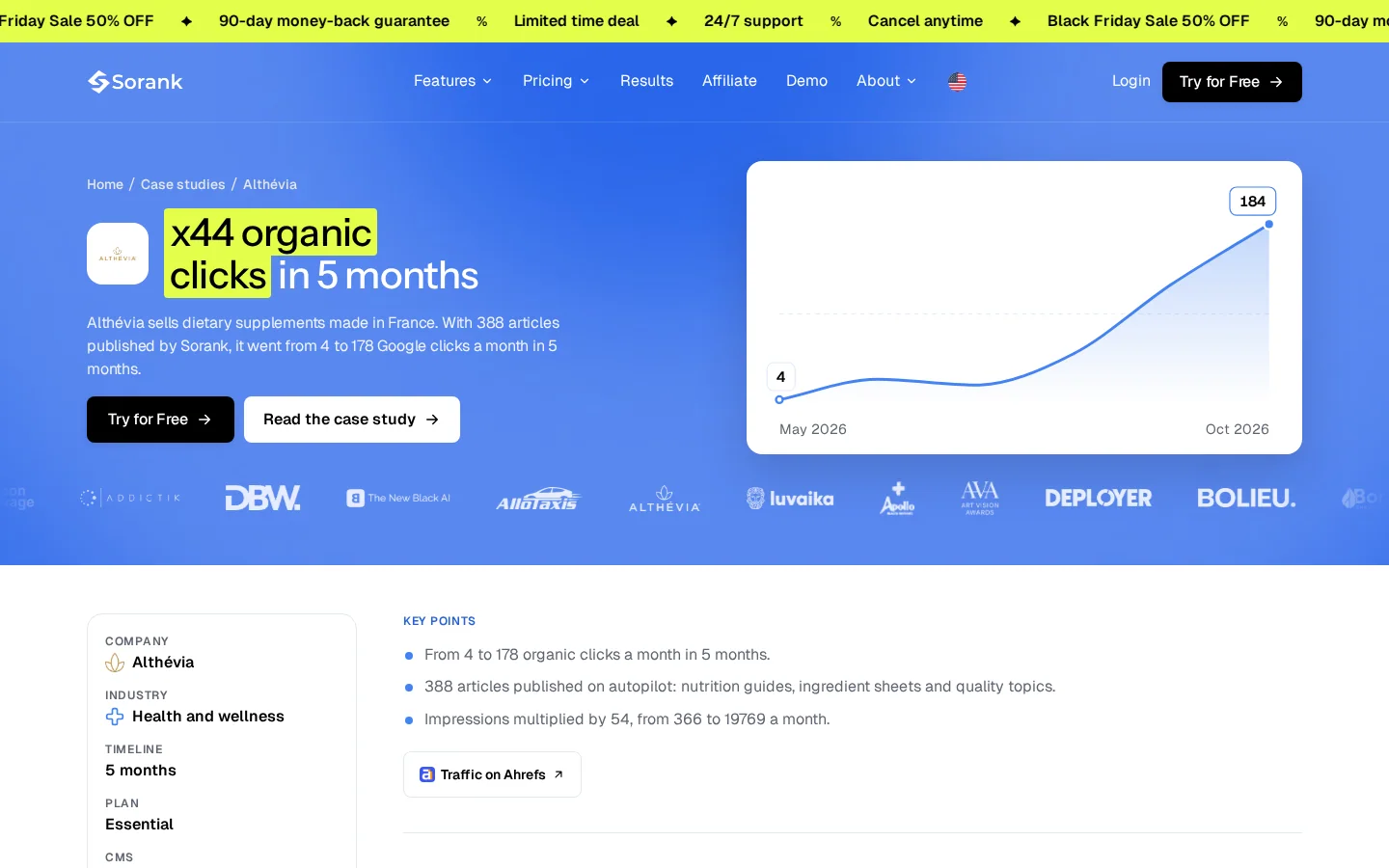
Sorank's public case studies follow a similar order, from the headline to a question-and-answer block at the end. The Althévia page is one example, so you can compare its layout with your draft.
The same facts can be arranged in three frames. Each one serves a different reader and carries a different risk. Choose the frame before you draft, because the frame decides where the result goes and how long the piece will be.
Principle: three blocks, each answering one question: what was the problem, what did we do, and what changed.
When to use it: landing pages, sales decks and short summaries, where a buyer needs the logic in a few seconds.
Advantages: it is fast to scan, easy to template across customers, and consistent to read.
Limits: it hides the decision, the doubts and the timeline, so the story can sound generic. A reader who has seen five of these stops after the second block.
Example: "Challenge: reviews of search performance were manual and late. Solution: a weekly report with the three changes that mattered. Result: the review moved from several days to one meeting."
Principle: tell the story in time order, from the first conversation to the most recent check-in.
When to use it: multi-phase projects such as migrations, rebuilds and programmes that run over several quarters.
Advantages: it shows the work and how long it took, which is exactly what a buyer planning a similar project needs to know.
Limits: the result arrives late. Put the headline result in the snapshot, or readers who stop early will miss it.
Example: "In the first week, the team listed every report it produced. In week three, the first automated version went live. By the end of the quarter, the review was one meeting."
Principle: open with a sentence from the customer, then prove it with the rest of the story.
When to use it: when the customer is a strong speaker, and for video, audio and social cut-downs.
Advantages: it sounds human, and readers share it.
Limits: a striking quote can cover a vague result, and readers notice when the proof is thin. Always follow the quote with a measure.
Example: "We finally know which pages matter before we write anything." The next paragraph gives the baseline, the period and the source.
| Frame | Best for | Main risk | Typical length |
|---|---|---|---|
| Challenge, solution, result | Landing pages and sales decks | Generic tone | Short |
| Chronological narrative | Multi-phase projects | Late result, lost readers | Long |
| Quote-led | Video, social and podcasts | Vague praise without proof | Short to medium |
In practice, open with the quote, use the timeline for the body, and close with a challenge, solution and result summary. That gives the reader the voice, the work and the logic in one piece.
The results section decides whether the rest of the story is believed. A reader who sees a large figure with no baseline assumes the worst. Four rules keep your claims honest: name the baseline, name the period, name the method, and name the other changes.
A result is a difference between two states. Write down the starting value, the end value and the window between them. For search, that might be organic clicks per month in the month before the project and in the sixth month after, measured in the same tool on the same set of pages. Name the tool. Search Console and an analytics tool often disagree, so choose one and say which.
Example
Invented figures, for illustration only: a team reports 1200 organic clicks in the month before the project and 4000 in the sixth month, from Search Console, on the same set of pages. A careful reader can check that sentence. "Our traffic exploded" cannot be checked, so it cannot persuade them.
Something else changed during the window: a seasonal peak, a new campaign, a product launch, a change in how search engines show results. List those changes in one short paragraph. It does not weaken the story. It makes the claim credible, and a sales team can repeat it without fear. Use "after" rather than "because of" when you cannot isolate your part.
Round only with the customer's agreement, and never in your favour. If the customer says "about a third", write "about a third" unless the exact figure is in their report. Use the same unit and the same format throughout the text, the table and the bullet points.
Two ways to state the same result
The headline and the results figure are what people repeat. Get them right, and your case study is easier to share, easier to quote, and easier for a search engine to match to the question someone typed.
Use this pattern: customer or sector, then what changed, then the period. For example, "How a furniture store grew its organic sales in one year" is less exciting than "How a furniture store doubled its search revenue overnight", but you can defend the first one. The second is a promise about the result, and the first one is a description of the work.
"Our traffic grew a lot" becomes a sentence the reader can check: organic clicks from Google, in one report, rose from the figure in the baseline month to the figure in the last month of the period. Explain the change in terms the reader can verify. If the number is modest, say so. A modest figure that is exact earns more trust than a large figure nobody can trace.
Vague headline or checkable headline
Search results cut long titles, and a headline that works on a slide can be unreadable in a results list. Check the length and the wording before the page goes live.
Tip
Run your draft headline through the free Headline Analyzer from Sorank. It scores the title before you publish, so you can fix the length and the wording in one pass.
A written page is not the only option. Each format fits a different job, and one story can be cut into several. Here are five formats, what each one is for, and where each one falls short.
Principle: one full story on one page, with headings, detail and the complete method.
When to use it: for search, for sales teams who send a link, and for AI assistants that read your site.
Advantages: it can rank, it holds the detail, and it lives as a page you can link to from anywhere on your site.
Limits: it takes the most time to write and to keep up to date.
Example: a snapshot at the top, the method in the middle, and a question-and-answer block at the end.
Principle: the same facts on one downloadable page, for a sales conversation.
When to use it: when the buyer has to forward something to a manager who will not click a link.
Advantages: easy to share inside a company, and easy to print.
Limits: search engines index a PDF less reliably than a page, and it goes stale in a folder nobody opens.
Example: one side of an A4 sheet with the challenge, three results and a short quote.
Principle: the customer tells the story in their own voice, cut to two or three minutes.
When to use it: for brands whose buyers trust people more than text, and for events where the story can be shown live.
Advantages: the voice is hard to fake, and viewers feel the customer's credibility.
Limits: expensive to produce, and invisible to search engines unless you add a full transcript on the same page.
Example: the customer on camera describing the one decision that changed the result, with the transcript below the video.
Principle: one result, one image, one line, pointing to the full story.
When to use it: for distribution on LinkedIn or X, where most people never click through.
Advantages: cheap to make, and you can publish one every week.
Limits: no method, so the reader cannot judge the result, and it should never stand alone.
Example: a card with the headline result, the period and a link to the long case study.
Principle: several customers in the same sector, combined, with the methods they shared.
When to use it: when you want authority in a category, or when no single customer can be named.
Advantages: more weight than one story, and more useful to a reader who is not in the same position as any one customer.
Limits: it needs clean data from several customers, and clear rules on how you combined the figures.
Example: a report showing the methods customers in one sector used, and the range of their results, with the same measurement rules for each.
| Format | Best for | Main advantage | Main limit | Effort to produce |
|---|---|---|---|---|
| Long web case study | Search and sales links | Can rank, holds detail | Takes time to keep current | High |
| One-page PDF | Forwarding to a manager | Easy to share | Not indexed like a page | Low |
| Video interview | Trust and events | Credible voice | Costly, needs a transcript | High |
| Short social card | Distribution | Cheap and frequent | No method shown | Low |
| Benchmark report | Authority in a category | Weight and usefulness | Needs several customers | High |
Note
Start with the long web case study, then cut the other formats from it. Going the other way, from a social card to a full story, usually leaves the method missing.
A case study is a page like any other. Search engines have to find it, read it and understand what it is about. Three things help: a clear URL, a page that answers its question on the first screen, and the right structured data.
Give each customer its own page, with a URL that names the customer or the sector. Do not bury the story behind a carousel or a form. Crawlers cannot read a form, and most readers will not fill one in to see a case study.
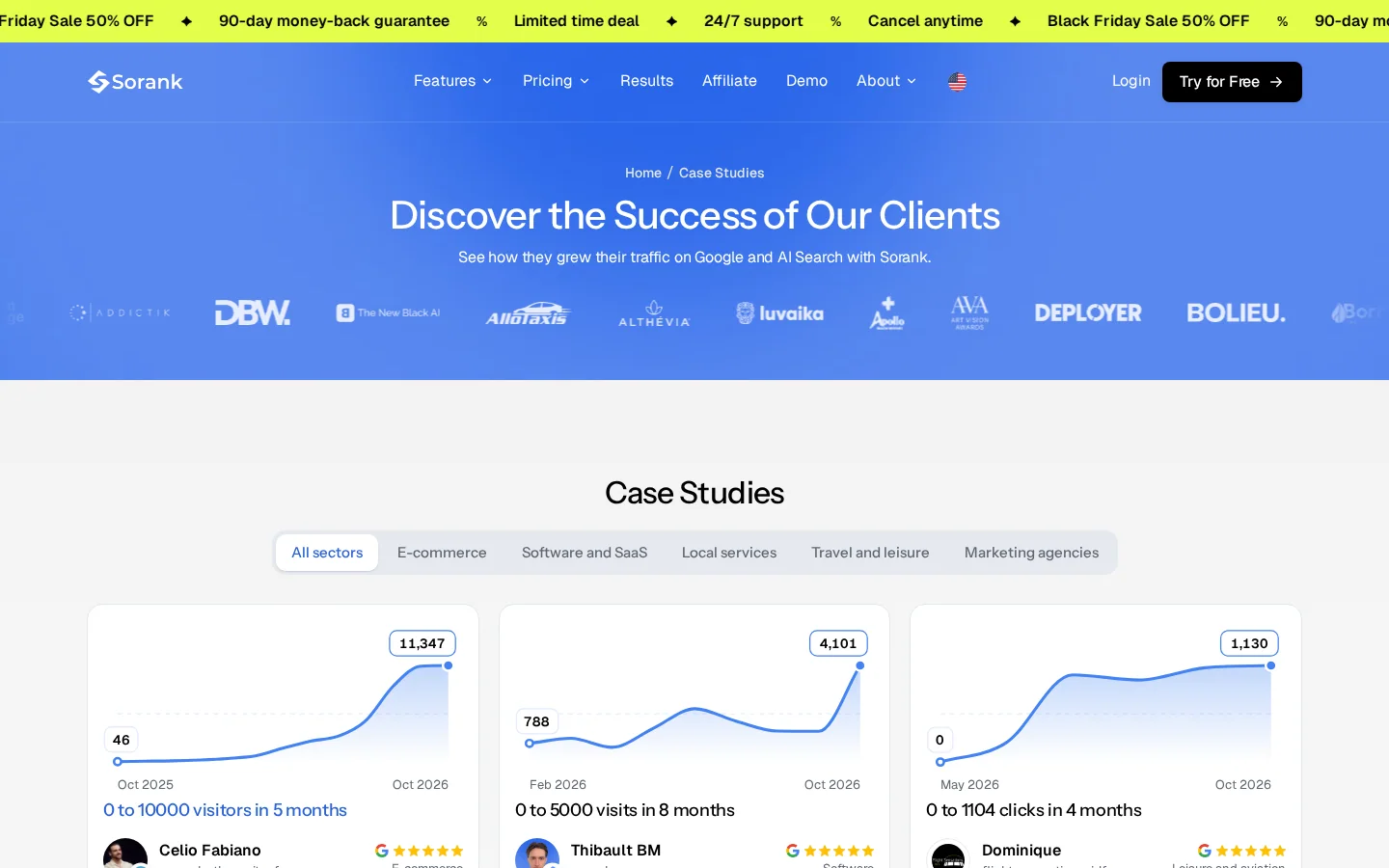
A listing page helps readers choose. Sorank's public listing filters its case studies by sector, so a reader can jump straight to their own industry.
If your team publishes case studies at volume, the workflow matters more than the page. Sorank's page for content teams describes how a team plans and publishes at that pace: Sorank for content teams.
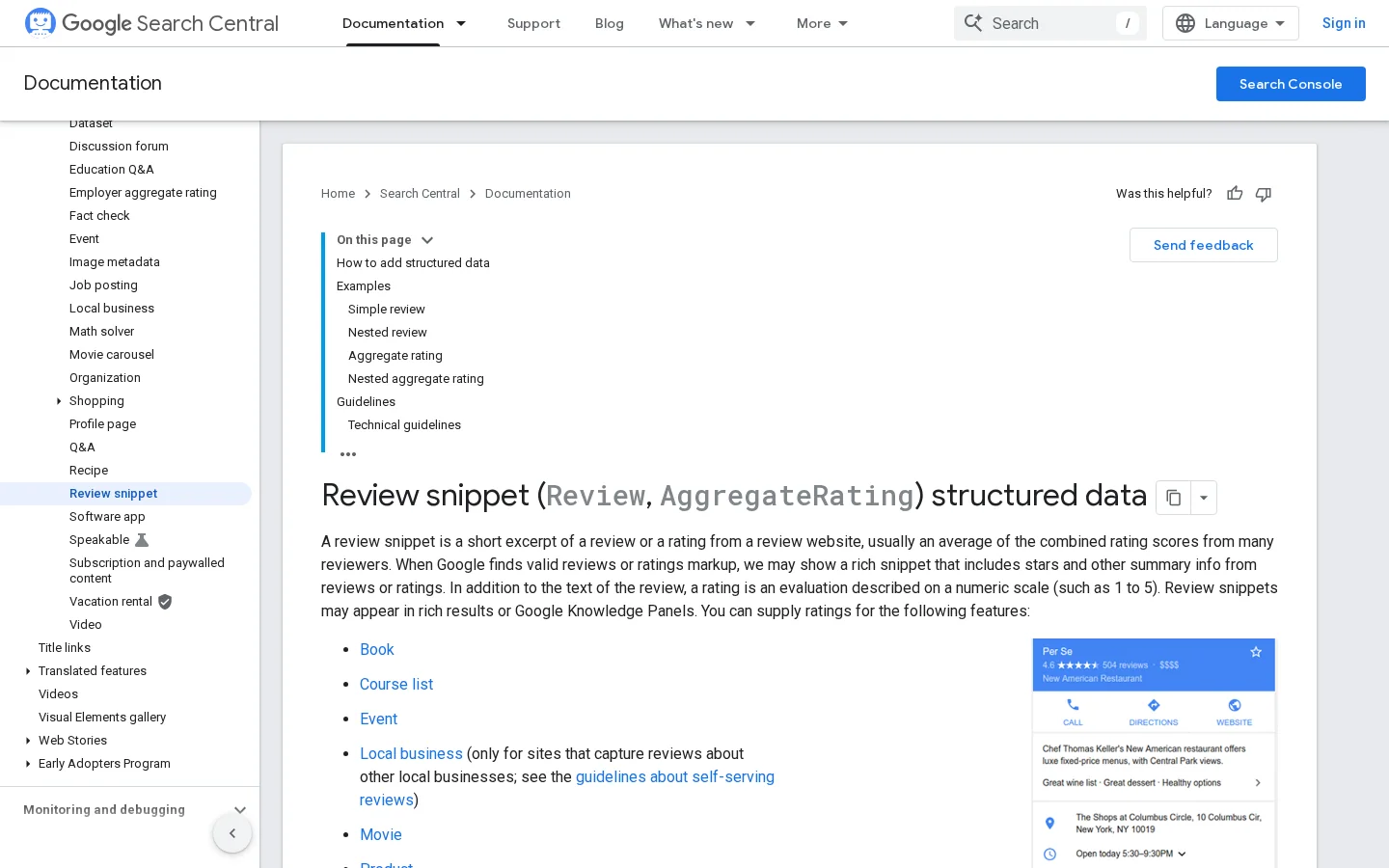
Use Article structured data for a case study page. A customer story is not a review of your product, and Google's review snippet guidelines are strict about reviews that a business controls itself. Here is a minimal example. Replace the placeholders in brackets, and check the result with a structured data validator before you publish.
<script type="application/ld+json">
{
  "@context": "https://schema.org",
  "@type": "Article",
  "headline": "[Customer and result, as in the headline]",
  "datePublished": "[YYYY-MM-DD]",
  "dateModified": "[YYYY-MM-DD]",
  "author": {
    "@type": "Person",
    "name": "[Author name]"
  }
}
</script>
Warning
Google's guidelines say that when the entity being reviewed controls the reviews about itself, pages that use LocalBusiness or any other Organization structured data are not eligible. Do not add review ratings about your own company or product to your organization page or to a case study page.
A case study that names a method should link to the page that explains the method. If your story is about content, link to content marketing examples for a wider set of cases. If it is about how proof supports a sales page, link to social proof marketing.
A case study uses a customer's words and figures, so the rules on testimonials apply to it. In the United States, the FTC's rule on consumer reviews and testimonials took effect on October 21, 2024. The FTC's questions and answers on the rule, published in November 2024, explain how staff read it. The rule is codified at 16 CFR Part 465.
Two dates for testimonials in the United States
Source: FTC, Consumer Reviews and Testimonials Rule: Questions and Answers
The FTC's page says the rule's misrepresentation section covers what a reviewer or testimonialist says about their experience with a product or service. It does not address merely their opinion of it. For a case study, that means each sentence attributed to the customer must match what they told you and what they can support. Do not tidy a quote until it says something they did not say, even if the meaning is close.
The same page says that people who lie about having used a product or service can be liable, and it notes that fake reviews have polluted the marketplace. Treat every quote as a statement you would have to defend.
If you gave the customer a discount, a free month or a fee for the interview or the quote, say so next to the quote. Google's review guidance is blunt on this point: "Don't include fake or undisclosed incentivized reviews on your page or in your structured data markup." Never make the approval of a story depend on a positive verdict. A customer who feels pressure to praise you will give you a quote that reads as fake.
Sometimes a customer cannot be named, or you want to combine several projects into one story. That is allowed if you label it. Write "a composite of three clinics" or "a logistics company that asked not to be named", and describe the sector and size precisely. Do not present a composite as one real, named client. Our guide to review schema covers which markup fits which page, if you are unsure where a story belongs.
Warning
This section gives general information about US rules and Google's guidelines. It is not legal advice. For your own case, check with a lawyer, especially if you sell in France or the EU, where other rules on advertising and personal data also apply.
These are the mistakes that show up most in weak case studies. For each one, you will find what it is, how to spot it in your draft, and how to fix it.
What it is: a headline that says clicks went up a lot, with no starting point, or with a starting point taken from a different period than the result.
How to spot it: read the headline figure and ask, compared with what? If the answer is not in the text, the figure has no baseline.
How to fix it: put the baseline period, the result period and the data source next to the figure. If the baseline is not available, say so, and choose a different result to publish.
What it is: the case study reads like a feature list, and the customer appears only in the quote at the end.
How to spot it: count the sentences where your product is the subject, then count the sentences where the customer decides something. If your product wins by a wide margin, the draft is a product page.
How to fix it: make the customer the subject of the decisions, and mention your product only where it made a specific difference, with the reason.
What it is: the text says your work caused the result, when other changes could explain it: a seasonal peak, a competitor's outage, a price change, a new product launch.
How to spot it: look for "because of", "thanks to" and "led to" with no second source behind them.
How to fix it: write what happened in sequence, list the other changes the customer made in the same period, and say that the link between your work and the result is your reading of the data, not a controlled test.
What it is: "Working with them was a fantastic experience." The sentence is pleasant and empty.
How to spot it: remove the company name and check whether the quote still fits any vendor in your category. If it does, it adds nothing.
How to fix it: in the interview, ask for a sentence about one specific change: what they did differently, what they noticed first, and what they would tell a peer who is in the same position.
What it is: the customer approves the text, then you update a number or add a sentence before publishing.
How to spot it: compare the final page with the version the customer approved, line by line. Check the figures first, because they are the most sensitive.
How to fix it: send the exact final version, ask for a yes on each figure, and keep the approval with the page file. If you must change anything, send it again.
What it is: a case study from two years ago describes a tool or a method that no longer exists, and the page shows no date, so the reader cannot tell.
How to spot it: check whether the page shows a publication date, and whether every tool and method it names still exists.
How to fix it: show the date, add an updated date each time you change a figure, and take the page down or label it clearly when its result is no longer true.
Before you publish
A case study has a job. It might bring search visitors, help a sales call, or support a claim in an AI answer. Decide the job first, then pick the metric that fits it, so you do not judge a sales story by search traffic or a search page by sales calls alone.
| Metric | Question it answers | Where to read it |
|---|---|---|
| Clicks and impressions on the case study page | Does the story appear for its own searches? | Google Search Console, page report |
| Visits from AI assistants | Do assistants send readers to the story? | Referral reports in your analytics tool |
| Sales calls that mention the story | Does the story help close a deal? | CRM notes or call tags |
| Shares and forwards | Is it useful enough to pass on? | Social and email analytics |
| Cost per story | Is it worth producing? | Your time and budget records |
To compare the cost of a story with its return, estimate the value of the traffic it brings and the time it took to produce. Then review the page again at fixed points, for example after 30, 90 and 180 days, and compare each reading with the baseline you wrote down at the start.
Tip
The free Content Marketing ROI Calculator from Sorank helps you turn the traffic and the cost of a story into a return you can compare with other projects.
For a wider view of how to set these measures up, read content marketing metrics and KPIs.
Do this week:
There is no fixed length. Make the result visible on the first screen, give the method in order, and cut any paragraph that does not help a buyer decide. A long page is fine when every section answers a question the reader has.
Yes. Get written approval for the story, the name, the logo and each figure. Let the customer read the final text, and keep their approval next to the draft.
Not on its own. A specific case study can rank for its own searches and earn mentions, but its strongest effect is on the reader who compares vendors and needs proof.
We analyse your competitors, your website and your AI visibility to create a tailored content plan for free.
 AI Content Brief Generator
 FAQ Schema Generator
 AI Blog Post Ideas Generator
 Structured Data Validator (Schema Validator)
 Alt Text Checker
 Internal Link Analyzer
 Backlink Challenge
 AI Meta Description Generator
 AI Blog Title Generator
 Google Indexability Checker
 AI Blog Outline Generator
 UTM Link Builder
 Keyword Clustering Tool
 Canonical Tag Checker
 XML Sitemap Generator
 Broken Link Checker
 AI SEO Title Generator
 Headline Analyzer
 SERP Preview Tool
 Redirect Checker
 Hreflang Tag Generator
 Heading Structure Analyzer
 HTTP Headers Checker
 Favicon Extractor
 SERP CTR Calculator
 SEO vs Paid Search Savings Calculator
 SEO Share of Voice Calculator
 SEO ROI Calculator
 SEO Traffic and Revenue Forecast Calculator
 SEO Budget Calculator
 SEO Break-Even Calculator
 SaaS SEO ROI Calculator
 ROAS Calculator
 Reading Time Calculator
 Ranking Gain Simulator
 Organic Traffic Value Calculator
 Organic Traffic Estimator and Website Traffic Checker
 LTV to CAC Ratio Calculator
 Local SEO ROI Calculator
 Link Building Cost Calculator
 Keyword Value Calculator
 Keyword Opportunity Score Calculator
 Keyword Density Calculator
 GEO ROI Calculator
 GEO Content Investment Calculator
 Ecommerce SEO ROI Calculator
 Customer Lifetime Value Calculator
 Customer Acquisition Cost Calculator
 CTR Calculator
 Cost Per Article Calculator
 Conversion Rate Calculator
 Content Marketing ROI Calculator
 ChatGPT Referral Traffic Estimator
 Bounce Rate Calculator
 Backlink ROI Calculator
 AI Visibility Score Calculator
 AI Traffic Value Calculator
 AI Share of Voice Calculator
 Cost of AI Invisibility Calculator
 AI Citation Rate Calculator
 llms.txt Validator
 AI Overview Checker and AI Overviews Rank Checker
 Robots.txt Checker
 AI SEO Audit
 LLM Readability Checker
 SearchGPT Readiness Checker
 Structured Data LLM Audit
 Website Crawlability AI Audit
 Why ChatGPT Is Not Recommending My Website
 Gemini Ranking Tool
 Perplexity Ranking Checker
 LLM Citation Checker
 Answer Engine Optimization Audit
 GEO Audit
 AI Search Visibility Test
 ChatGPT Visibility Checker
 llms.txt Generator
 URL Extractor
 Webpage to Markdown
 Sitemap Checker
 SERP Volatility Sensor
 Page Size Checker
 Word Counter
 Slug Generator
 Schema Generator
 Robots Generator
 OG Preview
 Meta Tags Generator
 Image Compressor
 Favicon Generator
 On-Page SEO Audit: SEO Checker and SEO Analyzer
 Backlink Analysis Tool
 Keyword Research Tool
 Domain Authority Checker
 “I tested Sorank on a real client site and it's insane. It does everything an agency would bill you $1500 a month for. It's going into production on that client now.”

 Guillaume Guersanguersanguillaume.com“We are an Ads agency and we wanted to get our SEO back on track once and for all. Sorank gave us a clear view of our site, helped us prioritize optimizations, and properly structure our content. The tool is easy to use, well designed for a team, and very practical for centralizing tracking without having to juggle multiple platforms. A very solid foundation to start fresh with our SEO.”
 Gaspard MadouiAds Agency
 “I just let the Sorank software do its thing, and now my DR is 25 and my page is ranking higher.”
 Lucas Flandrefoundertrace.fr“I specialized in GEO thanks to Sorank. The GEO Leaderboard allows me to show my clients their position vs competitors on ChatGPT. It’s a real commercial differentiator.”
 MélanieSEO Freelance“Great service, works well for our website and helps us understand how to improve it to rank better on Google and elsewhere. Congrats, keep going, I recommend it.”
 Hugo T.E-commerce merchant