Preferences
Privacy is important to us, so you have the option of disabling certain types of storage that may not be necessary for the basic functioning of the website. Blocking categories may impact your experience on the website. More information
Privacy is important to us, so you have the option of disabling certain types of storage that may not be necessary for the basic functioning of the website. Blocking categories may impact your experience on the website. More information

 ChatGPT Ads Study: What the Research Shows and How to Read It
What the ChatGPT ads studies measure, where they disagree, and how to read their numbers before you change your ad or brand strategy, step by step.

In short
ChatGPT ads are sponsored units that OpenAI shows to logged-in adults on the Free and Go plans. Three studies published between August and November 2026 measured how often these ads appear, whether they match the question, and who gets them. None of them proves whether ads change the answer itself, and most samples are small or short.
Want to go further? Ask
Quick quiz
How should you get mentioned by ChatGPT and other AI assistants?
Sorank matches your answers


Test it for 3 days on your own site and see where you stand on Google, ChatGPT and the other AIs.
Start 3-day free trial3 days free, then stop whenever you want. 90-day results guarantee, conditions apply.
ChatGPT ads are labeled sponsored placements that run next to the assistant's answer. They reach logged-in adults on the Free and Go tiers, and no paid plan sees them. Every study below starts from these rules, so you need them before you read any number.
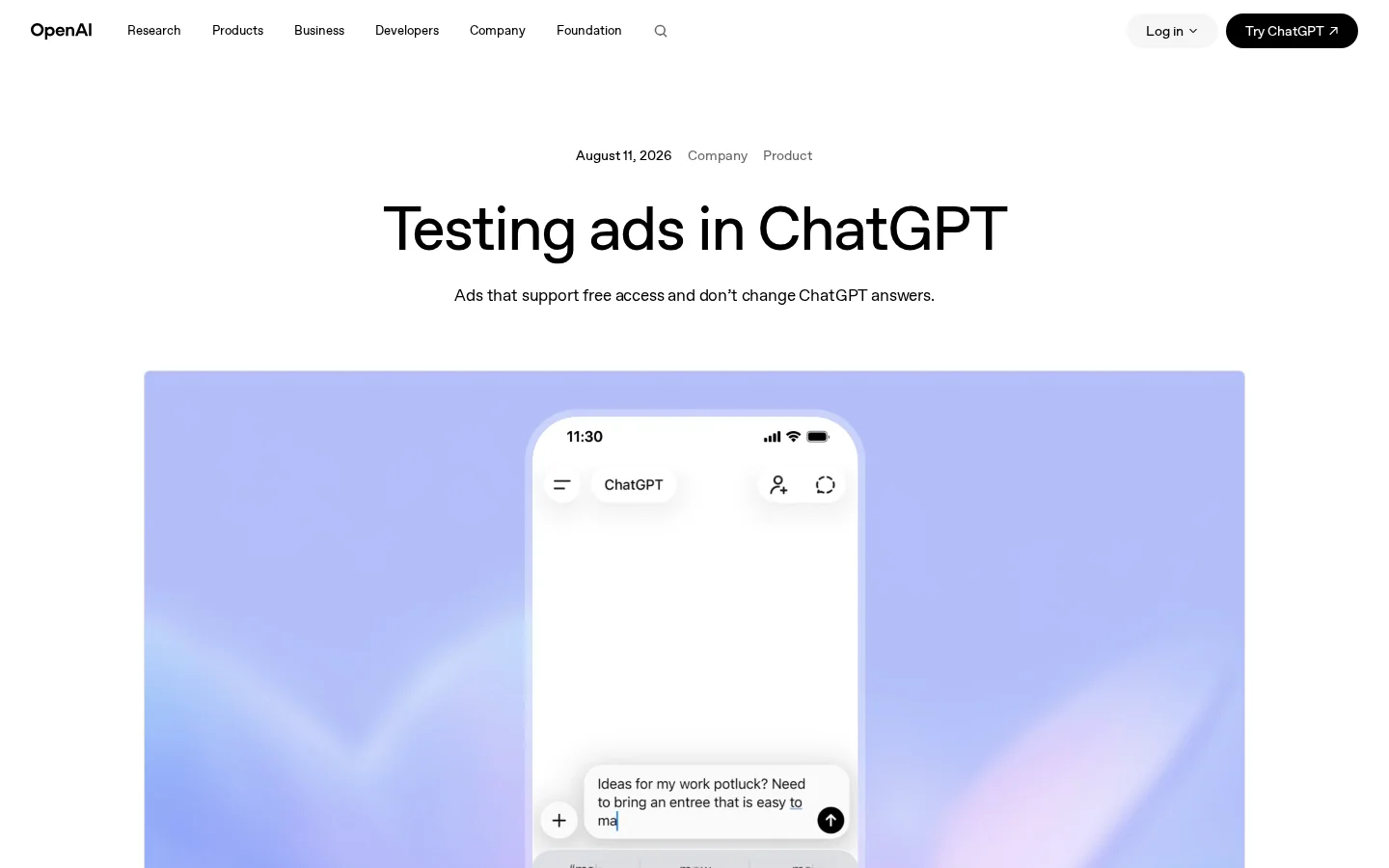
OpenAI published its test announcement on February 9, 2026. Its page says the test covers "logged-in adult users on the Free and Go subscription tiers", while Plus, Pro, Business, Enterprise and Education have no ads. Ads are "always clearly labeled as sponsored and visually separated from the organic answer". OpenAI also states that "ads do not influence the answers ChatGPT gives you", and that advertisers receive aggregate performance data such as views or clicks, not your chats or personal details. The OpenAI announcement on testing ads in ChatGPT is the reference every write-up points to, so read it first.
The plan rule matters for measurement. A study run on a Plus account will find zero ads, and that says nothing about the market. It reflects the plan. If you want the wider picture of how the assistant builds its answers, start with how ChatGPT works, from training to web search and citations, and the ChatGPT model page. For the buyer's side of the ad system, our guide to ChatGPT ads and the OpenAI Ads Manager covers setup and measurement.
Three studies published between August and November 2026 are the most detailed public measurements of ChatGPT ads that we could trace to the publisher's own page. They ask different questions, so they do not give the same numbers. The table shows what each one measured and what it leaves out.
| Study | Published | Data | What it measured | What it leaves out |
|---|---|---|---|---|
| SE Ranking | August 10, 2026 | 50006 commercial prompts across 20 US niches, data collected July 23, 2026 | Ad rate per prompt, relevance of ads to the prompt, comparison with Google AI Mode | Plus and other paid plans, the effect of ads on answers, any trend (one snapshot) |
| Seer Interactive | November 12, 2026 | 161 recorded AI search sessions from nine unmoderated usability studies, March to September 2026 | Whether real users saw ads on screen, and whether they matched the prompt | A representative sample of users (only two of the nine studies asked about ads) |
| Brookings | Early October 2026 | 91 logged-in sock-puppet accounts, more than 3600 ads collected, accounts created January to March 2026 | Who receives ads, tested by income and by race or ethnicity | Group size (only a few accounts per combination), and any period after the accounts stopped receiving more ads |
The samples behind the studies
Sources: SE Ranking, August 10, 2026; Seer Interactive, November 12, 2026; Brookings, October 2026
Other write-ups on this topic come from GEO tools, and we could not check their figures against a primary source, so we left them out. Quote only the numbers you can trace to the publisher's own page, and check the sample line before you repeat any of them.
In SE Ranking's sample, 25.94% of commercial prompts returned an ad on ChatGPT, against 29.45% on Google AI Mode. The rate depends heavily on the topic, so a single overall rate tells you little about the answers your own buyers see.
SE Ranking used 50006 commercial prompts from 20 US niches, about 2500 per niche. For each prompt it recorded the generated answer, its cited sources and any sponsored placement. In total, 12974 prompts returned an ad. The prompts came from an earlier AI Mode study by the same publisher, which makes the two platforms comparable. The data was collected on July 23, 2026, and the study was published on August 10, 2026 (SE Ranking, ChatGPT ads study, August 10, 2026).
The gap by topic is much larger than the gap between platforms. In healthcare, the study found ads on 28.69% of ChatGPT prompts against 2.64% in AI Mode, more than ten times higher. In News and Politics, the figure was 28.76% on ChatGPT against 6.8% on AI Mode. Overall rates look similar, and the topic mix is where the platforms differ.
Example
Imagine a buyer asks ChatGPT which accounting software suits a freelancer. The organic answer lists three tools, and a sponsored card for a fourth product appears next to it. That is the situation the rate measures: an ad in the same answer as the organic recommendation, not an ad that replaced it. This is an illustration, not a measured case.
Seer Interactive took a different route. Its article of November 12, 2026 reports 161 AI search sessions recorded while participants used their own assistants and thought aloud. In the insurance study, 34 of 76 observable responses (45%) carried an ad. That figure covers one vertical with 16 sessions, so it is not a rate for ChatGPT in general.
Seer also reports a trend at user level: the share of ChatGPT users in its sessions who saw an in-answer ad rose from 2 of 22 in March to 12 of 19 from July to September 2026. These are people, not answers, so they show that more of the participants saw an ad, not how many answers carried one. The trend is the most useful signal in the three studies, and the least precise, because the groups differ from month to month. Answers and ads change from one week to the next, which is why a single reading is a snapshot, not a verdict.
Often, but not always. SE Ranking estimates that 14.35% of ad impressions were no more related to their prompt than a randomly paired ad. Seer found that every ad in its insurance study was relevant to the prompt. The two results come from different samples and different tests, so they describe different things rather than contradicting each other.
SE Ranking's test works like this. It computes embedding-based cosine similarity between the prompt, the ad and the answer, then compares each real prompt and ad pair with randomly shuffled pairs. An ad counts as off-target only when its similarity falls inside the range that random pairs produce. A sample of flagged cases was then reviewed by hand. Here is a simplified reading of the logic:
sim_real   = cos(embed(prompt), embed(ad))
sim_random = cos(embed(prompt), embed(ad_from_another_prompt))   # shuffled pairs
off_target = sim_real falls inside the range produced by sim_random
This is a conservative test. An ad has to look no more related than a random ad to be flagged, so weakly relevant ads that look somewhat related pass as on-topic. The authors say 14.35% is likely an underestimate, because manual review found more weakly relevant ads than the test caught. The spread across topics is wide: 2.6% for Pets, 51.1% for Relationships and 54.2% for News and Politics.
Two relevance and exposure measures, from two studies
Sources: SE Ranking, August 10, 2026; Seer Interactive, November 12, 2026
Seer adds a point that matters for brands. In five of six verticals with a branded task, the sponsored card was for a different company than the brand the user named. So a prompt that names your company may show your competitor's ad in the same answer. Seer's article also notes that advertisers change with the question, which means the advertisers you see depend on how the prompt is worded.
Brookings's audit found that lower-income accounts were significantly more likely to receive ads, and found no evidence that race or ethnicity changed whether an account got one. The authors caution that the sample is small, so the race result, which is a null finding, needs care in both directions. Treat the income result as the stronger one.
The design is worth knowing because it is the only one of the three that controls the profile. The researchers created 91 logged-in accounts across three racial and ethnic groups (Black, Hispanic and white) and three income terciles, with at least nine accounts in each race and income combination. Because platforms do not expose income or race, they used geographic region as a proxy, by accessing each account from zip codes with those characteristics. Each day the accounts were prompted across many topic categories. Some categories were ones where ads are plausible, such as a lasagna recipe, and some were ones where OpenAI said it would not serve ads, such as mental health. The study collected more than 3600 ads (Brookings, "Understanding the beginning of advertising on ChatGPT", early October 2026).
How the sock-puppet audit was run
The income finding comes from 53 accounts that received at least one ad. Their income clustered around a mode near $60000, while the accounts that never received one peaked near $80000. The result is significant in the study's terms, but it describes a small set of accounts from a single early period.
The study also ended early. About a month in, every account stopped being shown more ads. The authors say OpenAI may have detected them. That is a warning for anyone who copies the method: a platform that spots audit accounts can change what they see, so the data they produce is not a neutral sample. The study found no evidence that guardrails on sensitive topics failed, and the authors caution against reading too much into that either.
No public study so far shows that they do, and no study so far can prove that they don't. OpenAI says ads do not influence answers. The three studies record where ads appear and who sees them, not whether an answer would differ without them.
Outside researchers cannot switch ads off for a single answer, so they cannot run a clean control. The closest they can get is to compare answers for the same prompt across days or accounts. That comparison is confounded. Ads appear mainly on commercial prompts, and commercial prompts already produce different answers, with more product lists, comparisons and sources of their own. A difference in citations between ad and no-ad answers would not show influence on its own.
A fair test would hold the prompt, plan, location and day constant, then record the citations of each answer, and repeat the test enough times to see past the rotation of ads. Even then, you would be measuring what the assistant did, not why. Until OpenAI publishes data or an independent audit tests the claim, treat "ads do not influence answers" as the company's position. The public studies neither confirm nor refute it.
What the studies can and cannot tell you
The three studies use three methods: a fixed prompt panel, recorded usability sessions and sock-puppet accounts. Each answers one question well and misses the others, so compare them by method rather than by headline. OpenAI's own statement is a fourth kind of evidence, a company claim rather than a measurement.
The principle: run a fixed list of prompts through each platform and record every answer and every ad. When to use it: when you need rates across many topics and want to compare platforms. Advantage: scale, and the same prompts can be rerun. Limit: the prompt set sets the result. SE Ranking itself warns that advertiser rankings are sensitive to keyword choice, that ads rotate so the same prompt can get a different ad or none on repeat, and that the advertiser pool changes quickly. Example: the healthcare gap (28.69% against 2.64%) appears only because the same healthcare prompts were run on both platforms.
The principle: real participants use their own AI tools while thinking aloud, and the screen is recorded. Seer sampled each recording every two seconds with on-device text recognition to find ad units, then checked each unit by eye against what the participant said. When to use it: when you want to know what a person actually sees on screen. Advantage: the ad was really on screen, and the participant's own words are there. Limit: 161 sessions are not a representative sample, and only two of the nine studies asked participants about ads directly. In one study the automated scan matched manual review on every session and ad count, but it undercounted some creative variations. Seer also notes that Gemini, Claude and Grok were scanned only in some studies, so an absence there means "what we observed", not "none exists".
The principle: controlled accounts with set profiles receive the same prompts, so differences can be traced to the profile. When to use it: when you want to know who gets targeted. Advantage: the variables are controlled, which the other two methods cannot do. Limit: small groups, geography as a stand-in for income and race, and detection risk, which ended this study early. Example: the 53 accounts that received an ad, clustered around lower incomes, against those that never received one.
| Method | Study | Unit measured | Best question | Main blind spot |
|---|---|---|---|---|
| Fixed prompt panel | SE Ranking | Prompt and answer | How often, and does it match? | Depends on the prompt set; a snapshot |
| Recorded sessions | Seer Interactive | Session and user | What a real user sees | Small, not representative, few direct questions about ads |
| Sock-puppet audit | Brookings | Account | Who receives ads | Small groups, detection, early end |
The numbers disagree for reasons you can name: different prompts (commercial only, or a wider mix), different units (answers, sessions, users), different periods (one day in July, March to September, January to March) and different plan tiers. Some secondary summaries attribute to Seer an on-topic share of 38% from about 55000 responses. The Seer article we read reports no such split and covers 161 sessions, so we could not confirm the figure. Do not quote it until you find it on the publisher's page.
When the data was collected and when it was published
Run a fixed list of 30 to 50 buyer prompts from one logged-in Free account, on the same day and in the same market, and record every ad and every citation of your domain. The ad rate is the number of answers that carried an ad divided by all answers. Repeat the run on at least three days, because ads rotate.
Before you run the test
Warning
Do not create a set of accounts to copy the Brookings audit. The authors say that about a month in, all of their accounts stopped being shown more ads. Use one account you own, run the prompts by hand, and read OpenAI's terms before any automated collection. A manual test is slower, but it keeps the account safe and the result honest.
=COUNTIF(F2:F51,"yes")/COUNTA(A2:A51)Tip
Before you spend anything, check whether ChatGPT already names your brand in organic answers. Our free ChatGPT Visibility Checker asks ChatGPT with web search on, then reports whether your domain is cited as a source and whether your brand is named in the answer.
An ad buys a labeled slot next to the answer, not a place inside it. OpenAI says ads do not influence answers, so the citation in the organic answer cannot be bought with a campaign. The studies also show that the sponsored card often comes from a company other than the one a user asked about. Plan for both channels, and measure them separately.
Paid ad or organic citation
Brand prompts need extra attention. If your company is the subject of a question, expect the ad slot to go to someone else. Track brand prompts for ads the way you track branded search on Google, and check the ad you see for your own name at least once a week during a campaign.
Test budgets small and compare the cost per acquisition with your search and social campaigns before you move money. Our AI ads explainer compares ads inside AI answers with other paid formats, and ad copywriting covers how to write short ads that fit the conversation.
For the organic side, track a fixed list of prompts over time instead of checking by hand. Sorank's AI Mention Tracking runs your prompts on ChatGPT, Claude and Gemini every month and shows which answers mention your brand and which sources they cite. If you prefer to do it by hand first, our guide to an AI visibility audit explains the steps, and the glossary entry on AI citations defines what counts as a citation.
The most common mistakes are treating a sample as the whole market, mixing answers with users, and quoting a figure without its unit or source. Each one is easy to catch once you know the question to ask.
Reading a study the wrong way and the right way
What it is: a headline that says "ChatGPT shows ads on X% of answers" when the sample is a list of commercial prompts, or 16 insurance sessions. How to spot it: read the sample line before the result, and check whether the prompts, niches, sessions or accounts are described. How to fix it: restate the claim with its sample, for example "in SE Ranking's sample of 50006 commercial prompts across 20 US niches".
What it is: putting a share of responses next to a share of users as if they measured the same thing. Seer's 45% is a share of responses in one vertical, and its trend from 2 of 22 to 12 of 19 is a share of users. How to spot it: look for the words "of responses", "of sessions", "of users" or "of accounts" next to each figure. How to fix it: write the unit beside every number you quote.
What it is: calling a single day's rate a trend, or comparing two studies run in different months as if they were one series. SE Ranking itself warns that ads rotate and the advertiser pool changes quickly. How to spot it: check the collection dates. A rate from one day, or from a period of a few weeks, is a reading. How to fix it: repeat the same prompts on several dates, and compare the rates only for the same prompts.
What it is: concluding that ads push answers toward or away from brands because the two show up together. Ads appear mostly on commercial prompts, and those answers look different anyway. How to spot it: any sentence that says ads "increase", "reduce" or "shape" recommendations, without a control. How to fix it: write "co-occurs with", and name the confounders: prompt type, topic and plan.
What it is: repeating a number that appears in several write-ups, none of which links the primary page, or whose sample does not match the publisher's. How to spot it: search the publisher's page for the number. If it is not there, it does not belong to that study. How to fix it: open the primary page, find the sentence, and quote its wording. The 38% on-topic figure above is an example: we could not find it on the Seer page, so we did not use it.
Run a small test before you make a budget decision. Measure the ad rate for your own prompts, record your own citations, and only then decide whether a paid test makes sense for your category.
A one-week plan
The research will keep changing as the rollout widens. The method you use to read it will last longer than any single figure, so keep the sample, the unit and the date next to every number you quote.
Yes. Since February 9, 2026, OpenAI has tested sponsored placements in ChatGPT for logged-in adults on the Free and Go plans. Plus, Pro, Business, Enterprise and Education have no ads, and OpenAI says ads do not influence answers.
In SE Ranking's August 2026 sample, 25.94% of commercial prompts returned an ad on ChatGPT, against 29.45% on Google AI Mode. The rate varies widely by topic, with healthcare showing the largest gap, so the figure describes that sample only.
No public study has shown that they do, and none can prove that they don't. OpenAI says ads do not influence answers, but outside studies only record where ads appear and who sees them.
We analyse your competitors, your website and your AI visibility to create a tailored content plan for free.
 AI Content Brief Generator
 FAQ Schema Generator
 AI Blog Post Ideas Generator
 Structured Data Validator (Schema Validator)
 Alt Text Checker
 Internal Link Analyzer
 Backlink Challenge
 AI Meta Description Generator
 AI Blog Title Generator
 Google Indexability Checker
 AI Blog Outline Generator
 UTM Link Builder
 Keyword Clustering Tool
 Canonical Tag Checker
 XML Sitemap Generator
 Broken Link Checker
 AI SEO Title Generator
 Headline Analyzer
 SERP Preview Tool
 Redirect Checker
 Hreflang Tag Generator
 Heading Structure Analyzer
 HTTP Headers Checker
 Favicon Extractor
 SERP CTR Calculator
 SEO vs Paid Search Savings Calculator
 SEO Share of Voice Calculator
 SEO ROI Calculator
 SEO Traffic and Revenue Forecast Calculator
 SEO Budget Calculator
 SEO Break-Even Calculator
 SaaS SEO ROI Calculator
 ROAS Calculator
 Reading Time Calculator
 Ranking Gain Simulator
 Organic Traffic Value Calculator
 Organic Traffic Estimator and Website Traffic Checker
 LTV to CAC Ratio Calculator
 Local SEO ROI Calculator
 Link Building Cost Calculator
 Keyword Value Calculator
 Keyword Opportunity Score Calculator
 Keyword Density Calculator
 GEO ROI Calculator
 GEO Content Investment Calculator
 Ecommerce SEO ROI Calculator
 Customer Lifetime Value Calculator
 Customer Acquisition Cost Calculator
 CTR Calculator
 Cost Per Article Calculator
 Conversion Rate Calculator
 Content Marketing ROI Calculator
 ChatGPT Referral Traffic Estimator
 Bounce Rate Calculator
 Backlink ROI Calculator
 AI Visibility Score Calculator
 AI Traffic Value Calculator
 AI Share of Voice Calculator
 Cost of AI Invisibility Calculator
 AI Citation Rate Calculator
 llms.txt Validator
 AI Overview Checker and AI Overviews Rank Checker
 Robots.txt Checker
 AI SEO Audit
 LLM Readability Checker
 SearchGPT Readiness Checker
 Structured Data LLM Audit
 Website Crawlability AI Audit
 Why ChatGPT Is Not Recommending My Website
 Gemini Ranking Tool
 Perplexity Ranking Checker
 LLM Citation Checker
 Answer Engine Optimization Audit
 GEO Audit
 AI Search Visibility Test
 ChatGPT Visibility Checker
 llms.txt Generator
 URL Extractor
 Webpage to Markdown
 Sitemap Checker
 SERP Volatility Sensor
 Page Size Checker
 Word Counter
 Slug Generator
 Schema Generator
 Robots Generator
 OG Preview
 Meta Tags Generator
 Image Compressor
 Favicon Generator
 On-Page SEO Audit: SEO Checker and SEO Analyzer
 Backlink Analysis Tool
 Keyword Research Tool
 Domain Authority Checker
 “I tested Sorank on a real client site and it's insane. It does everything an agency would bill you $1500 a month for. It's going into production on that client now.”

 Guillaume Guersanguersanguillaume.com“We are an Ads agency and we wanted to get our SEO back on track once and for all. Sorank gave us a clear view of our site, helped us prioritize optimizations, and properly structure our content. The tool is easy to use, well designed for a team, and very practical for centralizing tracking without having to juggle multiple platforms. A very solid foundation to start fresh with our SEO.”
 Gaspard MadouiAds Agency
 “I just let the Sorank software do its thing, and now my DR is 25 and my page is ranking higher.”
 Lucas Flandrefoundertrace.fr“I specialized in GEO thanks to Sorank. The GEO Leaderboard allows me to show my clients their position vs competitors on ChatGPT. It’s a real commercial differentiator.”
 MélanieSEO Freelance“Great service, works well for our website and helps us understand how to improve it to rank better on Google and elsewhere. Congrats, keep going, I recommend it.”
 Hugo T.E-commerce merchant