
Preferences
Privacy is important to us, so you have the option of disabling certain types of storage that may not be necessary for the basic functioning of the website. Blocking categories may impact your experience on the website. More information

Privacy is important to us, so you have the option of disabling certain types of storage that may not be necessary for the basic functioning of the website. Blocking categories may impact your experience on the website. More information

Inbound marketing explained: definition (attract, engage, delight), inbound vs outbound, the role of SEO and GEO, examples by business type and the metrics to track.
Tools


In short
Inbound marketing attracts customers by being useful where they search, instead of interrupting them. It follows three stages: attract (content found on Google, the AIs and social media), engage (offers, email and conversations that turn visitors into leads and customers) and delight (support and follow-up that create repeat buyers and referrals). SEO and GEO are its main engines, because they put your answers in front of people at the moment they ask. Results take a few months but accumulate, since every page keeps working.
Want to go further? Ask
People no longer wait for a salesperson to explain a product: they search, compare and ask an AI assistant before they ever contact a company. Inbound marketing is the strategy built for that behaviour. This guide covers the definition and its three stages, the difference with outbound, the role of SEO and GEO, examples by type of business and the metrics that show whether it works.
Inbound marketing is a strategy that brings customers to you by creating content and experiences that answer their questions, so that they choose to contact you. The term was popularized by HubSpot's founders in the late 2000s, in opposition to "outbound" methods that push messages toward people who did not ask for them.
The principle is simple: a business publishes what its future customers are looking for (guides, comparisons, tools, answers), makes it easy to find, then offers a next step to those who are interested. Instead of buying attention, it earns it.
Inbound relies on several channels working together:
Inbound follows three stages: attract, engage and delight. HubSpot describes them as a flywheel rather than a funnel, because satisfied customers bring in new ones and keep the wheel turning.
| Stage | Goal | Main tools | Example of content |
|---|---|---|---|
| Attract | Bring qualified strangers to your site | SEO, GEO, blog, social media, video | A guide answering a question your buyers ask before they know you |
| Engage | Turn visitors into leads, then customers | Lead magnets, landing pages, email, chat, demos | A template or checklist offered in exchange for an email address |
| Delight | Make customers successful so they stay and recommend you | Onboarding, support, knowledge base, surveys | A help center that answers usage questions before they become tickets |
The stages match the steps of the marketing funnel (top, middle and bottom), with one addition: the delight stage feeds the top again through reviews, referrals and word of mouth.
Inbound waits to be found by people who are already looking; outbound goes to find people who are not. Both have a place, but their economics are very different.
| Criteria | Inbound marketing | Outbound marketing |
|---|---|---|
| Principle | Be found when people search | Push a message to a target audience |
| Typical channels | SEO, GEO, content, email to opt-in contacts | Ads, cold email, cold calling, trade shows |
| Speed | Slow start, a few months before clear results | Immediate results once the campaign runs |
| Cost over time | Decreases: content keeps working | Constant: stops when you stop paying |
| Lead intent | High: the person came to you | Variable: the person did not ask |
| What remains | Pages, rankings, an email list, backlinks | Little once the budget is spent |
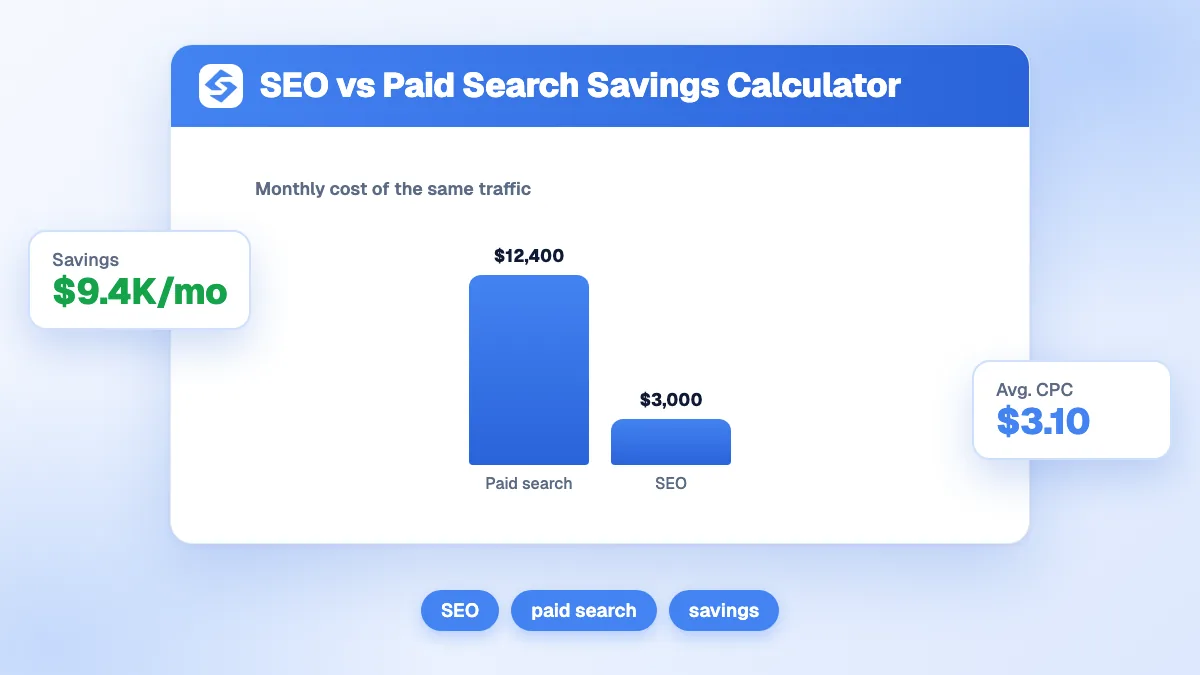
To compare the two on your own market, our SEO vs paid search savings calculator estimates what the organic traffic you could earn would cost in ads.
SEO and GEO power the attract stage: they put your content in front of people at the exact moment they ask a question. Without them, inbound depends on social media reach and paid promotion. With them, every article becomes a permanent entry point.
Inbound is a form of content marketing organized around the customer's journey: each piece has a stage, a target question and a next step.
Every inbound example follows the same path: a useful answer, an offer that matches it, and a follow-up. Typical cases by business type:
Track each stage separately, then the revenue that comes out of it.
| Stage | Metrics |
|---|---|
| Attract | Organic traffic, rankings on target queries, impressions in Search Console, brand mentions and citations in the AIs |
| Engage | Visitor-to-lead conversion rate, number of qualified leads, lead-to-customer rate, sales cycle length |
| Delight | Retention or churn, repeat purchases, reviews, referrals, customer satisfaction |
| Overall | Customer acquisition cost by channel, revenue from organic channels, customer lifetime value |
Visibility in the AIs deserves its own tracking, since a growing share of discovery happens in answers rather than in blue links. AI mention tracking shows on which questions your brand is cited and who is cited instead.
Start from your customers' questions, cover them with content, then add an offer at each stage.
Inbound marketing replaces bought attention with earned attention. Answer the questions your customers ask, make those answers easy to find on Google and in the AIs, offer a useful next step, and take care of customers so they bring others. It takes a few months, but what you build keeps working.
Sorank runs the attract stage on autopilot: it finds your customers' questions, writes and publishes one SEO and GEO article per day and tracks whether the AIs cite your brand. Start with a 3-day free trial.

Inbound marketing means attracting customers by publishing content and experiences that help them, instead of interrupting them with ads or cold calls. People find you when they search for an answer, read your content, leave their contact for something useful and buy when they are ready. The approach relies on SEO, content, email and social media.
The usual model has three stages: attract, engage and delight. Attract brings the right visitors with useful content found on Google, the AIs or social media. Engage turns them into leads and customers with offers, conversations and email. Delight keeps customers satisfied so they buy again and recommend you, which brings in new visitors.
Neither is better in every case. Inbound costs less per lead over time and builds assets that keep working, but it takes months to produce results. Outbound (ads, cold email, events) is faster and easier to control, but stops as soon as you stop paying. Most companies combine both and shift the balance toward inbound as their content grows.
 AI Content Brief Generator
 FAQ Schema GeneratorAI Blog Post Ideas GeneratorStructured Data Validator
 Alt Text Checker
 Internal Link AnalyzerBacklink ChallengeAI Meta Description GeneratorAI Blog Title Generator
 Google Indexability CheckerAI Blog Outline GeneratorUTM Link BuilderKeyword Clustering ToolCanonical Tag Checker
 XML Sitemap GeneratorBroken Link CheckerAI SEO Title GeneratorHeadline AnalyzerSERP Preview ToolRedirect Checker
 Hreflang Tag GeneratorHeading Structure AnalyzerHTTP Headers CheckerFavicon Extractor
 SERP CTR Calculator
 SEO vs Paid Search Savings Calculator
 SEO Share of Voice Calculator
 SEO ROI Calculator
 SEO Traffic and Revenue Forecast Calculator
 SEO Budget Calculator
 SEO Break-Even Calculator
 SaaS SEO ROI Calculator
 ROAS Calculator
 Reading Time Calculator
 Ranking Gain Simulator
 Organic Traffic Value Calculator
 Organic Traffic Estimator
 LTV to CAC Ratio Calculator
 Local SEO ROI Calculator
 Link Building Cost Calculator
 Keyword Value Calculator
 Keyword Opportunity Score Calculator
 Keyword Density Calculator
 GEO ROI Calculator
 GEO Content Investment Calculator
 Ecommerce SEO ROI Calculator
 Customer Lifetime Value Calculator
 Customer Acquisition Cost Calculator
 CTR Calculator
 Cost Per Article Calculator
 Conversion Rate Calculator
 Content Marketing ROI Calculator
 ChatGPT Referral Traffic Estimator
 Bounce Rate Calculator
 Backlink ROI Calculator
 AI Visibility Score Calculator
 AI Traffic Value Calculator
 AI Share of Voice Calculator
 Cost of AI Invisibility Calculator
 AI Citation Rate Calculatorllms.txt ValidatorAI Overview CheckerRobots.txt CheckerAI SEO AuditLLM Readability CheckerSearchGPT Readiness Checker
 Structured Data LLM AuditWebsite Crawlability AI AuditWhy ChatGPT Is Not Recommending My Website
 Gemini Ranking ToolPerplexity Ranking CheckerLLM Citation CheckerAnswer Engine Optimization AuditGEO AuditAI Search Visibility TestChatGPT Visibility Checkerllms.txt Generator
 URL ExtractorWebpage to MarkdownSitemap CheckerSERP Volatility SensorPage Size Checker
 Word Counter
 Slug GeneratorSchema GeneratorRobots Generator
 OG PreviewMeta Tags Generator
 Image CompressorFavicon Generator
 On-Page SEO Audit
 Backlink Analysis Tool
 Keyword Research Tool
 Domain Authority Checker
THEY TRIED SORANK BEFORE YOU
 “I tested Sorank on a real client site and it's insane. It does everything an agency would bill you $1500 a month for. It's going into production on that client now.”

 Guillaume Guersanguersanguillaume.com“We are an Ads agency and we wanted to get our SEO back on track once and for all. Sorank gave us a clear view of our site, helped us prioritize optimizations, and properly structure our content. The tool is easy to use, well designed for a team, and very practical for centralizing tracking without having to juggle multiple platforms. A very solid foundation to start fresh with our SEO.”
 Gaspard MadouiAds Agency
 “I just let the Sorank software do its thing, and now my DR is 25 and my page is ranking higher.”
 Lucas Flandrefoundertrace.fr“I specialized in GEO thanks to Sorank. The GEO Leaderboard allows me to show my clients their position vs competitors on ChatGPT. It’s a real commercial differentiator.”
 MélanieSEO Freelance“Great service, works well for our website and helps us understand how to improve it to rank better on Google and elsewhere. Congrats, keep going, I recommend it.”
 Hugo T.E-commerce merchant























