Preferences
Privacy is important to us, so you have the option of disabling certain types of storage that may not be necessary for the basic functioning of the website. Blocking categories may impact your experience on the website. More information
Privacy is important to us, so you have the option of disabling certain types of storage that may not be necessary for the basic functioning of the website. Blocking categories may impact your experience on the website. More information

Learn what multi-segment marketing is, see a full example with three segments, and follow a 7-step method to build, track and measure an offer per segment.
In short
Multi-segment marketing is a strategy where you target two or more distinct customer groups at the same time, each with its own offer, message, price or channel. It is also called differentiated marketing. It pays off when each segment is large enough, reachable and different enough to justify the extra cost of a separate plan.
Want to go further? Ask
Quick quiz
Which way of finding customers online fits you best?
Sorank matches your answers


Test it for 3 days on your own site and see where you stand on Google, ChatGPT and the other AIs.
Start 3-day free trial3 days free, then stop whenever you want. 90-day results guarantee, conditions apply.
Multi-segment marketing means you split your market into groups that buy for different reasons, pick several of them, and build a separate marketing plan for each one. One product can serve three segments. Three products can serve three segments. What matters is that each group gets an offer and a message built for its own needs.
Take a coffee roaster. Home brewers want a fresh 250 g bag and brewing tips. Offices want a monthly 5 kg delivery, an invoice and zero effort. Cafés want wholesale prices, a consistent roast and barista training. Same beans, three different businesses. Sending one generic "Buy our coffee" ad to all three wastes money on two of them.
These terms get mixed up, so here is the clean split:
In practice, multi-segment marketing works at the level of the marketing mix (the 4Ps of product, price, place and promotion). For each segment, you decide which of the four Ps changes and which stays the same. A good plan changes as few Ps as possible while still matching each segment's real need.
For the marketing team, a segment only counts as a target in a multi-segment plan when it has four things: a distinct need (it buys for a different reason), a distinct response (it reacts differently to price, message or channel), its own budget line and its own success metric. If two "segments" share the same need, react the same way and are measured together, you have one segment with two names.
One message for everyone vs multi-segment marketing
Multi-segment marketing is one of four classic ways to choose who you target. The right one depends on your budget, how different your customers are and how many products you have. Here is each one in detail, then a table that compares them.
Principle: one offer and one message for the whole market. When to use it: commodity products where needs barely differ (salt, basic batteries, a utility). Advantages: lowest cost, simplest operations, one brand story. Limits: any competitor that speaks to one group better will take that group from you. Example: a regional water utility runs one awareness campaign for every household.
Principle: several segments, each with its own plan. When to use it: your customers clearly split into groups with different needs, and you have the budget and team to run several plans. Advantages: higher relevance, wider reach, less dependence on one group. Limits: cost and complexity grow with each segment; your brand can feel scattered if the core promise is not shared. Example: a hotel group runs one brand for business travelers (fast check-in, desks, airport locations) and another for families (connecting rooms, pools, resort locations), each with its own prices and campaigns.
Principle: all your effort on one segment. When to use it: small budget, new company, or a segment big enough to grow on its own. Advantages: deep expertise, strong word of mouth, efficient spending. Limits: if that segment shrinks or a big player moves in, you have nothing else. Example: a roaster that only sells to specialty cafés.
Principle: the offer adapts to a city, a store, an account or one person. When to use it: high value per customer (B2B), strong local differences, or rich first-party data. Advantages: maximum relevance. Limits: needs good data, automation and privacy compliance; hard to scale by hand. Example: account-based marketing for large B2B deals, where each target company gets its own campaign.
| Strategy | Segments targeted | Cost | Relevance | Risk | Best for |
|---|---|---|---|---|---|
| Undifferentiated | All, as one | Low | Low | Losing groups to focused rivals | Commodities, utilities |
| Multi-segment (differentiated) | 2 or more, each with a plan | Medium to high | High | Spreading budget too thin | Brands with clearly different buyer groups |
| Concentrated (niche) | 1 | Low to medium | Very high | All eggs in one basket | Startups, small budgets |
| Micromarketing | Accounts, cities or individuals | High (needs automation) | Maximum | Data quality, privacy rules | B2B, local chains, ecommerce with rich data |
Note
Most companies move from concentrated to multi-segment marketing as they grow: win one segment, prove the model, then add a second segment that shares part of the product or channel. Adding segments one by one is safer than launching four at once.
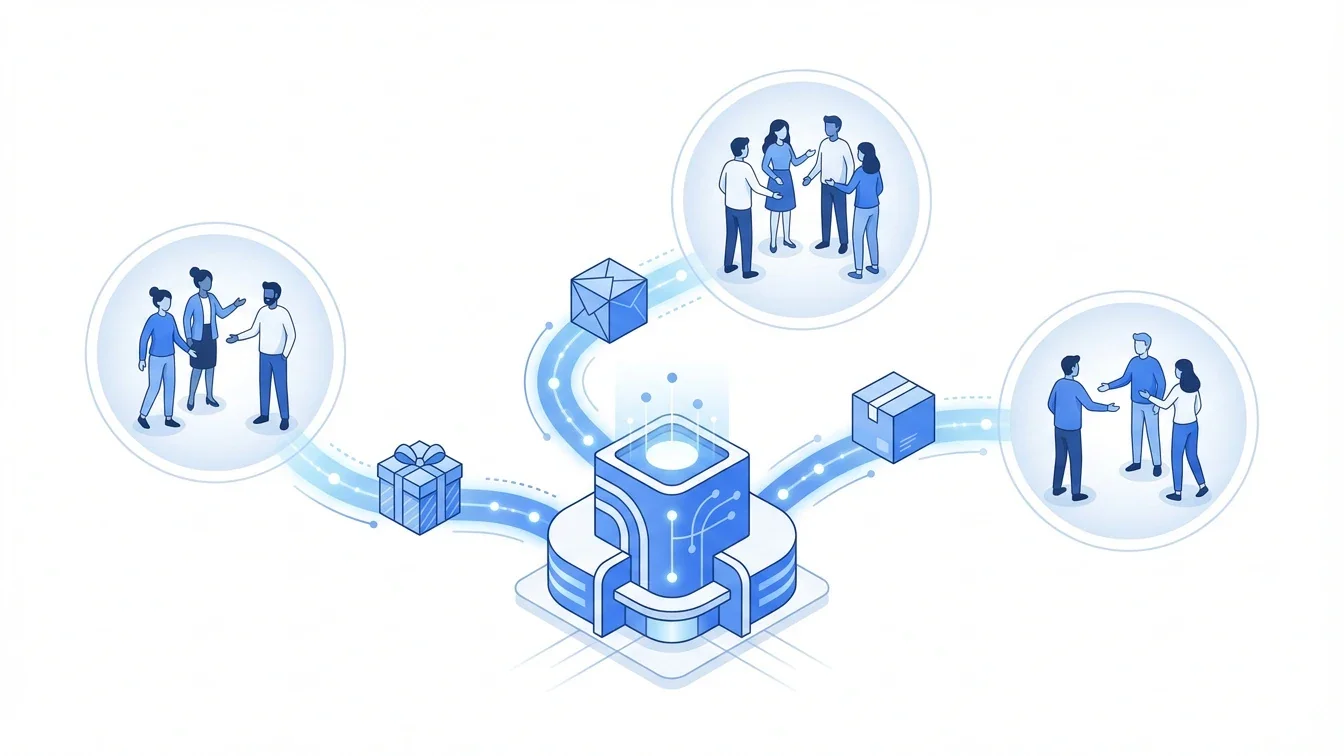
The fastest way to understand multi-segment marketing is to see one business run it end to end. Here is the roaster from earlier, with a full plan per segment. The numbers in this section are illustrative, to show the method.
| Element | Home brewers | Offices | Cafés |
|---|---|---|---|
| Main need | Fresh, tasty coffee and the pleasure of brewing | Good coffee for the team with zero admin | Consistent quality and a reliable margin |
| Product | 250 g bags, single origins, gift boxes | 5 kg monthly delivery, machine rental | Custom house blend, 10 kg bags |
| Price | Retail price, subscription discount | Monthly plan per number of employees | Wholesale price per kg, volume tiers |
| Place | Website, marketplaces | Direct sales, online quote form | Sales rep, trade fairs |
| Promotion | Instagram, brewing guides, newsletter | LinkedIn, Google search, office manager emails | Barista events, case studies, referrals |
| Message | "Roasted this week, shipped tomorrow" | "Great coffee at work, nothing to manage" | "The same roast every week, with training" |
| Main KPI | Subscription rate, repeat orders | Signed contracts, churn | Volume per account, account retention |
The beans, the roasting quality, the brand name and the core promise ("freshly roasted specialty coffee") stay the same. This is what keeps three plans from turning into three companies. A strong brand positioning statement written once, then adapted per segment, is the glue.
Each segment has a different decision maker. The home brewer buys for themselves. The office manager buys for others and cares about invoices and delivery days. The café owner buys an input for their own business and cares about margin. So the product format, the price model and the channel all change, not just the ad copy. This is the difference between real multi-segment marketing and simply writing three versions of one ad.
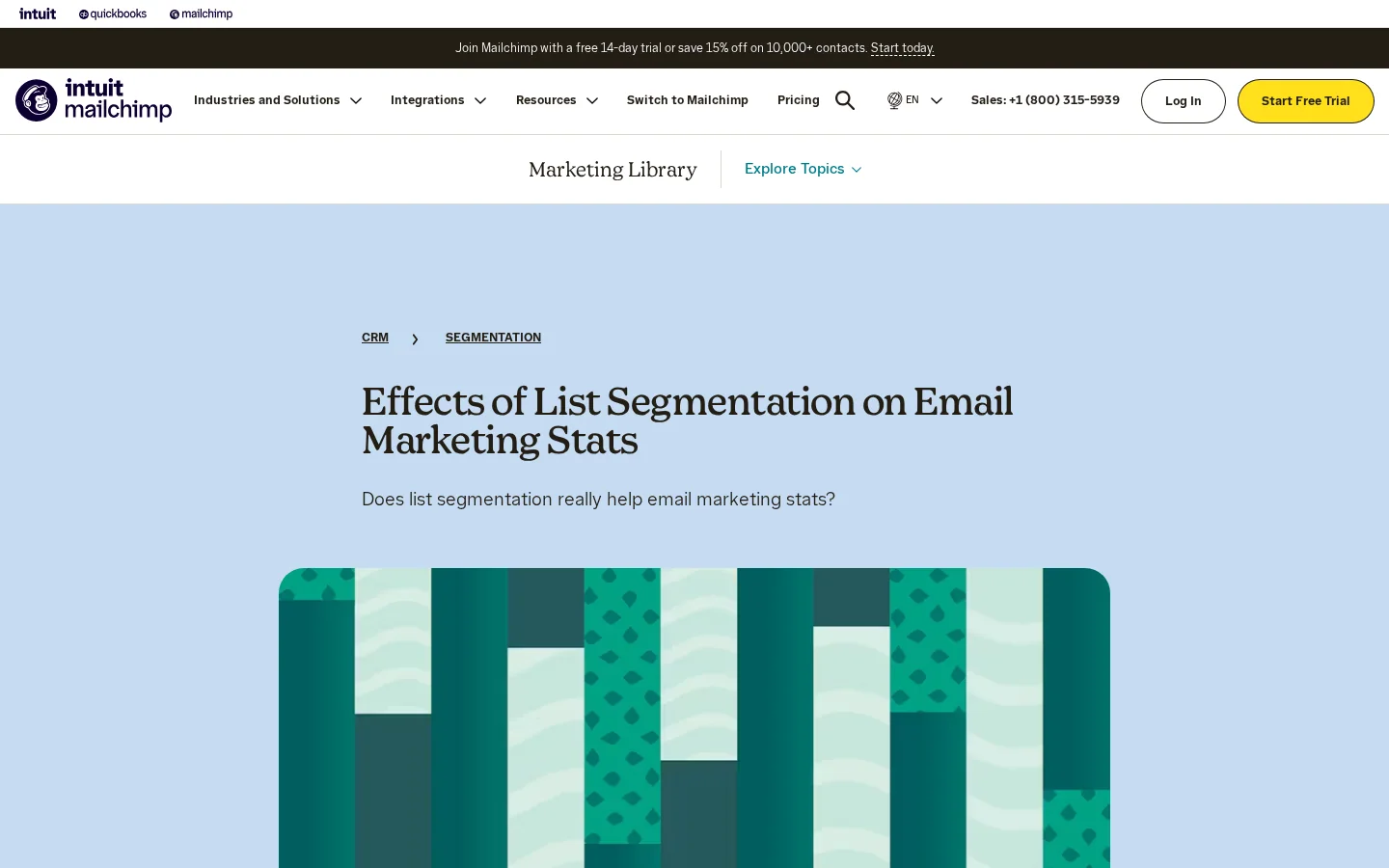
It pays off because a message built for one group gets more attention and fewer rejections than a generic one. The best public data on this comes from email, where it is easy to compare segmented and unsegmented sends to the same lists.
Mailchimp compared about 11000 segmented campaigns sent by around 2000 of its users to almost 9 million recipients, against the same users' unsegmented campaigns. In its study on the effects of list segmentation (updated February 2017), segmented campaigns got 14.31% more opens, 100.95% more clicks and 9.37% fewer unsubscribes.
Segmented vs unsegmented email campaigns
Source: Mailchimp, Effects of List Segmentation on Email Marketing Stats, updated February 2017
The same study shows that the type of segmentation matters. Segments built on stated interests lifted clicks far more than segments built on recent activity.
The lesson for multi-segment marketing: segments built on why people buy (needs, interests) beat segments built on what they did lately. Leaders know it. In the State of Personalization Report 2024 by Twilio Segment, 89% of business leaders said personalization is crucial to their success in the next three years.
Multi-segment marketing costs more. Each segment needs its own content, its own campaigns and sometimes its own product version. It loses money when a segment is too small, too expensive to reach, or not different enough to need its own plan. Before you add a segment, run the math.
segment_contribution = segment_revenue × gross_margin - segment_specific_costs

segment_specific_costs = content + ads + tools + product changes + team time

Keep the segment if:
  segment_contribution > 0 over 12 months
  AND segment_LTV / segment_CAC >= 3   (common rule of thumb)
Example with illustrative numbers: the office segment brings 60000 in revenue a year at a 40% gross margin, so 24000 of gross profit. If the office plan costs 15000 a year (LinkedIn ads, a quote page, part of a sales rep), the segment contributes 9000. It stays. If it cost 30000, it would lose 6000 and you would merge it back into a broader plan.
Tip
Check each segment's unit economics in two minutes with the free LTV to CAC ratio calculator. Run it once per segment, not once for the whole company: the average hides the segment that loses money.
Choose segments by the reason people buy first, then check that each one is measurable, reachable and big enough. Demographics alone (age, gender) rarely make a good segment, because two people of the same age can buy for opposite reasons.
| Base | What you split on | Example | Where the data comes from |
|---|---|---|---|
| Needs (jobs to be done) | The problem the buyer wants solved | "Coffee for my team" vs "coffee I sell" | Sales calls, surveys, reviews, search queries |
| Behavioral | Purchase frequency, basket size, usage | Monthly subscribers vs one-time gift buyers | CRM, ecommerce data, analytics |
| Firmographic (B2B) | Company size, industry, role of the buyer | Offices of 20 to 200 people | CRM, LinkedIn, public registers |
| Geographic | Country, region, city, urban or rural | Delivery zone vs shipping zone | Orders, analytics location reports |
| Psychographic | Values, lifestyle, attitudes | Ethical sourcing fans vs price seekers | Surveys, social listening, interviews |
| Demographic | Age, income, family situation | Students vs families | Surveys, ad platform reports |
The strongest segments combine two bases: a need plus a behavior, or a need plus a firmographic filter. If you sell to companies, start from your ideal customer profile, then split it by need.
Is this group a real segment?
Score each candidate segment from 1 to 5 on each test. A segment below 3 on "differentiable" is not a segment: merge it with its neighbor. A segment below 3 on "accessible" is a future segment: park it until you find a channel.
Build it in seven steps, from your own data to a plan you review every quarter. Start with two segments, not five.
The 7-step multi-segment marketing method
Do not start from guesses. Start from who already pays you. Export 12 months of orders from your ecommerce platform or CRM, add a customer type column (even a rough one), and calculate the revenue per group. If your data sits in a database, one query does it:
SELECT
  customer_type,
  COUNT(DISTINCT customer_id)                         AS customers,
  SUM(order_total)                                    AS revenue,
  ROUND(AVG(order_total), 2)                          AS avg_order,
  ROUND(SUM(order_total) / COUNT(DISTINCT customer_id), 2) AS revenue_per_customer,
  ROUND(COUNT(*)::numeric / COUNT(DISTINCT customer_id), 2) AS orders_per_customer
FROM orders
WHERE order_date >= CURRENT_DATE - INTERVAL '12 months'
GROUP BY customer_type
ORDER BY revenue DESC;
Look at three columns: revenue (is it substantial?), revenue per customer (is it worth a sales effort?) and orders per customer (is it a repeat business?). A group with few customers but high revenue per customer is a candidate for a sales-led plan. A group with many small customers needs a self-serve plan.
Numbers tell you who buys. Only customers tell you why. Talk to five customers per group. Ask what they were trying to do, what they tried before, and what almost stopped them. Then read the words they use in reviews, support tickets and search queries: these words become your segment messages and your keywords. Our guide on building buyer personas from real interviews gives a full interview script.
Score each candidate on the five tests above. Keep the two or three with the best total, and check that at least one of them is already profitable today. That one funds the learning on the others.
For each segment, write a one-page brief with four lines: the need, the main objection, the proof that removes it, and the call to action. Keep the core brand promise identical across briefs. Example for the office segment: need "good coffee, no admin", objection "machines break", proof "free replacement within 48 hours", call to action "get a quote for your team size".
Go through the four Ps for each segment and change only what the need requires. Changing the product is the most expensive move; changing the message is the cheapest. Many segments only need a different price model and a different channel, with the same product.
Each segment needs a place to be counted and a place to be reached. In Google Analytics 4, create one audience per segment under Admin, Data display, Audiences. The Google Analytics help page on creating audiences sets the limits: up to 100 audiences per standard property, a maximum of 10 conditions per audience, and a membership duration of up to 540 days.
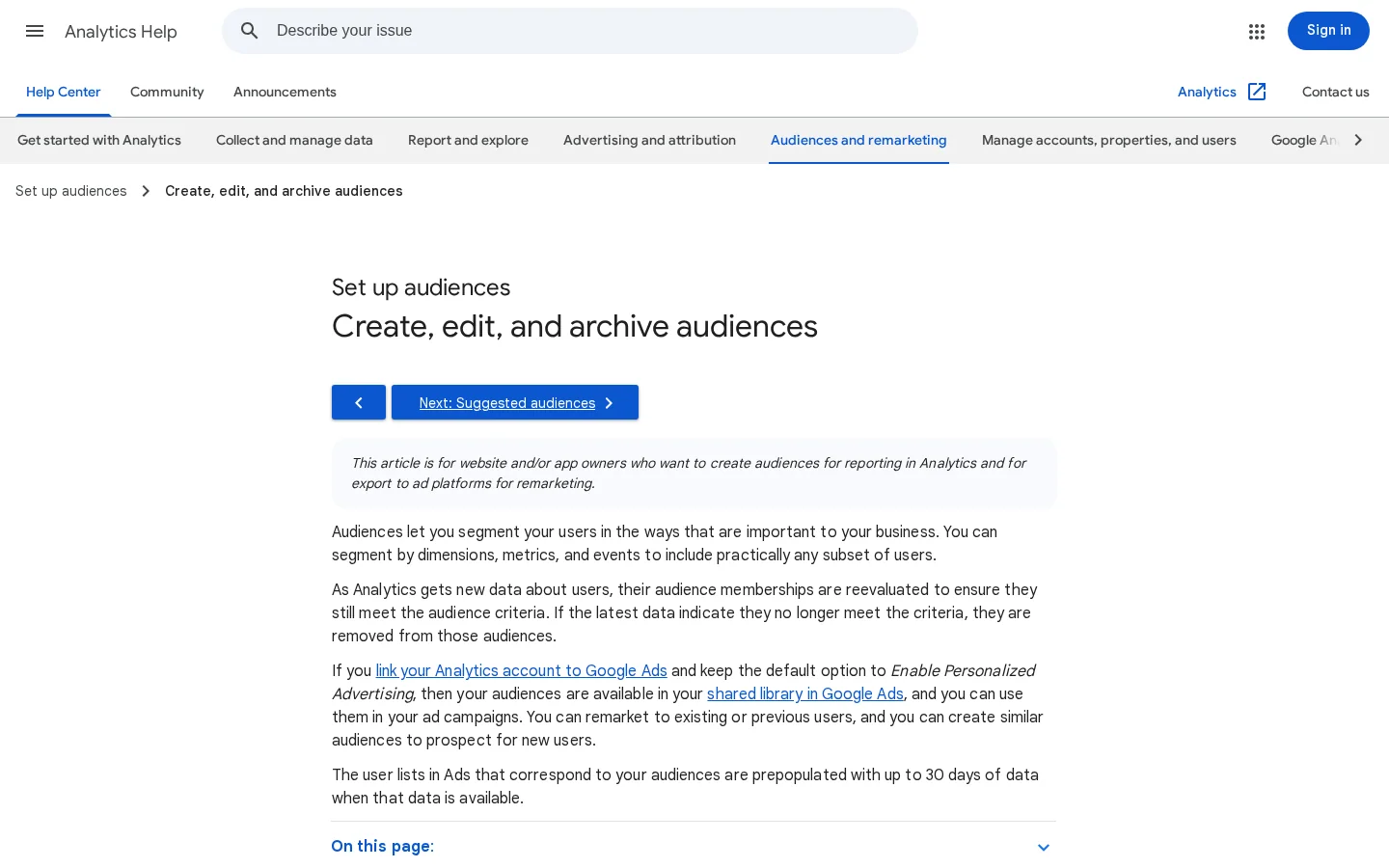
Here is how the office segment of the roaster could be defined:
Audience name: Segment - Offices
Include users when (scope: across all sessions):
  event_name = generate_lead
  AND page_location contains "/offices/"
Exclude permanently:
  user property customer_type = "cafe"
Membership duration: 540 days (maximum)
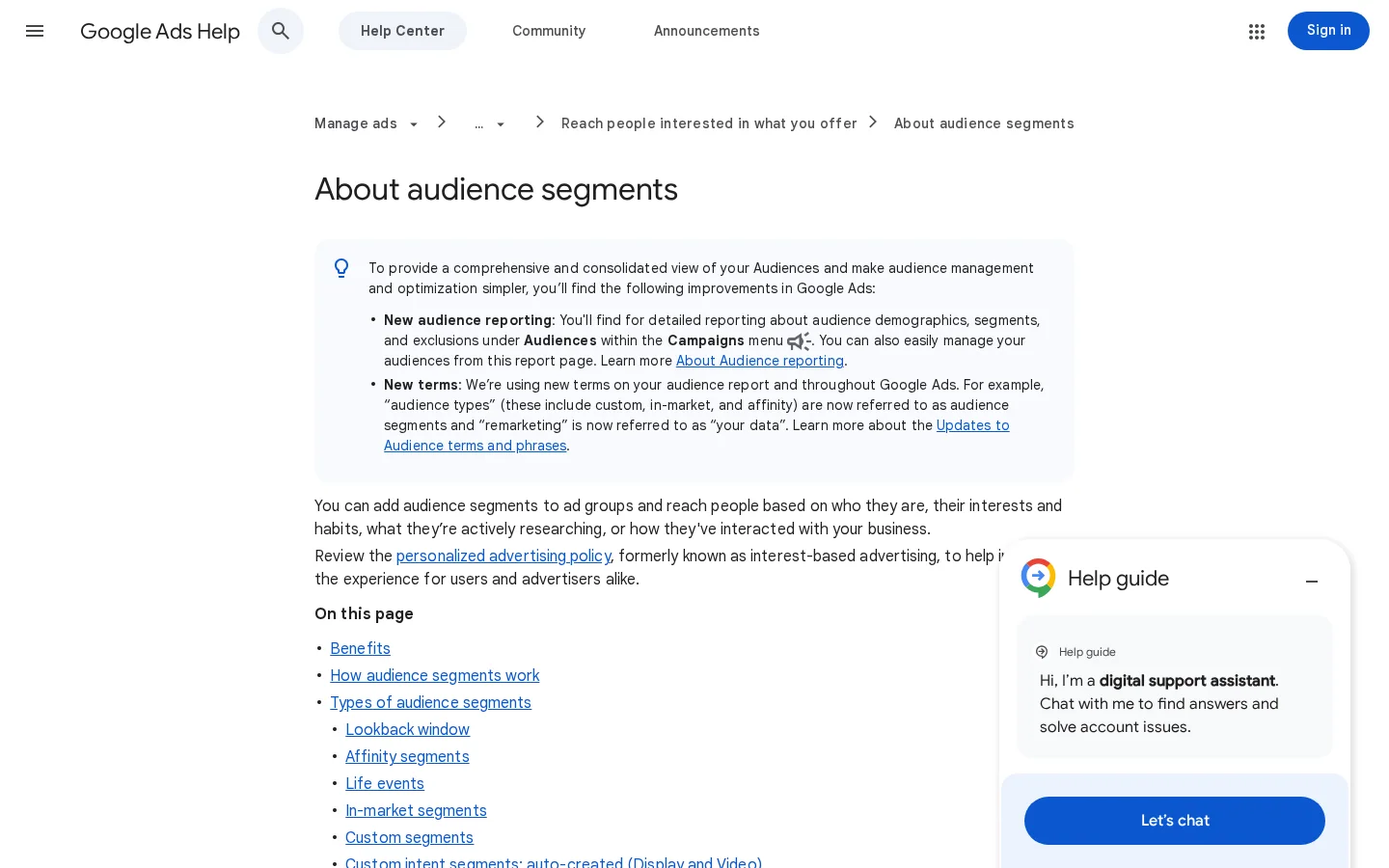
On the paid side, Google Ads lets you reach segments through several audience types: affinity, in-market, life events, custom segments, detailed demographics and your own data (site visitors and customer lists), as listed on the Google Ads help page about audience segments. Map each of your segments to one or two of these types, then build one campaign or ad group per segment so the budget can be moved independently.
Every report must be readable per segment. Tag every link with the segment name so you never lose the split. A simple naming convention keeps it clean:
https://example.com/offices/?utm_source=linkedin
  &utm_medium=paid-social
  &utm_campaign=q1-office-plan
  &utm_content=seg-offices_ad-quote-v2
Tip
Build these links without typos with the free UTM link builder, and always put the segment at the start of utm_content (seg-offices, seg-cafes, seg-home) so you can filter on it in one click.
Review once a month. Start with an equal budget per segment, then move money each quarter toward the segment with the lowest acquisition cost and the best retention. Do not kill a segment after one month: B2B segments often need a full sales cycle before they show results.
In organic search, multi-segment marketing means each segment gets pages that answer its own queries. People in different segments type different words, and AI models like ChatGPT, Claude and Gemini get different questions from them. One generic page cannot rank for all of them.
The home brewer searches "best coffee for french press". The office manager searches "office coffee delivery" or asks an AI model "how much coffee does an office of 30 people use per month". The café owner searches "wholesale coffee supplier". These are three intents, so three pages. List the queries per segment, then use keyword mapping by page to assign each query to exactly one page.
Finding the questions each segment asks AI models is harder than finding Google keywords, because those prompts are not public. Sorank's AI prompt research feature finds the questions your customers ask AI, which you can then sort by segment. For Google, its automated keyword research for Google and AI groups keywords so each page targets one intent.
Give each segment a clear entry point: a hub page per segment (/offices/, /cafes/, /home/), linked from the main menu, with its own guides below it. This helps visitors pick their path in one click and helps search engines understand which page serves which audience.
| Segment | Hub page | Supporting content | Conversion goal |
|---|---|---|---|
| Home brewers | /home/ | Brewing guides, origin stories, gift guides | Subscription |
| Offices | /offices/ | Cost per employee, machine comparisons, case studies | Quote request |
| Cafés | /cafes/ | Margin per cup, blend customization, training | Tasting appointment |
Warning
Two segment pages that target the same keyword compete with each other. If "/offices/" and "/cafes/" both aim at "wholesale coffee", Google may rank neither well. Check for keyword cannibalization between pages before you publish segment pages.
When your segments are countries or languages, the site structure has technical rules. Google's guide to managing multi-regional and multilingual sites recommends country domains, subdomains or subdirectories, advises against URL parameters, and warns against redirecting visitors automatically based on their guessed language or location. Tell Google which version serves which audience with hreflang annotations:
<link rel="alternate" hreflang="en-us" href="https://example.com/us/offices/" />
<link rel="alternate" hreflang="en-gb" href="https://example.com/uk/offices/" />
<link rel="alternate" hreflang="fr-fr" href="https://example.com/fr/bureaux/" />
<link rel="alternate" hreflang="x-default" href="https://example.com/offices/" />
Every version must list all the others and itself. Missing return links are the most common hreflang error. The free hreflang tag generator writes the full set for you.
Measure each segment on its own, with the same set of metrics, so you can compare them side by side. A blended company average hides the segment that drains the budget.
| Metric | What it tells you | How to calculate it per segment |
|---|---|---|
| Customer acquisition cost (CAC) | What it costs to win one customer | Segment marketing and sales spend ÷ new customers in the segment |
| Conversion rate | How well your message fits | Segment conversions ÷ segment visitors (filter by audience or utm_content) |
| Customer lifetime value (LTV) | What one customer is worth over time | Average revenue per customer × gross margin × average lifetime |
| LTV / CAC | Whether the segment is worth growing | Segment LTV ÷ segment CAC |
| Retention or churn | Whether the offer keeps its promise | Customers still active after 6 or 12 months ÷ customers at start |
| Share of segment revenue | Your dependence on one group | Segment revenue ÷ total revenue |
Watch the last line closely. If one segment passes about two thirds of revenue, you are back to a niche strategy in disguise, with its risk. That is not wrong, but it should be a choice, not an accident. Follow each segment along its own customer journey map to see where it drops.
Most failures come from too many segments, segments that are not really different, or plans that change the ad but not the offer. Here are the seven mistakes we see most, with how to spot and fix each one.
What it is: launching five or six segments in the same quarter. How to spot it: each segment gets a budget too small to produce a clear result, and every report says "not enough data". How to fix it: cut back to two segments, give each enough budget for a statistically readable test, and add the next one only when the first two are stable.
What it is: "women 25 to 34" or "men over 50" as segments. How to spot it: conversion rates and messages are almost the same across segments. How to fix it: rebuild segments on needs or behavior, then use demographics only as a targeting filter inside each.
What it is: writing three versions of one ad while the product, price and landing page stay identical. How to spot it: click rates differ by segment but conversion rates do not. How to fix it: change at least one more P per segment, often the price model or the landing page.
What it is: the CRM, analytics and ad accounts do not record which segment a customer belongs to. How to spot it: you cannot answer "what is the CAC of the office segment?" in under five minutes. How to fix it: add one mandatory segment field in the CRM, one analytics audience per segment and one utm_content prefix per segment.
What it is: each segment plan invents its own tone, promise and visuals. How to spot it: a customer who sees two of your ads would not guess they come from the same company. How to fix it: write one shared core promise and visual identity, then adapt only the angle per segment. The principles of integrated marketing communications apply here.
What it is: two segment pages target the same keyword. How to spot it: in Search Console, two URLs swap positions on the same query week after week. How to fix it: give each page a distinct primary query, merge the weaker page into the stronger one if both serve the same intent, and link between them with clear anchors.
What it is: the split decided at launch stays the same all year. How to spot it: the segment with the worst LTV / CAC still gets the same budget after two quarters. How to fix it: set a quarterly review with a simple rule, for example move 10% to 20% of the weakest segment's budget to the strongest one.
A weak plan vs a strong multi-segment plan
You do not need a large software stack. You need one tool per job: store the segment, count it, reach it and report on it.
| Job | Tool type | Examples | What to set up per segment |
|---|---|---|---|
| Store the segment | CRM | HubSpot, Pipedrive, Salesforce | A mandatory "segment" field on every contact and company |
| Count the segment | Web analytics | Google Analytics 4 | One audience per segment, conversions per audience |
| Reach by ads | Ad platforms | Google Ads, Meta Ads, LinkedIn Ads | One campaign or ad group per segment |
| Reach by email | Email platform | Mailchimp, Brevo, Klaviyo | One list segment and one sequence per segment |
| Reach by search | SEO and GEO | Google Search Console, Sorank | One hub page and one keyword set per segment, AI visibility per segment |
| Report | Dashboard | Looker Studio, a spreadsheet | CAC, conversion, LTV and retention side by side |
For the search part, Sorank's autopilot platform for marketing teams plans and publishes the articles for each segment's queries and tracks whether ChatGPT, Claude and Gemini mention your brand. That leaves your team free to work on the offer itself.
Start this week with your own data, not with a new tool. In 30 days you can have two segments defined, tracked and live, with a first read of results.
30-day multi-segment marketing checklist
Multi-segment marketing is not about talking to more people. It is about talking to each group in its own words, with an offer that fits, and moving your budget to the groups that pay back. Fold it into your overall marketing strategy and its components, review it every quarter, and add a new segment only when the current ones run on their own.
Market segmentation is the analysis that divides a market into groups with shared traits. Multi-segment marketing is the decision to target several of those groups at once, each with its own offer, message, price or channel.
Yes, the two terms describe the same strategy: serving two or more segments with separate marketing plans. It sits between undifferentiated (mass) marketing, which uses one message for everyone, and concentrated marketing, which focuses on a single niche.
Start with two, and three at most. Each segment needs enough budget to give a readable result, and at least one of them should already be profitable. Add a new segment only when the first ones run on their own.
We analyse your competitors, your website and your AI visibility to create a tailored content plan for free.
 Website Value Calculator
 Website Accessibility Checker
 Google Analytics Checker
 Duplicate Content Checker
 Mobile-Friendly Test
 Website Speed Test
 Subdomain Finder
 Domain Age Checker
 CMS Detector
 Googlebot Simulator
 Nofollow Link Checker
 Meta Tag Checker
 Keyword Cannibalization Checker
 Keyword Intent Checker
 Keyword Extractor
 Google Ads Cost Calculator
 CPC Calculator
 Local Citation Finder
 Reddit Threads Finder
 Disavow File Generator
 Redirect Generator
 Canonical Tag Generator
 Passive Voice Checker
 Google Location Changer
 Google Review Calculator
 Google Review Link Generator
 Keyword Combiner
 Podcast Show Notes Generator
 AI Content Rewriter
 AI Text Humanizer
 ChatGPT Prompt Generator
 Twitter Thread Generator
 Tweet Generator
 Landing Page Copy Generator
 Google Ads Copy Generator
 Pinterest Pin Description Generator
 Anchor Text Generator
 Social Media Post Generator
 LinkedIn Post Generator
 Free AI Writer
 Review Response Generator
 LSI Keyword Generator
 YouTube Video Ideas Generator
 YouTube Tag Generator
 YouTube Description Generator
 Product Description Generator
 CTA Generator
 Blog Introduction Generator
 Conclusion Generator
 Hook Generator
 AI Content Brief Generator
 FAQ Schema Generator
 AI Blog Post Ideas Generator
 Structured Data Validator (Schema Validator)
 Alt Text Checker
 Internal Link Analyzer
 Backlink Challenge
 AI Meta Description Generator
 AI Blog Title Generator
 Google Indexability Checker
 AI Blog Outline Generator
 UTM Link Builder
 Keyword Clustering Tool
 Canonical Tag Checker
 XML Sitemap Generator
 Broken Link Checker
 AI SEO Title Generator
 Headline Analyzer
 SERP Preview Tool
 Redirect Checker
 Hreflang Tag Generator
 Heading Structure Analyzer
 HTTP Headers Checker
 Favicon Extractor
 SERP CTR Calculator
 SEO vs Paid Search Savings Calculator
 SEO Share of Voice Calculator
 SEO ROI Calculator
 SEO Traffic and Revenue Forecast Calculator
 SEO Budget Calculator
 SEO Break-Even Calculator
 SaaS SEO ROI Calculator
 ROAS Calculator
 Reading Time Calculator
 Ranking Gain Simulator
 Organic Traffic Value Calculator
 Organic Traffic Estimator and Website Traffic Checker
 LTV to CAC Ratio Calculator
 Local SEO ROI Calculator
 Link Building Cost Calculator
 Keyword Value Calculator
 Keyword Opportunity Score Calculator
 Keyword Density Calculator
 GEO ROI Calculator
 GEO Content Investment Calculator
 Ecommerce SEO ROI Calculator
 Customer Lifetime Value Calculator
 Customer Acquisition Cost Calculator
 CTR Calculator
 Cost Per Article Calculator
 Conversion Rate Calculator
 Content Marketing ROI Calculator
 ChatGPT Referral Traffic Estimator
 Bounce Rate Calculator
 Backlink ROI Calculator
 AI Visibility Score Calculator
 AI Traffic Value Calculator
 AI Share of Voice Calculator
 Cost of AI Invisibility Calculator
 AI Citation Rate Calculator
 llms.txt Validator
 AI Overview Checker and AI Overviews Rank Checker
 Robots.txt Checker
 AI SEO Audit
 LLM Readability Checker
 SearchGPT Readiness Checker
 Structured Data LLM Audit
 Website Crawlability AI Audit
 Why ChatGPT Is Not Recommending My Website
 Gemini Ranking Tool
 Perplexity Ranking Checker
 LLM Citation Checker
 Answer Engine Optimization Audit
 GEO Audit
 AI Search Visibility Test
 ChatGPT Visibility Checker
 llms.txt Generator
 URL Extractor
 Webpage to Markdown
 Sitemap Checker
 SERP Volatility Sensor
 Page Size Checker
 Word Counter
 Slug Generator
 Schema Generator
 Robots Generator
 OG Preview
 Meta Tags Generator
 Image Compressor
 Favicon Generator
 On-Page SEO Audit: SEO Checker and SEO Analyzer
 Backlink Analysis Tool
 Keyword Research Tool
 Domain Authority Checker
 “I tested Sorank on a real client site and it's insane. It does everything an agency would bill you $1500 a month for. It's going into production on that client now.”

 Guillaume Guersanguersanguillaume.com“We are an Ads agency and we wanted to get our SEO back on track once and for all. Sorank gave us a clear view of our site, helped us prioritize optimizations, and properly structure our content. The tool is easy to use, well designed for a team, and very practical for centralizing tracking without having to juggle multiple platforms. A very solid foundation to start fresh with our SEO.”
 Gaspard MadouiAds Agency
 “I just let the Sorank software do its thing, and now my DR is 25 and my page is ranking higher.”
 Lucas Flandrefoundertrace.fr“I specialized in GEO thanks to Sorank. The GEO Leaderboard allows me to show my clients their position vs competitors on ChatGPT. It’s a real commercial differentiator.”
 MélanieSEO Freelance“Great service, works well for our website and helps us understand how to improve it to rank better on Google and elsewhere. Congrats, keep going, I recommend it.”
 Hugo T.E-commerce merchant