Preferences
Privacy is important to us, so you have the option of disabling certain types of storage that may not be necessary for the basic functioning of the website. Blocking categories may impact your experience on the website. More information
Privacy is important to us, so you have the option of disabling certain types of storage that may not be necessary for the basic functioning of the website. Blocking categories may impact your experience on the website. More information

Integrated marketing communications (IMC) means one consistent message across ads, social, PR and sales. Learn its key elements, examples and how to plan it.







Founder Sorank, 7+ years in SEO.
Summary
Integrated marketing communications (IMC) is a planning approach that brings all of a brand's communication, such as advertising, public relations, social media, sales promotion and personal selling, into one consistent message. Each channel says the same thing, and the channels are planned together instead of run as separate projects.
Want to go further? Ask
Integrated marketing communications means that every place a customer meets your brand tells the same story. That includes a TV ad, a product page, a sales email, a social post and the call with your sales rep. When the team plans these together, the customer gets one clear message. When each team runs its own campaign, the customer gets mixed signals and has to work out what your company really offers.
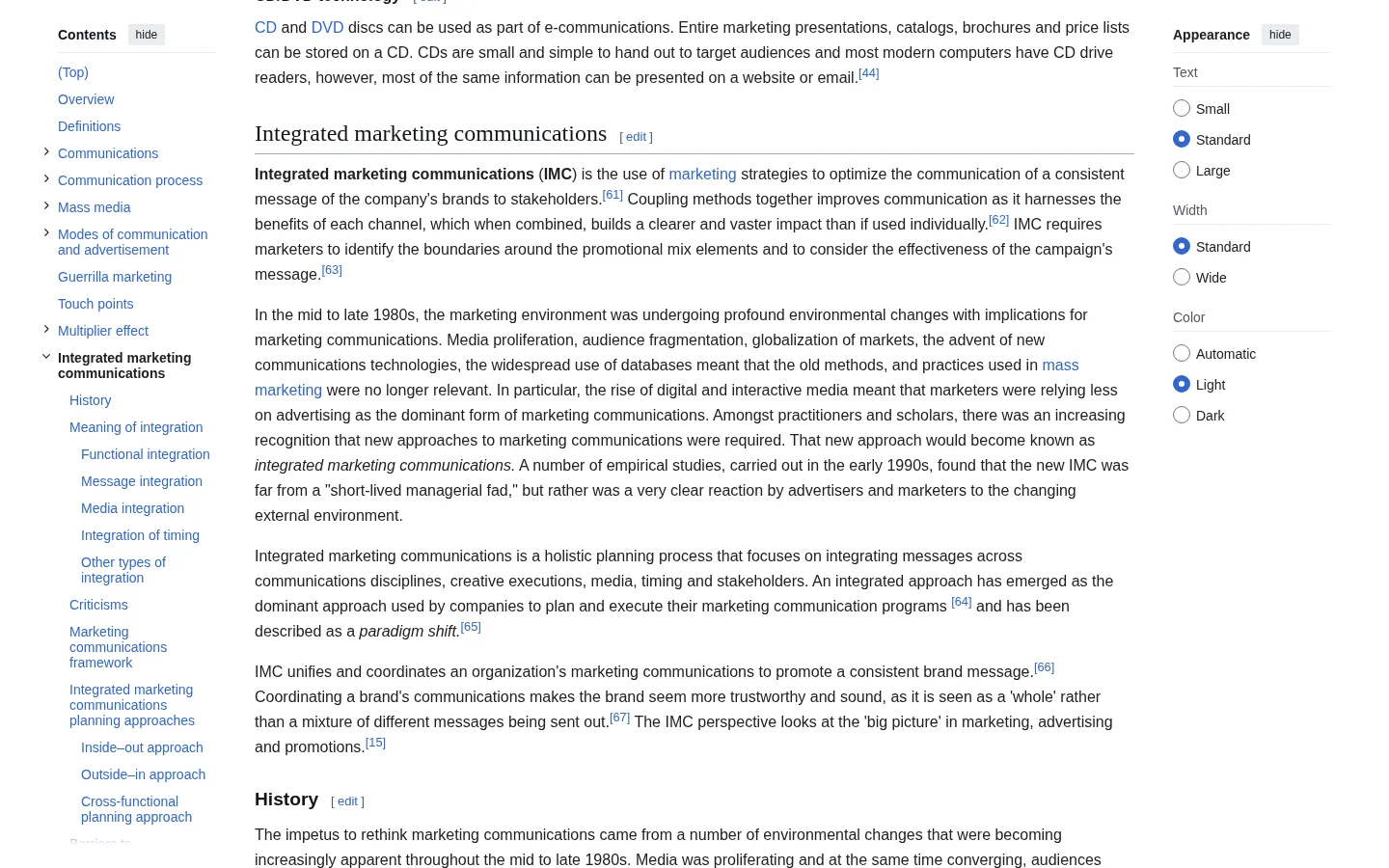
The idea is simple: decide on the message first, then choose the channels that carry it. Wikipedia's IMC article describes it as the use of marketing strategies to keep the communication of a company's brands consistent for its stakeholders, meaning customers, partners and anyone else who deals with the company.
A textbook page on the same topic, a LibreTexts marketing chapter, describes IMC as coordinating all communication activity across different methods. The goal is a variety of tools that all aim at one shared message and that shape how customers see the brand and what they do next.
In practice, this means your marketing team, your sales team and your support team agree on three things before anything goes live: what you promise, who the buyer is and when each message appears.
Three elements make IMC work. Use them as a checklist when you review a campaign.
The plan also covers the materials that buyers read before they decide. These are marketing collateral such as one-page sheets, case studies and sales decks. They should repeat the same message as your ads, or the buyer will notice the gap.
The Wikipedia article on IMC splits integration into several types. Each one is a way to check that your communication fits together. The table below sums them up in plain words.
| Type of integration | What to check |
|---|---|
| Message integration | The same core promise appears in every piece of content. |
| Media integration | The same message carries across TV, search, social and print, with the format adapted to each one. |
| Timing integration | Messages arrive in a planned order, so the email does not land before the ad that explains it. |
| Functional integration | Advertising, public relations, sales and customer service plan together, not in separate silos. |
Your marketing mix decides which tools you use, such as price, product, place and promotion. IMC decides how those tools agree with each other.
Cision, a communications software company, lists several campaigns in its article on integrated marketing communications examples. Two of them show the idea clearly.
Cision also describes Cheetos "Hands-Free," where a hands-free house at the SXSW festival and a TV ad shared one tagline. The lesson is the same in each case: the physical experience, the media and the offer all point to one idea.
Start with one goal and one buyer. A plan with five goals and three audiences will break down in the first month. Then follow these steps:
For the steps behind a single launch, read our guide to planning, running and measuring a marketing campaign. This page covers the longer question: how the channels agree with each other over time.
Most failures come from three habits. Each one below explains what it is, how to spot it and how to fix it.
Search engines and AI answer tools form a view of your brand from everything they find about it. Your website, your social profiles, your listings and your ads all feed that view. When they describe you in three different ways, the search engine and the AI have no clear answer to give. When they agree, it is easier for both to connect your brand to the question a buyer asks.
This is the same reason integrated communication helps your search results. When your ads, landing pages and blog posts use the same terms for your product, the topic becomes clear. Our brand consistency guide shows how to audit the wording across your channels. For the wider channel question, the guide to omnichannel marketing looks at the customer's path from one channel to the next, while this page is about the one message and the plan behind it.
Keeping the message consistent by hand is slow when you publish often. Sorank's brand voice feature lets you set your tone, your form of address and your key terms once. Then every article follows them, so the blog and the site sound like the same company. To see whether the message reaches AI answers, use brand monitoring to follow your brand across the web and AI.
Integrated marketing communications means one message, planned across every channel. Start with the promise, then write the plan, then agree on one calendar and one set of numbers. Review the message every quarter, because a consistent brand is easier to find, easier to trust and easier for search engines and AI answers to describe correctly.
Sources
Integrated marketing communications focuses on the message and the plan behind it. Omnichannel marketing focuses on the path a customer takes from one channel to the next. Many brands use both: one keeps the message the same, and the other keeps the journey smooth.
Yes, at a smaller scale. A small business can start with one core message, one shared calendar and two or three channels. The rule stays the same: every channel should say the same thing.
Put your ad, your website, your emails and your sales script side by side. If they promise different things or name your product in different ways, they are not integrated. Ask three people on your team for your main message. If the answers differ, fix the message before you fix the channels.
 “I tested Sorank on a real client site and it's insane. It does everything an agency would bill you $1500 a month for. It's going into production on that client now.”

 Guillaume Guersanguersanguillaume.com“We are an Ads agency and we wanted to get our SEO back on track once and for all. Sorank gave us a clear view of our site, helped us prioritize optimizations, and properly structure our content. The tool is easy to use, well designed for a team, and very practical for centralizing tracking without having to juggle multiple platforms. A very solid foundation to start fresh with our SEO.”
 Gaspard MadouiAds Agency
 “I just let the Sorank software do its thing, and now my DR is 25 and my page is ranking higher.”
 Lucas Flandrefoundertrace.fr“I specialized in GEO thanks to Sorank. The GEO Leaderboard allows me to show my clients their position vs competitors on ChatGPT. It’s a real commercial differentiator.”
 MélanieSEO Freelance“Great service, works well for our website and helps us understand how to improve it to rank better on Google and elsewhere. Congrats, keep going, I recommend it.”
 Hugo T.E-commerce merchant