
Preferences
Privacy is important to us, so you have the option of disabling certain types of storage that may not be necessary for the basic functioning of the website. Blocking categories may impact your experience on the website. More information

Privacy is important to us, so you have the option of disabling certain types of storage that may not be necessary for the basic functioning of the website. Blocking categories may impact your experience on the website. More information

How Google Ads works: the auction, Quality Score, campaign types, what drives your cost per click, and when paid search beats SEO or works best alongside it.
Tools


In short
Google Ads is Google's advertising platform: you bid on keywords and audiences, and your ads appear on Google Search, YouTube, Gmail, Maps and partner sites. You pay per click (or per view or conversion), and the position of your ad depends on your bid multiplied by its quality, not on your budget alone. It brings traffic from day one and stops the moment you stop paying, which is why it works best alongside SEO rather than instead of it.
Want to go further? Ask
Google Ads is the largest search advertising platform in the world, and also one of the easiest ways to waste money online. This guide explains how the auction really works, which campaign types exist, what makes a click expensive or cheap, and how to decide between paid search, organic search and the AIs.
A self-service auction where advertisers pay to appear when people search or browse. Formerly called Google AdWords (renamed in 2018), it lets you create ads, choose who sees them, set a budget and measure results. Ads can show on the results page above and below the organic listings, on YouTube videos, in Gmail, on Google Maps and across millions of sites in the Display Network.
Search ads remain the core of the platform because they reach people at the moment they express a need. Someone typing "emergency plumber near me" is ready to buy; an ad that answers that query well converts far better than a banner shown to a random visitor.
Every search triggers an auction, and the winner is the ad with the best Ad Rank, not the highest bid. According to the Google Ads Help Center, Ad Rank combines your bid, the quality of your ad and landing page, the Ad Rank thresholds, the context of the search (device, location, time) and the expected impact of your ad assets.
The practical consequence: a relevant ad pointing to a useful page can outrank a bigger competitor while paying less per click. Quality is the cheapest lever you have.
Pick the campaign type from your goal, not from what the interface suggests first.
| Campaign type | Where ads show | Best for |
|---|---|---|
| Search | Google results pages | Capturing existing demand on precise keywords |
| Performance Max | All Google channels, driven by automation | Conversion volume when you have good tracking and assets |
| Shopping | Product listings with image and price | E-commerce with a product feed in Merchant Center |
| Display | Sites and apps of the Display Network | Retargeting and awareness |
| Video | YouTube | Awareness and consideration |
| Demand Gen | YouTube, Discover, Gmail | Visual campaigns that create demand |
For a first campaign, a Search campaign on a small set of high-intent keywords, with exact and phrase match, gives the clearest data and the least waste.
Competition sets the price range; your quality and targeting decide where you land in it. Industries with a high customer value (legal services, insurance, finance, B2B software) have much higher costs per click than local retail or hobby niches, because each customer is worth more to the advertisers bidding.
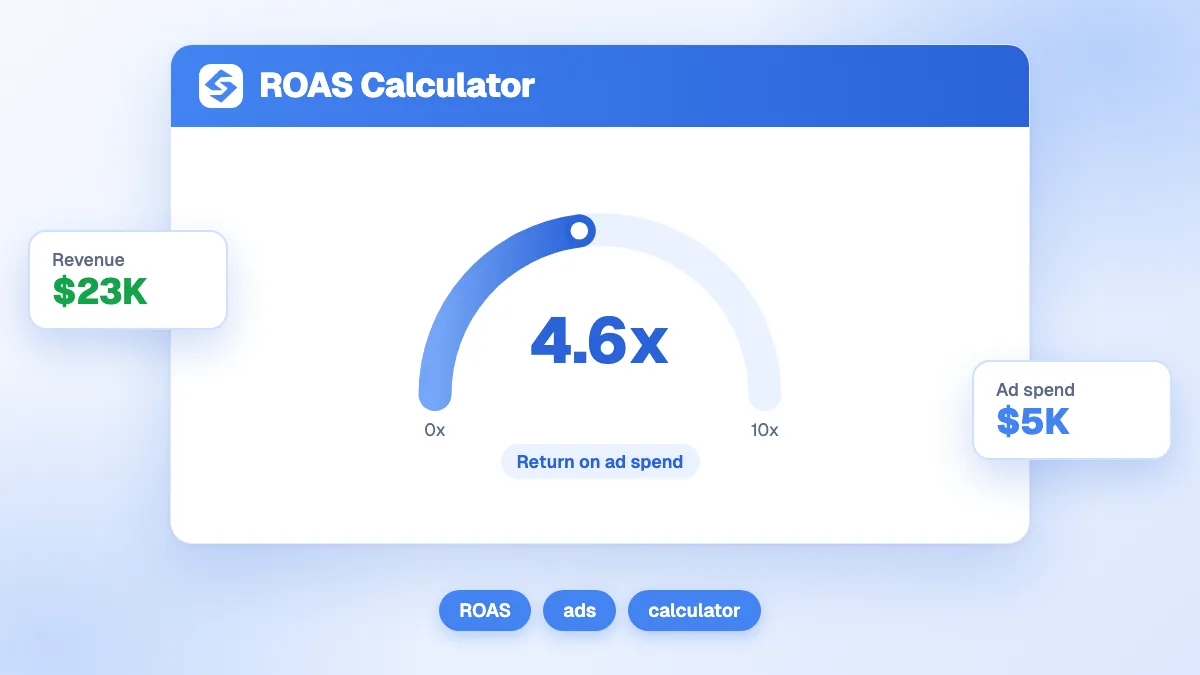
The number that matters in the end is the return on ad spend. Our ROAS calculator shows in a minute whether a campaign pays for itself.
Use Google Ads for speed and testing, SEO for the long-term cost of acquisition, and both when you can. Ads deliver traffic on launch day, which makes them ideal for testing which keywords convert, promoting an offer with a deadline or covering a query you do not rank for yet. The cost is linear: every visit is paid.
SEO works the other way around. It takes 2 to 4 months before pages rank, then each article keeps bringing organic traffic without a cost per click. The SEO vs paid savings calculator estimates what your organic visits would cost if you bought them as ads.
| Criterion | Google Ads | SEO |
|---|---|---|
| Time to first results | Hours | 2 to 4 months |
| Cost model | Pay per click, forever | Content and links, then no cost per visit |
| When you stop | Traffic stops | Traffic decays slowly |
| Visibility in the AIs | Limited to ad placements | Pages can be cited in answers |
A useful routine: run ads on a keyword, check that it converts, then write the organic page that will take over the traffic. The ads data tells you which pages deserve to be written first.
More answers are given directly on the results page, so fewer clicks are left for everyone, paid or organic. AI Overviews summarize an answer above the links, and Google has started placing ads inside and around these summaries. At the same time, a growing share of research happens in ChatGPT, Gemini, Perplexity or Claude, where there is no ad auction you can enter for most queries.
The answers of those assistants are built from pages they can read and trust. Being cited there depends on organic content: clear answers, sources, mentions on third-party sites. Ads buy the click; content earns the citation.
Start small, precise and measured.
Google Ads rewards relevance: the right keyword, the right ad and the right page cost less and convert more. Use it to capture urgent demand and to learn which keywords make money, then build the organic pages that keep that traffic without paying per click and that the AIs can cite. To publish those pages every day without writing them yourself, Sorank creates and publishes SEO and GEO articles on autopilot and tracks your visibility in the AIs: see the plans and the 3-day free trial.

There is no fixed price. You set a daily budget and a maximum bid, and you pay each time someone clicks your ad. The cost per click depends on competition for the keyword, your Quality Score and your targeting: a few cents in quiet niches, tens of dollars in legal, insurance or B2B software.
Neither is better in general. Google Ads brings traffic the day you launch and stops when you stop paying. SEO takes 2 to 4 months to show results, then keeps bringing visits without paying per click. Most businesses use ads to test keywords and capture urgent demand, and SEO to lower the long-term cost of acquisition.
Quality Score is rated from 1 to 10 at keyword level. A score of 7 or more is generally considered good. It reflects expected click-through rate, ad relevance and landing page experience, so the way to raise it is a tighter match between the keyword, the ad text and the page the click lands on.
 AI Content Brief Generator
 FAQ Schema GeneratorAI Blog Post Ideas GeneratorStructured Data Validator
 Alt Text Checker
 Internal Link AnalyzerBacklink ChallengeAI Meta Description GeneratorAI Blog Title Generator
 Google Indexability CheckerAI Blog Outline GeneratorUTM Link BuilderKeyword Clustering ToolCanonical Tag Checker
 XML Sitemap GeneratorBroken Link CheckerAI SEO Title GeneratorHeadline AnalyzerSERP Preview ToolRedirect Checker
 Hreflang Tag GeneratorHeading Structure AnalyzerHTTP Headers CheckerFavicon Extractor
 SERP CTR Calculator
 SEO vs Paid Search Savings Calculator
 SEO Share of Voice Calculator
 SEO ROI Calculator
 SEO Traffic and Revenue Forecast Calculator
 SEO Budget Calculator
 SEO Break-Even Calculator
 SaaS SEO ROI Calculator
 ROAS Calculator
 Reading Time Calculator
 Ranking Gain Simulator
 Organic Traffic Value Calculator
 Organic Traffic Estimator
 LTV to CAC Ratio Calculator
 Local SEO ROI Calculator
 Link Building Cost Calculator
 Keyword Value Calculator
 Keyword Opportunity Score Calculator
 Keyword Density Calculator
 GEO ROI Calculator
 GEO Content Investment Calculator
 Ecommerce SEO ROI Calculator
 Customer Lifetime Value Calculator
 Customer Acquisition Cost Calculator
 CTR Calculator
 Cost Per Article Calculator
 Conversion Rate Calculator
 Content Marketing ROI Calculator
 ChatGPT Referral Traffic Estimator
 Bounce Rate Calculator
 Backlink ROI Calculator
 AI Visibility Score Calculator
 AI Traffic Value Calculator
 AI Share of Voice Calculator
 Cost of AI Invisibility Calculator
 AI Citation Rate Calculatorllms.txt ValidatorAI Overview CheckerRobots.txt CheckerAI SEO AuditLLM Readability CheckerSearchGPT Readiness Checker
 Structured Data LLM AuditWebsite Crawlability AI AuditWhy ChatGPT Is Not Recommending My Website
 Gemini Ranking ToolPerplexity Ranking CheckerLLM Citation CheckerAnswer Engine Optimization AuditGEO AuditAI Search Visibility TestChatGPT Visibility Checkerllms.txt Generator
 URL ExtractorWebpage to MarkdownSitemap CheckerSERP Volatility SensorPage Size Checker
 Word Counter
 Slug GeneratorSchema GeneratorRobots Generator
 OG PreviewMeta Tags Generator
 Image CompressorFavicon Generator
 On-Page SEO Audit
 Backlink Analysis Tool
 Keyword Research Tool
 Domain Authority Checker
THEY TRIED SORANK BEFORE YOU
 “I tested Sorank on a real client site and it's insane. It does everything an agency would bill you $1500 a month for. It's going into production on that client now.”

 Guillaume Guersanguersanguillaume.com“We are an Ads agency and we wanted to get our SEO back on track once and for all. Sorank gave us a clear view of our site, helped us prioritize optimizations, and properly structure our content. The tool is easy to use, well designed for a team, and very practical for centralizing tracking without having to juggle multiple platforms. A very solid foundation to start fresh with our SEO.”
 Gaspard MadouiAds Agency
 “I just let the Sorank software do its thing, and now my DR is 25 and my page is ranking higher.”
 Lucas Flandrefoundertrace.fr“I specialized in GEO thanks to Sorank. The GEO Leaderboard allows me to show my clients their position vs competitors on ChatGPT. It’s a real commercial differentiator.”
 MélanieSEO Freelance“Great service, works well for our website and helps us understand how to improve it to rank better on Google and elsewhere. Congrats, keep going, I recommend it.”
 Hugo T.E-commerce merchant























