Preferences
Privacy is important to us, so you have the option of disabling certain types of storage that may not be necessary for the basic functioning of the website. Blocking categories may impact your experience on the website. More information

Privacy is important to us, so you have the option of disabling certain types of storage that may not be necessary for the basic functioning of the website. Blocking categories may impact your experience on the website. More information

Buying intent keywords are searches made close to a purchase. Modifier lists, a scoring grid, the right page for each, and how buyers ask AI assistants.
Tools

In short
Buying intent keywords are searches typed by people who are close to a purchase: "buy", "price", "discount", "near me" (transactional), or "best", "vs", "review", "alternative" (commercial). They bring less traffic than informational queries but far more revenue per visit. To use them, find them with modifiers, the search results page and cost per click, score them, then give each one the page that matches it: product, pricing, comparison or local page. In ChatGPT and Gemini, the same intent shows up as long prompts with a budget, a use case and constraints.
Want to go further? Ask
Quick quiz
How should you find the right keywords?
Sorank matches your answers


Test it for 3 days on your own site and see where you stand on Google, ChatGPT and the other AIs.
Start 3-day free trial3 days free, then stop whenever you want. 90-day results-or-refund guarantee.
Most keyword lists are built for traffic. Buying intent keywords are built for sales: they catch the searcher in the last steps before paying. Google's own Search Quality Rater Guidelines (version of September 11, 2025) describe this as a "Do" query, whose goal "may be to download, to buy, to obtain". This guide shows how to recognize them, find them for your own business, decide which ones to target first, and build the page that converts each one. If you are new to the idea of search intent, start there.
A buying intent keyword is a query whose wording shows that the searcher wants to purchase, book, hire or subscribe, now or soon. Two families make up the category, and they sit next to the other types of keywords you already track:
Two neighbouring families also carry buying intent. Branded searches with a product name ("iPhone 17 Pro 256GB") are often one step from the checkout, and local searches ("dentist in Lyon") usually end in a call or a visit. Informational queries ("how does a heat pump work") rarely convert directly, but they feed the same buyers earlier.
| Intent | What the searcher wants | Example | Distance to purchase |
|---|---|---|---|
| Informational | Understand a problem | how to reduce heating costs | Far |
| Commercial | Compare solutions | best heat pump for a small house | Close |
| Transactional | Buy or book | heat pump installation quote | Immediate |
| Local | A provider nearby | heat pump installer near me | Immediate |
Buying intent is visible in the modifiers attached to the product or service. The table below groups the most reliable ones and the page each group deserves.
| Modifier group | Examples | Intent | Page to build |
|---|---|---|---|
| Action verbs | buy, order, purchase, book, hire, subscribe, download, get a quote | Transactional | Product, category or booking page |
| Price and deal | price, pricing, cost, how much, cheap, discount, coupon, deal, free trial | Transactional | Pricing page, offer page |
| Comparison | best, top, vs, compare, alternative to, cheaper than | Commercial | Comparison article, "best X" ranking |
| Evaluation | review, reviews, rating, pros and cons, worth it, is X legit | Commercial | Review or case page |
| Specification | model number, size, color, "for small business", "for beginners" | Transactional | Product variant or use-case page |
| Local | near me, in [city], open now, same day | Transactional | Location page and Google Business Profile |
| B2B | demo, pricing, integration, "software for [industry]", vendor, supplier | Commercial to transactional | Demo, pricing, industry or integration page |
Example
A bakery equipment seller starts from the seed "commercial oven". Adding modifiers gives "commercial oven price", "best commercial oven for a small bakery", "Rational vs Unox", "used commercial oven for sale" and "commercial oven repair near me": five buying queries, five different pages.
A modifier alone is a hint, not proof. "Free" can mean a buyer looking for a free trial or a student who will never pay. "Review" can be a buyer, or a current customer looking for help. The search results page settles the question, as the next section shows.
Six sources cover almost every buying query in a market. Use them in this order: the first three build the list, the last three complete it with what tools miss.
List what you sell (products, services, categories, use cases) and cross each item with the modifier groups above. A spreadsheet with 20 offers and 15 modifiers already gives 300 candidates. Then check each one in a keyword tool to keep the queries people type, and drop the ones with no demand.
Google shows what it believes the intent is. Shopping ads, text ads at the top, product pages, pricing pages and "best X" lists in the top 10 mean buying intent. Encyclopedias, how-to guides and videos mean informational intent. When the results are mixed, the query is ambiguous: target it only if your page can serve both readings.
Advertisers pay more for queries that bring customers, so a high CPC is a cheap proxy for commercial value. Google's Keyword Planner shows competition and the average cost to show an ad for each keyword. Our free keyword value calculator turns volume, CPC and expected position into a monthly value, which makes two queries with different volumes comparable.
Your own data is the most reliable source. In the Performance report, filter queries containing "price", "best", "vs", "buy" or your product names. Queries with impressions and an average position between 5 and 20 are the quickest wins: Google already associates your site with them, and a dedicated or improved page can move them to the top 3.
Competitors who sell the same thing have already found many of your buying queries. A keyword gap analysis lists the queries they rank for and you do not; filter it with the modifier groups to keep only the commercial ones.
The questions prospects ask before signing ("does it work with Shopify?", "is there a monthly plan?") are buying queries that tools often show at zero volume. They are also the questions buyers now type in full into ChatGPT.
Tip
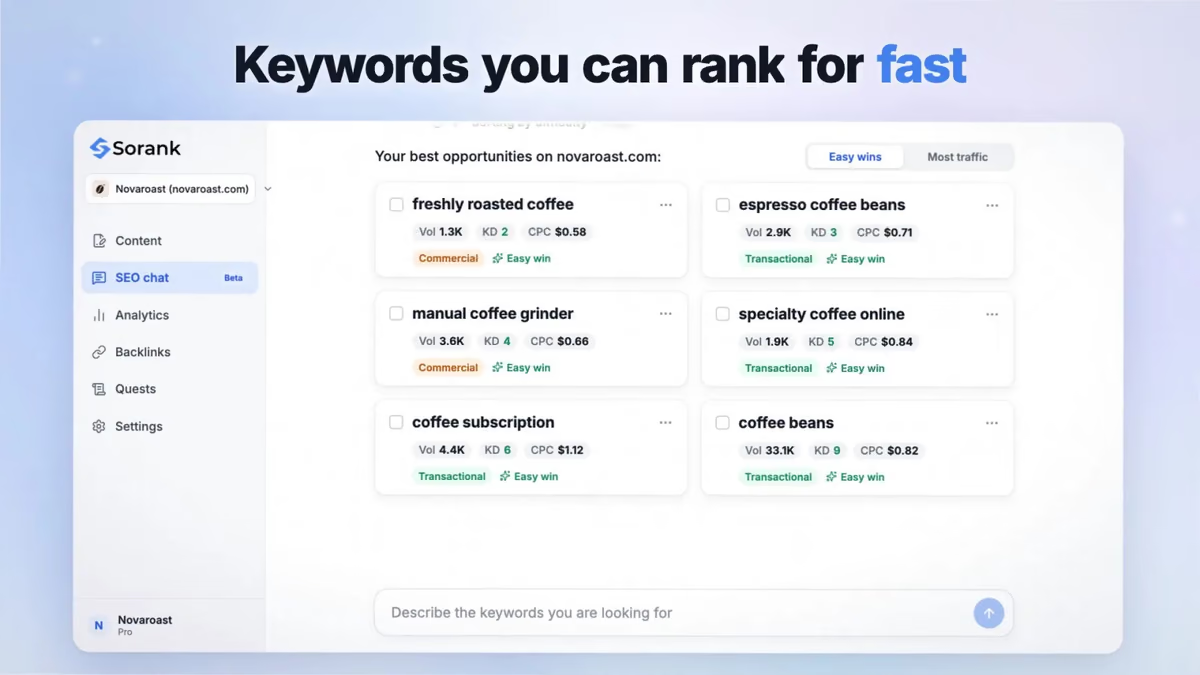
Sorank's SEO Chat answers a request such as "find buying intent keywords for my site" with a sorted list, and the automated keyword research labels the intent of each keyword in your silo, so the commercial ones can be filtered in one click.
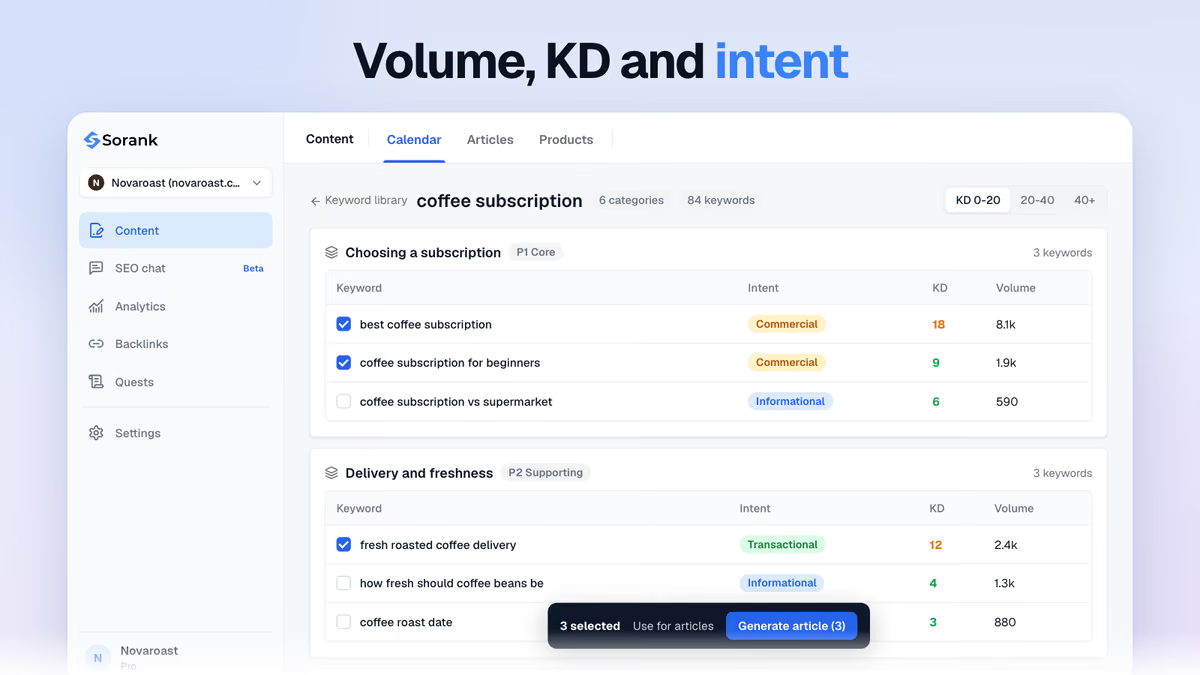
A list of 300 buying queries is useless without an order. Score each keyword from 0 to 3 on four criteria, add the points, and start with the highest totals.
| Criterion | 0 points | 3 points |
|---|---|---|
| Intent clarity | Mixed results page | Top 10 made of product, pricing or comparison pages |
| Business fit | You do not sell exactly this | Your core offer, with good margin |
| Difficulty | Top 10 held by giants with strong links | Small sites or weak pages in the top 10 |
| Value | Low volume and low CPC | High monthly value (volume x CPC x expected click-through) |
Two adjustments make the grid sharper. First, give long-tail queries a bonus: a long-tail keyword such as "CRM for real estate agents with WhatsApp" has a small volume, but a buyer who types it has already defined the need, and the keyword difficulty is usually low. Second, weight business fit double if your margins differ a lot between products.
Watch out
Do not drop a buying query because the tool shows 0 or 10 searches a month. Volume estimates are weakest on precise, low-volume queries, and those are often the ones that convert best. If prospects ask the question, write the page.
The most common mistake is to target "best accounting software" with a product page, or "buy X" with a blog post. Google ranks the format that matches the intent, so each query type needs its own page.
On product pages, Google's product structured data documentation explains that Product markup lets shoppers "see price, availability, review ratings, shipping information, and more right in search results": exactly the details a buyer checks. This page mapping is the bottom of your SEO funnel, and it should be planned in your keyword strategy alongside the informational content that feeds it.
Buyers now ask AI assistants the questions they used to split into several Google searches. A prompt such as "what is the best CRM for a 5-person real estate agency, under $50 a month, that works with WhatsApp?" contains a commercial modifier, a use case, a budget and an integration in one sentence. The keyword "best CRM" is still there, wrapped in constraints.
Behind the answer, the assistant runs its own searches. Google states in its documentation on AI features and your website that AI Overviews and AI Mode may issue "multiple related searches across subtopics and data sources", and that clicks from these results are "higher quality", with users more likely to spend time on the site. To be cited, a page must be indexed and eligible to appear with a snippet, so classic SEO remains the entry ticket.
Three habits make your buying pages easier to cite:
Note
Prompts have no public search volume. Our guide to keyword research for AI search explains how to build a prompt list from your buying keywords, and Sorank's AI mention tracking shows whether ChatGPT, Claude and Gemini cite your brand on those prompts, and who is cited instead.
Both, for different reasons. Paid search buys an immediate position on queries where you cannot rank yet, and it is the fastest way to test whether a query converts before writing a page for it. SEO takes longer (first effects usually appear after 2 to 4 months) but each ranked page keeps bringing buyers without a cost per click, and only organic pages can be cited by AI assistants. The usual split: ads on the most competitive transactional queries and on new offers, organic pages on comparison, review, long-tail and local queries. Our guide to SEO and PPC details how to make the two channels share their data.
Buying intent keywords are few, precise and profitable: find them with modifiers, the results page and CPC, score them, and give each one the page its intent calls for. Then check that the same pages answer the long prompts buyers type into ChatGPT and Gemini. To find your buying queries automatically and track the matching prompts in AI assistants, try Sorank with a 3-day free trial.

Commercial keywords are typed by people comparing options before a purchase, with words like best, vs, review or alternative. Transactional keywords are typed by people ready to act, with words like buy, price, order, coupon or near me. Both carry buying intent, but they need different pages: a comparison or ranking for commercial queries, a product or pricing page for transactional ones.
Yes, in most cases. A precise buying query with 20 searches a month can bring more customers than a broad informational query with 2,000, because the searcher has already defined the need. Volume estimates are also least reliable on these long, specific queries, so the real demand is often higher than the tool shows.
Search it on Google and look at the first page. Shopping ads, text ads, product pages, pricing pages and best-of lists indicate buying intent, while guides, definitions and videos indicate informational intent. Google Keyword Planner, free with a Google Ads account, adds a second signal: keywords with high competition and a high cost per click are usually commercial.
We analyse your competitors, your website and your AI visibility to create a tailored content plan for free.
 AI Content Brief Generator
 FAQ Schema Generator
 AI Blog Post Ideas Generator
 Structured Data Validator (Schema Validator)
 Alt Text Checker
 Internal Link Analyzer
 Backlink Challenge
 AI Meta Description Generator
 AI Blog Title Generator
 Google Indexability Checker
 AI Blog Outline Generator
 UTM Link Builder
 Keyword Clustering Tool
 Canonical Tag Checker
 XML Sitemap Generator
 Broken Link Checker
 AI SEO Title Generator
 Headline Analyzer
 SERP Preview Tool
 Redirect Checker
 Hreflang Tag Generator
 Heading Structure Analyzer
 HTTP Headers Checker
 Favicon Extractor
 SERP CTR Calculator
 SEO vs Paid Search Savings Calculator
 SEO Share of Voice Calculator
 SEO ROI Calculator
 SEO Traffic and Revenue Forecast Calculator
 SEO Budget Calculator
 SEO Break-Even Calculator
 SaaS SEO ROI Calculator
 ROAS Calculator
 Reading Time Calculator
 Ranking Gain Simulator
 Organic Traffic Value Calculator
 Organic Traffic Estimator and Website Traffic Checker
 LTV to CAC Ratio Calculator
 Local SEO ROI Calculator
 Link Building Cost Calculator
 Keyword Value Calculator
 Keyword Opportunity Score Calculator
 Keyword Density Calculator
 GEO ROI Calculator
 GEO Content Investment Calculator
 Ecommerce SEO ROI Calculator
 Customer Lifetime Value Calculator
 Customer Acquisition Cost Calculator
 CTR Calculator
 Cost Per Article Calculator
 Conversion Rate Calculator
 Content Marketing ROI Calculator
 ChatGPT Referral Traffic Estimator
 Bounce Rate Calculator
 Backlink ROI Calculator
 AI Visibility Score Calculator
 AI Traffic Value Calculator
 AI Share of Voice Calculator
 Cost of AI Invisibility Calculator
 AI Citation Rate Calculator
 llms.txt Validator
 AI Overview Checker and AI Overviews Rank Checker
 Robots.txt Checker
 AI SEO Audit
 LLM Readability Checker
 SearchGPT Readiness Checker
 Structured Data LLM Audit
 Website Crawlability AI Audit
 Why ChatGPT Is Not Recommending My Website
 Gemini Ranking Tool
 Perplexity Ranking Checker
 LLM Citation Checker
 Answer Engine Optimization Audit
 GEO Audit
 AI Search Visibility Test
 ChatGPT Visibility Checker
 llms.txt Generator
 URL Extractor
 Webpage to Markdown
 Sitemap Checker
 SERP Volatility Sensor
 Page Size Checker
 Word Counter
 Slug Generator
 Schema Generator
 Robots Generator
 OG Preview
 Meta Tags Generator
 Image Compressor
 Favicon Generator
 On-Page SEO Audit: SEO Checker and SEO Analyzer
 Backlink Analysis Tool
 Keyword Research Tool
 Domain Authority Checker
THEY TRIED SORANK BEFORE YOU
 “I tested Sorank on a real client site and it's insane. It does everything an agency would bill you $1500 a month for. It's going into production on that client now.”

 Guillaume Guersanguersanguillaume.com“We are an Ads agency and we wanted to get our SEO back on track once and for all. Sorank gave us a clear view of our site, helped us prioritize optimizations, and properly structure our content. The tool is easy to use, well designed for a team, and very practical for centralizing tracking without having to juggle multiple platforms. A very solid foundation to start fresh with our SEO.”
 Gaspard MadouiAds Agency
 “I just let the Sorank software do its thing, and now my DR is 25 and my page is ranking higher.”
 Lucas Flandrefoundertrace.fr“I specialized in GEO thanks to Sorank. The GEO Leaderboard allows me to show my clients their position vs competitors on ChatGPT. It’s a real commercial differentiator.”
 MélanieSEO Freelance“Great service, works well for our website and helps us understand how to improve it to rank better on Google and elsewhere. Congrats, keep going, I recommend it.”
 Hugo T.E-commerce merchant