Preferences
Privacy is important to us, so you have the option of disabling certain types of storage that may not be necessary for the basic functioning of the website. Blocking categories may impact your experience on the website. More information

Privacy is important to us, so you have the option of disabling certain types of storage that may not be necessary for the basic functioning of the website. Blocking categories may impact your experience on the website. More information

Question keywords are searches phrased as questions. Learn 7 ways to find them, which ones to target, and how to answer them in H2s and FAQs.
Tools

In short
question keywords are search queries phrased as a question, usually starting with who, what, where, when, why, how, can, does or is. Find them in Google autocomplete, People Also Ask, your own Search Console data, the question filters of keyword tools, forums and the questions AI assistants break a prompt into. Then give each important question its own page or H2, answer it in the first two or three sentences under that heading, and group the smaller ones in a FAQ.
Want to go further? Ask
Quick quiz
How should you find the right keywords?
Sorank matches your answers


Test it for 3 days on your own site and see where you stand on Google, ChatGPT and the other AIs.
Start 3-day free trial3 days free, then stop whenever you want. 90-day results-or-refund guarantee.
Question keywords are the closest thing to reading your audience's mind: the searcher tells you exactly what they want to know. A Backlinko analysis of 306 million US keywords (updated December 2020) found that 14.1% of searches contain a question word such as who, what, where, why or how. That share is the lower bound of the opportunity, because the same questions now reach ChatGPT, Gemini and Perplexity as full sentences, and Google's own AI features break them into more questions behind the scenes. This guide covers where to find them, how to choose, and how to answer them so the page ranks and gets quoted.
A question keyword is a search query written as a question, explicit ("how do I verify a Google Business Profile") or implicit ("verify google business profile without postcard", which hides "how can I..."). Most of them are long-tail keywords: four words or more, low individual volume, and a precise need. Their great advantage over a short head term is that the search intent is almost always readable from the question word itself.
| Question word | Usual intent | Example | Best content format |
|---|---|---|---|
| What / What is | Definition, learning | what is a canonical tag | Definition page or glossary entry |
| How / How to | Step-by-step task | how to submit a sitemap to google | Numbered guide |
| Why | Cause, diagnosis | why is my page not indexed | Diagnostic article with causes and fixes |
| Which / What is the best | Comparison, buying | which CMS is best for SEO | Comparison with a table |
| Can / Does / Is | Yes or no, reassurance | does google penalize AI content | Short H2 or FAQ answer |
| How much / How long | Cost, time, planning | how long does SEO take | Answer with ranges and factors |
| Who / Where / When | Fact, place, date | when was google founded | Usually answered by Google directly (low click value) |
The last row matters: questions with one factual answer are often solved on the results page itself, which makes them weak traffic targets. Questions that need an explanation, a method or a judgement (how, why, which) keep sending clicks. For the full family of keyword categories, see our guide to the 14 types of keywords.
People talk to ChatGPT, Claude and Gemini in questions, and Google applies the same logic inside its own AI answers. Google's documentation on AI features and your website (last updated December 2025) states that AI Overviews and AI Mode "may use a query fan-out technique", issuing several related searches across subtopics to build one answer. In other words, one user question becomes five or ten sub-questions, and each one is a chance for your page to be retrieved and cited.
Three consequences for your keyword work:
Note
Google also says there are no special optimizations or AI text files needed to appear in AI Overviews or AI Mode. Clear, crawlable text that answers the question is the requirement, which is exactly what question keywords push you to write.
Use at least three of these sources: each one surfaces questions the others miss.
Type a question word followed by your topic ("how to [topic]", "why does [topic]", "can you [topic]") and note every suggestion. Google confirms in its help page on how autocomplete predictions work that predictions "reflect real searches that have been done on Google", weighted by language, location and trending interest. Add letters after the question ("how to [topic] a", "b"...) to reveal more.
The People Also Ask box lists related questions with a short answer and the page Google took it from. Each question you expand loads more, so a few clicks give you a map of the follow-up questions around your topic, and the source pages show you who you compete with. Our guide to People Also Search For explains how this box differs from the related searches block and how to use both.
This is the most underused source, because it shows questions you already rank for. In Google Search Console, open Performance, add a Query filter, choose "Custom (regex)" and paste a pattern such as ^(who|what|where|when|why|how|which|can|do|does|is|are|should)\s. Google's help page on advanced filtering confirms the filter uses RE2 syntax and is case-insensitive by default. Sort by impressions: questions with many impressions and a position between 8 and 30 are your quickest wins, because one dedicated H2 often lifts them.
Semrush's Keyword Magic Tool and Ahrefs' Keywords Explorer both have a "Questions" view that lists question variants of a seed term with volume and difficulty. AnswerThePublic and AlsoAsked collect autocomplete and People Also Ask data in bulk. For a free start, our keyword research tool returns suggestions you can filter by question words.
Reddit, Quora, Stack Exchange and niche forums show questions in the words real users choose, including the ones too new or too specific for any keyword database. They also show which answers the community upvotes, a good hint of the angle to take. Reddit threads are also among the sources AI assistants cite most often, as our Reddit AI citation study shows.
The questions your customers ask before buying are the ones closest to revenue, and competitors rarely write about them. Export the subject lines of support tickets, ask the sales team for the ten questions they hear every week, and read the questions in product reviews.
Ask ChatGPT or Gemini a question your buyers would ask and note the follow-up questions the answer covers or suggests. A dedicated AI prompt research tool goes further by listing the prompts people type in your market and the sub-queries AI assistants run behind one question.
| Source | Cost | Volume data | Best for |
|---|---|---|---|
| Google autocomplete | Free | No | Fast list of real phrasings |
| People Also Ask | Free | No | Follow-up questions and current answer sources |
| Search Console regex filter | Free | Your own impressions and clicks | Questions you almost rank for |
| Keyword tools (Questions view) | Paid, limited free plans | Yes, estimated | Prioritizing by volume and difficulty |
| Forums and communities | Free | No (upvotes as a signal) | New and very specific questions |
| Sales and support | Free | No (frequency as a signal) | Bottom-of-funnel questions |
| AI assistants and prompt research | Free to paid | Partial | Questions asked in AI chats and fan-out sub-queries |
A list of 300 questions is useless until you decide what to do with each. Score them on four criteria:
Then decide the format, so that each question lands in the right place and two pages never compete for the same one:
| Situation | Where the question goes |
|---|---|
| The question has its own demand and needs 1,000 words or more to answer | A dedicated page, with the question (or its keyword form) in the title and H1 |
| The question is a step or a sub-topic of a bigger page | An H2 or H3 of that page |
| The answer fits in two to four sentences | The FAQ block of the most relevant page |
| Several questions share the same answer | One page or H2, with the variants in the text |
Grouping questions this way is the same work as building a topic cluster: a pillar page for the broad question and supporting pages for the deeper ones, linked together.
Tip
Before you create a new page for a question, check in Search Console whether an existing page already gets impressions for it. Adding an H2 to that page is faster and avoids two pages competing for the same query.
Ranking for a question and being quoted for it depend on the same thing: a clear answer placed right under the question.
On the FAQ, one update matters. Google limited FAQ rich results to well-known government and health websites in 2023, then announced in its Search Central documentation updates that the feature would no longer appear in Google Search from May 7, 2026. Our guide to FAQ schema covers what this changes. The visible FAQ keeps its value: readers use it, and AI assistants read the text whatever the markup.
Watch out
Do not stack dozens of near-identical questions on one page to catch every phrasing. Google understands variants of the same question, and a page padded with repeated answers reads as low quality to both readers and ranking systems.
Question keywords sit where SEO and GEO (generative engine optimization) meet. The same questions bring clicks from Google and appear as prompts in ChatGPT, Claude, Gemini and Perplexity, so a page that answers them well serves both. The difference lies in measurement: Google gives you impressions in Search Console, while AI assistants give you nothing unless you track the prompts yourself.
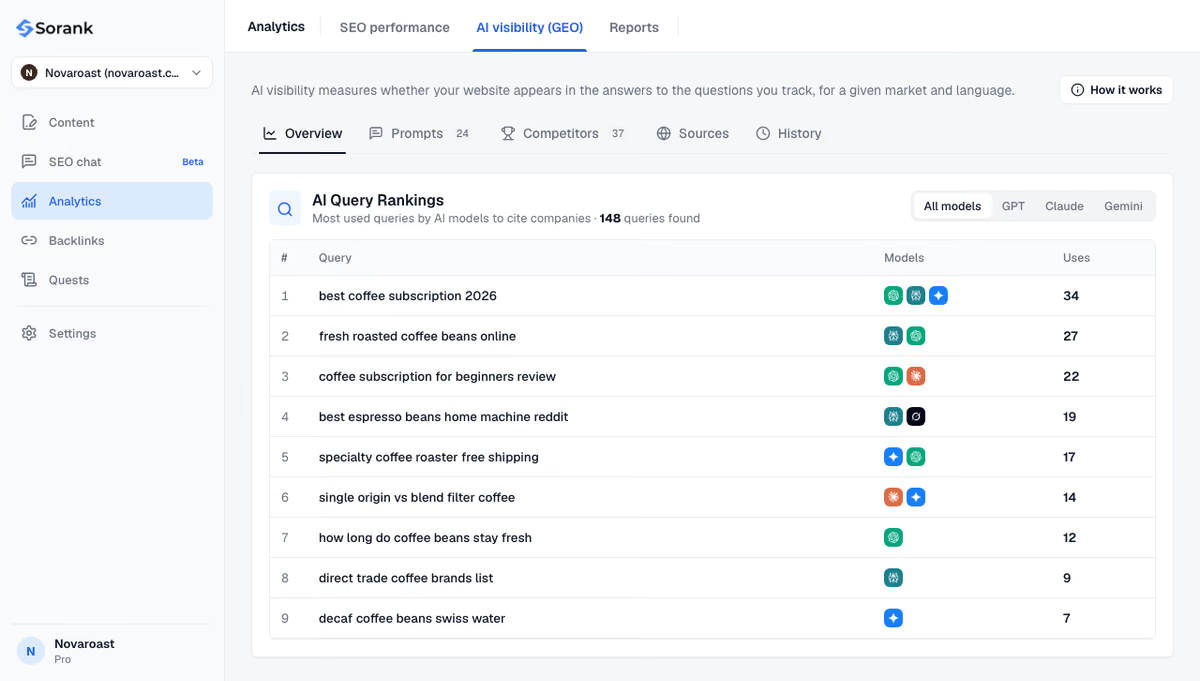
Sorank, our product, automates this loop. Its automated keyword research analyzes your site and finds the keywords and questions worth targeting, the article generator writes and publishes answer-first articles with sources and internal links, and AI mention tracking follows 25 to 150 prompts on ChatGPT, Claude and Gemini (plus Perplexity and Grok from the Pro plan) to show whether your brand is cited and who is cited instead.
Collect questions from at least three sources, keep the ones with real intent and a clear chance to answer better, and give each one the right place: a page, an H2 or a FAQ entry. A heading that repeats the question, followed by a direct answer, is the format that ranks on Google and gets quoted by AI assistants. If you would rather have the research, writing and tracking run on autopilot, Sorank plans start at $49 per month on the annual plan, with a 3-day free trial on the pricing page.

"How long does SEO take" is a question keyword: it starts with a question word and shows a clear need, here a timeline with its factors. Other examples are "what is a canonical tag", "why is my page not indexed" and "which CMS is best for SEO". Each one points to a specific content format.
Often, yes, because most question keywords are long-tail queries with lower competition than short head terms. A precise question also lets a smaller site win by giving a clearer, more direct answer than a broad page from a large site. Factual questions answered directly on the results page bring fewer clicks, so favor how, why and which questions.
No. Add a FAQ when real follow-up questions exist that the main sections do not already answer, typically three to six of them. A FAQ that repeats the headings adds length without value. Since FAQ rich results no longer appear in Google Search, the FAQ is there for readers and for AI assistants that read the text.
We analyse your competitors, your website and your AI visibility to create a tailored content plan for free.
 AI Content Brief Generator
 FAQ Schema Generator
 AI Blog Post Ideas Generator
 Structured Data Validator (Schema Validator)
 Alt Text Checker
 Internal Link Analyzer
 Backlink Challenge
 AI Meta Description Generator
 AI Blog Title Generator
 Google Indexability Checker
 AI Blog Outline Generator
 UTM Link Builder
 Keyword Clustering Tool
 Canonical Tag Checker
 XML Sitemap Generator
 Broken Link Checker
 AI SEO Title Generator
 Headline Analyzer
 SERP Preview Tool
 Redirect Checker
 Hreflang Tag Generator
 Heading Structure Analyzer
 HTTP Headers Checker
 Favicon Extractor
 SERP CTR Calculator
 SEO vs Paid Search Savings Calculator
 SEO Share of Voice Calculator
 SEO ROI Calculator
 SEO Traffic and Revenue Forecast Calculator
 SEO Budget Calculator
 SEO Break-Even Calculator
 SaaS SEO ROI Calculator
 ROAS Calculator
 Reading Time Calculator
 Ranking Gain Simulator
 Organic Traffic Value Calculator
 Organic Traffic Estimator and Website Traffic Checker
 LTV to CAC Ratio Calculator
 Local SEO ROI Calculator
 Link Building Cost Calculator
 Keyword Value Calculator
 Keyword Opportunity Score Calculator
 Keyword Density Calculator
 GEO ROI Calculator
 GEO Content Investment Calculator
 Ecommerce SEO ROI Calculator
 Customer Lifetime Value Calculator
 Customer Acquisition Cost Calculator
 CTR Calculator
 Cost Per Article Calculator
 Conversion Rate Calculator
 Content Marketing ROI Calculator
 ChatGPT Referral Traffic Estimator
 Bounce Rate Calculator
 Backlink ROI Calculator
 AI Visibility Score Calculator
 AI Traffic Value Calculator
 AI Share of Voice Calculator
 Cost of AI Invisibility Calculator
 AI Citation Rate Calculator
 llms.txt Validator
 AI Overview Checker and AI Overviews Rank Checker
 Robots.txt Checker
 AI SEO Audit
 LLM Readability Checker
 SearchGPT Readiness Checker
 Structured Data LLM Audit
 Website Crawlability AI Audit
 Why ChatGPT Is Not Recommending My Website
 Gemini Ranking Tool
 Perplexity Ranking Checker
 LLM Citation Checker
 Answer Engine Optimization Audit
 GEO Audit
 AI Search Visibility Test
 ChatGPT Visibility Checker
 llms.txt Generator
 URL Extractor
 Webpage to Markdown
 Sitemap Checker
 SERP Volatility Sensor
 Page Size Checker
 Word Counter
 Slug Generator
 Schema Generator
 Robots Generator
 OG Preview
 Meta Tags Generator
 Image Compressor
 Favicon Generator
 On-Page SEO Audit: SEO Checker and SEO Analyzer
 Backlink Analysis Tool
 Keyword Research Tool
 Domain Authority Checker
THEY TRIED SORANK BEFORE YOU
 “I tested Sorank on a real client site and it's insane. It does everything an agency would bill you $1500 a month for. It's going into production on that client now.”

 Guillaume Guersanguersanguillaume.com“We are an Ads agency and we wanted to get our SEO back on track once and for all. Sorank gave us a clear view of our site, helped us prioritize optimizations, and properly structure our content. The tool is easy to use, well designed for a team, and very practical for centralizing tracking without having to juggle multiple platforms. A very solid foundation to start fresh with our SEO.”
 Gaspard MadouiAds Agency
 “I just let the Sorank software do its thing, and now my DR is 25 and my page is ranking higher.”
 Lucas Flandrefoundertrace.fr“I specialized in GEO thanks to Sorank. The GEO Leaderboard allows me to show my clients their position vs competitors on ChatGPT. It’s a real commercial differentiator.”
 MélanieSEO Freelance“Great service, works well for our website and helps us understand how to improve it to rank better on Google and elsewhere. Congrats, keep going, I recommend it.”
 Hugo T.E-commerce merchant