
Preferences
Privacy is important to us, so you have the option of disabling certain types of storage that may not be necessary for the basic functioning of the website. Blocking categories may impact your experience on the website. More information

Privacy is important to us, so you have the option of disabling certain types of storage that may not be necessary for the basic functioning of the website. Blocking categories may impact your experience on the website. More information

SEO copywriting explained: titles, meta descriptions, product and landing page copy, headlines and CTAs, plus keyword placement without stuffing.
Tools


In short
SEO copywriting is writing persuasive text that ranks in search results and turns the visitor into a customer. It covers the elements that decide a click and a conversion: title tags, meta descriptions, product and category pages, landing pages, headlines and calls to action. The method is to start from the searcher's intent, place the main keyword where it matters (title, H1, opening, URL), then write for the reader with concrete benefits and proof. Relevance, clarity and a specific promise move rankings and conversions far more than repetition.
Want to go further? Ask
SEO copywriting sits where two goals meet: being found and being chosen. A page can rank in position three and still lose the click to a sharper title in position five, or win the click and lose the visitor to vague copy. This guide covers each element of the job, with formulas, examples and the placement rules that keep copy readable.
SEO copywriting is the craft of writing web copy that matches what people search for and persuades them to act. It combines two skills that used to belong to different people: keyword and intent research on one side, classic direct response copywriting on the other.
It differs from informational content writing by its goal. A guide is judged on traffic and engagement; SEO copy is judged on click through rate from the results page and on conversions once the visitor lands. Long form SEO articles are covered in our guide to SEO writing; this page focuses on the short, high stakes texts.
| Element | Where it appears | Main job | Metric |
|---|---|---|---|
| Title tag | Search results, browser tab | Win the click | CTR |
| Meta description | Snippet under the title (when Google uses it) | Support the click | CTR |
| H1 and headlines | On the page | Confirm the visitor is in the right place | Bounce, scroll depth |
| Product or service copy | Product, category, service pages | Explain value and remove doubts | Add to cart, leads |
| Call to action | Buttons, closing lines | Trigger the next step | Conversion rate |
Put the main keyword near the start, add a specific benefit or qualifier, and keep it short enough to display in full. The title tag is the strongest on-page signal you write, and Google uses it most of the time as the title link in results, as explained in its title link documentation.
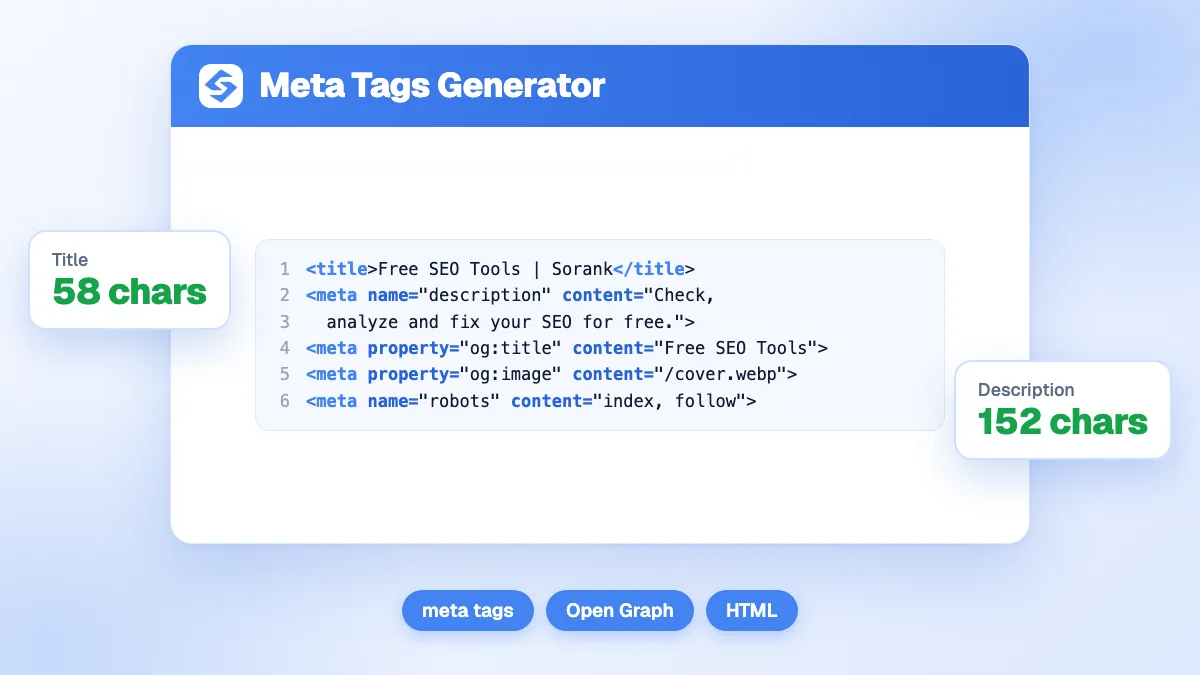
Our glossary entry on the title tag details the technical side, and the free meta tags generator lets you preview a title and description before publishing.
Summarise the page's promise in one or two sentences, include the query's wording, and end with a reason to click. The meta description has no direct ranking weight, but Google may display it as the snippet when it describes the page better than on-page text (Google's snippet guidelines), and matching words appear in bold.
Lead with the benefit the searcher wants, then prove it with specific details, then remove the objections that block the purchase. Product and landing pages often rank on commercial queries ("buy", "best", "price", a model name), so the copy has to satisfy someone ready to buy.
Two classic frameworks keep the copy focused:
For SEO, add three habits. Write a unique description for each product instead of the manufacturer's text that dozens of shops already publish. Answer the questions buyers actually ask (sizes, compatibility, delivery, returns), ideally in a short FAQ. And name the attributes people type in searches: material, dimensions, use case, compatible models.
Use the main keyword in a few strategic spots, then let synonyms, related terms and entities carry the rest. Google's ranking systems understand variants and context, and its spam policies explicitly list keyword stuffing as a manipulative practice; our guide to keyword stuffing shows where the line sits.
| Placement | Main keyword | Why |
|---|---|---|
| Title tag | Yes, near the start | Strongest relevance signal, bold in results |
| H1 | Yes, naturally phrased | Confirms the topic to the reader |
| First 100 words | Yes, once | Sets context immediately |
| URL slug | Yes, short form | Readable and descriptive |
| Subheadings | Variants and questions | Covers related queries |
| Body copy | When it reads naturally | Synonyms and entities do the rest |
| Image alt text | Only if it describes the image | Accessibility first |
The reading test is simple: read the copy aloud. If a sentence sounds like it was written for a robot, rewrite it.
Make headlines specific and outcome focused, and make calls to action describe what the visitor gets rather than what they must do. "Get my free audit" generally says more than "Submit", and "Compare plans" more than "Learn more".
Yes, because ChatGPT, Gemini, Perplexity and Google's AI Overviews pick brands and products from pages that state facts clearly. When someone asks an assistant "which accounting software suits a freelancer", it looks for pages that say plainly who the product is for, what it does and how it compares.
Persuasive copy built on vague superlatives ("the best solution on the market") gives an AI nothing to quote. Copy that states the audience, the main use cases, the differentiators and verifiable details (integrations, guarantees, limits) is much easier to extract. Consistency also matters: the same positioning across your site, listings and reviews helps the AIs describe you correctly.
SEO copywriting means matching the searcher's words in the places that count, then persuading with specific benefits, proof and a clear next step. Titles and meta descriptions win the click, product and landing copy win the conversion, and factual, consistent wording helps the AIs recommend you.
If you want optimised titles, meta descriptions and articles produced and published for you every day, Sorank handles them in autopilot and tracks how the AIs talk about your brand. Compare the plans on the pricing page, with a 3-day free trial.

SEO writing usually refers to informational content such as guides and blog articles built to rank. SEO copywriting focuses on persuasive text that must also rank: page titles, meta descriptions, product and category pages, landing pages and calls to action. The first is judged on traffic, the second on clicks and conversions.
There is no required number. Place the main keyword in the title tag, the H1, the first paragraph and the URL when it fits, then use synonyms and related terms naturally. Google has never published a target density, and repeating a phrase to manipulate rankings is listed as keyword stuffing in its spam policies.
AI tools are useful for drafting variants of titles, meta descriptions and product descriptions quickly. The final copy still needs a person or a well configured process to add real product details, proof, brand voice and a clear offer, and to check every claim, because generic copy rarely earns clicks or trust.
 AI Content Brief Generator
 FAQ Schema GeneratorAI Blog Post Ideas GeneratorStructured Data Validator
 Alt Text Checker
 Internal Link AnalyzerBacklink ChallengeAI Meta Description GeneratorAI Blog Title Generator
 Google Indexability CheckerAI Blog Outline GeneratorUTM Link BuilderKeyword Clustering ToolCanonical Tag Checker
 XML Sitemap GeneratorBroken Link CheckerAI SEO Title GeneratorHeadline AnalyzerSERP Preview ToolRedirect Checker
 Hreflang Tag GeneratorHeading Structure AnalyzerHTTP Headers CheckerFavicon Extractor
 SERP CTR Calculator
 SEO vs Paid Search Savings Calculator
 SEO Share of Voice Calculator
 SEO ROI Calculator
 SEO Traffic and Revenue Forecast Calculator
 SEO Budget Calculator
 SEO Break-Even Calculator
 SaaS SEO ROI Calculator
 ROAS Calculator
 Reading Time Calculator
 Ranking Gain Simulator
 Organic Traffic Value Calculator
 Organic Traffic Estimator
 LTV to CAC Ratio Calculator
 Local SEO ROI Calculator
 Link Building Cost Calculator
 Keyword Value Calculator
 Keyword Opportunity Score Calculator
 Keyword Density Calculator
 GEO ROI Calculator
 GEO Content Investment Calculator
 Ecommerce SEO ROI Calculator
 Customer Lifetime Value Calculator
 Customer Acquisition Cost Calculator
 CTR Calculator
 Cost Per Article Calculator
 Conversion Rate Calculator
 Content Marketing ROI Calculator
 ChatGPT Referral Traffic Estimator
 Bounce Rate Calculator
 Backlink ROI Calculator
 AI Visibility Score Calculator
 AI Traffic Value Calculator
 AI Share of Voice Calculator
 Cost of AI Invisibility Calculator
 AI Citation Rate Calculatorllms.txt ValidatorAI Overview CheckerRobots.txt CheckerAI SEO AuditLLM Readability CheckerSearchGPT Readiness Checker
 Structured Data LLM AuditWebsite Crawlability AI AuditWhy ChatGPT Is Not Recommending My Website
 Gemini Ranking ToolPerplexity Ranking CheckerLLM Citation CheckerAnswer Engine Optimization AuditGEO AuditAI Search Visibility TestChatGPT Visibility Checkerllms.txt Generator
 URL ExtractorWebpage to MarkdownSitemap CheckerSERP Volatility SensorPage Size Checker
 Word Counter
 Slug GeneratorSchema GeneratorRobots Generator
 OG PreviewMeta Tags Generator
 Image CompressorFavicon Generator
 On-Page SEO Audit
 Backlink Analysis Tool
 Keyword Research Tool
 Domain Authority Checker
THEY TRIED SORANK BEFORE YOU
 “I tested Sorank on a real client site and it's insane. It does everything an agency would bill you $1500 a month for. It's going into production on that client now.”

 Guillaume Guersanguersanguillaume.com“We are an Ads agency and we wanted to get our SEO back on track once and for all. Sorank gave us a clear view of our site, helped us prioritize optimizations, and properly structure our content. The tool is easy to use, well designed for a team, and very practical for centralizing tracking without having to juggle multiple platforms. A very solid foundation to start fresh with our SEO.”
 Gaspard MadouiAds Agency
 “I just let the Sorank software do its thing, and now my DR is 25 and my page is ranking higher.”
 Lucas Flandrefoundertrace.fr“I specialized in GEO thanks to Sorank. The GEO Leaderboard allows me to show my clients their position vs competitors on ChatGPT. It’s a real commercial differentiator.”
 MélanieSEO Freelance“Great service, works well for our website and helps us understand how to improve it to rank better on Google and elsewhere. Congrats, keep going, I recommend it.”
 Hugo T.E-commerce merchant























