Preferences
Privacy is important to us, so you have the option of disabling certain types of storage that may not be necessary for the basic functioning of the website. Blocking categories may impact your experience on the website. More information

Privacy is important to us, so you have the option of disabling certain types of storage that may not be necessary for the basic functioning of the website. Blocking categories may impact your experience on the website. More information

Content writing vs copywriting: one informs to earn trust and traffic, the other persuades to convert. Differences, examples, metrics and when you need each.

Tools

In short
content writing informs, copywriting persuades. Content writing produces articles, guides and newsletters that answer a reader's question, earn trust and bring traffic from Google and AI assistants over months. Copywriting produces headlines, landing pages, ads and emails that push one reader toward one action now, and is judged on conversions. Most businesses need both: content to be found and trusted, copy to turn that attention into sales.
Want to go further? Ask
Quick quiz
How should you run your blog?
Sorank matches your answers


Test it for 3 days on your own site and see where you stand on Google, ChatGPT and the other AIs.
Start 3-day free trial3 days free, then stop whenever you want. 90-day results-or-refund guarantee.
The debate on content writing vs copywriting often turns into a fight over job titles, when the useful question is simpler: what should this page make the reader do? Wikipedia defines copywriting as writing persuasive text for advertising or other forms of marketing, aimed at selling products or services. Content writing covers the rest of the written marketing: the pages people read to learn something. This guide compares the two side by side, shows the same topic written both ways, and explains where each one wins on Google and in AI answers.
The core difference is the goal of the text. A content writer succeeds when the reader understands something and comes back. A copywriter succeeds when the reader acts: buys, books a demo, signs up, clicks. Everything else (length, tone, structure, metrics) follows from that goal.
| Criterion | Content writing | Copywriting |
|---|---|---|
| Main goal | Inform, educate, build trust | Persuade, drive one action |
| Reader's stage | Discovery and research | Comparison and decision |
| Typical formats | Blog articles, guides, newsletters, case studies, white papers | Landing pages, ads, sales emails, product pages, headlines, calls to action |
| Length | Long (1,000 to 3,000 words for an article) | Short to medium, every word counts |
| Call to action | Soft, often one link at the end | Central, repeated, impossible to miss |
| Main metrics | Organic traffic, time on page, rankings, AI citations, subscribers | Conversion rate, click-through rate, revenue per visitor |
| Time to results | Months, results compound | Immediate, results stop when traffic stops |
| Lifespan | Years, with updates | Campaign-length, tested and replaced |
| Role in SEO | Brings most organic traffic | Turns organic traffic into customers |
| Key skill | Research, clarity, structure | Psychology, concision, testing |
The table describes the two poles. In real projects many pages sit in between, which is why the same person often does both.
A content writer turns knowledge into pages that answer questions. The work starts before writing: choosing a topic people search for, understanding the search intent behind it, collecting sources and data, then building an outline that answers the question early and goes deeper section by section.
Typical deliverables:
Good content writing is measured by how useful it is. Google's guidance on creating helpful, reliable, people-first content asks whether a page provides original information, research or analysis, and whether it adds substantial value compared with the other results. That is the content writer's brief in one sentence.
A copywriter writes the words that sit at the moment of decision. The job is to understand one reader deeply (their problem, their objections, the words they use) and write the shortest text that moves them to act. Wikipedia credits John Emory Powers (1837-1919) as the world's first full-time copywriter, and the craft has kept the same principle since: one message, one reader, one action.
Typical deliverables:
Copywriters work with proven structures such as AIDA (attention, interest, desire, action) or PAS (problem, agitation, solution), and they test: two headlines, two offers, two buttons. Direct response copywriting pushes this logic furthest, with every line tied to a measurable response.
Watch out
Persuasion has limits. Claims in ads and sales pages must be true and provable (results, prices, comparisons, reviews). A punchy promise you cannot back up costs more in refunds, complaints and lost trust than it earns in clicks.
Take a company selling project management software. Its content writer and its copywriter work on the same subject, for two different moments in the buyer's journey.
The content writer publishes "How to run a weekly team meeting in 30 minutes". The article explains an agenda, a timing per item, the mistakes that make meetings run long, and a template. The product appears once, at the end, as one way to share the agenda. The article ranks for "weekly team meeting agenda", gets read for years and gets quoted when someone asks ChatGPT how to shorten meetings.
The copywriter writes the landing page for the meeting feature. Headline: "Cut your weekly meeting in half." Subheading: one sentence on how agendas, notes and tasks live in one place. Then three benefits, one customer quote, a screenshot and a button: "Start your free trial". The page is judged on one number, the share of visitors who start the trial.
Example
The two pieces work as a pair. The article's closing paragraph links to the landing page, and the landing page links back to the article for readers who need more context before deciding. One brings the visitor, the other converts them.
The border is blurry on several page types, and the most effective writers master both registers:
Two habits apply to both. People skim: in Nielsen Norman Group's research on how users read on the web, 79% of test users always scanned a new page and only 16% read word by word. Clear headings, short paragraphs and bold key phrases help an article as much as a sales page. And both need a consistent brand voice, so that the blog and the checkout page sound like the same company.
A simple way to staff a website is to sort pages by the reader's stage. The table below is the split we recommend for a typical small business or software company.
| Page or asset | Main skill | Success metric |
|---|---|---|
| Blog article (how-to, guide, definition) | Content writing | Organic traffic, AI citations |
| Comparison article ("X vs Y") | Content writing, with copy at the end | Traffic and clicks to product pages |
| Homepage | Copywriting | Clicks to the main call to action |
| Service or product page | SEO copywriting (both) | Rankings and conversion rate |
| Landing page for ads | Copywriting | Conversion rate, cost per lead |
| Pricing page | Copywriting | Trial or purchase starts |
| Newsletter | Content writing | Open rate, clicks, unsubscribes |
| Sales and onboarding emails | Copywriting | Replies, activations, revenue |
Copy gets judged on conversion rate optimization tests, content on the content marketing metrics that track reach and engagement. Mixing the two scorecards is the classic mistake: judging a guide on sales in its first week, or a landing page on time on page.
On Google, content writing carries most of the organic traffic, because people search for answers far more often than for sales pages. Copywriting turns that traffic into revenue on the pages it leads to. Both are now read by AI assistants too, and they play different roles there.
When someone asks ChatGPT, Gemini or Perplexity a question, the assistant looks for pages that answer it clearly, then cites them. Informative articles with a direct answer, definitions, tables and sourced figures are the pages that get quoted. Google's advice on succeeding in its AI experiences (May 2025) says it plainly: focus on unique, non-commodity content that visitors will find helpful and satisfying. Our marketing AI citation study looks at which sources the assistants cite in this sector.
Questions such as "best project management tool for a small team" or "is X worth the price" are decision prompts. Assistants answer them from comparison pages, pricing pages, reviews and product pages, so clear, factual copy (who the product is for, what it costs, how it differs) helps you appear in those answers. Vague slogans give an assistant nothing to quote. AI mention tracking shows which prompts cite your brand and which cite a competitor instead.
Tip
Start every article and every key product page with a two- to four-sentence answer that stands on its own. It serves skimmers, featured snippets and AI assistants at the same time, and it forces you to know what the page is for.
AI makes both kinds of writing faster, which tempts sites to publish hundreds of thin pages. Google's spam policies name this scaled content abuse: many pages generated mainly to manipulate rankings, with little value for users, however they were produced. AI copywriting works when a human sets the angle, the proof and the offer; AI content works when it is researched, sourced and edited.
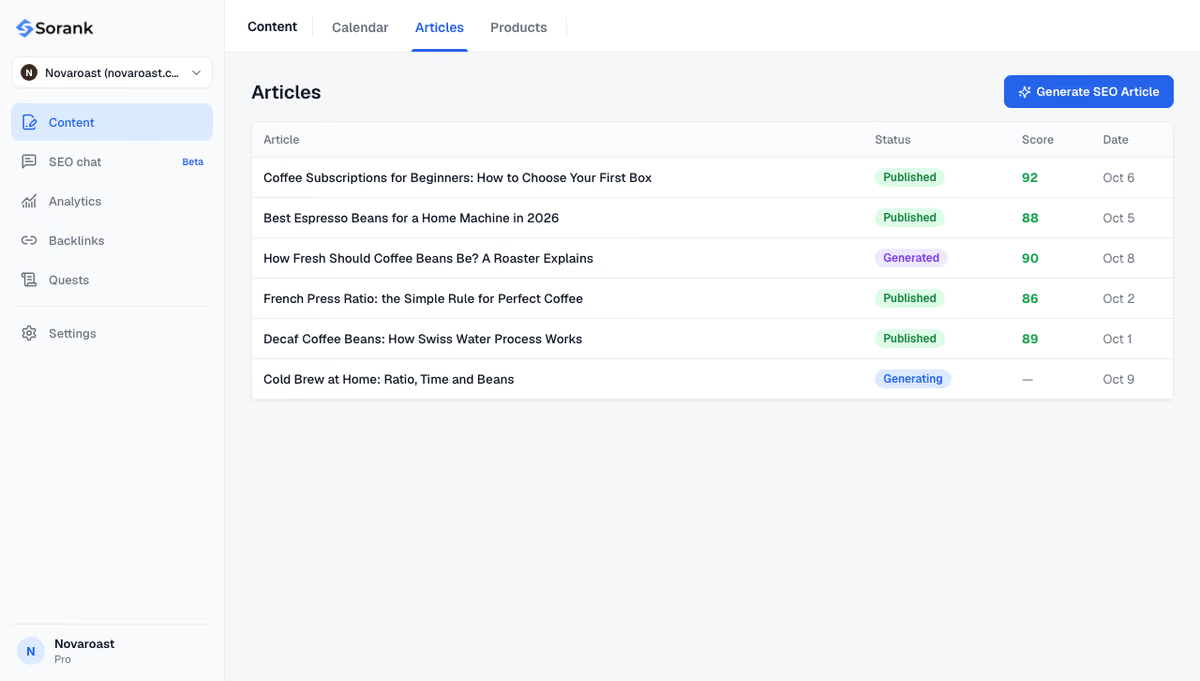
For the content side, Sorank's blog article generator finds the keywords your buyers search, writes sourced articles optimized for Google and AI assistants, and publishes them to your site, with internal links to your product pages.
Content writing brings readers and trust, copywriting turns them into customers, and a website that grows needs both. Write your articles to answer questions better than anyone, write your key pages to make the next step obvious, and link the two so every reader has a path from learning to buying.

Both, depending on the page. SEO articles that answer a question are content writing, while service, product and category pages written to rank and convert are SEO copywriting. The common ground is keyword research and search intent; the difference is whether the page aims to inform or to sell.
Often, because copy is tied directly to revenue and can be measured in sales, which makes it easier to price high. Pay depends far more on niche, results and experience than on the title. A content writer with deep expertise in a technical field can earn as much as a generalist copywriter.
Yes, and in small teams one person usually does. The skills overlap (clear writing, understanding the reader, structure), but the mindset differs, so it helps to write each piece with its goal in mind. Many writers start with content and add copywriting as they learn conversion and testing.
We analyse your competitors, your website and your AI visibility to create a tailored content plan for free.
 AI Content Brief Generator
 FAQ Schema Generator
 AI Blog Post Ideas Generator
 Structured Data Validator (Schema Validator)
 Alt Text Checker
 Internal Link Analyzer
 Backlink Challenge
 AI Meta Description Generator
 AI Blog Title Generator
 Google Indexability Checker
 AI Blog Outline Generator
 UTM Link Builder
 Keyword Clustering Tool
 Canonical Tag Checker
 XML Sitemap Generator
 Broken Link Checker
 AI SEO Title Generator
 Headline Analyzer
 SERP Preview Tool
 Redirect Checker
 Hreflang Tag Generator
 Heading Structure Analyzer
 HTTP Headers Checker
 Favicon Extractor
 SERP CTR Calculator
 SEO vs Paid Search Savings Calculator
 SEO Share of Voice Calculator
 SEO ROI Calculator
 SEO Traffic and Revenue Forecast Calculator
 SEO Budget Calculator
 SEO Break-Even Calculator
 SaaS SEO ROI Calculator
 ROAS Calculator
 Reading Time Calculator
 Ranking Gain Simulator
 Organic Traffic Value Calculator
 Organic Traffic Estimator and Website Traffic Checker
 LTV to CAC Ratio Calculator
 Local SEO ROI Calculator
 Link Building Cost Calculator
 Keyword Value Calculator
 Keyword Opportunity Score Calculator
 Keyword Density Calculator
 GEO ROI Calculator
 GEO Content Investment Calculator
 Ecommerce SEO ROI Calculator
 Customer Lifetime Value Calculator
 Customer Acquisition Cost Calculator
 CTR Calculator
 Cost Per Article Calculator
 Conversion Rate Calculator
 Content Marketing ROI Calculator
 ChatGPT Referral Traffic Estimator
 Bounce Rate Calculator
 Backlink ROI Calculator
 AI Visibility Score Calculator
 AI Traffic Value Calculator
 AI Share of Voice Calculator
 Cost of AI Invisibility Calculator
 AI Citation Rate Calculator
 llms.txt Validator
 AI Overview Checker and AI Overviews Rank Checker
 Robots.txt Checker
 AI SEO Audit
 LLM Readability Checker
 SearchGPT Readiness Checker
 Structured Data LLM Audit
 Website Crawlability AI Audit
 Why ChatGPT Is Not Recommending My Website
 Gemini Ranking Tool
 Perplexity Ranking Checker
 LLM Citation Checker
 Answer Engine Optimization Audit
 GEO Audit
 AI Search Visibility Test
 ChatGPT Visibility Checker
 llms.txt Generator
 URL Extractor
 Webpage to Markdown
 Sitemap Checker
 SERP Volatility Sensor
 Page Size Checker
 Word Counter
 Slug Generator
 Schema Generator
 Robots Generator
 OG Preview
 Meta Tags Generator
 Image Compressor
 Favicon Generator
 On-Page SEO Audit: SEO Checker and SEO Analyzer
 Backlink Analysis Tool
 Keyword Research Tool
 Domain Authority Checker
THEY TRIED SORANK BEFORE YOU
 “I tested Sorank on a real client site and it's insane. It does everything an agency would bill you $1500 a month for. It's going into production on that client now.”

 Guillaume Guersanguersanguillaume.com“We are an Ads agency and we wanted to get our SEO back on track once and for all. Sorank gave us a clear view of our site, helped us prioritize optimizations, and properly structure our content. The tool is easy to use, well designed for a team, and very practical for centralizing tracking without having to juggle multiple platforms. A very solid foundation to start fresh with our SEO.”
 Gaspard MadouiAds Agency
 “I just let the Sorank software do its thing, and now my DR is 25 and my page is ranking higher.”
 Lucas Flandrefoundertrace.fr“I specialized in GEO thanks to Sorank. The GEO Leaderboard allows me to show my clients their position vs competitors on ChatGPT. It’s a real commercial differentiator.”
 MélanieSEO Freelance“Great service, works well for our website and helps us understand how to improve it to rank better on Google and elsewhere. Congrats, keep going, I recommend it.”
 Hugo T.E-commerce merchant