Preferences
Privacy is important to us, so you have the option of disabling certain types of storage that may not be necessary for the basic functioning of the website. Blocking categories may impact your experience on the website. More information
Privacy is important to us, so you have the option of disabling certain types of storage that may not be necessary for the basic functioning of the website. Blocking categories may impact your experience on the website. More information

Real financial copywriting examples from Wise, YNAB, Betterment and more: why they work, reusable templates, FINRA and SEC rules, and a step-by-step method.
In short
Financial copywriting is writing that sells a money product (an account, a card, a loan, an investment, advice) in plain words, with proof and with the risks shown. The best financial copywriting examples, from Wise, YNAB, Betterment, Chime, Mercury and Vanguard, all do three things: name one concrete benefit, prove it with a number, and say the catch out loud.
Want to go further? Ask
Quick quiz
How should you get better texts and prompts?
Our advice for you
Wise: name the hidden cost and make it the enemy is the right solution for you
Number 1 in this ranking, the best match for your answers.
Our advice for you
YNAB: start with the feeling, then prove the outcome is the right solution for you
Number 2 in this ranking, the best match for your answers.
Our advice for you
Betterment: turn the legal status into the selling point is the right solution for you
Number 3 in this ranking, the best match for your answers.
Financial copywriting is any text that persuades someone to act on a money decision: open an account, switch banks, book a call with an adviser, buy insurance, invest. It covers homepages, landing pages, emails, ads, app screens, product pages and blog posts.
It is harder than selling shoes for three reasons. First, the reader is anxious: money is the topic people avoid. Second, the reader often does not understand the product. Third, the text is regulated, so one exaggerated sentence can become a compliance problem.
The gap in knowledge is real and measured. In its April 2025 release, the FINRA Foundation reported that only 27% of US adults answered at least five of its seven financial knowledge questions correctly, and 58% answered the inflation question correctly. If a quarter of your readers can pass a basic quiz, words like "APY", "basis points" or "expense ratio" lose most of the others.
How much the average reader knows about money
Source: FINRA Foundation, National Financial Capability Study 2024, preliminary release of April 2025
Every piece of financial copy has three jobs, in this order:
Generic copywriting advice stops at the first job. In finance, the second and third jobs are what turn a reader into a customer, because the reader is looking for the trap. If you want the general principles first, our guide to direct response copywriting that gets a measurable action covers the mechanics; this article focuses on what changes when the product is money.
The examples below are taken from the live public pages of each brand, read in November 2026. For each one, you get the exact words, why they work, and a template you can reuse. Brands change their copy often, so check the page before you quote it.
Wise's pricing page opens with "Wise is built to save you money", then: "Other providers hide fees in the exchange rate to charge you more. Not Wise." Further down: "We only use the mid-market rate", followed by the fact that it is the rate you can check on Google, and a fee line that starts "From 0.24%".
Why it works:
Reusable template: "Other [providers] hide [cost] in [place]. We don't. You pay [visible fee], and you can check [proof] yourself."
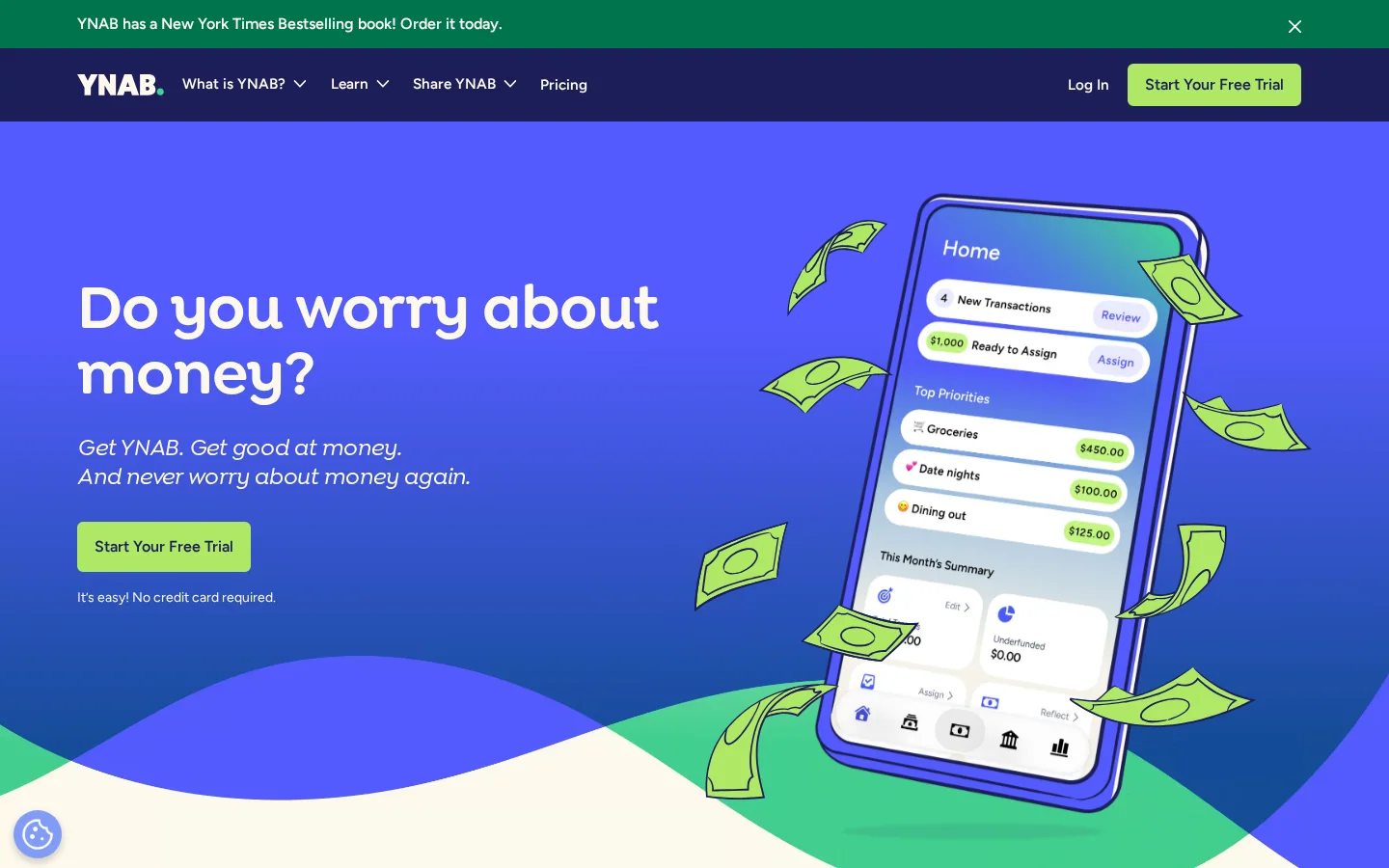
YNAB (You Need A Budget) opens its homepage with a question: "Do you worry about money?" The subheadline answers: "Get YNAB. Get good at money. And never worry about money again." Then comes proof: YNAB states that the average user saves $600 in the first month and $6000 in the first year, and that "92% of YNABers feel less money stress since starting." The call to action reads "Start Your Free 34-Day Trial", with "No credit card required."
Why it works:
Reusable template: "[Question that names the fear]? [Product]. [Short promise in 3 to 6 words]. [Average outcome with a time frame, sourced]. [Risk-free first step]."
Warning
"Never worry about money again" works for a budgeting app. The same sentence for an investment product would be a promissory claim under most rules (see the compliance section). Borrow the structure, not the boldness.
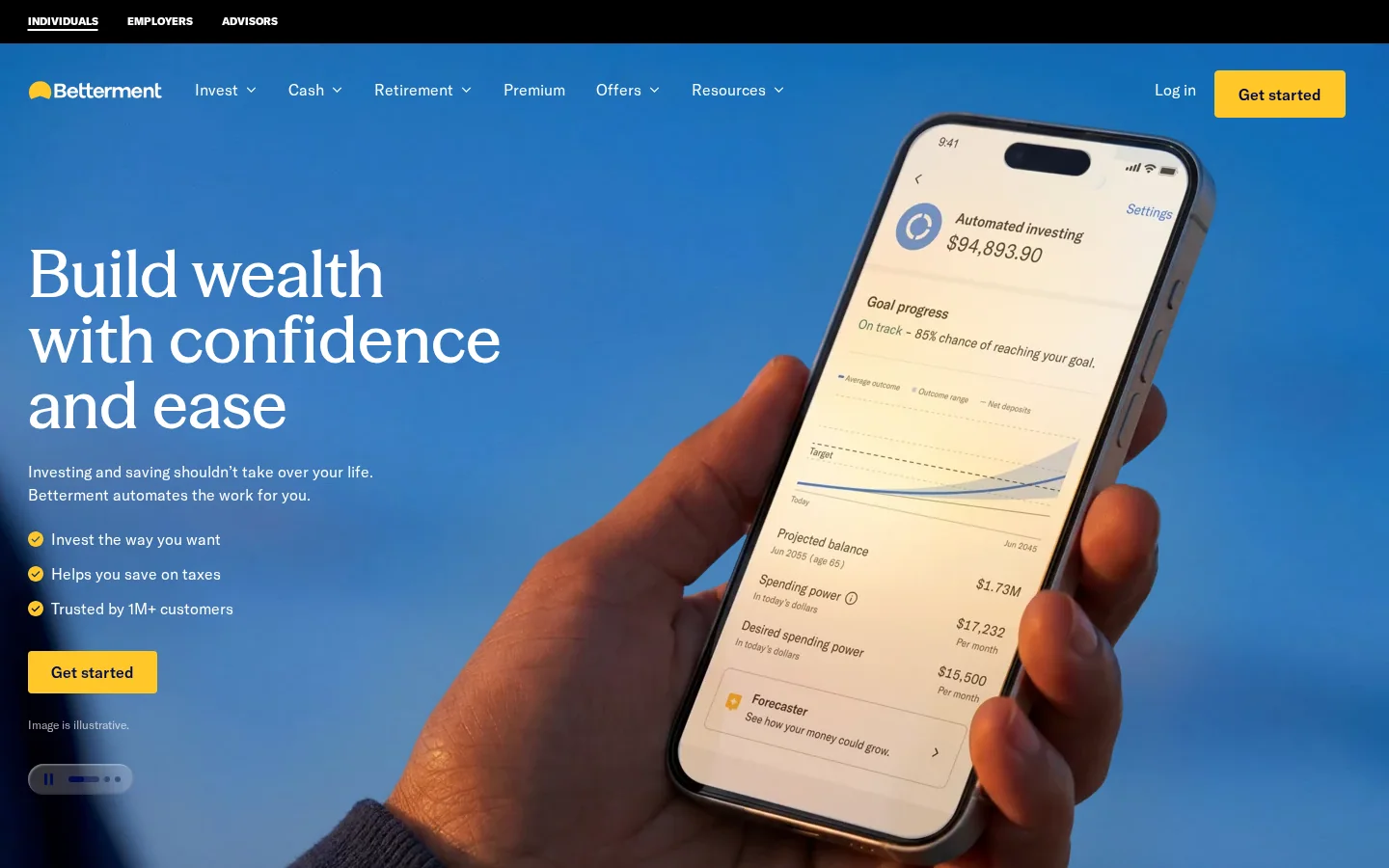
Betterment's headline is "Build wealth with confidence and ease", followed by "Investing and saving shouldn't take over your life. Betterment automates the work for you." The strongest line comes later: "We're a fiduciary." It is explained right after: "Betterment is a registered investment adviser, which means we're legally required to act in your interest." The page also shows "Investing involves risk and there is the potential of losing money when you invest in securities."
Why it works:
Reusable template: "We're [legal status]. That means [plain consequence for you]."
Chime's page says "Fee-free banking plus early pay access", "Overdraft up to $200 fee-free" and "Get your paycheck up to two days early" with direct deposit. Each claim points to a numbered disclosure. At the top of the page: "Chime is a fintech, not a bank. Optional services and products may have fees or charges."
Why it works:
Reusable template: "[Common fee] free, [limit]. [Who actually holds or insures your money, in one line]."
Mercury, a business banking product, opens with "Radically different banking" and "Apply online in 10 minutes". The proof lines are pure numbers: "$0 to send money in USD via wire, ACH, check, and real-time payment" and "Get up to $5M FDIC insurance through our partner banks and their sweep networks". The disclosure is plain: "Mercury is a fintech company, not an FDIC-insured bank."
Why it works:
Reusable template: "[Bold positioning]. [Setup time]. [$0 or exact fee] for [list every option by name]. [Protection, with how it works]."
Vanguard's investor homepage says "Investing for everything it's worth" and "Our purpose is to take a stand for all investors and prioritize our clients' needs." The same page states "All investing is subject to risk, including the possible loss of the money you invest."
Why it works:
| Brand | Product | Main lever | Proof used | How the catch is shown |
|---|---|---|---|---|
| Wise | Money transfer | Expose a hidden cost | Mid-market rate, fee from 0.24% | Fee varies by currency |
| YNAB | Budgeting app | Emotion (worry) | Average savings, survey share | Trial terms stated up front |
| Betterment | Robo-adviser | Legal status | Fiduciary, registered adviser | Full sentence risk warning |
| Chime | Mobile banking | Absence of fees | Caps ("up to $200") | "Not a bank" plus numbered disclosures |
| Mercury | Business banking | Speed and cost | 10 minutes, $0 transfers, $5M cover | "Not an FDIC-insured bank" |
| Vanguard | Investing | Values | Client-first purpose | Plain loss warning |

All the examples above use one of six strategies. Pick one per page; mixing three on the same hero section blurs the message.
Principle: show the reader a cost they pay without knowing it, then show yours. When to use it: transfers, cards, brokerage, any product where competitors earn on spreads or fees. Advantages: educates and persuades at once. Limits: you must be able to prove the comparison, and your own fees must survive scrutiny. Example: Wise.
Principle: open with the feeling (worry, shame, control), then prove the change with an average outcome. When to use it: budgeting, debt, savings, consumer apps. Advantages: high attention, strong memory. Limits: dangerous for investments, where outcome promises are restricted. Example: YNAB.
Principle: use a legal or regulatory status (fiduciary, licensed, insured, regulated by a named authority) as the main trust signal, translated into a benefit. When to use it: advisers, robo-advisers, wealth managers, insurers. Advantages: fully verifiable, hard for unregulated rivals to copy. Limits: feels cold unless translated. Example: Betterment.
Principle: a vertical list of exact figures (time to open, fees, limits, coverage). When to use it: B2B banking, cards, loans, any buyer who compares. Advantages: scannable, comparison-friendly, easy to cite. Limits: every figure must be kept up to date, and each needs its condition. Example: Mercury.
Principle: sell what the reader will no longer suffer: no fees, no minimum, no paperwork. When to use it: challenger banks, switch campaigns. Advantages: instantly understood. Limits: "free" invites the question "how do you make money?", which you must answer. Example: Chime.
Principle: sell a philosophy (long term, low cost, client first) and support it with teaching content. When to use it: asset managers, advisers, pensions. Advantages: builds trust that lasts and ranks well in search. Limits: slow to convert, needs a lot of content. Example: Vanguard.
| Strategy | Best for | Speed to convert | Compliance risk | What you must have |
|---|---|---|---|---|
| Hidden-cost reveal | Transfers, cards, brokerage | Fast | Medium (comparisons) | A provable, cheaper price |
| Emotion then outcome | Budgeting, debt, savings apps | Fast | High for investments | Sourced average outcomes |
| Status as proof | Advisers, insurers | Medium | Low | A real licence or duty |
| Numbers stack | B2B banking, loans | Medium | Medium (conditions) | Current, exact figures |
| Absence of pain | Challenger banks | Fast | Medium ("free" claims) | A clear business model |
| Values and education | Asset managers, pensions | Slow | Low | A content engine |
Performance promise vs proof-based copy
The fastest way to learn is to see a weak line rewritten. The rewrites below are our own illustrations for fictional products (not quotes from any brand); the numbers in them are placeholders you replace with your real, sourced figures.
Before: "Unlock your financial potential with our innovative savings solution." After: "Earn 3.10% on savings you can withdraw any day. No fees, no minimum. Rate variable, last changed on 1 October." The rewrite names the rate, the flexibility and the condition. "Innovative solution" says nothing a reader can check.
Before: "Exciting news about your account!" After: "Your savings rate goes up on 1 December". The reader knows what changed and when. In a regulated context, a vague subject line can also look like phishing, which hurts opening rates and trust.
Before: "Best mortgage rates guaranteed." After: "Fixed for 5 years. See your rate in 2 minutes, no credit check." "Best" and "guaranteed" are the two words compliance teams cut first. The rewrite sells speed and a soft first step. Our guide to writing ad copy platform by platform covers character limits and testing.
Before: "With over 20 years of experience, we provide holistic wealth management solutions." After: "I help doctors near retirement decide when to stop working and how much they can spend each year. I'm paid a flat fee, never a commission." The rewrite names the client, the decision and the conflict of interest (or its absence).
Before: "Submit". After: "See my rate (no impact on my credit score)". A good call to action for a money product says what happens next and removes the main fear in brackets.
Rewriting a savings account hero
Tip
Before you publish a headline for a financial page, run it through our free headline analyzer to check length, clarity and the words that weaken it. Then remove every adjective you cannot prove.
Most regulators ask for the same thing in different words: no misleading claim, benefits balanced with risks, and proof on file. Write with those rules from the first draft and your review cycles get shorter.
For broker-dealers, FINRA Rule 2210 requires communications to be "fair and balanced" and bans any "false, exaggerated, unwarranted, promissory or misleading statement or claim" (paragraph (d)(1)). It also says communications may not predict or project performance (d)(1)(F), and testimonials about investment advice must disclose that they may not be representative and are no guarantee of future success (d)(6).
For registered investment advisers, the SEC Marketing Rule (17 CFR 275.206(4)-1) lists seven general prohibitions. Two matter most to copywriters: you may not discuss potential benefits "without providing fair and balanced treatment of any material risks" (a)(4), and you may not include a material statement of fact you cannot substantiate on demand (a)(2). If you show gross performance, net performance must appear "with at least equal prominence" (d)(1).
In the UK, the FCA requires every financial promotion to be fair, clear and not misleading. On risk warnings, the FCA page on mainstream investments (last updated 18 May 2026) is direct: "We do not prescribe risk wording for mainstream investments", and "just stating 'capital at risk' is often ineffective." In other words, the regulator wants risk explained in words the reader understands, which is a copywriting task, not a legal one.
| Risky word or phrase | Why it is flagged | Safer alternative |
|---|---|---|
| Guaranteed returns | Promissory, rarely true | "Fixed rate of X% for 12 months" |
| Risk-free | Almost no product is | "Protected up to [limit] by [scheme]" |
| Best, #1, leading | Needs a dated, named source | "Rated 4.7 on [platform], [month year]" |
| Beat the market | Projection of performance | "Low-cost funds built for the long term" |
| Free | Hidden fees elsewhere invalidate it | "No monthly fee. Other fees: [link]" |
| Up to X% | Misleading if few people get X | State the condition next to the figure |
Regulators ask for substantiation "upon demand". The simplest way to have it is a claim log: one line per claim, kept with the page. Here is a format you can paste into a spreadsheet or a repository:
claim; page; source; source_date; owner; next_review
"Fee from 0.24%"; /pricing; internal fee schedule v12; 2026-11-01; pricing team; 2027-02-01
"Open in 10 minutes"; /; median onboarding time report Q3; 2026-10-15; product; 2027-01-15
"Rated 4.7 on App Store"; /; App Store listing screenshot; 2026-11-20; marketing; 2026-12-20
Pre-publication compliance checklist
Note
This section is a writing guide, not legal advice. Rules depend on your licence, your product and your country. Your compliance officer has the final word.
Here is the method we recommend, from blank page to approved copy. It works for a landing page, an email or a product page.
The 6-step financial copywriting method
Most weak financial copy is weak because the writer did not have the facts, so they filled the gap with adjectives. Before writing a word, fill in a one-page fact sheet: product name, price and every fee, rates and how often they change, limits, eligibility, protection (deposit insurance, investor compensation scheme), legal status, three customer proofs, and the three objections sales hears most.
Pick one reader, with a real situation. "A nurse who wants to save for a house deposit in 3 years" gives you the vocabulary, the fears and the time frame. "Millennials" gives you nothing. If you sell to several segments, write one landing page per segment rather than one page for everyone.
For a hero section, this structure rarely fails: headline (the benefit in under 10 words), proof line (one number or status), catch line (the condition), call to action (what happens next). For more patterns, see our list of headline formulas with a test method.
AI models write fluent financial copy fast, but they invent numbers and love words like "seamless" and "unlock". Give the model your fact sheet and forbid everything else. A prompt you can adapt:
You are a financial copywriter. Write a landing page hero for the product below.
Rules:
- Use ONLY the facts in the fact sheet. Do not add any number, rate or claim.
- Reader: [one person, one situation, one decision].
- Strategy: [hidden-cost reveal | emotion then outcome | status as proof | numbers stack | absence of pain | values].
- Output: headline (max 10 words), proof line, catch line (condition or risk), call to action.
- Banned words: guaranteed, risk-free, best, unlock, seamless, revolutionary.
- Plain English, sentences under 20 words, write to "you".
Fact sheet:
[paste your fact sheet]
Then check every figure in the output against the fact sheet, line by line. Our guide to writing copy with AI that still sounds like you goes further on prompts and editing.
Plain language is the highest-return skill in financial copywriting: the clearer the text, the more readers believe it. The rules below apply to every format.
| Jargon | Plain version for a consumer page |
|---|---|
| APY | What you earn in a year, interest on interest included |
| Expense ratio | The yearly fee the fund takes, as a share of your money |
| Fiduciary | Legally required to act in your interest |
| Variable rate | The rate can go up or down; we tell you before it changes |
| Diversification | Spreading your money so one bad investment hurts less |
| Capital at risk | You could get back less than you put in |
The FCA's remark that "capital at risk" alone is often ineffective gives you the method: replace the label with what happens to the reader. "Capital at risk" becomes "The value of your investment can fall. You could get back less than you invested." Two short sentences, no jargon, same legal meaning.
Financial pages are judged more strictly by search engines and by AI models, because a wrong answer about money can hurt someone. Your copy must sell and also prove who wrote it and why it is right.
Google treats finance as a YMYL topic ("Your Money or Your Life"), where its quality raters look hard at experience, expertise and trust. In practice, that means named authors with real credentials, a reviewed-by line on advice content, dates on every rate, and links to the official source behind each rule you mention.
Our own study of AI citations in finance found that AI models lean towards regulators, public authorities and established institutions when they answer money questions. To be cited, your pages need the same qualities: precise figures, sources, and answers in the first sentence of each section. Pages written that way are also easier for a reader to trust.
The hard part is not one great landing page. It is keeping the same plain, careful tone across your blog, your product pages and your help center. Sorank's brand voice feature for AI-written articles learns your tone and your words, so the articles it writes and publishes for you stay on brand. Financial firms can also see how Sorank works for their sector on the pages for fintech companies and financial advisors.
SEO and AI checklist for a financial page
Links matter too: in finance, a few relevant links from trusted sites weigh more than many weak ones. Our guide to link building for financial websites within the rules explains which methods are safe.
These are the mistakes we see most often on bank, fintech and adviser websites. For each: what it is, how to spot it, how to fix it.
What it is: "competitive rates", "low fees", "fast approval". How to spot it: highlight every adjective on the page; if it describes a price, a rate or a delay, it is a missing number. How to fix it: replace each one with the figure from your fact sheet and its date.
What it is: the headline promises "4% interest" and the footnote says it only applies to new customers for three months. How to spot it: read only what is visible on the first screen on a phone; is the condition there? How to fix it: move the main condition next to the claim, in the same font size as the proof line. This is also what the "fair and balanced" standards ask for.
What it is: APY, AUM, ETF, basis points, with no explanation. How to spot it: ask someone outside finance to explain your hero section back to you. Every word they skip is jargon. How to fix it: translate on first use (see the table above) or drop the term.
What it is: one page for students, retirees and business owners. How to spot it: the page uses "individuals and businesses" or "whatever your goals". How to fix it: one landing page per segment, with its own headline and proof.
What it is: "grow your wealth faster", "returns you can count on". How to spot it: any sentence about the future value of an investment. How to fix it: sell the process (low cost, automation, fiduciary duty) instead of the result, and keep hypothetical illustrations clearly labelled as such.
What it is: "the best savings app", "#1 for small businesses". How to spot it: search your page for best, #1, leading, top. How to fix it: either cite the ranking, its publisher and its date, or remove the word. Chime's "#1 Choice" claim, for instance, carries a registered mark and sits on a page full of numbered disclosures.
What it is: "Get started" on a form that will run a hard credit check. How to spot it: click your own button and note what surprises you. How to fix it: say what happens and what does not ("See my rate, no impact on my credit score").
What it is: a rate that changed last month, still on a blog post from two years ago. How to spot it: search your site for every rate and fee in your fact sheet. How to fix it: keep figures in one place (a shared fact sheet or a variable in your site) and give each one a review date in the claim log.
Good financial copy is not clever. It is clear, specific and honest about the catch, and the examples above prove that this style sells. Here is your action list for today:
If you write content as well as pages, our guide to SEO copywriting that ranks and converts shows how to apply the same discipline to articles that bring readers from Google and from AI models.
Financial copywriting is writing that persuades people to act on a money decision, such as opening an account, investing or booking an adviser. It must be clear, backed by proof and balanced with the risks, because the reader is cautious and the text is regulated.
A good example names one concrete benefit, proves it with a number or a legal status, and shows the main condition or risk next to the claim. Wise, YNAB and Betterment all follow this pattern on their public pages.
In most cases, no. FINRA Rule 2210 bans promissory claims and performance projections, and the SEC Marketing Rule requires fair and balanced treatment of material risks. Sell the process, the fees or the legal duty instead of the future result.
We analyse your competitors, your website and your AI visibility to create a tailored content plan for free.
 Website Value Calculator
 Website Accessibility Checker
 Google Analytics Checker
 Duplicate Content Checker
 Mobile-Friendly Test
 Website Speed Test
 Subdomain Finder
 Domain Age Checker
 CMS Detector
 Googlebot Simulator
 Nofollow Link Checker
 Meta Tag Checker
 Keyword Cannibalization Checker
 Keyword Intent Checker
 Keyword Extractor
 Google Ads Cost Calculator
 CPC Calculator
 Local Citation Finder
 Reddit Threads Finder
 Disavow File Generator
 Redirect Generator
 Canonical Tag Generator
 Passive Voice Checker
 Google Location Changer
 Google Review Calculator
 Google Review Link Generator
 Keyword Combiner
 Podcast Show Notes Generator
 AI Content Rewriter
 AI Text Humanizer
 ChatGPT Prompt Generator
 Twitter Thread Generator
 Tweet Generator
 Landing Page Copy Generator
 Google Ads Copy Generator
 Pinterest Pin Description Generator
 Anchor Text Generator
 Social Media Post Generator
 LinkedIn Post Generator
 Free AI Writer
 Review Response Generator
 LSI Keyword Generator
 YouTube Video Ideas Generator
 YouTube Tag Generator
 YouTube Description Generator
 Product Description Generator
 CTA Generator
 Blog Introduction Generator
 Conclusion Generator
 Hook Generator
 AI Content Brief Generator
 FAQ Schema Generator
 AI Blog Post Ideas Generator
 Structured Data Validator (Schema Validator)
 Alt Text Checker
 Internal Link Analyzer
 Backlink Challenge
 AI Meta Description Generator
 AI Blog Title Generator
 Google Indexability Checker
 AI Blog Outline Generator
 UTM Link Builder
 Keyword Clustering Tool
 Canonical Tag Checker
 XML Sitemap Generator
 Broken Link Checker
 AI SEO Title Generator
 Headline Analyzer
 SERP Preview Tool
 Redirect Checker
 Hreflang Tag Generator
 Heading Structure Analyzer
 HTTP Headers Checker
 Favicon Extractor
 SERP CTR Calculator
 SEO vs Paid Search Savings Calculator
 SEO Share of Voice Calculator
 SEO ROI Calculator
 SEO Traffic and Revenue Forecast Calculator
 SEO Budget Calculator
 SEO Break-Even Calculator
 SaaS SEO ROI Calculator
 ROAS Calculator
 Reading Time Calculator
 Ranking Gain Simulator
 Organic Traffic Value Calculator
 Organic Traffic Estimator and Website Traffic Checker
 LTV to CAC Ratio Calculator
 Local SEO ROI Calculator
 Link Building Cost Calculator
 Keyword Value Calculator
 Keyword Opportunity Score Calculator
 Keyword Density Calculator
 GEO ROI Calculator
 GEO Content Investment Calculator
 Ecommerce SEO ROI Calculator
 Customer Lifetime Value Calculator
 Customer Acquisition Cost Calculator
 CTR Calculator
 Cost Per Article Calculator
 Conversion Rate Calculator
 Content Marketing ROI Calculator
 ChatGPT Referral Traffic Estimator
 Bounce Rate Calculator
 Backlink ROI Calculator
 AI Visibility Score Calculator
 AI Traffic Value Calculator
 AI Share of Voice Calculator
 Cost of AI Invisibility Calculator
 AI Citation Rate Calculator
 llms.txt Validator
 AI Overview Checker and AI Overviews Rank Checker
 Robots.txt Checker
 AI SEO Audit
 LLM Readability Checker
 SearchGPT Readiness Checker
 Structured Data LLM Audit
 Website Crawlability AI Audit
 Why ChatGPT Is Not Recommending My Website
 Gemini Ranking Tool
 Perplexity Ranking Checker
 LLM Citation Checker
 Answer Engine Optimization Audit
 GEO Audit
 AI Search Visibility Test
 ChatGPT Visibility Checker
 llms.txt Generator
 URL Extractor
 Webpage to Markdown
 Sitemap Checker
 SERP Volatility Sensor
 Page Size Checker
 Word Counter
 Slug Generator
 Schema Generator
 Robots Generator
 OG Preview
 Meta Tags Generator
 Image Compressor
 Favicon Generator
 On-Page SEO Audit: SEO Checker and SEO Analyzer
 Backlink Analysis Tool
 Keyword Research Tool
 Domain Authority Checker
 “I tested Sorank on a real client site and it's insane. It does everything an agency would bill you $1500 a month for. It's going into production on that client now.”

 Guillaume Guersanguersanguillaume.com“We are an Ads agency and we wanted to get our SEO back on track once and for all. Sorank gave us a clear view of our site, helped us prioritize optimizations, and properly structure our content. The tool is easy to use, well designed for a team, and very practical for centralizing tracking without having to juggle multiple platforms. A very solid foundation to start fresh with our SEO.”
 Gaspard MadouiAds Agency
 “I just let the Sorank software do its thing, and now my DR is 25 and my page is ranking higher.”
 Lucas Flandrefoundertrace.fr“I specialized in GEO thanks to Sorank. The GEO Leaderboard allows me to show my clients their position vs competitors on ChatGPT. It’s a real commercial differentiator.”
 MélanieSEO Freelance“Great service, works well for our website and helps us understand how to improve it to rank better on Google and elsewhere. Congrats, keep going, I recommend it.”
 Hugo T.E-commerce merchant