Preferences
Privacy is important to us, so you have the option of disabling certain types of storage that may not be necessary for the basic functioning of the website. Blocking categories may impact your experience on the website. More information
Privacy is important to us, so you have the option of disabling certain types of storage that may not be necessary for the basic functioning of the website. Blocking categories may impact your experience on the website. More information

Learn which link building methods work for financial websites, how to disclose paid links safely, and a five-step plan you can start this week.

In short
Link building for financial websites is the work of earning links from relevant, trustworthy sites while following the disclosure rules that apply to financial promotion. Finance is a "your money or your life" (YMYL) topic for Google, so every link is judged on proof and trust. The methods that work best are original data, useful tools, and expert contributions.
Want to go further? Ask
Quick quiz
How should you get links from other websites?
Sorank matches your answers


Test it for 3 days on your own site and see where you stand on Google, ChatGPT and the other AIs.
Start 3-day free trial3 days free, then stop whenever you want. 90-day results guarantee, conditions apply.
Link building for a financial site is harder for one simple reason: a wrong rate, a hidden fee or an unclear savings tip can cost a reader real money. Editors who review your content, and the search systems that rank it, look for proof before they trust a page. A link from an unknown blog tells them little. A link from a regional business paper, a university course page or a trade association tells them much more.
Google's search quality guidelines ask reviewers to hold "your money or your life" pages to a higher standard for expertise, authoritativeness and trust. Those pages include loans, insurance, investing, banking and taxes. For you, the practical result is that the authority of the linking site matters more than the number of links. Ten links from weak sites rarely help a bank page. One link from a well-known financial publication that cites your data can move a page further.
Editors on those publications also check claims before they link. If your page says "the lowest fees in the market" without a source, the editor will either remove the claim or skip the link. Plan your content so every number has a date, a method and a source. That is the first filter, and it removes most weak links before outreach starts.
A financial link is also a promotion. In the United States, rules on endorsements and advertising apply to what you publish and to what you give the person who promotes you. A payment, a free product or a family or business tie can require a disclosure, even when the link itself looks like editorial content. Section 5 covers the rules in detail. The short version is that you should treat any paid or relationship-based link as a regulated message, not as a simple favor.
A financial site is judged on a higher bar
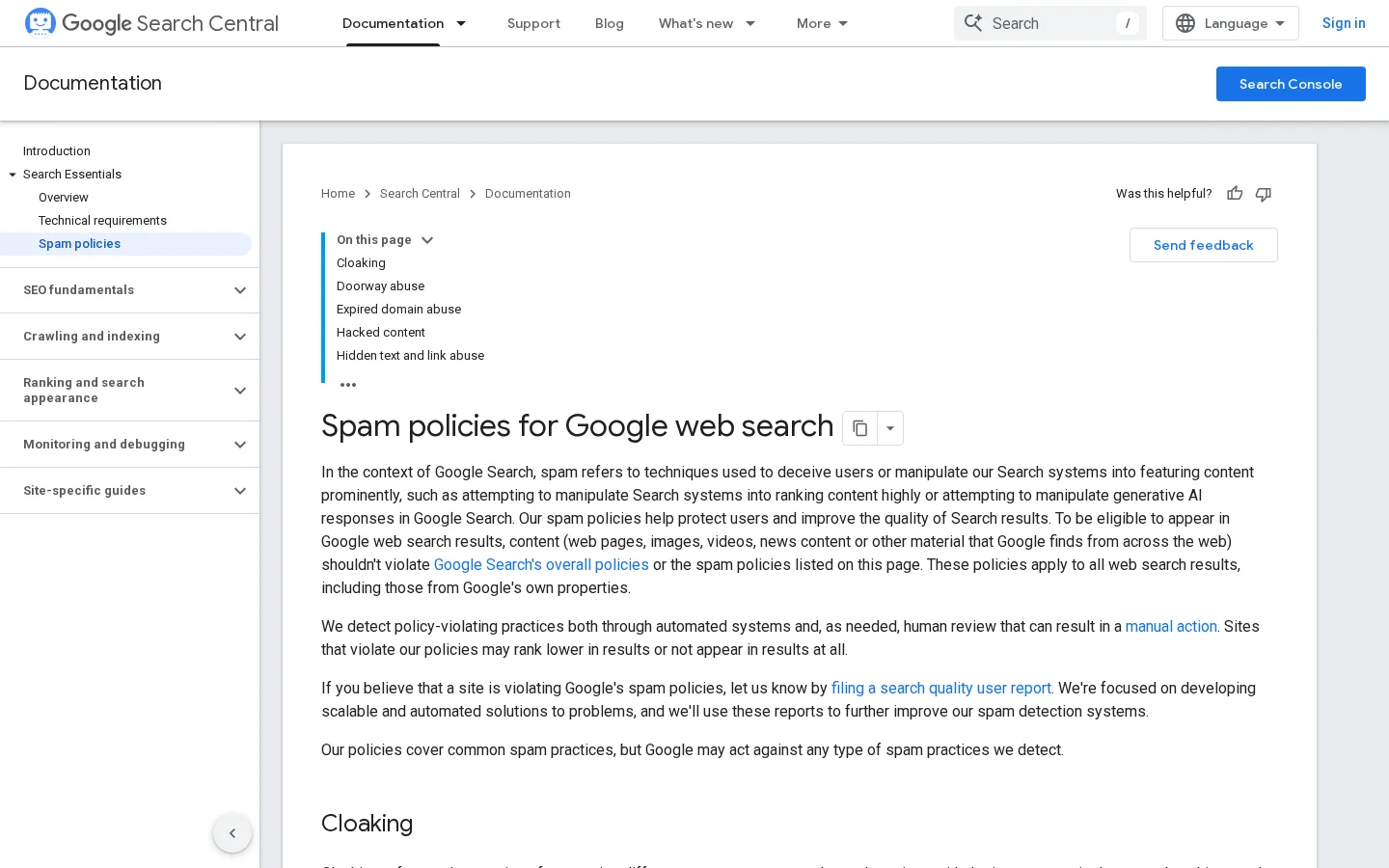
A link helps when a relevant, trusted site points to you for a reason its readers would accept. A link puts you at risk when it exists mainly to move rankings, or when it hides a payment. Google Search Central's spam policies state the test directly: link spam is "the practice of creating links to or from a site primarily for the purpose of manipulating search rankings." Ask who benefits from the link, and whether a reader would click it if search engines did not exist.
A natural link profile for a financial site is uneven. It has links from news sites that cite your data, from local institutions that list your branch or your service, from forums or Q&A threads where experts mention your calculator, and from partners that show your product in their own resources. The anchor texts vary too. Some are your brand name, some are a plain URL, and some are a descriptive phrase. If every link uses the phrase "best mortgage rates", you have built a pattern that a reviewer will notice.
Four patterns cause most of the trouble. The first is a paid link with no label. The second is a link exchange between sites that exist only to cross-link. The third is directory or footer links bought in bulk. The fourth is a sponsored article that uses a keyword anchor and passes ranking credit. Google lists each of these as link spam in its spam policies. A bank or a broker faces one more risk: a sponsored article can also make a product claim, and that claim needs its own review before it goes live.
The table below puts the two types of link side by side. Use it as a quick test before you accept any placement.
Earned link or bought link: the same placement, two different signals

Eight methods work for financial sites, and they do not all suit every business. Original data, calculators and expert contributions earn the most durable editorial links. Unlinked mentions and resource pages are faster but depend on other people's pages. Sponsored placements can work, but only when they are labeled and reviewed. Each method below has a principle, a use case, its advantages and its limits, with one example.
The principle is simple: you collect a dataset that nobody else has and publish the findings with the method. For a financial site, this might be a survey of savings rates across regional banks, an analysis of how fee disclosures are worded, or a study of how long mortgage approvals take in your region. Journalists and bloggers link to the source of a number, so the data page becomes the link target.
Use this method when you have data that is real, dated and explained. The advantage is that the links are editorial and often last for years. The limit is that it takes weeks to build, and a weak method will be picked apart in the comments. Example: a credit union publishes a quarterly table of average car loan rates in its state, with the method, the sample size and the source of each figure on the page.
A calculator or a checker answers one money question, such as how much a debt payoff plan costs in interest over five years. Tools earn links because people reuse them and cite them in their own articles. Your team has to explain the formula, show it on the page and keep it correct after rate changes.
The advantage is that one good tool can attract links for years while it also helps readers. The limit is that a calculator with a wrong formula or outdated rates attracts complaints rather than links. Example: a loan comparison tool that shows the total cost of a loan over its term, with the formula written under the tool and a visible last-updated date. If you build one, our guide to linkable assets covers the seven asset types that earn links.
A guest contribution is a signed article for a publication that already reaches your audience, with a specific angle. Finance publications accept contributions when the author is qualified and the article carries sources. Use this method when a named expert on your team has a point that the publication's readers need, such as a new reporting rule or a common fraud pattern.
The advantage is that the link comes from a trusted editorial site. The limit is that many outlets sell guest slots or ask for a link in the author bio, which turns the placement into a paid one. Read the editorial policy before you pitch, and check whether the outlet labels paid content. Our guest posting guide explains how to judge the value of a placement.
Here you answer reporters' questions with a quoted opinion, and the outlet links to your name or your company in the story. This works when your team covers a topic that reporters need: rate changes, fraud warnings, pension rules or payment regulation. The links come with context, because the reporter explains why your comment matters.
The limit is that links are not guaranteed, and many outlets name the source without linking to it. Example: a fintech compliance lead gives a quote on a new payments rule, and the article links to the company's explainer page on the same rule. Keep a record of each quote and each link, so you can measure which topics bring results.
You find pages that already mention your bank, fund or product without linking to it, and you ask the author to add the link. The request is easy to accept, because the page already exists and already talks about you. Use this method when your brand has appeared in the news, in forums or in reviews.
The limit is that many mentions sit on pages that cannot be edited, and some authors refuse a link request on principle. Keep your request short, polite and specific. The unlinked brand mentions guide walks through the search method and the follow-up sequence.
A resource page lists useful tools or sources, such as a list of budgeting apps maintained by a university. You can suggest your page as an addition, or you can find a dead link on the page and offer your replacement. Use this when a page in your field is linked from many places and has at least one dead link.
The advantage is that the link fits the purpose of the page. The limit is that the work is slow, and many resource pages only accept sites that have existed for years. Keep the offer specific: name the broken URL, name the replacement, and explain in one sentence why the replacement helps the readers of that page.
You pay a publisher for an article or a placement, and the publisher labels it as sponsored. Use this method when the publisher's audience matches your customers and your compliance team has reviewed the content. The advantage is control: you choose the timing, the message and the page the reader lands on.
The limit is that paid placements carry both a disclosure duty and a ranking limit. Google's spam policies say it is "not a violation of our policies to have such links as long as they are qualified", which means marked with the right attribute. Qualified paid links are not meant to pass ranking credit, so the gain is mostly referral traffic and visibility. Section 5 covers the disclosure side, and section 6 covers the attributes.
You become a member, sponsor, speaker or partner of a body that already has a member directory or a partner page. Use this when the membership is real and you contribute to the organization beyond the link. The advantage is a stable link from a site with real authority in its field.
The limit is that a membership bought only for a link is a pattern that Google's spam examples describe, and paid directories that look like memberships are no better. Keep only the memberships that have a reason beyond the link, such as a training program your staff teaches or a research panel your analysts join.
The table compares all eight methods on the same criteria.
| Method | Principle | Use it when | Main advantage | Main limit |
|---|---|---|---|---|
| Original data and studies | Publish a dataset others cite | Your data is real, dated and documented | Editorial links that can last for years | Weeks of work, and weak methods get exposed |
| Calculators and free tools | Answer one money question with a working tool | Your team can maintain the formula and the rates | One tool can earn links for years | A wrong formula attracts complaints, not links |
| Guest contributions | Signed article for a relevant publication | A named expert has a specific point to make | Link from a trusted editorial site | Many outlets sell slots, which makes them paid |
| Expert commentary | Quoted opinion for reporters | Your team covers a topic reporters need | Links come with context | Many outlets name the source without linking |
| Unlinked brand mentions | Ask an author to link an existing mention | Your brand is already in the news or in reviews | The page already exists | Some pages cannot be edited |
| Resource pages and broken links | Suggest your page or a replacement for a dead link | The page is established and has a dead link | The link fits the page's purpose | Slow, and many lists only accept old sites |
| Sponsored placements | Pay for a labeled article | The audience fits and compliance has reviewed it | Control of timing and message | Mostly referral traffic, with disclosure duties |
| Associations and institutions | Real membership, sponsorship or partnership | You contribute to the body beyond the link | Stable link from an authoritative site | Memberships bought only for a link are a spam pattern |
Run the work in five steps: audit the links you have, build one asset worth linking to, qualify your targets, pitch with a specific reason, and record and repeat. Expect the first earned links to take weeks, not days, because editors publish on their own schedule. Do one step at a time, and do not skip the audit, because it tells you which patterns to avoid.
Five steps for a financial site
Start with the links you already earned, because they show what editors accept. Export your referring domains, sort them by topic fit, and mark the ones that are off topic or that came from link lists. The step is covered in detail in our backlink audit guide. Then search for mentions of your brand that have no link. Google's search operators do most of the work:
"Your Bank Name" -site:yourbank.com
"Your Bank Name" "savings" -site:yourbank.com
"Your Bank Name" "reviews" -site:yourbank.com
The first line finds every page that mentions your brand outside your own site. The next two narrow the results to pages on a topic you care about. Put each page in a sheet with its date and whether it already links to you.
Tip
Run the pages you already have through our free backlink checker before you build the target list. It helps you see the links that already point to your domain.
Pick one asset and finish it before you start outreach. An asset that is accurate, dated and explained earns links without much help. A half-finished calculator or a study with no method section does not. Write the method on the page: where the data came from, the period covered, the sample size and any limits. Editors trust a page that tells them what it cannot show.
Score each site before you contact it. Check topic fit, whether the site's readers match your customers, and whether the site labels paid content. Look at its outbound links too. A site that links to many casino or crypto pages from a finance article has a quality problem, and linking to you from that page does not help. Put a simple score from 1 to 5 on each criterion, and only pitch sites that score well on topic fit and disclosure.
A pitch works when it names one thing: a page, a fact or a tool, and the reason it helps this site's readers. Avoid generic praise and avoid a request for a link without a reason. Our email outreach guide includes the sending rules and the templates that match this approach. For a financial site, add one line about your review process, so the editor knows the content has been checked.
Log each earned link with its date, its anchor, its rel value and the page it sits on. Review the list once a month, and look for the patterns that work: which asset, which type of site and which kind of pitch brought the link. Drop the patterns that bring nothing or that bring risky placements. This log is also the evidence you need if a regulator or a partner asks how a placement was approved.
Two frameworks matter most for a US audience: the SEC marketing rule for registered investment advisers, and the FTC Endorsement Guides, which apply to endorsements in general. Both treat a material connection as something a reader must be able to see. If you work outside the US, the details differ, so check with your compliance team before you publish a sponsored link in any market.
If your site promotes an investment adviser, the SEC's marketing rule applies to that adviser's advertisements. The SEC's small business compliance guide on investment adviser marketing, dated April 28, 2021, lists the key dates: the Commission adopted the amendments on December 22, 2020, the rule took effect on May 4, 2021, and advisers had to comply by November 4, 2022. The rule permits testimonials and endorsements when the adviser meets disclosure, oversight and disqualification conditions.
The guide also says an adviser must have a written agreement with promoters, with one exception: the agreement is not needed when the promoter's compensation is de minimis. The guide does not mention links specifically, so treat any paid placement that promotes an adviser as an endorsement and follow the same conditions.
Key dates of the SEC marketing rule
Source: SEC, Investment Adviser Marketing small business compliance guide, April 28, 2021
Promoter payments under the SEC rule
Source: SEC, Investment Adviser Marketing small business compliance guide, April 28, 2021
The FTC Endorsement Guides, in 16 CFR Part 255, set the rule for endorsements in advertising. Section 255.5 says that when a connection between the endorser and the seller "might materially affect the weight or credibility of the endorsement" and the audience does not expect it, "such connection must be disclosed clearly and conspicuously." Material connections include payments, free or discounted products, and family or business relationships. The same section lists affiliate links among its examples, so an affiliate link in a finance article can require a disclosure too.
The rule does not ask for every detail. A disclosure needs to give enough information for a reader to judge how much the connection matters. A connection that is too small to affect credibility does not need a disclosure. In practice, a short, plain sentence near the link does the job better than a footer note.
Write the disclosure in plain words, close to the link, and in the same language as the article. Say who paid, and say what the payment covers. Do not hide the disclosure in a footer, a tooltip or a link to a separate page. Keep the wording stable across all your placements, so compliance can review it once.
Example
"This article was commissioned by Example Bank, which paid for this placement. The rates and fees in the table come from the bank's published schedule as of the date at the top of the page."
Warning
A disclosure does not fix a claim that is wrong or unsupported. If a sponsored article says "the lowest rate in the market", the disclosure makes the problem visible, but it does not make the claim true. Remove the claim, or source it with a date and a method.
Mark paid links with rel="sponsored", user-generated links with rel="ugc", and use rel="nofollow" only when neither of the other values applies. Write anchors that describe the destination, and vary them across your placements. The markup and the wording are the two parts of a link that you control after the placement is agreed.
Google Search Central's documentation on qualifying outbound links describes the three values. It says to mark "links that are advertisements or paid placements (commonly called paid links)" with the sponsored value. It recommends the ugc value for user-generated content such as comments and forum posts. It says to use nofollow "when other values don't apply, and you'd rather Google not associate your site with" the target. The three examples below show the markup:
<a href="https://example.com/study" rel="sponsored">sponsored study</a>
<a href="https://example.com/forum/thread-42" rel="ugc">forum thread</a>
<a href="https://example.com/resources" rel="nofollow">resource page</a>
Check the markup on every page where your link appears, not only in the draft. Editors sometimes change the HTML when they publish, and a sponsored link that loses its attribute is a problem you need to find quickly. Ask them to keep the attribute in the agreement.
An anchor is the visible text of a link. The most common mistake on financial sites is an anchor that repeats the same commercial phrase on every placement. A reviewer sees the pattern at once. Read more about the concept in our anchor text glossary entry, and about how to audit the spread in the anchor text optimization guide.
Anchor text on a guest article for a savings account
The spread matters more than any single anchor. Keep a note of the anchors you have used, and use a different descriptive phrase for each placement. A brand name, a plain URL and a descriptive phrase should all appear in the mix. The term nofollow is worth understanding too, because it is one of the three values in the markup above.
The costly mistakes are buying links that look editorial, writing a keyword anchor for every link, publishing claims with no source, and skipping the compliance review. Each one has a way to spot it and a fix. Check your work against these six before you publish a new placement.
This is a paid article or a paid link that carries no sponsored label and no disclosure. You spot it by asking whether a reader can tell the link was paid. If the answer is no, the placement is a problem. Fix it by asking the publisher to add the sponsored attribute and a visible disclosure, or by dropping the placement. Do not accept a deal that forbids either one.
Link exchanges happen when two sites agree to link to each other for ranking reasons, often through a shared "partners" page. You spot them by looking at the page that holds the link: if it exists only to list other sites, the link is an exchange. Fix it by removing the exchange and replacing it with a link that the partner would add for its readers. Our backlink exchange guide explains why Google calls this a scheme and what to do instead.
This is the repeated commercial phrase. You spot it with the anchor report from your audit. Fix it by rewriting the anchor for future placements and by asking partners to use a descriptive or branded phrase when they update the link. Do not try to change anchors on pages you do not control.
A financial page that promises a rate, a return or a saving without a date, a method or a source invites both regulatory risk and editorial rejection. You spot it by reading the page as a compliance officer would. Fix it by adding the source, the date and the method, or by removing the claim. A sentence that says "as of the date shown in the table" is more useful to a reader than a bold figure.
Your brand is mentioned on pages that never link to you, and no one asks for the link. You spot these with the search operators in step 1. Fix it by sending a short request to the author. Our method for turning mentions into links covers the request and the follow-up.
A template pitch that could be sent to any finance site gets no reply. You spot it by reading your last ten pitches side by side. If the only difference is the name, the pitch is a template. Fix it by naming one page, one fact or one tool, and by saying why it helps the site's readers. A pitch that is shorter and more specific gets more answers.
Before you publish a financial link
Measure three things: the quality of the referring domains, the rankings and traffic of the pages that earned links, and whether AI assistants cite your pages. Count the links you lost as well as the ones you gained. A link that disappears tells you as much as a link that appears, because it can reveal a page that changed or a partner that stopped updating.
| Metric | What it tells you | How to check it |
|---|---|---|
| Topic fit of referring domains | Whether the links come from sites your readers trust | Review the domain list in your monthly log |
| Lost links | Pages that changed, moved or stopped linking | Compare the monthly list with the previous one |
| Rankings of linked pages | Whether the earned links support the target page | Track the target keywords in your rank tracker |
| Organic traffic to linked pages | Whether the links bring readers who stay | Compare sessions and engagement before and after the link |
| AI citations of the page | Whether assistants name or cite the page | Test the key questions in the assistants you use |
| Cost per earned link | Whether the method is worth its time | Divide the total cost by the links kept after 90 days |
Look at the domains that link to you once a month. Ask whether each one would still be a good link if you had to explain it to a regulator. Then check the links that disappeared. A lost link from a strong site may mean the editor updated the article, and a short note can bring it back. A pattern of lost links from the same partner is a warning sign about that partner's quality.
Measure the page that earned the link, not only your domain. A new study might lift the page it supports, while the homepage barely moves. Compare the target keywords and the sessions to that page before and after the link, and allow a full quarter before you judge the result, because search systems take time to reassess a page.
Editorial links can help a page become a source that AI assistants find and cite, but that is a hypothesis to test, not a promise. Test the questions your customers ask, in the assistants they use, and record whether your page is named or cited. Repeat the test each month with the same questions, so the results are comparable.
Divide the total cost of a method by the links you kept after 90 days. Include the time of your team, not only the invoices. A calculator can help you build the number, and our link building cost calculator is a starting point. For the return side, the backlink ROI calculator helps you estimate what a link brings in traffic or leads.
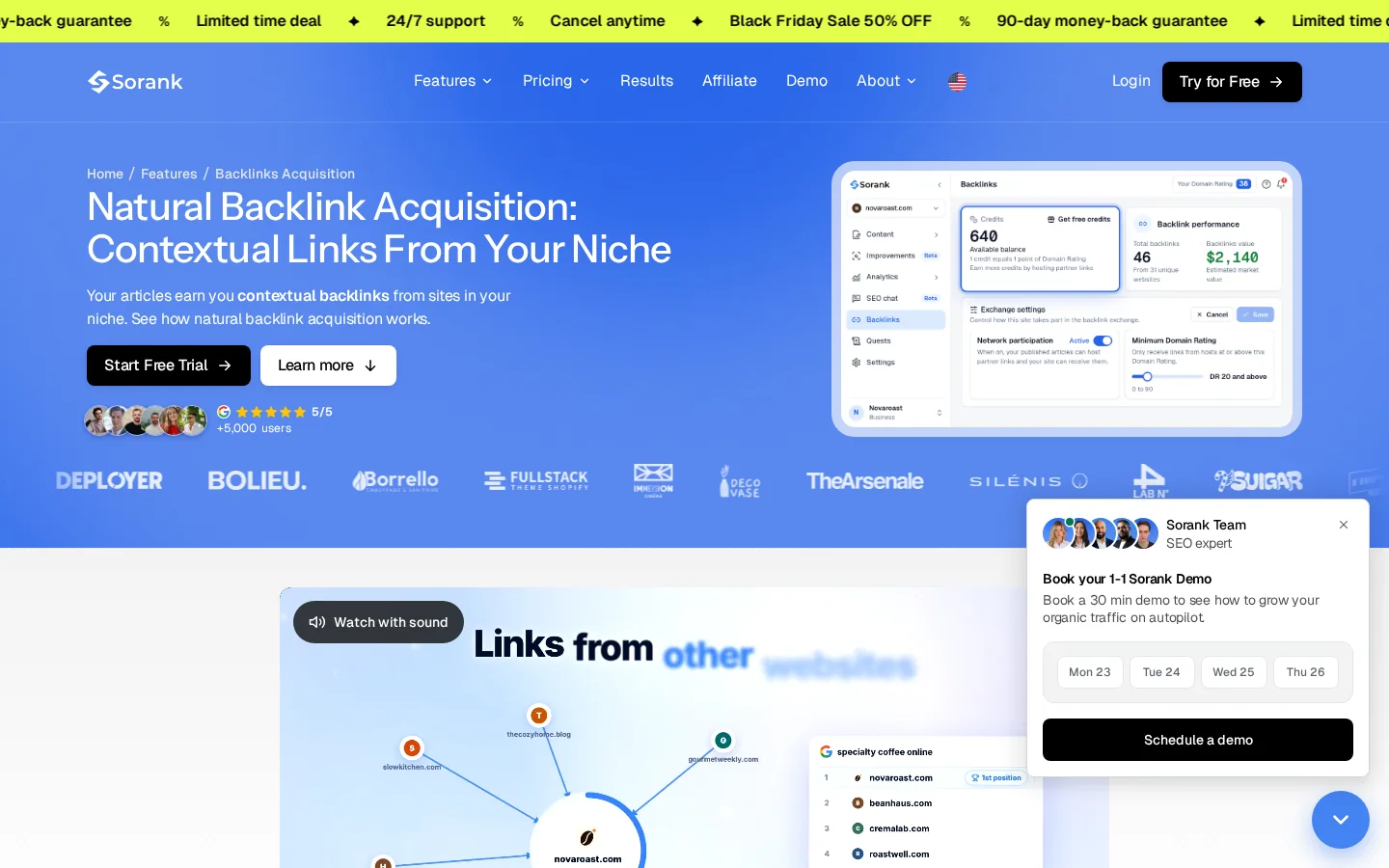
Start with the audit and one asset, because no tool can replace a page that is accurate and useful. Sorank has a feature for natural backlink acquisition. It matches your site with other member sites in your niche, and each partner link is placed in an article, in context. The links are one-way: you earn credits by hosting a partner link on your site, and you spend them to receive one. The dashboard lists each link with its source page, anchor text and Domain Rating, and you can set a minimum Domain Rating, refuse links in your articles and set a daily spending cap.
A credit network like this is still a pattern to check against section 2, not an automatic pass. Ask whether each link would exist without the credit system, and whether the editorial context is real. For a financial site, the partner links you host are also your publications, so they need to meet the disclosure rules in section 5. Review the placements with your compliance team before you accept them, and keep the same test you use for every other link.
If your business is a bank, a fintech or an advisory firm, see how our approach applies to your sector on the SEO software for fintech page. The same rules apply across the sector, but the claims you can make differ, so your compliance team should set the limits first.
This week, do three things. Export your referring domains and your unlinked mentions. Pick one asset that you can finish in a month. Write the disclosure wording your compliance team will approve. With those in place, every link you earn after that will be easier to defend.
Buying links that pass ranking credit breaks Google's spam policies, so a bank or fintech can lose rankings or face a manual action. Paid placements are allowed when they are marked as sponsored, and the disclosure must follow the rules that apply to the business.
In most cases yes, when a reader would not expect the payment or relationship. The FTC Endorsement Guides in 16 CFR 255.5 require clear and conspicuous disclosure of material connections, and SEC marketing rules apply if you promote an investment adviser.
Expect months rather than weeks, because editors publish on their own schedule and search systems take time to reassess a page. Track referring domains and rankings every month, and judge the results over a full quarter.
We analyse your competitors, your website and your AI visibility to create a tailored content plan for free.
 AI Content Brief Generator
 FAQ Schema Generator
 AI Blog Post Ideas Generator
 Structured Data Validator (Schema Validator)
 Alt Text Checker
 Internal Link Analyzer
 Backlink Challenge
 AI Meta Description Generator
 AI Blog Title Generator
 Google Indexability Checker
 AI Blog Outline Generator
 UTM Link Builder
 Keyword Clustering Tool
 Canonical Tag Checker
 XML Sitemap Generator
 Broken Link Checker
 AI SEO Title Generator
 Headline Analyzer
 SERP Preview Tool
 Redirect Checker
 Hreflang Tag Generator
 Heading Structure Analyzer
 HTTP Headers Checker
 Favicon Extractor
 SERP CTR Calculator
 SEO vs Paid Search Savings Calculator
 SEO Share of Voice Calculator
 SEO ROI Calculator
 SEO Traffic and Revenue Forecast Calculator
 SEO Budget Calculator
 SEO Break-Even Calculator
 SaaS SEO ROI Calculator
 ROAS Calculator
 Reading Time Calculator
 Ranking Gain Simulator
 Organic Traffic Value Calculator
 Organic Traffic Estimator and Website Traffic Checker
 LTV to CAC Ratio Calculator
 Local SEO ROI Calculator
 Link Building Cost Calculator
 Keyword Value Calculator
 Keyword Opportunity Score Calculator
 Keyword Density Calculator
 GEO ROI Calculator
 GEO Content Investment Calculator
 Ecommerce SEO ROI Calculator
 Customer Lifetime Value Calculator
 Customer Acquisition Cost Calculator
 CTR Calculator
 Cost Per Article Calculator
 Conversion Rate Calculator
 Content Marketing ROI Calculator
 ChatGPT Referral Traffic Estimator
 Bounce Rate Calculator
 Backlink ROI Calculator
 AI Visibility Score Calculator
 AI Traffic Value Calculator
 AI Share of Voice Calculator
 Cost of AI Invisibility Calculator
 AI Citation Rate Calculator
 llms.txt Validator
 AI Overview Checker and AI Overviews Rank Checker
 Robots.txt Checker
 AI SEO Audit
 LLM Readability Checker
 SearchGPT Readiness Checker
 Structured Data LLM Audit
 Website Crawlability AI Audit
 Why ChatGPT Is Not Recommending My Website
 Gemini Ranking Tool
 Perplexity Ranking Checker
 LLM Citation Checker
 Answer Engine Optimization Audit
 GEO Audit
 AI Search Visibility Test
 ChatGPT Visibility Checker
 llms.txt Generator
 URL Extractor
 Webpage to Markdown
 Sitemap Checker
 SERP Volatility Sensor
 Page Size Checker
 Word Counter
 Slug Generator
 Schema Generator
 Robots Generator
 OG Preview
 Meta Tags Generator
 Image Compressor
 Favicon Generator
 On-Page SEO Audit: SEO Checker and SEO Analyzer
 Backlink Analysis Tool
 Keyword Research Tool
 Domain Authority Checker
 “I tested Sorank on a real client site and it's insane. It does everything an agency would bill you $1500 a month for. It's going into production on that client now.”

 Guillaume Guersanguersanguillaume.com“We are an Ads agency and we wanted to get our SEO back on track once and for all. Sorank gave us a clear view of our site, helped us prioritize optimizations, and properly structure our content. The tool is easy to use, well designed for a team, and very practical for centralizing tracking without having to juggle multiple platforms. A very solid foundation to start fresh with our SEO.”
 Gaspard MadouiAds Agency
 “I just let the Sorank software do its thing, and now my DR is 25 and my page is ranking higher.”
 Lucas Flandrefoundertrace.fr“I specialized in GEO thanks to Sorank. The GEO Leaderboard allows me to show my clients their position vs competitors on ChatGPT. It’s a real commercial differentiator.”
 MélanieSEO Freelance“Great service, works well for our website and helps us understand how to improve it to rank better on Google and elsewhere. Congrats, keep going, I recommend it.”
 Hugo T.E-commerce merchant