Preferences
Privacy is important to us, so you have the option of disabling certain types of storage that may not be necessary for the basic functioning of the website. Blocking categories may impact your experience on the website. More information

Privacy is important to us, so you have the option of disabling certain types of storage that may not be necessary for the basic functioning of the website. Blocking categories may impact your experience on the website. More information

Broken link building in 2026: find dead links on relevant sites, rebuild the missing page and pitch it as a replacement. 8 steps and 3 email templates.

Tools

In short
broken link building means finding links on other websites that point to pages that no longer exist (404 errors), then offering the site owner a working page of yours as the replacement. It works because you fix a real problem for the editor instead of asking for a favor. The method has four parts: find dead pages that still have backlinks, check the linking sites, create or adapt a page that covers the same need, and send a short, specific email.
Want to go further? Ask
Quick quiz
How should you get links from other websites?
Sorank matches your answers


Test it for 3 days on your own site and see where you stand on Google, ChatGPT and the other AIs.
Start 3-day free trial3 days free, then stop whenever you want. 90-day results-or-refund guarantee.
The web loses pages at a steady pace. A Pew Research Center study published in May 2024 found that 38% of webpages that existed in 2013 were no longer accessible ten years later, and that 23% of news pages contain at least one broken link. Every one of those dead links is a gap an editor would rather close. Broken link building turns that gap into a link building opportunity: this guide gives the full method in eight steps, a table of the best sources of dead links, three email templates and the mistakes that get pitches ignored.
Broken link building is a white hat link acquisition tactic. You look for outbound links on relevant pages (articles, guides, resource lists) that lead to an error page, usually a 404 or 410, or to a domain that has expired. You then tell the page owner which link is dead and suggest a live page on your site that serves the same purpose. If the editor agrees, they swap the URL and you earn an editorial backlink.
The tactic has two sides. The outbound side covers dead links on other people's pages, whatever site they used to point to. The inbound side, often called link reclamation, covers links that point to pages on your own site that you deleted or moved: you recover them with a redirect instead of an email. A complete campaign starts with the second side because it costs almost nothing, then moves to the first.
Note
Broken link building is close to the unlinked brand mentions method: in both cases you contact a page that already talks about your topic and ask for a fix that improves it for its readers.
Three facts keep the tactic effective, even though it has been known for more than a decade.
Its limits are real too: popular dead pages are known to many link builders, editors of large sites receive several pitches for the same link, and some pages are no longer maintained at all. Volume and precision matter more than with other tactics.
Export the backlinks of your site from Google Search Console (Links report) or from a backlink analysis tool and check the status code of each target URL. Every link that points to a deleted or renamed page on your site should be fixed with a 301 redirect to the closest live page. This is the fastest win of the whole method: no email, no negotiation. A regular backlink audit catches these cases before they pile up.
List the sites that rank on your topics and look at their pages that return a 404 but still receive backlinks. Large SEO suites (Ahrefs, Semrush, Moz, Majestic) show this in their "best pages by links" or "broken pages" reports: filter on the 404 status and sort by number of referring domains. A dead guide with 30 linking domains gives you 30 prospects who all linked to the same subject. To see which competitors to study, a tool such as SEO Competitor Spy shows who is ranked and cited on your keywords.
Resource pages (lists of useful links on a theme) are the classic target because they exist to link out. Find them with Google search operators, documented in Google's guide to search operators:
Run each page through a broken link checker to list the outbound links that return an error. Note the dead URL, its anchor text and the sentence around it: the anchor text tells you what the editor expected the reader to find. Discard pages that have not been updated in years or that are full of dead links: nobody maintains them.
Before writing anything, check that each linking site is worth the effort. Look at topical relevance first, then real traffic, then authority (a domain authority checker gives a quick view). Remove sites that sell links, link farms and pages unrelated to your audience. A short list of 20 relevant sites beats a list of 300 random ones.
Paste the dead URL into the Internet Archive's Wayback Machine to read the last saved version. Write down what made people link to it: a statistic, a definition, a checklist, a calculator, a template. Your replacement must cover that exact point, otherwise the editor has no reason to switch.
If you already have a page on the subject, update it so it covers the points found in step 6. If you do not, create a page that answers the same need and improves on it: current data with sources, a clearer structure, a table or a template the original lacked. Keep the URL stable, since a replacement that breaks in turn would hurt your reputation with the editor.
Find a named person (author, editor, webmaster) rather than a generic address. Send a message that names the page, the dead link and its position, then offers your page as one option among others. If there is no answer after five to seven working days, send a single follow-up in the same thread. Log every prospect, date and answer in a spreadsheet so you never contact the same person twice for the same link. Our guide to email outreach covers deliverability and personalization in more detail.
Tip
Report every dead link you find on the page, not only the one you want to replace. The editor sees you as helpful, and your page stands out as the answer to one of the problems.
| Source | How to find it | Effort | Value of the link |
|---|---|---|---|
| Your own deleted or moved pages | Search Console Links report, backlink tool, status check | Low (one redirect) | High: the links already exist |
| Dead pages of competitors with many backlinks | 404 reports of SEO suites, sorted by referring domains | Medium to high (new page needed) | High: many prospects for one page |
| Resource pages in your niche | Search operators, then broken link checker | Medium | Medium to high, depending on upkeep |
| Expired domains in your topic | Domain lists, backlink tools on old domains | High | Variable: check why the site died |
| Dead references in Wikipedia | "dead link" tags on Wikipedia pages | Low | Nofollow links, but strong visibility for readers and AIs |
These three templates follow the structure that works best: a precise subject, the problem in the first line, the replacement offered without pressure, no attachment. Adapt every bracket; a template sent unchanged is spotted at once.
Subject: Dead link on your [topic] resources page
Hi [first name],
I was going through your list of [topic] resources and noticed that the link to [name of the dead resource] (in the "[section]" part) now leads to an error page. [Other dead link] does too.
If you are looking for a replacement for the first one, our guide covers the same ground with updated figures: [URL]. Either way, thanks for keeping this list up to date, it is one of the most useful on the subject.
[Signature]
Subject: Quick fix for your article on [topic]
Hi [first name],
In your article "[title]", the sentence about [point] links to [dead URL], which now returns a 404. The original page gave [what it contained, from the Wayback Machine].
We published a page with the same [statistic / checklist / template], sourced and updated this year: [URL]. It could work as a replacement if you want to keep the reference.
[Signature]
Subject: Re: Dead link on your [topic] resources page
Hi [first name], a quick follow-up in case my message got buried: the link to [dead resource] on [page] still returns an error. Happy to send other options if mine does not fit.
[Signature]
For Google, each successful replacement is an editorial link from a page that already proved its topic is worth linking to, which is exactly the kind of signal that strengthens rankings. For AI assistants such as ChatGPT, Gemini and Perplexity, the effect is indirect but real: they build answers from pages they find and trust, and the resource pages, guides and Wikipedia references you target are among the sources they read. Our study of Wikipedia citations in AI answers shows how much weight these reference pages carry.
Broken link building remains manual work: a good campaign takes a few hours a week for several months. It fits into a wider plan with other backlink strategies and the free methods of our guide on how to get backlinks. To build a base of links without outreach, Sorank, our software, obtains natural backlinks automatically from the sites of its 5,000+ users, while it writes the articles that give those links something to point to, and shows which competitors the AIs cite in your place.
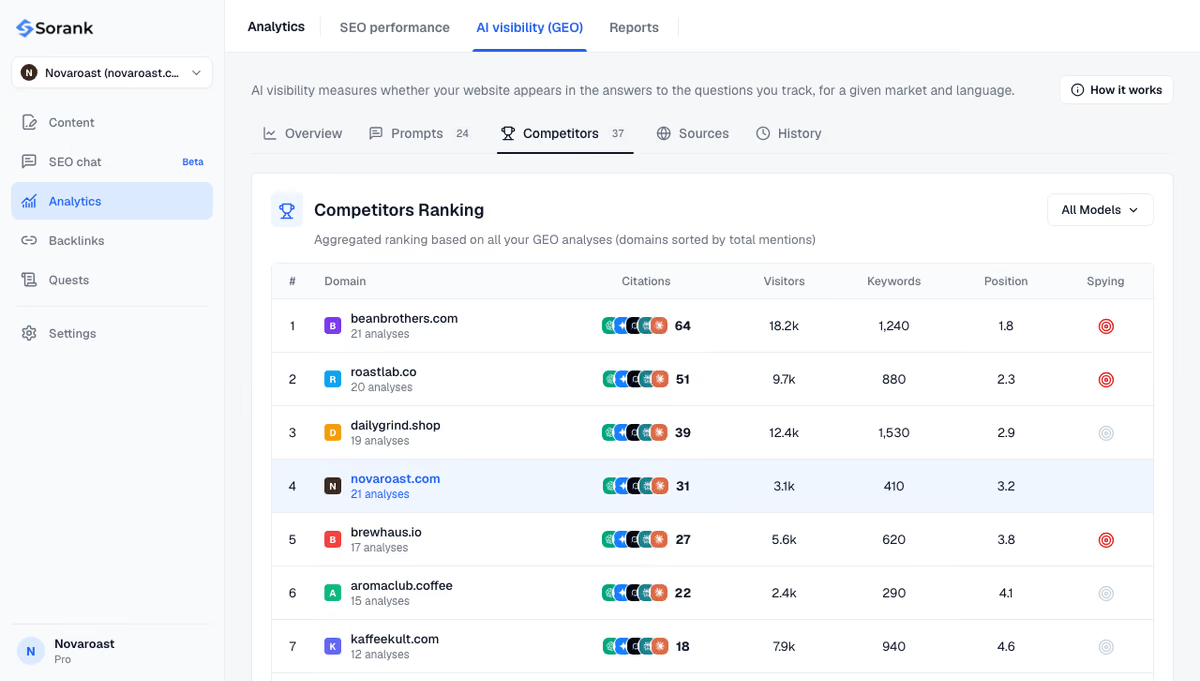
Broken link building works when you fix a real problem for the editor with a page that is better than the one they lost. Start with your own dead backlinks, then work through competitor 404 pages and resource lists in small, relevant batches. Plans start at $49 per month (billed annually) on the pricing page, with a 3-day free trial.

Yes, as long as the editor decides freely to replace the dead link and you offer nothing in return. Google's spam policies target links bought for ranking purposes and excessive reciprocal linking, not a helpful report of a dead link. It becomes risky only if you pay for the replacement or ask for a link in exchange for one.
There is no reliable public benchmark: results depend on niche, relevance and the quality of the replacement page. Expect most emails to go unanswered and treat a few positive replies per batch of well-targeted prospects as a normal outcome. Precise targeting and a better page raise the rate more than sending more emails.
Link reclamation recovers links that already point to your site but lead to deleted or moved pages, usually with a 301 redirect and no outreach. Broken link building targets dead links that point to other sites and asks the editor to replace them with your page. Most campaigns start with reclamation because it is faster.
We analyse your competitors, your website and your AI visibility to create a tailored content plan for free.
 AI Content Brief Generator
 FAQ Schema Generator
 AI Blog Post Ideas Generator
 Structured Data Validator (Schema Validator)
 Alt Text Checker
 Internal Link Analyzer
 Backlink Challenge
 AI Meta Description Generator
 AI Blog Title Generator
 Google Indexability Checker
 AI Blog Outline Generator
 UTM Link Builder
 Keyword Clustering Tool
 Canonical Tag Checker
 XML Sitemap Generator
 Broken Link Checker
 AI SEO Title Generator
 Headline Analyzer
 SERP Preview Tool
 Redirect Checker
 Hreflang Tag Generator
 Heading Structure Analyzer
 HTTP Headers Checker
 Favicon Extractor
 SERP CTR Calculator
 SEO vs Paid Search Savings Calculator
 SEO Share of Voice Calculator
 SEO ROI Calculator
 SEO Traffic and Revenue Forecast Calculator
 SEO Budget Calculator
 SEO Break-Even Calculator
 SaaS SEO ROI Calculator
 ROAS Calculator
 Reading Time Calculator
 Ranking Gain Simulator
 Organic Traffic Value Calculator
 Organic Traffic Estimator and Website Traffic Checker
 LTV to CAC Ratio Calculator
 Local SEO ROI Calculator
 Link Building Cost Calculator
 Keyword Value Calculator
 Keyword Opportunity Score Calculator
 Keyword Density Calculator
 GEO ROI Calculator
 GEO Content Investment Calculator
 Ecommerce SEO ROI Calculator
 Customer Lifetime Value Calculator
 Customer Acquisition Cost Calculator
 CTR Calculator
 Cost Per Article Calculator
 Conversion Rate Calculator
 Content Marketing ROI Calculator
 ChatGPT Referral Traffic Estimator
 Bounce Rate Calculator
 Backlink ROI Calculator
 AI Visibility Score Calculator
 AI Traffic Value Calculator
 AI Share of Voice Calculator
 Cost of AI Invisibility Calculator
 AI Citation Rate Calculator
 llms.txt Validator
 AI Overview Checker and AI Overviews Rank Checker
 Robots.txt Checker
 AI SEO Audit
 LLM Readability Checker
 SearchGPT Readiness Checker
 Structured Data LLM Audit
 Website Crawlability AI Audit
 Why ChatGPT Is Not Recommending My Website
 Gemini Ranking Tool
 Perplexity Ranking Checker
 LLM Citation Checker
 Answer Engine Optimization Audit
 GEO Audit
 AI Search Visibility Test
 ChatGPT Visibility Checker
 llms.txt Generator
 URL Extractor
 Webpage to Markdown
 Sitemap Checker
 SERP Volatility Sensor
 Page Size Checker
 Word Counter
 Slug Generator
 Schema Generator
 Robots Generator
 OG Preview
 Meta Tags Generator
 Image Compressor
 Favicon Generator
 On-Page SEO Audit: SEO Checker and SEO Analyzer
 Backlink Analysis Tool
 Keyword Research Tool
 Domain Authority Checker
THEY TRIED SORANK BEFORE YOU
 “I tested Sorank on a real client site and it's insane. It does everything an agency would bill you $1500 a month for. It's going into production on that client now.”

 Guillaume Guersanguersanguillaume.com“We are an Ads agency and we wanted to get our SEO back on track once and for all. Sorank gave us a clear view of our site, helped us prioritize optimizations, and properly structure our content. The tool is easy to use, well designed for a team, and very practical for centralizing tracking without having to juggle multiple platforms. A very solid foundation to start fresh with our SEO.”
 Gaspard MadouiAds Agency
 “I just let the Sorank software do its thing, and now my DR is 25 and my page is ranking higher.”
 Lucas Flandrefoundertrace.fr“I specialized in GEO thanks to Sorank. The GEO Leaderboard allows me to show my clients their position vs competitors on ChatGPT. It’s a real commercial differentiator.”
 MélanieSEO Freelance“Great service, works well for our website and helps us understand how to improve it to rank better on Google and elsewhere. Congrats, keep going, I recommend it.”
 Hugo T.E-commerce merchant