Preferences
Privacy is important to us, so you have the option of disabling certain types of storage that may not be necessary for the basic functioning of the website. Blocking categories may impact your experience on the website. More information

Privacy is important to us, so you have the option of disabling certain types of storage that may not be necessary for the basic functioning of the website. Blocking categories may impact your experience on the website. More information

White label link building explained for agencies: how it works, the 4 delivery models, costs and margins, how to vet a provider and the risks to avoid.

Tools

In short
white label link building means an agency outsources backlink acquisition to a specialist provider and sells the result to its clients under its own brand. The provider finds the sites, gets the links published and sends an unbranded report that the agency rebrands. It lets an agency sell link building without hiring an outreach team; margin and client retention depend on the quality of the links and on how much of the process the agency still controls.
Want to go further? Ask
Quick quiz
How should you get links from other websites?
Sorank matches your answers


Test it for 3 days on your own site and see where you stand on Google, ChatGPT and the other AIs.
Start 3-day free trial3 days free, then stop whenever you want. 90-day results-or-refund guarantee.
Most agencies hit the same wall: clients ask for backlinks, but outreach is slow, hard to staff and impossible to scale one email at a time. White label link building solves that by applying the logic of a white-label product, made by one company and sold by another under its own name, to backlinks. This guide covers how the model works, the four ways to buy it, how to price it, how to vet a provider and what lands in front of your client at the end of the month.
White label link building is a reseller arrangement. Your agency owns the client relationship, the strategy and the invoice; a third party does the link building itself, in the background. Your client never sees the provider: reports, emails and dashboards carry your brand.
It differs from two close models:
In the white label version, the provider is invisible. That is the whole point for an SEO or marketing agency: it can add a high-value service to its offer without changing its brand, its team or its client experience.
The workflow is similar across providers. What changes is how much you approve before a link goes live.
You send the client's domain, the target pages, the niche, the anchor preferences and any site you want to exclude (competitors, unrelated topics, languages you do not target).
The provider selects host sites that match the niche. Depending on the offer, links come from guest posts, links added to existing articles, resource pages or a network of partner sites. Some providers send a list of sites for pre-approval; others place links directly.
The provider writes or adapts the content around the link, gets it published and checks that the link is live and followed.
You check each link: the page is indexed, the link points to the right URL, the anchor reads naturally. The Links report in Google Search Console shows the client's top linking sites, top linked pages and top linking text, which lets you confirm that new links have been picked up.
The provider sends an unbranded report (live URL, host domain, anchor, target page, date). You add your logo and your commentary, and the client receives it as your work.
Tip
Ask for reports in a spreadsheet format, not only in PDF. You can then merge links from several clients and several providers into one tracking file and spot lost links month after month.
"White label link building" covers four different products. Choosing the wrong one is the most common reason an agency loses money on the service.
| Model | How you buy | Your control | Scales with | Best for |
|---|---|---|---|---|
| Per-link reseller | One price per placement, often by site authority | High: you pick each site | Your time spent ordering and checking | Agencies with a few clients and custom needs |
| Monthly package | A fixed number of links per month and per client | Medium: you set the brief, the provider picks | Number of packages sold | Recurring retainers with a stable budget |
| Managed campaign | A retainer including strategy, digital PR and outreach | Low on execution, high on goals | Budget per client | Large accounts that need editorial links from media |
| Automated network (software) | A subscription per client site | Rules set once, links flow continuously | Number of client sites | Agencies that want links included in every retainer |
The first three models still rely on people sending emails, so their cost grows with each link. The automated model ties backlinks to a subscription per site, which makes the cost predictable and the service easy to package.
Prices depend on the model and on the authority of the host sites. Per-link offers usually rise with the authority and traffic of the host site, managed campaigns are billed as monthly retainers, and software models are billed per client site. Before quoting a client, estimate your own cost with the link building cost calculator.
The figure that matters to an agency is gross margin per client: what the client pays you minus what the provider charges, minus your own time spent on briefs, checks and reporting. The table below is an illustration with round numbers, not market data.
| Line | Per-link reseller | Subscription per site |
|---|---|---|
| Client price (monthly retainer) | $800 | $800 |
| Provider cost | 4 links x $120 = $480 | $99 flat |
| Agency time (ordering, checks, report) | 4 hours | 1 hour |
| Gross margin before time | $320 (40%) | $701 (88%) |
| What happens with 20 clients | 80 orders and checks a month | 20 reports a month |
Two rules keep the margin healthy. Price on outcomes and a full service (links, content, reporting), never on a visible cost per link that the client can compare online. And count your own hours: a cheap link that needs three rounds of corrections costs more than it looks.
Your brand is on every link the provider places, so audit it before you resell it. Order a small test batch for your own site or a friendly client, then grade it with the grid below. The criteria follow the same logic as any quality backlink assessment.
| Criterion | What to ask or check | Red flag |
|---|---|---|
| Relevance | Is the host site about the client's topic or industry? | Generic sites that publish on every subject |
| Real audience | Does the host site get organic traffic, and on which countries? | High authority score, no traffic |
| Anchor text | Are anchors varied and natural? | Exact-match keyword anchors on every link |
| Placement | Is the link inside the body of a real article? | Footer, sidebar or author box only |
| Transparency | Do you see the full URL before or right after publication? | "Private network, URLs on request" |
| Durability | Is a replacement guaranteed if a link disappears? | No answer on lost links |
| Reporting | Live URL, anchor, target, date, white-label format | Screenshots without URLs |
On anchors, Google's documentation asks for link text that is descriptive, reasonably concise and relevant to both pages. Use the same standard for your clients, and read our guide to anchor text to set the mix in your brief. Then run each delivered URL through a backlink analysis tool to confirm the host's profile.
The risks of white label link building are mostly commercial: the agency answers for work it did not do.
Note
Put four clauses in your provider contract: confidentiality (no direct contact with your clients), full URL list in every report, replacement of lost links within a set period, and ownership of the reporting data.
For the last point, pair link data with rankings and traffic in a monthly SEO report: the client sees what the links changed, not only that they exist.
Clients now ask a second question: "Does ChatGPT recommend us?" Links still feed Google rankings, and AI assistants build part of their answers from pages that rank. They also weigh how often a brand is mentioned across the web. In an Ahrefs study of 75,000 brands (May 2025), branded web mentions showed the strongest correlation with visibility in Google's AI Overviews (0.664), ahead of branded anchors (0.527) and backlinks (0.218). Our own AI citation study shows which types of sites each AI cites most.
For a white label offer, that means two deliverables in the same retainer: backlinks from relevant sites in the client's niche, and proof that the brand is cited by the AI assistants its buyers use.
Sorank covers both for agencies. Every client site you add obtains natural backlinks automatically through Sorank's natural backlink acquisition, from more than 5,000 Sorank users whose sites link to one another: one-way links from sites in the same niche, with no outreach and no cold email. The same subscription writes and publishes 20 SEO and GEO articles a month on the client's site and runs AI mention tracking on ChatGPT, Claude and Gemini, so you can show which competitors the AI cite instead of your client.
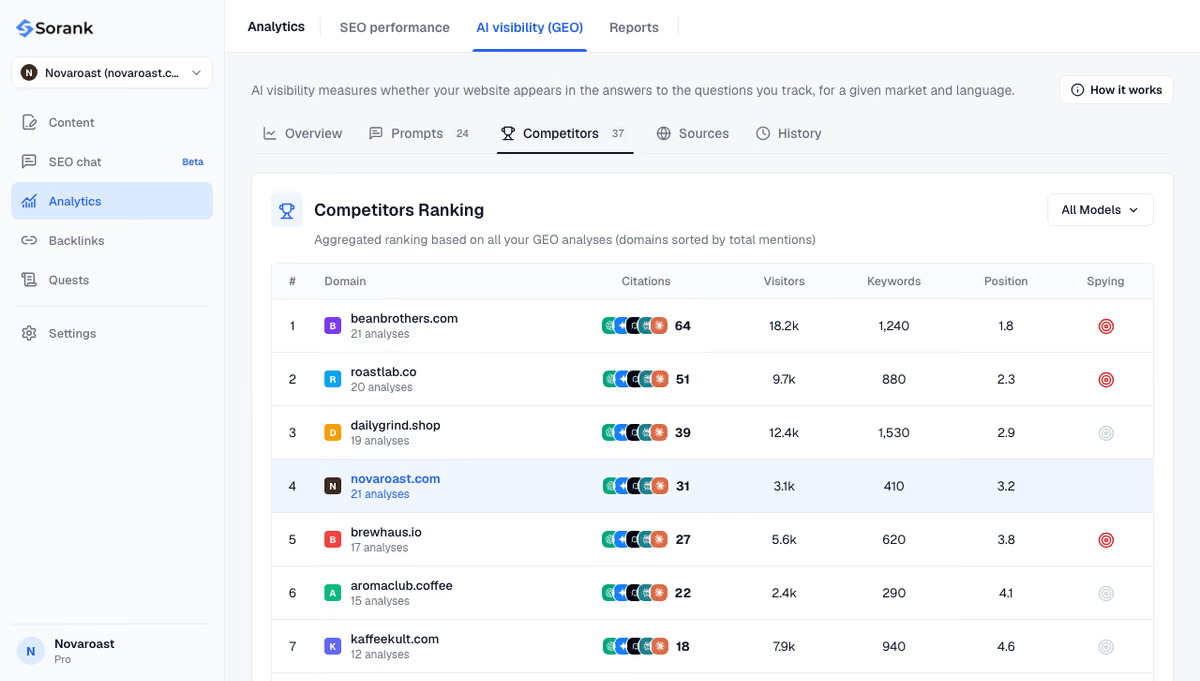
Each client site costs $99 a month, or $49 a month billed yearly. The White label plan adds a $2,000 yearly subscription that puts the dashboard on your own domain, with your logo, so your clients log in to your brand.
Yes, when the provider is transparent and the cost scales with clients rather than with emails sent. The best white label link building setup is the one your client never notices and your margin never feels: relevant links, full URL reporting, a contract that protects your brand and a price you can fold into every retainer. To add backlinks, content and AI visibility to your offer under your own brand, see the Sorank white label program, with a 3-day free trial.

Not if the provider respects the white label agreement. Reports, emails and dashboards carry the agency's brand, and the provider never contacts the client. Many agencies still explain that they work with specialist partners, without naming them, which keeps trust intact if the question comes up.
Links are usually placed within a few weeks of the brief, but rankings take longer to move because Google has to crawl the host pages and reassess the target page. Expect first effects within 2 to 4 months on a site that already publishes useful content, and track progress in Search Console rather than by counting links.
Yes. Per-site subscriptions and monthly packages have no minimum team size, so a freelancer can include backlinks in a retainer from the first client. The key is to pick a model where the time spent on ordering and checking stays low, otherwise the margin disappears as clients are added.
We analyse your competitors, your website and your AI visibility to create a tailored content plan for free.
 AI Content Brief Generator
 FAQ Schema Generator
 AI Blog Post Ideas Generator
 Structured Data Validator (Schema Validator)
 Alt Text Checker
 Internal Link Analyzer
 Backlink Challenge
 AI Meta Description Generator
 AI Blog Title Generator
 Google Indexability Checker
 AI Blog Outline Generator
 UTM Link Builder
 Keyword Clustering Tool
 Canonical Tag Checker
 XML Sitemap Generator
 Broken Link Checker
 AI SEO Title Generator
 Headline Analyzer
 SERP Preview Tool
 Redirect Checker
 Hreflang Tag Generator
 Heading Structure Analyzer
 HTTP Headers Checker
 Favicon Extractor
 SERP CTR Calculator
 SEO vs Paid Search Savings Calculator
 SEO Share of Voice Calculator
 SEO ROI Calculator
 SEO Traffic and Revenue Forecast Calculator
 SEO Budget Calculator
 SEO Break-Even Calculator
 SaaS SEO ROI Calculator
 ROAS Calculator
 Reading Time Calculator
 Ranking Gain Simulator
 Organic Traffic Value Calculator
 Organic Traffic Estimator and Website Traffic Checker
 LTV to CAC Ratio Calculator
 Local SEO ROI Calculator
 Link Building Cost Calculator
 Keyword Value Calculator
 Keyword Opportunity Score Calculator
 Keyword Density Calculator
 GEO ROI Calculator
 GEO Content Investment Calculator
 Ecommerce SEO ROI Calculator
 Customer Lifetime Value Calculator
 Customer Acquisition Cost Calculator
 CTR Calculator
 Cost Per Article Calculator
 Conversion Rate Calculator
 Content Marketing ROI Calculator
 ChatGPT Referral Traffic Estimator
 Bounce Rate Calculator
 Backlink ROI Calculator
 AI Visibility Score Calculator
 AI Traffic Value Calculator
 AI Share of Voice Calculator
 Cost of AI Invisibility Calculator
 AI Citation Rate Calculator
 llms.txt Validator
 AI Overview Checker and AI Overviews Rank Checker
 Robots.txt Checker
 AI SEO Audit
 LLM Readability Checker
 SearchGPT Readiness Checker
 Structured Data LLM Audit
 Website Crawlability AI Audit
 Why ChatGPT Is Not Recommending My Website
 Gemini Ranking Tool
 Perplexity Ranking Checker
 LLM Citation Checker
 Answer Engine Optimization Audit
 GEO Audit
 AI Search Visibility Test
 ChatGPT Visibility Checker
 llms.txt Generator
 URL Extractor
 Webpage to Markdown
 Sitemap Checker
 SERP Volatility Sensor
 Page Size Checker
 Word Counter
 Slug Generator
 Schema Generator
 Robots Generator
 OG Preview
 Meta Tags Generator
 Image Compressor
 Favicon Generator
 On-Page SEO Audit: SEO Checker and SEO Analyzer
 Backlink Analysis Tool
 Keyword Research Tool
 Domain Authority Checker
THEY TRIED SORANK BEFORE YOU
 “I tested Sorank on a real client site and it's insane. It does everything an agency would bill you $1500 a month for. It's going into production on that client now.”

 Guillaume Guersanguersanguillaume.com“We are an Ads agency and we wanted to get our SEO back on track once and for all. Sorank gave us a clear view of our site, helped us prioritize optimizations, and properly structure our content. The tool is easy to use, well designed for a team, and very practical for centralizing tracking without having to juggle multiple platforms. A very solid foundation to start fresh with our SEO.”
 Gaspard MadouiAds Agency
 “I just let the Sorank software do its thing, and now my DR is 25 and my page is ranking higher.”
 Lucas Flandrefoundertrace.fr“I specialized in GEO thanks to Sorank. The GEO Leaderboard allows me to show my clients their position vs competitors on ChatGPT. It’s a real commercial differentiator.”
 MélanieSEO Freelance“Great service, works well for our website and helps us understand how to improve it to rank better on Google and elsewhere. Congrats, keep going, I recommend it.”
 Hugo T.E-commerce merchant