Preferences
Privacy is important to us, so you have the option of disabling certain types of storage that may not be necessary for the basic functioning of the website. Blocking categories may impact your experience on the website. More information

Privacy is important to us, so you have the option of disabling certain types of storage that may not be necessary for the basic functioning of the website. Blocking categories may impact your experience on the website. More information

Automated link building explained: what software handles well (prospecting, outreach, monitoring), what to keep human, and how to get backlinks on autopilot.

Tools

In short
automated link building means using software to run the repetitive parts of earning backlinks: finding prospects, scoring them, finding contacts, sending and following up emails, checking that links go live and stay live. The judgment calls (which sites deserve a link, what you offer them, what you refuse) stay with you. The most automated option today is natural backlink acquisition, where the software places contextual links between member sites with no outreach at all.
Want to go further? Ask
Quick quiz
How should you get links from other websites?
Sorank matches your answers


Test it for 3 days on your own site and see where you stand on Google, ChatGPT and the other AIs.
Start 3-day free trial3 days free, then stop whenever you want. 90-day results-or-refund guarantee.
Automated link building covers a wide range of tools, from a spreadsheet that flags broken links to a platform that delivers backlinks every week without a single email. The common thread is time: classic outreach is slow and mostly ignored. In an analysis of 12 million outreach emails, Backlinko and Pitchbox found that only 8.5% received a reply (study published in 2019). This guide splits the work into the tasks that software does better than a person, the ones it does worse, and the setups that combine both.
Automated link building is the use of software to replace manual steps in link building. A manual campaign has six stages: research, prospecting, qualification, contact, negotiation and tracking. Each one can be partly or fully automated, and most tools cover one or two stages only.
There are three families of tools:
Automation in link building is part of a wider trend covered in our guide to SEO automation: hand the volume to software, keep the decisions.
Most of the hours in a link building campaign go into research and email logistics, and those are exactly the tasks software handles well. The table below rates each stage by how far it can be automated today.
| Stage | What software does | Level of automation | What stays human |
|---|---|---|---|
| Competitor research | Lists the referring domains of your competitors and the ones you lack | Full | Choosing which competitors matter |
| Prospecting | Finds broken links, unlinked mentions, resource pages, guest post targets | Full | Defining the search footprints |
| Qualification | Scores sites on authority, traffic, topic and outbound link patterns | High | Final check of the host page |
| Contact finding | Finds and verifies email addresses | Full | None |
| Outreach | Sends personalized sequences and follow-ups, stops on reply | High | The pitch and the offer |
| Negotiation | Little to nothing | Low | Replies, edits, relationships |
| Link placement (network) | Matches sites and places the link inside an article | Full | Setting filters, refusing links |
| Monitoring | Checks that each link is live, indexed and keeps its attributes | Full | Deciding what to do with lost links |
A backlink analysis of three to five competitors gives you a list of domains that link to them and not to you. Software does this in minutes; a person would need days. Pair it with competitor tracking to see who actually wins the queries you target, in Google and in AI answers, before you chase their links.
Prospecting is the stage that gains the most from automation. Crawlers find pages with dead outbound links (a broken link checker does it page by page), alerts surface new unlinked brand mentions, and search operators pull resource pages by the hundred. The output is a list, and a list is only as good as its filters.
Sequencing tools send a first email, then follow-ups at set intervals, and stop when the prospect replies. Follow-ups matter: in the same Backlinko study, a single follow-up increased replies by 65.8%. Our guide to email outreach has templates that work with these tools.
Tip
Automate the merge fields, never the reason for writing. One sentence that proves you read the page (the broken link you found, the statistic they cite) does more for your reply rate than any subject line test.
Links disappear: pages get deleted, sites migrate, editors switch a link to nofollow. Backlink monitoring checks every acquired link on a schedule and alerts you when one drops, which no one does reliably by hand past a few dozen links.
Three things do not survive automation. First, the judgment on a host page: a script can read authority metrics, but it does not see that a site publishes thin content on every topic or sells links on every page. Second, the relationship: journalists, bloggers and editors answer people, and the best links often come from the second or third exchange. Third, the content that deserves links: a study, a tool or a guide that someone wants to cite cannot be generated by an outreach tool.
Some tools push automation too far: mass submission software, meaning bots that post thousands of comments, forum profiles and auto-generated blog pages. Those links rarely sit inside real content, nobody reads the pages they land on, and they bring no traffic or authority worth having.
Watch out
An offer of thousands of backlinks for a few dollars is mass submission. Those links land on pages nobody reads, and you have no way to remove them afterwards.
Paid placements bought one by one are a separate case, with their own rules on the nofollow and sponsored attributes: see our guide on how to buy backlinks.
Each model trades control against time. The figures below are orders of magnitude to compare models, not market prices.
| Model | Your time per link | Control over host sites | Best for |
|---|---|---|---|
| Manual outreach | Several hours | Total | Digital PR, high authority targets |
| Automated outreach (sequences) | About an hour, mostly replies | High | Broken links, resource pages, guest posts |
| Marketplace placements | Minutes | Medium, page by page | Quick volume on chosen sites |
| Backlink acquisition on autopilot | Near zero after setup | Filters set once, right to refuse | Steady link growth for small teams |
| Mass submission software | Near zero | None | Nothing worth having |
Write down your criteria before you touch a tool: topic relevance, minimum authority, real organic traffic, the link placed inside an article, no sitewide links. Our grid of quality backlink criteria gives nine checks you can turn into filters.
Links work best when they point at pages that can rank: guides, tools, comparison pages and service pages already on page two. Pointing every link at the homepage wastes most of their value.
A typical stack chains a backlink database, an email finder, a sequencing tool and a monitoring tool through exports or integrations. Each handoff is a place where lists get stale, so run the chain weekly with small batches rather than one large campaign per quarter.
Automated campaigns tend to repeat the same anchor. Mix brand names, page titles, natural phrases and a few partial matches, and keep exact match anchors rare.
Count referring domains gained, then follow the rankings and clicks of the target pages in Search Console over two to four months. A link that never moves a page is a cost, whatever its authority score.
Links still help Google find, crawl and rank pages. For AI answers, they are one signal among several. An Ahrefs study of 75,000 brands (May 2025) found that branded web mentions correlated with visibility in Google AI Overviews at 0.664, against 0.218 for the number of backlinks and 0.295 for referring domains. The practical reading: links from pages where your brand appears in a relevant context help both channels, and our study of the sources AI platforms cite shows which sites they draw on most.
This is the logic behind Sorank. The software obtains natural backlinks automatically through Sorank's natural backlink acquisition, from more than 5,000 Sorank users whose sites link to one another. Sorank classifies your site in its niche and places one-way, contextual links inside published articles of sites in the same niche, never from a direct competitor. You set the minimum Domain Rating of the sites allowed to link to you and a daily cap that keeps growth gradual, you can refuse any link hosted on your own articles, and every received backlink appears in your dashboard with its page, anchor, host authority and status until it is verified. No prospect lists, no cold emails, no follow-ups.
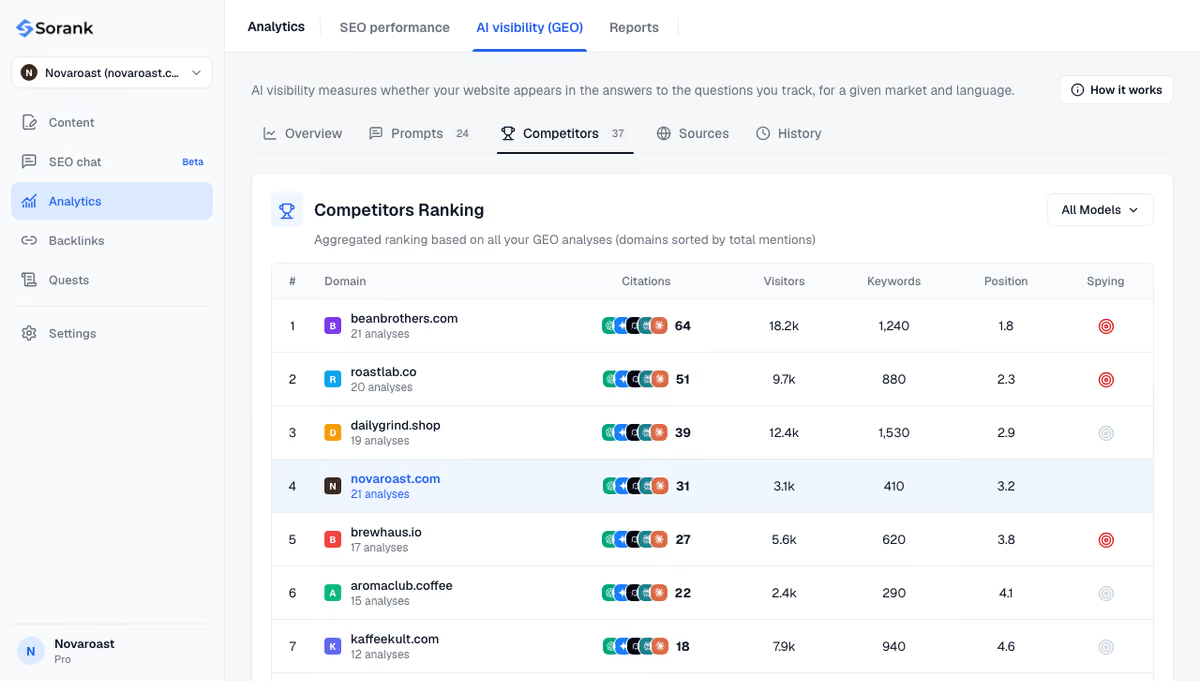
The same subscription writes and publishes SEO and GEO articles on your site and tracks your brand in ChatGPT, Claude and Gemini, so you can see whether new links and new content turn into citations.
Yes, for the tasks where software beats people: research, prospecting, sequencing and monitoring, and for link placement through a network built for it. Automate the volume, keep the criteria and the content in your hands, and judge every link by the rankings it moves. To get backlinks, articles and AI visibility on autopilot, see the Sorank plans, from $49 a month billed annually, with a 3-day free trial and a 90-day money-back guarantee.

It depends on what is automated. Research, prospecting, email sequences and link monitoring are standard practice and carry no particular risk. Mass submission software that posts links in comments, forums and auto-generated pages is what Google targets in its link spam policies.
It depends on the stage. Backlink databases such as Ahrefs, Semrush or Majestic handle research and prospecting, sequencing tools handle outreach, and natural backlink acquisition such as Sorank's handles link placement itself with no outreach. Most teams combine a research tool with one placement method.
Google first has to crawl the host page and reassess the target page, which takes weeks. Expect first effects within 2 to 4 months on a site that already publishes useful content, and measure them with the rankings and clicks of the target pages in Search Console.
We analyse your competitors, your website and your AI visibility to create a tailored content plan for free.
 AI Content Brief Generator
 FAQ Schema Generator
 AI Blog Post Ideas Generator
 Structured Data Validator (Schema Validator)
 Alt Text Checker
 Internal Link Analyzer
 Backlink Challenge
 AI Meta Description Generator
 AI Blog Title Generator
 Google Indexability Checker
 AI Blog Outline Generator
 UTM Link Builder
 Keyword Clustering Tool
 Canonical Tag Checker
 XML Sitemap Generator
 Broken Link Checker
 AI SEO Title Generator
 Headline Analyzer
 SERP Preview Tool
 Redirect Checker
 Hreflang Tag Generator
 Heading Structure Analyzer
 HTTP Headers Checker
 Favicon Extractor
 SERP CTR Calculator
 SEO vs Paid Search Savings Calculator
 SEO Share of Voice Calculator
 SEO ROI Calculator
 SEO Traffic and Revenue Forecast Calculator
 SEO Budget Calculator
 SEO Break-Even Calculator
 SaaS SEO ROI Calculator
 ROAS Calculator
 Reading Time Calculator
 Ranking Gain Simulator
 Organic Traffic Value Calculator
 Organic Traffic Estimator and Website Traffic Checker
 LTV to CAC Ratio Calculator
 Local SEO ROI Calculator
 Link Building Cost Calculator
 Keyword Value Calculator
 Keyword Opportunity Score Calculator
 Keyword Density Calculator
 GEO ROI Calculator
 GEO Content Investment Calculator
 Ecommerce SEO ROI Calculator
 Customer Lifetime Value Calculator
 Customer Acquisition Cost Calculator
 CTR Calculator
 Cost Per Article Calculator
 Conversion Rate Calculator
 Content Marketing ROI Calculator
 ChatGPT Referral Traffic Estimator
 Bounce Rate Calculator
 Backlink ROI Calculator
 AI Visibility Score Calculator
 AI Traffic Value Calculator
 AI Share of Voice Calculator
 Cost of AI Invisibility Calculator
 AI Citation Rate Calculator
 llms.txt Validator
 AI Overview Checker and AI Overviews Rank Checker
 Robots.txt Checker
 AI SEO Audit
 LLM Readability Checker
 SearchGPT Readiness Checker
 Structured Data LLM Audit
 Website Crawlability AI Audit
 Why ChatGPT Is Not Recommending My Website
 Gemini Ranking Tool
 Perplexity Ranking Checker
 LLM Citation Checker
 Answer Engine Optimization Audit
 GEO Audit
 AI Search Visibility Test
 ChatGPT Visibility Checker
 llms.txt Generator
 URL Extractor
 Webpage to Markdown
 Sitemap Checker
 SERP Volatility Sensor
 Page Size Checker
 Word Counter
 Slug Generator
 Schema Generator
 Robots Generator
 OG Preview
 Meta Tags Generator
 Image Compressor
 Favicon Generator
 On-Page SEO Audit: SEO Checker and SEO Analyzer
 Backlink Analysis Tool
 Keyword Research Tool
 Domain Authority Checker
THEY TRIED SORANK BEFORE YOU
 “I tested Sorank on a real client site and it's insane. It does everything an agency would bill you $1500 a month for. It's going into production on that client now.”

 Guillaume Guersanguersanguillaume.com“We are an Ads agency and we wanted to get our SEO back on track once and for all. Sorank gave us a clear view of our site, helped us prioritize optimizations, and properly structure our content. The tool is easy to use, well designed for a team, and very practical for centralizing tracking without having to juggle multiple platforms. A very solid foundation to start fresh with our SEO.”
 Gaspard MadouiAds Agency
 “I just let the Sorank software do its thing, and now my DR is 25 and my page is ranking higher.”
 Lucas Flandrefoundertrace.fr“I specialized in GEO thanks to Sorank. The GEO Leaderboard allows me to show my clients their position vs competitors on ChatGPT. It’s a real commercial differentiator.”
 MélanieSEO Freelance“Great service, works well for our website and helps us understand how to improve it to rank better on Google and elsewhere. Congrats, keep going, I recommend it.”
 Hugo T.E-commerce merchant