Preferences
Privacy is important to us, so you have the option of disabling certain types of storage that may not be necessary for the basic functioning of the website. Blocking categories may impact your experience on the website. More information

Privacy is important to us, so you have the option of disabling certain types of storage that may not be necessary for the basic functioning of the website. Blocking categories may impact your experience on the website. More information

SaaS link building in 2026: 10 strategies for SaaS and B2B brands (integrations, partner pages, data studies), effort compared and how to measure results.

Tools

In short
SaaS link building means earning backlinks to a software company's site from the places its buyers already read: integration partners, app marketplaces, review sites, industry media and other relevant websites. The strongest links for SaaS and B2B brands come from assets competitors cannot copy (integrations, original data, free tools, customer stories), pointed at commercial pages as well as the blog. Links help the site rank on Google and make the brand more likely to be cited by ChatGPT, Gemini and Perplexity when buyers ask for software recommendations.
Want to go further? Ask
Quick quiz
How should you get links from other websites?
Sorank matches your answers


Test it for 3 days on your own site and see where you stand on Google, ChatGPT and the other AIs.
Start 3-day free trial3 days free, then stop whenever you want. 90-day results-or-refund guarantee.
Software and B2B companies fight for search results against review platforms, media sites and comparison aggregators, all of which hold thousands of referring domains. SaaS link building is how a product site closes that gap. Google itself explains in its SEO Starter Guide that it primarily finds pages through links from pages it has already crawled, often on other websites. This guide covers the 10 strategies that fit software and B2B brands, compares their effort and value, explains which pages the links should point to and how to measure the result.
SaaS link building is the part of link building adapted to software companies: the same goal (getting other websites to link to yours), applied to a business that sells a product online, has integration partners, publishes documentation and competes on long, considered purchases. B2B link building follows the same logic for service firms, agencies, manufacturers and consultancies that sell to other companies.
Three things make it different from link building for a local shop or a media site:
For the wider marketing picture of software companies, see our page on SEO and GEO for SaaS.
Links remain one of the signals Google uses to judge which pages deserve to rank, an idea that goes back to PageRank, the algorithm named after Google co-founder Larry Page. In software markets, the keywords that bring trials and demos ("[category] software", "[competitor] alternative", "[tool] integration") are crowded with domains that have years of links behind them. Content alone rarely beats them; content plus a steady flow of relevant backlinks does.
The second reason is newer: buyers now ask AI assistants for a shortlist. According to G2 research published in April 2026 (survey of 1,076 B2B software buyers, March 2026), 51% of B2B software buyers now start their research with an AI chatbot more often than with Google, up from 29% a year earlier, and 85% think more highly of a vendor when the AI includes it in an answer. AI assistants build those answers from pages that rank and from sources that mention the brand, so the same backlinks and mentions feed both channels. Our study of the platforms the AIs cite most shows how often third-party sites appear in those answers.
The 10 strategies below are ranked from the most specific to software (links only a product company can earn) to the most general. Most SaaS and B2B teams combine four or five of them; the wider list of methods is in our guide to backlink strategies.
Every tool you integrate with is a potential link. Large platforms publish directories of their integrations: Zapier alone lists more than 10,000 connected apps (checked October 2026). Ask each partner for a listing page with a link, publish a matching page on your own site, and co-write an announcement post when the integration launches. These links are relevant by definition, because they come from software your buyers already use.
CRM, e-commerce and collaboration platforms run marketplaces (HubSpot, Salesforce, Shopify, Slack, Atlassian and many others). A listing usually includes a link to your site, reviews and a description indexed by Google. Complete every field, add screenshots and link to a dedicated landing page rather than the homepage.
Profiles on software review sites and niche directories give a link (often nofollow) and, more importantly, a presence on the pages that rank for "best [category] software" and that the AIs often cite. Ask satisfied customers for reviews after a successful onboarding or renewal, not at random.
A SaaS product sits on aggregated usage data that nobody else has. A yearly benchmark ("average response time in customer support", "conversion rates by industry") earns links from journalists, bloggers and analysts who need a figure to quote. Publish the method, the sample size and a downloadable chart, and update the study every year at the same URL. Our guide to linkable assets details the formats that attract the most links.
A free calculator, generator or template that solves one task in your category attracts links for years with little upkeep. Build it on your own domain, keep it free without sign-up for the basic result, and link from it to the product feature that solves the full problem.
Articles ranking "the best [category] tools" are where buyers and AI assistants form shortlists. Find them with a search for your category plus "best", "top" or "alternatives", then contact the author with a short, factual pitch: what your tool does better, for which use case, with a free account for testing. Publish your own honest comparison pages too: they rank for "[competitor] alternative" queries and other writers link to them as references.
Customers who feature their tool stack, agencies that recommend your software to their clients and vendors you buy from all have pages where a link to you makes sense. Offer a testimonial to the tools you use, and give customers a co-branded case study they are proud to share.
Founders and product leads are credible voices in their niche. A guest article on an industry blog, an interview on a B2B podcast or a joint webinar with a partner each comes with an author bio or a show-notes link. Target publications your buyers read, not those with the highest authority score. Our guide to SaaS content marketing covers how to turn these appearances into content for your own site.
Funding rounds, product launches and data studies give journalists a story. A digital PR campaign built on your own data earns links from media sites that would never accept a guest post. Once your brand is talked about, monitor new mentions and ask authors to add a link: unlinked brand mentions are among the easiest links to win, because the author already knows you.
Outreach-based methods depend on a person sending emails every week. Natural backlink acquisition removes that bottleneck: your site receives one-way links from relevant sites in the same niche on a regular basis, without prospecting. This is how Sorank's natural backlink acquisition works: each site obtains natural backlinks automatically from more than 5,000 Sorank users whose sites link to one another, while your team keeps its time for integrations, studies and partnerships.
| Strategy | Effort | Link relevance | Time to first links | Best target page |
|---|---|---|---|---|
| Integration and partner pages | Low once the integration exists | Very high | 2 - 6 weeks | Integration page |
| App marketplaces and directories | Low | High | 1 - 4 weeks | Product landing page |
| Review sites | Medium (customer reviews) | High | 1 - 3 months | Homepage |
| Original data studies | High | High | 1 - 3 months | Study page |
| Free tools and templates | High upfront, low after | High | 2 - 6 months | Tool page |
| Roundups and comparisons | Medium | Very high | 1 - 3 months | Homepage or feature page |
| Customer and testimonial links | Low | Medium | 2 - 8 weeks | Homepage or case study |
| Guest articles, podcasts, webinars | Medium to high | Medium to high | 1 - 2 months | Blog article or study |
| Digital PR and unlinked mentions | High (PR), low (mentions) | Medium to high | 1 - 3 months | Study or homepage |
| Automated backlink acquisition | Very low | High (same niche) | Continuous | Blog articles and key pages |
Tip
Add a "link to us" line to every partner kit: the exact URL of your integration page, your logo and a two-sentence description. Partners update their directories faster when everything is ready to paste.
A B2B services firm, a manufacturer or a consultancy has no app marketplace or integration directory, but it has other link sources that software companies lack. The method is the same (earn links from the places buyers read), the sources change. Our guide to B2B SEO explains how these links fit into the full strategy.
| Link source | SaaS company | B2B services or industry firm |
|---|---|---|
| Product ecosystem | Integrations, app marketplaces, API docs | Supplier and distributor pages, certified partner lists |
| Data | Aggregated product usage | Project data, market surveys, price indexes |
| Associations and events | Tech meetups, conference sponsor pages | Trade associations, chambers of commerce, trade fair exhibitor lists |
| Media | Tech and startup press, SaaS podcasts | Trade magazines, industry newsletters |
| Customers | Tool stack pages, testimonials | Joint case studies, client project pages |
| Third-party lists | Review sites, "best software" roundups | Industry directories, "best agencies" rankings |
Most SaaS sites get links on the homepage and the blog, while pricing, feature and integration pages, the ones that bring sign-ups, receive almost none. Spread links deliberately:
Keep anchor text varied: brand name, product name, the page topic and plain URLs, with exact-match commercial anchors kept rare.
Note
One link from a partner your buyers already use often brings more trials than ten links from generic high-authority blogs. Judge a link by who reads the page, then by its authority score.
Counting links says little. Track four indicators each month:
Expect first ranking effects within 2 to 4 months of a steady link flow, faster on pages that already rank on page two.
The links that help a SaaS page rank on Google are also the signals AI assistants rely on: a brand mentioned on partner sites, review pages, roundups and industry media is a brand the AI considers a credible answer. Link building for SaaS now serves two goals at once: ranking on commercial keywords and being named when a buyer asks an AI for the best tool in your category.
Sorank automates the part that usually stalls. Your site obtains natural backlinks automatically from the sites of 5,000+ users, the software writes and publishes SEO and GEO articles that give those links relevant pages to land on, and AI mention tracking shows on ChatGPT, Claude and Gemini whether your brand is cited and which competitors appear in its place.
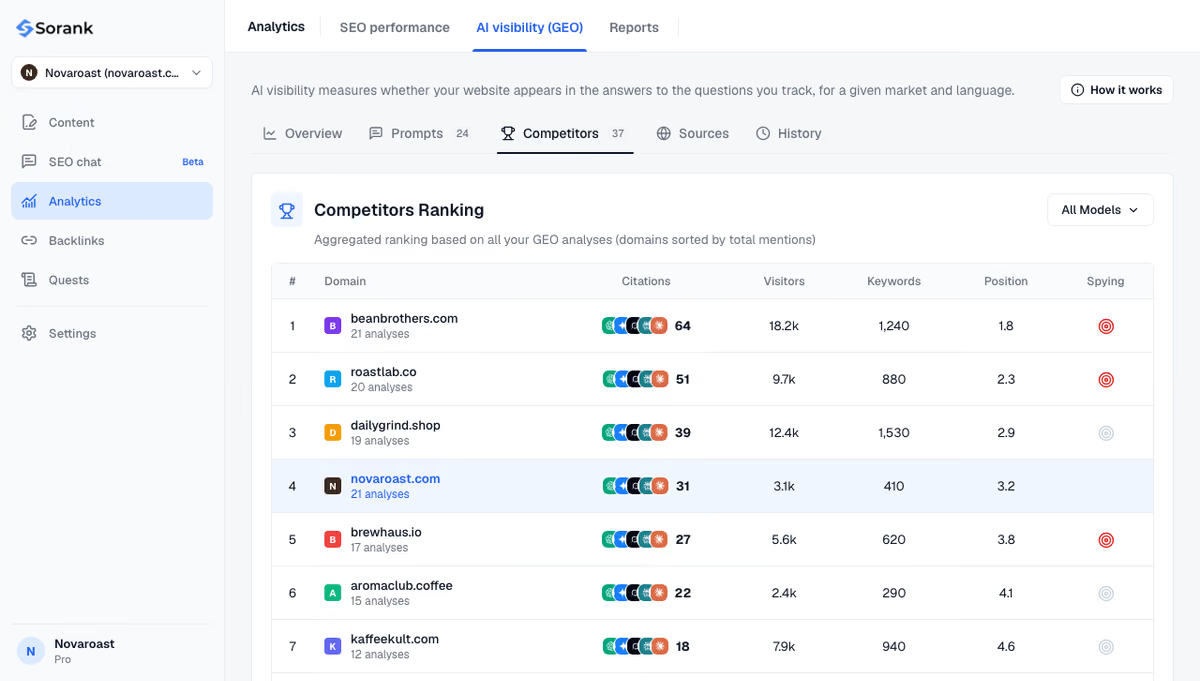
Plans start at $49 a month billed yearly ($99 a month without commitment), with a 3-day free trial.
Start with the links only your product can earn: integration partners, marketplaces and customers, then add one linkable asset and a regular flow of niche backlinks. The best SaaS link building strategy combines links your competitors cannot copy with a steady flow that does not depend on weekly outreach. To get backlinks, content and AI visibility running on your site, see the Sorank plans.

There is no fixed number: it depends on how many referring domains the pages already ranking for your target keywords have. Compare your key pages with the top 5 results for each commercial query and aim to close the gap in referring domains, focusing on relevant sites rather than raw volume. A steady monthly flow works better than a one-off burst.
Yes. Nofollow links from review sites and software directories pass less ranking value, but they bring qualified referral traffic and place your brand on pages that rank for category queries and that AI assistants often cite. They also make your link profile look natural next to editorial links.
Partner and marketplace links can appear within a few weeks, but rankings usually move 2 to 4 months after a steady flow of links starts, once Google has crawled the linking pages and reassessed yours. Pages that already rank on page two react fastest, so point your first links there.
We analyse your competitors, your website and your AI visibility to create a tailored content plan for free.
 AI Content Brief Generator
 FAQ Schema Generator
 AI Blog Post Ideas Generator
 Structured Data Validator (Schema Validator)
 Alt Text Checker
 Internal Link Analyzer
 Backlink Challenge
 AI Meta Description Generator
 AI Blog Title Generator
 Google Indexability Checker
 AI Blog Outline Generator
 UTM Link Builder
 Keyword Clustering Tool
 Canonical Tag Checker
 XML Sitemap Generator
 Broken Link Checker
 AI SEO Title Generator
 Headline Analyzer
 SERP Preview Tool
 Redirect Checker
 Hreflang Tag Generator
 Heading Structure Analyzer
 HTTP Headers Checker
 Favicon Extractor
 SERP CTR Calculator
 SEO vs Paid Search Savings Calculator
 SEO Share of Voice Calculator
 SEO ROI Calculator
 SEO Traffic and Revenue Forecast Calculator
 SEO Budget Calculator
 SEO Break-Even Calculator
 SaaS SEO ROI Calculator
 ROAS Calculator
 Reading Time Calculator
 Ranking Gain Simulator
 Organic Traffic Value Calculator
 Organic Traffic Estimator and Website Traffic Checker
 LTV to CAC Ratio Calculator
 Local SEO ROI Calculator
 Link Building Cost Calculator
 Keyword Value Calculator
 Keyword Opportunity Score Calculator
 Keyword Density Calculator
 GEO ROI Calculator
 GEO Content Investment Calculator
 Ecommerce SEO ROI Calculator
 Customer Lifetime Value Calculator
 Customer Acquisition Cost Calculator
 CTR Calculator
 Cost Per Article Calculator
 Conversion Rate Calculator
 Content Marketing ROI Calculator
 ChatGPT Referral Traffic Estimator
 Bounce Rate Calculator
 Backlink ROI Calculator
 AI Visibility Score Calculator
 AI Traffic Value Calculator
 AI Share of Voice Calculator
 Cost of AI Invisibility Calculator
 AI Citation Rate Calculator
 llms.txt Validator
 AI Overview Checker and AI Overviews Rank Checker
 Robots.txt Checker
 AI SEO Audit
 LLM Readability Checker
 SearchGPT Readiness Checker
 Structured Data LLM Audit
 Website Crawlability AI Audit
 Why ChatGPT Is Not Recommending My Website
 Gemini Ranking Tool
 Perplexity Ranking Checker
 LLM Citation Checker
 Answer Engine Optimization Audit
 GEO Audit
 AI Search Visibility Test
 ChatGPT Visibility Checker
 llms.txt Generator
 URL Extractor
 Webpage to Markdown
 Sitemap Checker
 SERP Volatility Sensor
 Page Size Checker
 Word Counter
 Slug Generator
 Schema Generator
 Robots Generator
 OG Preview
 Meta Tags Generator
 Image Compressor
 Favicon Generator
 On-Page SEO Audit: SEO Checker and SEO Analyzer
 Backlink Analysis Tool
 Keyword Research Tool
 Domain Authority Checker
THEY TRIED SORANK BEFORE YOU
 “I tested Sorank on a real client site and it's insane. It does everything an agency would bill you $1500 a month for. It's going into production on that client now.”

 Guillaume Guersanguersanguillaume.com“We are an Ads agency and we wanted to get our SEO back on track once and for all. Sorank gave us a clear view of our site, helped us prioritize optimizations, and properly structure our content. The tool is easy to use, well designed for a team, and very practical for centralizing tracking without having to juggle multiple platforms. A very solid foundation to start fresh with our SEO.”
 Gaspard MadouiAds Agency
 “I just let the Sorank software do its thing, and now my DR is 25 and my page is ranking higher.”
 Lucas Flandrefoundertrace.fr“I specialized in GEO thanks to Sorank. The GEO Leaderboard allows me to show my clients their position vs competitors on ChatGPT. It’s a real commercial differentiator.”
 MélanieSEO Freelance“Great service, works well for our website and helps us understand how to improve it to rank better on Google and elsewhere. Congrats, keep going, I recommend it.”
 Hugo T.E-commerce merchant