Preferences
Privacy is important to us, so you have the option of disabling certain types of storage that may not be necessary for the basic functioning of the website. Blocking categories may impact your experience on the website. More information
Privacy is important to us, so you have the option of disabling certain types of storage that may not be necessary for the basic functioning of the website. Blocking categories may impact your experience on the website. More information

SEO software for SaaS like Sorank helps a software company get found when a buyer types "best CRM for a 10-person sales team", searches "[competitor] alternatives" or asks ChatGPT which tool to trial. It does the recurring work for you: it finds the use-case, integration and comparison searches of your category, publishes articles that link to your feature pages and your signup, and checks every month which tools the AI assistants put on the shortlist.
Your product marketer approves the plan, then Sorank writes and publishes, from $49 per month.















































31,127
Articles created
12,138,478
Visits from Google
22,199
Visits from AI
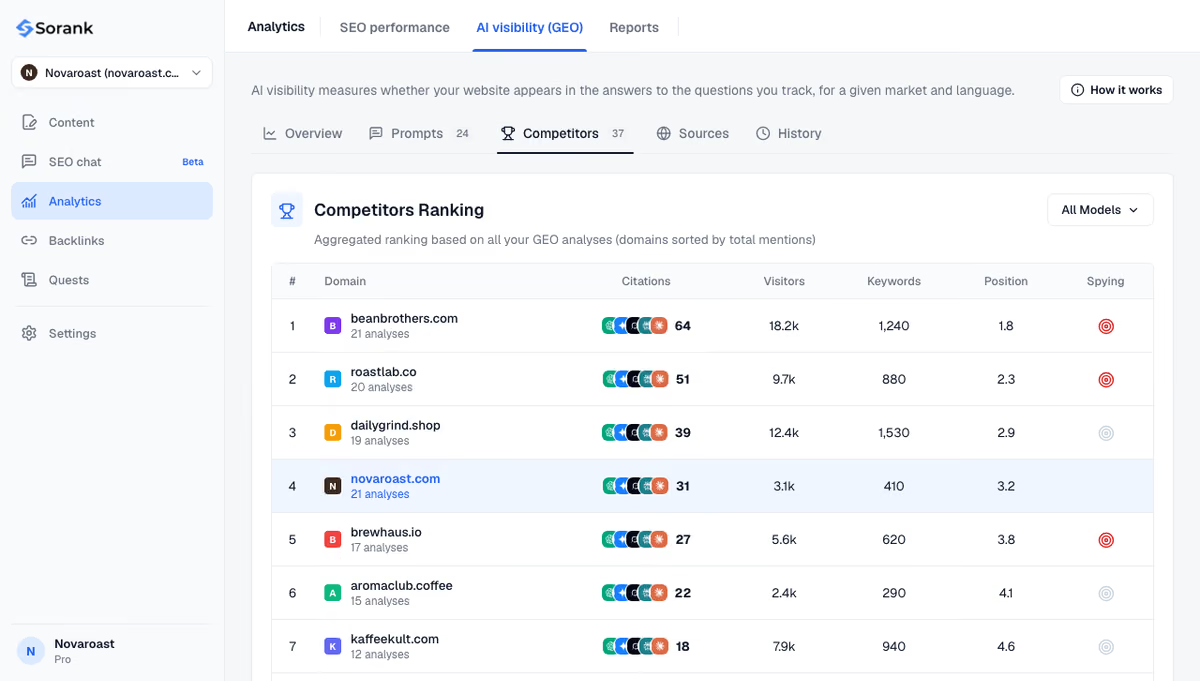
"Asana alternatives for agencies", "Pipedrive vs HubSpot for a small team", "cheaper alternative to Intercom": these buyers already know the category and are deciding where to move. Sorank reads the keywords of the competitors you track, then plans one comparison article per real matchup, with the trade-offs stated plainly and a link to your trial.
Add a rival in SEO competitor spy and its keywords feed your next plan.
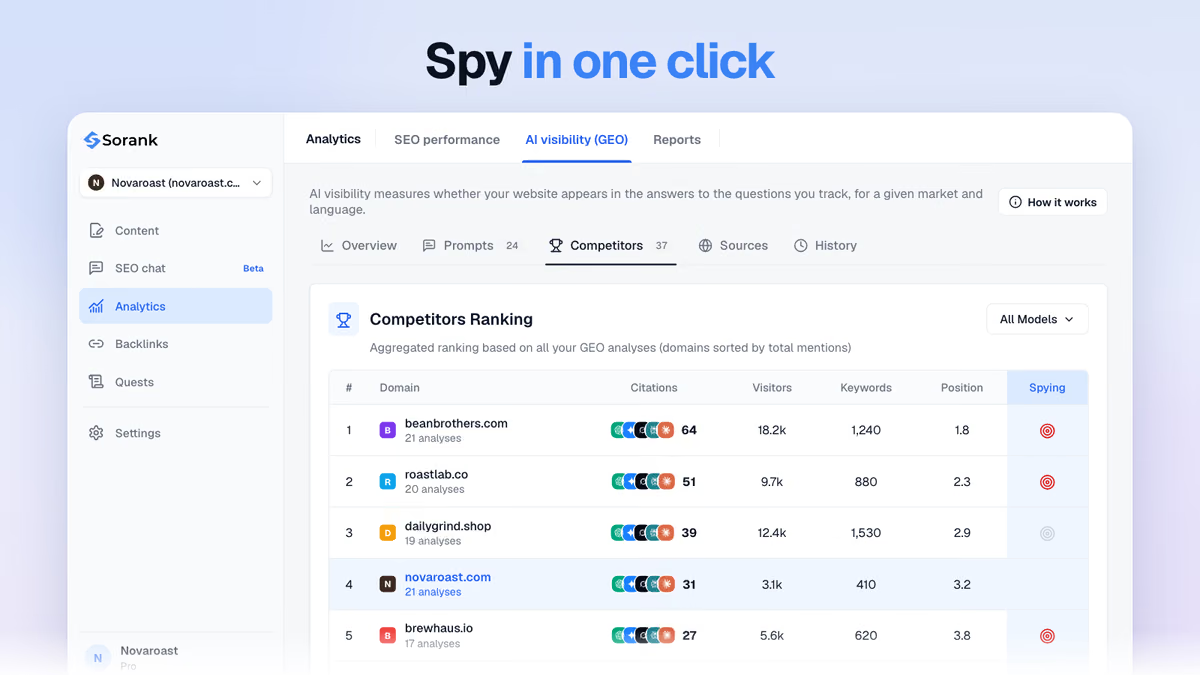
"How to automate invoice reminders", "sync Stripe payments to Google Sheets", "employee onboarding checklist template": most buyers search for a task long before they search for a product. Sorank groups these searches into topic clusters around each feature, writes one article per search and links it to the matching feature page, integration page or template.
See how topics are grouped in the topical cluster generator.
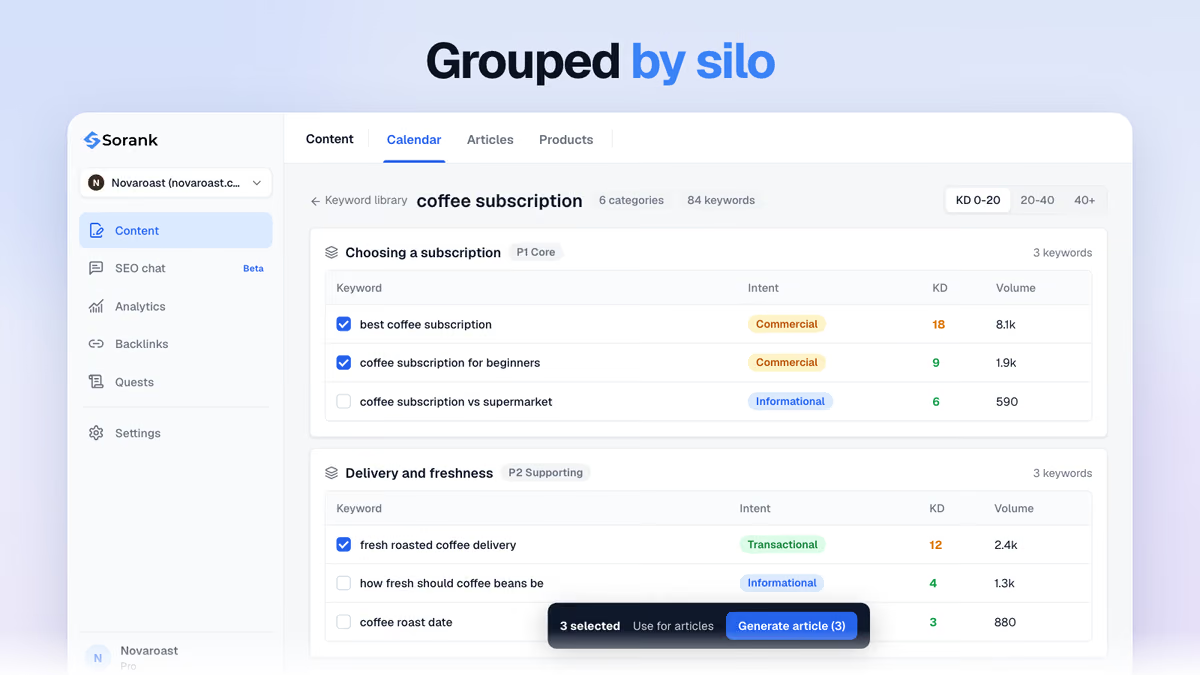
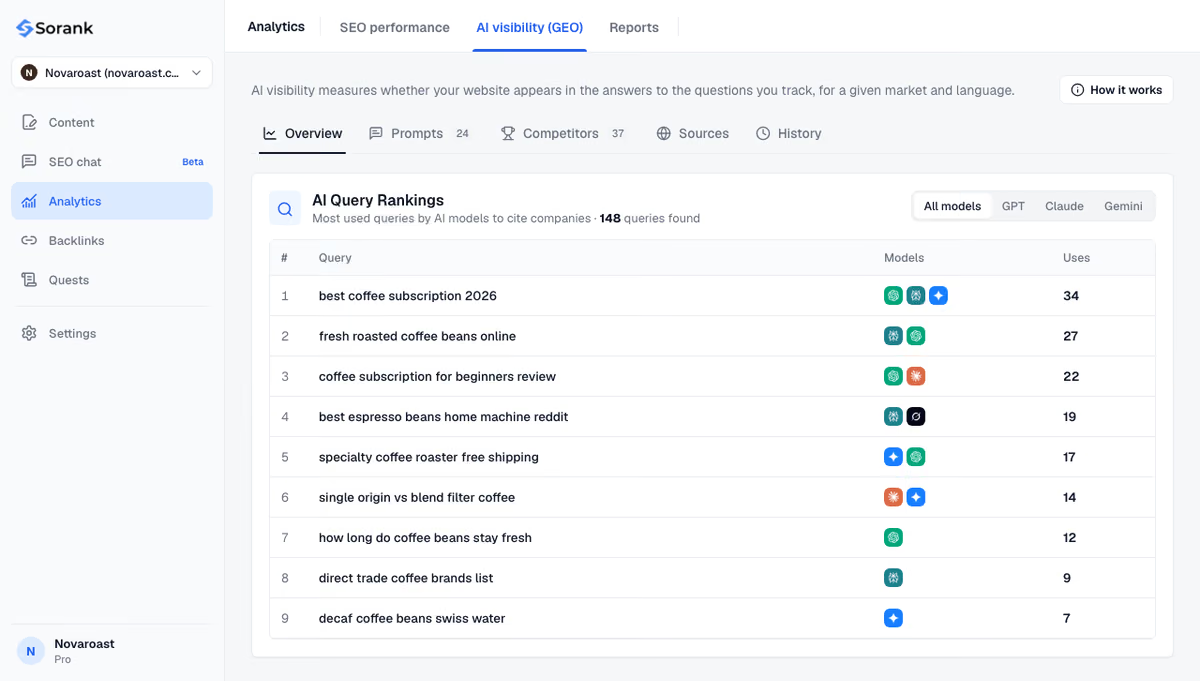
Ask ChatGPT "which project management tool for a remote agency?" and you get three to five names, each with a one-line verdict. Sorank asks the prompts of your category every month in ChatGPT, Claude and Gemini (Grok is added on the Pro plan) and shows which tools are named, and which searches and pages the answers rely on: review sites, comparison articles or your own docs.
Follow every answer in AI mention tracking.

Webflow, WordPress, Wix or Shopify connect in a few clicks; a Next.js or headless site receives articles through a webhook. Sorank reads Search Console to see which features and comparisons already earn impressions.
List the three to five tools buyers compare you with and the jobs your product does. Sorank builds the keyword plan from them: alternatives, comparisons, use cases and integrations, ranked by intent.

Your product marketer reads the drafts or lets them go live on the days you set. Every article links to a feature page and to the signup, and its clicks appear in Search Console.
“I tested Sorank on a real client site and it's insane. It does everything an agency would bill you $1500 a month for. It's going into production on that client now.”
 Guillaume Guersanguersanguillaume.com
 “I just let the Sorank software do its thing, and now my DR is 25 and my page is ranking higher.”
 Lucas Flandrefoundertrace.fr“Great service, works well for our website and helps us understand how to improve it to rank better on Google and elsewhere. Congrats, keep going, I recommend it.”
 Hugo T.E-commerce merchant“…In 4 months, I generate 15 organic leads per month without posting anything. It’s not 50/50 with LinkedIn yet, but I sleep better knowing I now have a second lead source growing on autopilot.”

 Valentin Thomyoffbound.fr
 “…With Sorank I finally understood how to structure my SEO and write articles to rank. The audit showed my product page was too slow. In 2 months, my organic traffic doubled and I’m starting to appear in ChatGPT answers when people search for Shopify themes. All of that with about 2 hours per week.”
 Thème FullStackgo.themefullstack.com“Great solution to manage SEO without headaches. Audits are fast, the interface is clear, and you quickly see which actions to implement. It has become an essential tool to track and improve the SEO of my sites. I highly recommend it.”
 XavEntrepreneur“I used Sorank for a client who needed SEO and it clearly made my life easier. I can quickly audit a site, track my projects, and keep a clear overview without multiplying tools. The onboarding is fast and the interface is great.”
 Céline MaurinFreelance CM
 “Blown away by Sorank’s performance. After testing many solutions on the market, I was amazed by how quickly our articles started ranking in the SERP. The results are concrete and much faster than anything we’ve experienced so far. It has been an excellent surprise for our team. We are confidently renewing our trust and highly recommend Sorank to agencies that demand fast and measurable results.”
 Patrick PerretFreelance Webdesign SEO“We’re a development agency and we use Sorank to run on-page audits on our clients’ Shopify stores. It helps us quickly identify optimization opportunities, structure fixes, and collaborate more easily with clients on the SEO side. Very useful to complement our technical support 🔥”

 Younes Yahyaluvaika.com“Sorank has transformed the results we deliver to our clients. We now identify the keywords AI really uses, understand why certain competitors get cited, and spot opportunities we were completely missing before. Our clients see faster rankings, better visibility in AI answers, and clearer ROI on every action we take.”

 Benjamin Rouxovirank.com“We are an Ads agency and we wanted to get our SEO back on track once and for all. Sorank gave us a clear view of our site, helped us prioritize optimizations, and properly structure our content. The tool is easy to use, well designed for a team, and very practical for centralizing tracking without having to juggle multiple platforms. A very solid foundation to start fresh with our SEO.”
 Gaspard MadouiAds Agency“I specialized in GEO thanks to Sorank. The GEO Leaderboard allows me to show my clients their position vs competitors on ChatGPT. It’s a real commercial differentiator.”
 MélanieSEO Freelance“I manage our dealership’s website and it had dozens of issues: slow pages, 404 errors, missing tags. We were losing rankings every month without understanding why. The Sorank audit detected everything in 5 minutes. I sent the report to our web provider with the priority fixes. We regained our rankings and traffic picked back up. Perfect for someone non-technical like me!”
 Xavier BreullMarketing Manager“I’m a CMO for a SaaS and I manage acquisition in a very competitive market. We were investing heavily in our product but not working on our SEO. No visibility on our real competitors, no tracking of our presence in AI. Sorank showed us our positioning vs competitors, which keywords to target, and GEO opportunities we had completely ignored!”
 Louis RAPPCMO SaaS
 “Very good version 2, I recommend it.”

 Antoine Verhillethenewblack.ai“I was skeptical at first, but this is the best SEO tool I’ve ever used. The interface is clear, audits are fast, and the recommendations are easy to implement. I’ve saved hours and hours managing SEO and tracking performance. I recommend it to all my entrepreneur friends who run an agency or work independently.”
 NoahEntrepreneur“Sorank completely changed the way our SEO agency operates. We now spend far less time on each client because everything is centralized and automated. What used to take hours now takes minutes, which finally allows us to stop working in the business and start working on the business.”

 Océane Bondismaison-leverage.com
Founder’s Note.
I ran my own SEO agency for years. I built Sorank to deliver the same results to every business, at scale.
Everything I know about Google rankings and Generative Engine Optimization (GEO) is coded into this software, and it runs on autopilot for you.
Try for Free
SaaS SEO is the work that brings software buyers to your site from Google and from AI assistants, at every step between the problem they have and the free trial they start. It differs from other sites in three ways: the buyer compares three to five tools before choosing, several people sign off on the purchase, and the conversion you measure is a trial or a demo, not a sale on the page.
The pages that carry it are well known: feature pages, use cases, integrations, comparisons, a pricing page and documentation. Our guides to B2B SEO and to product-led SEO cover the site structure; this page focuses on the content that brings buyers in every month.
More and more of them start with an AI assistant. In G2's Answer Economy survey of 1076 B2B software buyers in March 2026, 51% said they start their research with an AI chatbot more often than with Google, against 29% a year earlier, and 69% said a chatbot led them to a vendor they had not planned to choose.
The assistant builds its shortlist from pages it can read: review sites, comparison articles, documentation, forums. Generic blogging is losing ground there. In our HubSpot AI citation study, HubSpot went from 0.96% of measured AI answers in August 2025 to 0.37% in August 2026; the articles that keep being quoted carry first-hand facts such as setup steps, real limits and measured results. GEO for SaaS details the method.
Start at the bottom of the funnel, where volumes are small and intent is high, then move up:
Group them by feature so that each cluster points to one page, as our guide to keyword clustering explains.
Honestly, and from your own tests, because that is what both Google and the AI assistants reward. Google's guidance on high-quality reviews asks writers to evaluate from the user's perspective, explain what sets a product apart and discuss benefits and drawbacks based on original research.
For a SaaS page, that means a table of the plans and prices you checked, with the date, the cases where the competitor is the better pick, and the reasons a buyer would choose you. An assistant asked "is [competitor] or [you] better for a team of five?" quotes the page that answers that exact question. For examples of the genre in the SEO software market, see our own alternatives pages.
Yes, as long as each page holds something specific to its subject. Google's spam policies define scaled content abuse as many pages generated mainly to manipulate rankings, and give as an example pages produced with generative AI without adding value for users. One page per integration is fine when it shows the setup, what syncs and what does not; a hundred pages that only swap one app name for another are not. The glossary entry on programmatic SEO shows where the line sits. Sorank builds each article around its own search, from your product facts and instructions.
Sorank handles the keyword plan, the articles and their internal links, publication on Webflow, WordPress, Wix, Shopify or any stack through a webhook, the monthly AI tracking, backlinks from other Sorank users' sites, and one dashboard for Search Console, Analytics and AI visits.
Your team keeps the assets only it can produce: feature and pricing pages, documentation, product screenshots, your G2 and Capterra profiles, customer stories and the founder's voice on LinkedIn. For links from sites outside Sorank, read our guide to SaaS link building. Still searching for product-market fit? The startups page starts from there, and if you sell an AI product, the AI companies page is closer to your case.
With Sorank, the Essential plan costs $49 a month per site on a yearly plan, or $99 billed monthly, for 20 articles a month and 10 AI prompts tracked. Pro ($129 yearly, $249 monthly) brings 60 articles and adds Grok; Business ($249 yearly, $499 monthly) publishes 120 articles (see pricing). Every plan starts with a 3-day free trial and is covered by the 90-day guarantee. A content agency or an in-house writer is paid by the month or by salary and still needs a brief from you; the software does the recurring writing and leaves positioning to your team.
Count in months, not weeks. Google gives no fixed delay: a new comparison usually shows impressions in Search Console before it earns clicks, and a cluster of use-case articles builds traffic over several months. Judge each cluster after three months, on its impressions, its clicks and the trials that Analytics attributes to organic visits.
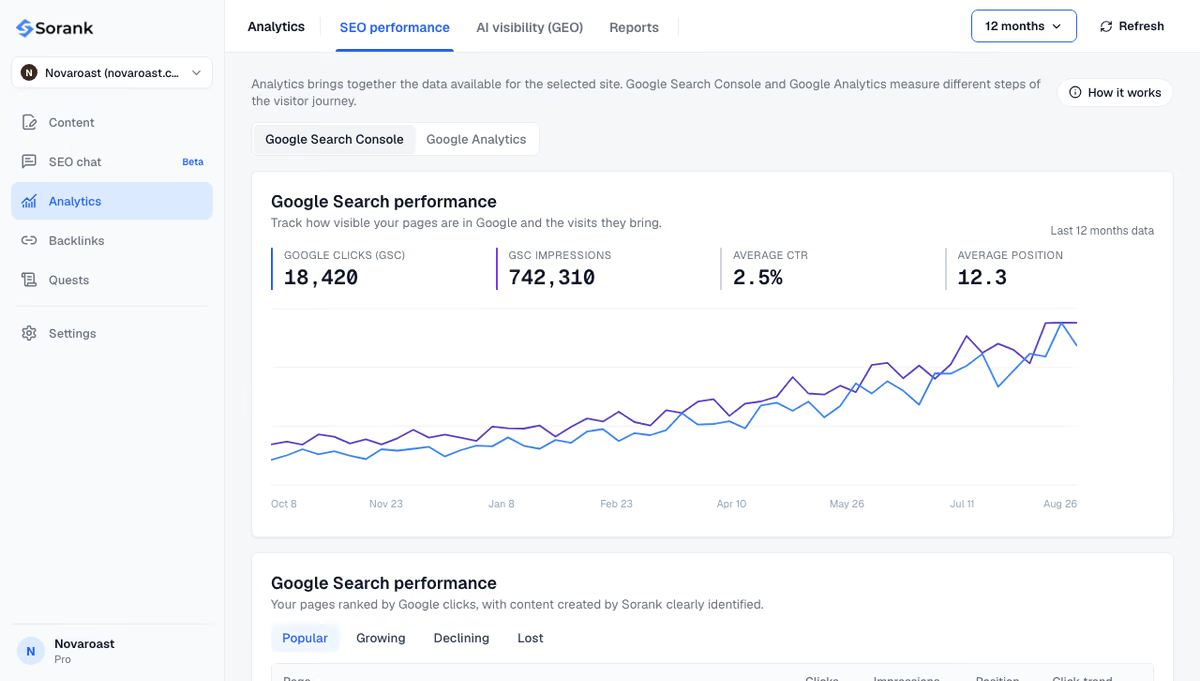
Several months. Comparison and alternatives articles usually show impressions first because their competition is narrower; judge each cluster after three months on its Search Console clicks and on the trials Analytics attributes to organic search.
Sorank starts at $49 a month per site on a yearly plan ($99 month to month), with 20 articles a month and 10 AI prompts tracked. Pro and Business publish 60 and 120 articles a month. There is a 3-day free trial.
No. Sorank is software: it plans, writes and publishes the articles and tracks the AI answers on autopilot. Your team sets the competitors, the features and the tone, and can approve each draft before it goes live.
Be described the same way on the pages ChatGPT reads: your own comparison and use-case articles, review sites such as G2 or Capterra, and your documentation. Then track the prompts of your category every month to see whether you are named and which sources the answer quotes.
Alternatives and comparison searches on your direct competitors, then the segments you serve best ("CRM for real estate agents"), then the integrations your users ask about. Broad terms like "best CRM" come last.
Yes. Sorank publishes to Webflow, WordPress, Wix and Shopify, and to Next.js, headless or custom sites through a webhook. Articles arrive live or as drafts.
We don't. Sorank isn't trying to be another Semrush or Ahrefs. Those tools are built for data, Sorank is built to do the work. Instead of more dashboards to check, it turns SEO and GEO insights into actions: articles written and published, backlinks earned, technical fixes and AI visibility tracking. Less complexity, more results.
From $49/month per website on a yearly plan, with a 3-day free trial and a 90-day money-back guarantee (conditions apply). Every plan includes articles, AI visibility tracking and access to natural backlink acquisition; higher plans add more articles, more AI prompts tracked and more backlinks. No setup fees, no paying for seats you don't use.
You shouldn't need a full marketing team or expensive tools to grow. Sorank handles your entire SEO and AI visibility, so you save time and money.