
Preferences
Privacy is important to us, so you have the option of disabling certain types of storage that may not be necessary for the basic functioning of the website. Blocking categories may impact your experience on the website. More information
Privacy is important to us, so you have the option of disabling certain types of storage that may not be necessary for the basic functioning of the website. Blocking categories may impact your experience on the website. More information

Programmatic SEO builds many pages from one template and structured data. See how it works, when it turns into spam and how to avoid thin pages.








Founder Sorank, 7+ years in SEO.
Summary
Programmatic SEO is the practice of publishing many pages from one template filled with structured data, each page targeting a repeatable search pattern such as a city, a product or a comparison. It scales well when every page holds accurate, useful facts, and it fails when the pages are thin or duplicated.
Want to go further? Ask
Programmatic SEO is a way to create search landing pages at scale with automation. Instead of writing each page by hand, a team defines one template with the headings, copy blocks, metadata and internal links, then fills it with rows from a database, an API or a spreadsheet. Queries such as "hotels in [city]" or "convert [currency] to [currency]" follow the same pattern with one or two variables, so one template can serve hundreds or thousands of them.
Programmatic SEO works in three steps. First, you find a search pattern with real demand, such as queries that repeat a city, product or service name. Second, you build one template that answers each query well for every row of data. Third, you publish the pages and measure which ones earn impressions, clicks and conversions. The layout stays the same from page to page, while the facts change row by row.
The method is common on marketplaces, directories, travel sites and software comparison hubs, because those businesses already own large, structured datasets. The risk is the same everywhere: if the data is thin, every page looks alike and adds little for the reader.
A programmatic page is only as useful as the data behind it. Strong data is accurate, specific to each row and refreshed on a schedule. A page for a city should show local prices, availability or real examples, not just the city name swapped into a sentence. Before you build, check that each row can support a paragraph of unique information. If it cannot, the row is not a page yet.
Keyword research comes first, because it decides which patterns are worth a template. Sorank's Topical Cluster Generator groups keywords into clusters with no overlapping pages, so each template has one clear target.
Not by itself. Programmatic SEO becomes a problem when the pages exist mainly to manipulate rankings. Google's spam policy on scaled content abuse describes this as generating many pages for the primary purpose of manipulating search rankings instead of helping users. The policy lists examples such as using generative AI tools to create many pages without adding value, and creating many pages where the content makes little or no sense to a reader but contains search keywords.
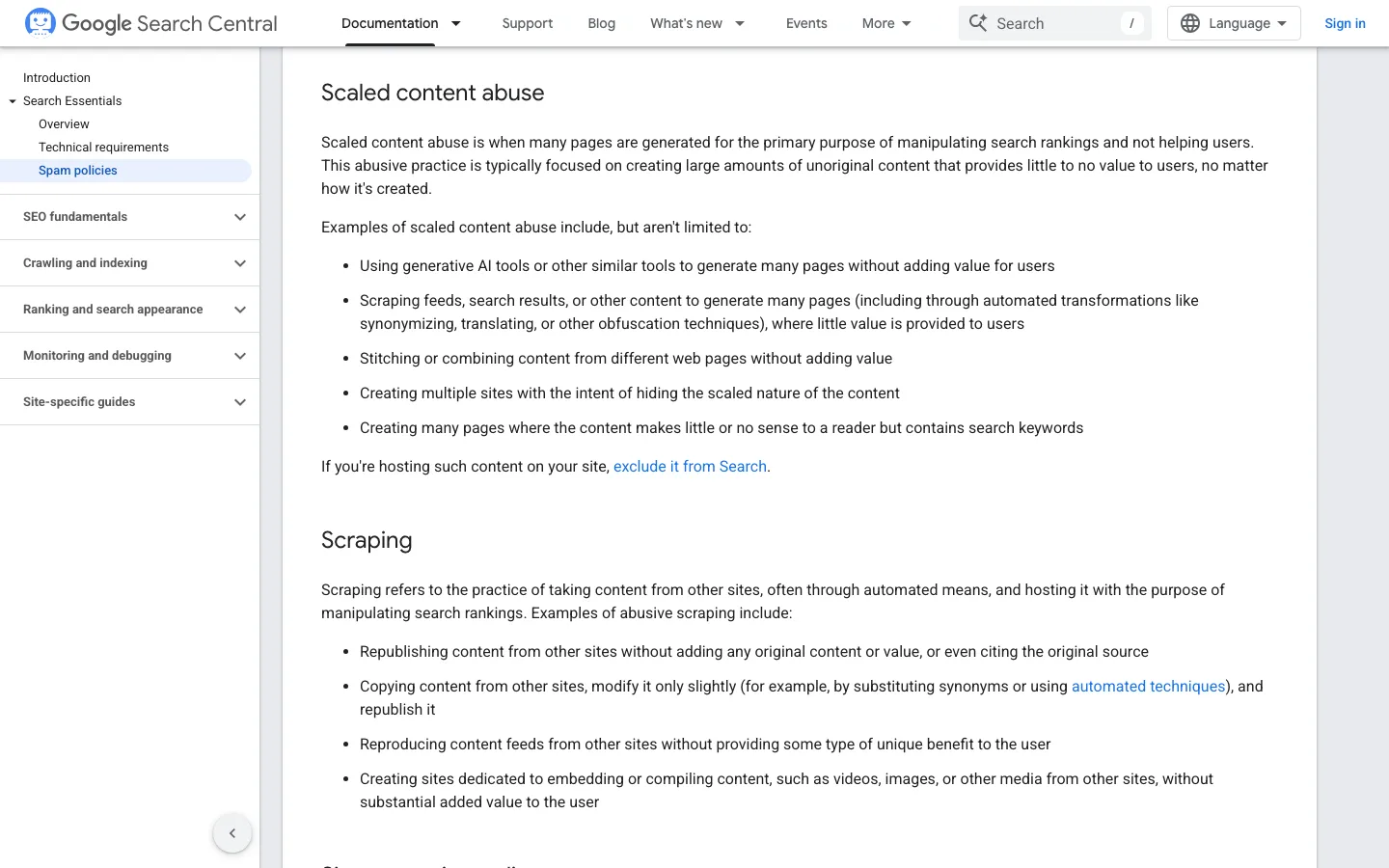
Google's guidance on helpful, people-first content asks why a page is created. The answer should be that it is made primarily to help people who arrive on the site directly. For a programmatic page, the test is simple: would a visitor find it useful if it were the only page on the site? If yes, the template is a reasonable way to scale. If the page only exists to catch a keyword, it is spam under Google's definition, whatever tool produced it.
A programmatic SEO tool builds many pages from one template and one dataset. Its real job is to refuse thin pages: it should hold back any row that lacks enough facts to fill a useful page. Judge each tool on four jobs: data import, template logic, metadata and URL control, and indexing rules.
Start with the data source, because every other choice depends on it. A spreadsheet is enough for a small list that rarely changes. A database or a CMS collection is better when rows change often or when editors must update them without a developer.
Next, check the template logic. A good tool hides a block when its field is empty instead of printing a blank sentence. This pattern shows the idea, where the sentence disappears when the price is missing:
{if min_price}Hotels in {city} start at {min_price}.{/if}The main setups differ in cost, control and upkeep. Match the choice to your data and your team, not to the longest feature list.
| Setup | Works well for | Watch out for |
|---|---|---|
| Spreadsheet with a page generator | Small lists that rarely change | Errors multiply as the sheet grows |
| CMS collection (Webflow, WordPress) | Rows that editors update without a developer | Item limits and prices depend on your plan |
| Code framework (Next.js, Astro) | Large datasets and full control of URLs and metadata | Each data refresh needs a developer and a new build |
| Dedicated programmatic SEO platform | Teams without a developer | Check how it handles thin rows and noindex rules before you pay |
For the wider picture of what software can automate, see SEO automation.
Whatever tool you pick, check four controls before launch:
Before you launch
The sitemap and canonical rules deserve the most care. Submit an XML sitemap only with pages that pass your quality bar. Point filter and sort URLs to the main page with a canonical tag or a noindex tag, as explained in canonical URLs at scale. Google’s guidance on large sites makes the same point: “eliminate duplicate content to focus crawling on unique content rather than unique URLs”.
Sorank writes and tracks articles and AI visibility, so it complements a template tool rather than replacing one.
Traditional SEO writes one page at a time around one keyword, and a writer researches each page. Programmatic SEO builds many pages from one template and one dataset. Use the first when each query needs an original answer. Use the second when the demand repeats a pattern and your data fills it with real facts. Both need a plan to avoid keyword cannibalization, where two pages compete for the same query.
| Factor | Traditional SEO | Programmatic SEO |
|---|---|---|
| Unit of work | One article or landing page | One template and one dataset |
| Best fit | Topics that need explanation or judgment | Repeating patterns such as "[service] in [city]" |
| Depth per page | Written by hand for each query | Only as deep as the data behind each row |
| Main risk | Slow output and few pages | Thin or near-duplicate pages |
| Upkeep | Update each page when the facts change | Refresh the data source on a schedule |
| What to measure | Rankings and clicks per page | Share of pages indexed and getting impressions |
Any business with a large, structured dataset and repeatable search demand is a strong candidate. Real estate listings, travel offers, ecommerce product catalogs, local services and financial comparison tools all rely on data such as prices, locations or availability. If your queries follow a predictable pattern and you own quality data, programmatic SEO can work well. If your whole dataset is ten items, a handful of hand-written pages will serve you better.
The closest real example is LV3D, a French 3D printing retailer. Sorank published dozens of articles a month for LV3D, each built around one buying intent rather than a template, and organic traffic multiplied by 4 in 5 months. Daily clicks rose from about 240 to over 1000. The principle is the same as programmatic SEO: one page for one clear intent, backed by real expertise, as described in the LV3D case study.
Google has to find and crawl each page before it can rank it, so a large set of pages must be easy to reach. Link each page from a parent hub, list the pages in an XML sitemap and make sure the template does not create endless filter or parameter URLs. Those URLs waste crawl budget, the attention Googlebot gives a site, and they can bury the good pages behind the weak ones. Use a canonical tag or a noindex tag on pages that should not rank, and write internal links that describe the target, such as "hotels in Lisbon", not "click here".
A common error is publishing the template before the data is ready. Pages then show empty fields, repeat the same paragraph or swap only the city name. The second error is building thin content at volume, with no unique fact on the page. The third is creating near-duplicate pages for queries that mean the same thing, such as two city pages for one metro area. Finally, teams often forget to refresh the data. A page built on old prices loses the trust of visitors and of search engines.
Programmatic SEO matters because it turns a dataset into a set of pages that answer many specific questions at once. Search engines reward pages that answer a question directly and show useful facts. Generative engine optimization (GEO), the work of getting cited by AI answer engines, works the same way: those systems look for clear, specific passages they can quote. A template that adds real facts to every row gives both search engines and AI systems something precise to use. A template that adds nothing gives them nothing.
Programmatic SEO scales search pages with a template and structured data. It works when each page holds facts a visitor could not get from the template alone, and it fails when the pages are thin or duplicated. Start with the pattern and the data, check the rules before you publish, then launch in small batches and measure the results. For the page types, data model and launch steps of a SaaS project, read programmatic SEO for SaaS.
Sources
Traditional SEO writes one page for one keyword, by hand. Programmatic SEO uses a single template filled with structured data to generate many pages, each aimed at a repeatable pattern such as a city or a product. The layout stays constant while the data changes.
It can, if the pages are thin or exist mainly to manipulate rankings. Google's spam policies call this scaled content abuse. The safeguard is accurate, specific data and real usefulness on every page, so each one would help a visitor even if it stood alone.
Businesses with a large, structured dataset and repeatable search demand are the strongest candidates. Real estate, travel, ecommerce and local services are classic examples, because they rely on listings, prices, locations or availability. If your queries follow a predictable pattern and you own quality data, the approach can work well.
 “I tested Sorank on a real client site and it's insane. It does everything an agency would bill you $1500 a month for. It's going into production on that client now.”

 Guillaume Guersanguersanguillaume.com“We are an Ads agency and we wanted to get our SEO back on track once and for all. Sorank gave us a clear view of our site, helped us prioritize optimizations, and properly structure our content. The tool is easy to use, well designed for a team, and very practical for centralizing tracking without having to juggle multiple platforms. A very solid foundation to start fresh with our SEO.”
 Gaspard MadouiAds Agency
 “I just let the Sorank software do its thing, and now my DR is 25 and my page is ranking higher.”
 Lucas Flandrefoundertrace.fr“I specialized in GEO thanks to Sorank. The GEO Leaderboard allows me to show my clients their position vs competitors on ChatGPT. It’s a real commercial differentiator.”
 MélanieSEO Freelance“Great service, works well for our website and helps us understand how to improve it to rank better on Google and elsewhere. Congrats, keep going, I recommend it.”
 Hugo T.E-commerce merchant



















