Preferences
Privacy is important to us, so you have the option of disabling certain types of storage that may not be necessary for the basic functioning of the website. Blocking categories may impact your experience on the website. More information

Privacy is important to us, so you have the option of disabling certain types of storage that may not be necessary for the basic functioning of the website. Blocking categories may impact your experience on the website. More information

Product-led SEO earns traffic with pages your product creates: integrations, listings, templates, tools. Page types, method and Google's limits in 2026.

Tools

In short
product-led SEO means earning search traffic with pages your product creates or feeds, instead of relying only on blog articles. Integration pages, listings, templates, free tools and data pages answer searches at the point where a user's need meets what the product does, so they convert better than generic content. It scales through templates and product data, and it only works if every page carries information that no other page in the results offers.
Want to go further? Ask
Quick quiz
Is SEO right for you, and how should you start?
Sorank matches your answers


Test it for 3 days on your own site and see where you stand on Google, ChatGPT and the other AIs.
Start 3-day free trial3 days free, then stop whenever you want. 90-day results-or-refund guarantee.
Product-led SEO is a term popularised by Eli Schwartz in his 2021 book of the same name. In an interview with Built In, he describes it as treating your SEO effort "as if it's an entire product", a content experience rather than one-off pieces aimed at single keywords. The companies usually cited, Zillow, Tripadvisor, Amazon, Zapier, did not grow search by writing more articles. They built pages that users wanted, and the traffic followed. This guide explains how it works, which page types it produces, how templates and programmatic SEO fit in, and where Google draws the line.
Product-led SEO is an organic growth strategy where the main search assets come from the product itself: its data, its features, its catalogue or its users. Instead of asking "what can we write about?", the team asks "which searches can our product answer better than anyone else?" and builds a page type for that question.
Three conditions define it:
It sits at the junction of SEO, product and product marketing: someone has to decide which features deserve a public, indexable surface, and engineering has to build it. That is why it is common among software companies, marketplaces and comparison sites, and why the SaaS sector uses it so heavily.
Content-led SEO grows through editorial articles; product-led SEO grows through page types driven by the product. Most successful sites combine both: articles capture demand early in the journey, product pages capture it when the visitor is ready to act.
| Criterion | Content-led SEO | Product-led SEO |
|---|---|---|
| Main asset | Articles, guides, definitions | Integration pages, listings, tools, templates, data pages |
| Who builds it | Writers and editors | Product, engineering and SEO together |
| Scale | One page per piece written | One template, many pages from data |
| Typical intent | Informational ("how to", "what is") | Transactional or task-based ("X + Y integration", "homes for sale in Z", "invoice template") |
| Conversion | Indirect, needs a next step | Direct, the page shows the product working |
| Main risk | Generic content that ranks nowhere | Thin or duplicate pages produced at scale |
| Time to value | Fast to start, slow to compound | Slower to build, then compounds with the product |
Neither replaces the other. A strong SaaS content marketing plan uses articles to explain the problem and product-led pages to show the solution.
The right page type depends on what your product holds that others do not. Here are the six families that work most often.
Each integration becomes a page that answers "does X work with Y?". Zapier is the textbook case: its app directory lists more than 10,000 apps (checked October 2026), with a page per app and pages per pair of apps, such as Gmail + Slack, each describing the triggers and actions available.
Marketplaces turn their inventory into pages by location, category or attribute: homes for sale in a city, hotels in a neighbourhood, jobs by title. Zillow and Tripadvisor dominate these queries because their pages hold data, photos and reviews that a blog post cannot reproduce.
Design, document and project tools publish galleries of templates ("invoice template", "content calendar template") that open directly in the product. The search intent is to get the template, and the page delivers it.
A calculator, checker or generator built from a slice of the product answers a task-based search and demonstrates the product in seconds. This is the most accessible format for smaller teams because one tool can rank on its own.
Profiles, reviews, public boards and community answers create pages as users act. They scale without the company writing anything, but they need moderation and quality thresholds before being indexed.
"X vs Y", "X alternatives" and "X for [industry]" pages capture buyers who are already choosing. They are product-led when they rely on real product data (features, limits, prices checked) rather than opinions, which matters especially in B2B SEO where buyers compare carefully.
Tip
To find your page type, list the data your product holds that competitors cannot copy (your catalogue, your usage data, your integrations). The page type with the most unique data and real search demand is your first candidate.
Programmatic SEO is the production method; product-led SEO is the strategy. Programmatic SEO generates many pages from one template and a database. Product-led SEO decides which pages deserve to exist because the product gives them something unique.
A template-driven page has three layers:
When the third layer is empty, pages differ only by a word in the title and become thin content. When the same data appears on several URLs, they become duplicate content. Both are the classic failure modes of programmatic projects.
Start from search data, not from features. Collect the queries that combine a need with an entity your product covers ("[tool] integration", "[city] + [service]", "[document] template") and check the search intent behind each pattern: if the results are articles, a product page will struggle; if they are tools, listings or templates, you have a match.
Count how many pages the pattern would produce and how much search volume the head and the tail carry. Start with one page type, not five. A pattern that yields 300 strong pages beats one that yields 30,000 empty ones.
Define the title, H1, URL and meta description patterns, the internal links between related pages, the structured data, and the content blocks that appear only when data exists. Pages with missing data should not be generated or should stay out of the index.
Rank the pages by potential and add hand-written context to the top of the list: setup steps, use cases, limits, examples. The long tail can rely on data alone if that data is rich.
Generate an XML sitemap per page type, link pages from hubs and category pages, and decide indexing rules before launch (noindex for empty or near-empty pages, canonicals for variants). Google's guide on managing crawl budget (updated July 2026) targets sites with more than 1 million unique pages, or more than 10,000 pages that change daily: below that, crawl budget is rarely the problem, page quality is. An indexability checker confirms each template returns the right status and directives.
Track impressions, clicks, indexation rate and sign-ups by template, not page by page. If more than a small share of a page type stays "Crawled, currently not indexed" in Search Console, Google is telling you the template lacks value: fix the template before adding pages.
Google has nothing against generated pages, only against generated pages without value. Its spam policies (updated August 2026) define scaled content abuse as "when many pages are generated for the primary purpose of manipulating search rankings and not helping users", "no matter how it's created". The same page defines doorway abuse as "when sites or pages are created to rank for specific, similar search queries".
| Warning sign | What Google sees | Fix |
|---|---|---|
| Pages differ only by a city or tool name | Doorway pages | Add local or product data, or merge into one page |
| Template filled with AI text and no data | Scaled content abuse | Generate only where real data exists |
| Thousands of pages, few indexed | Low value at template level | Improve the template, noindex the weakest pages |
| Same listing on several URLs (filters, sorting) | Duplicate content | Canonicals and indexing rules for parameters |
| Pages with zero results or "no reviews yet" | Empty pages | Do not generate until data exists |
Watch out
Launching thousands of pages at once is the fastest way to see most of them ignored. Publish a first batch, check how many get indexed and earn impressions, then extend the pattern.
Google's guidance on helpful, people-first content gives the test to apply to every template: "Does the content provide original information, reporting, research, or analysis?" A product-led page passes it naturally when it shows data only your product has.
Yes, for the same reason it works on Google: AI assistants such as ChatGPT, Gemini and Perplexity look for sources that hold specific, verifiable facts. A page listing exactly which actions an integration supports, or a listing page with prices and reviews, is easier to cite than a generic article. Sorank's Tripadvisor AI citation study looks at how often AI answers cite a platform whose pages are built from product data and user reviews.
Three habits make product pages more citable:
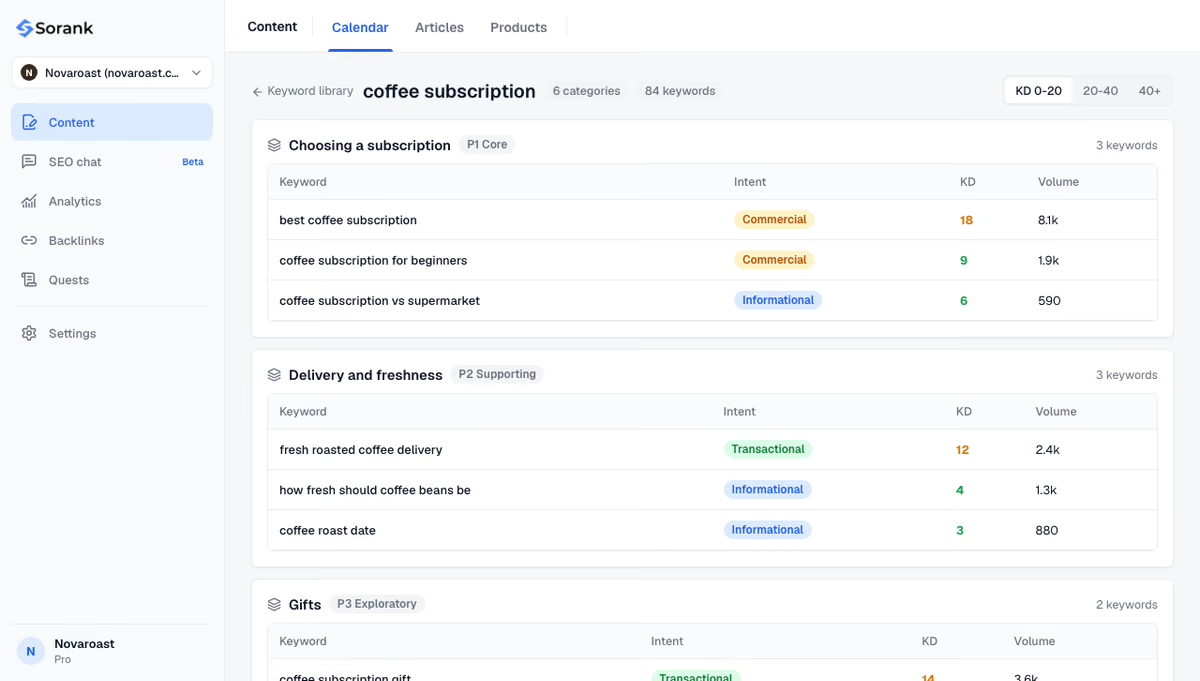
Product pages still need a supporting cluster of articles that explain the problem, compare approaches and link to them. This is where Sorank comes in: its automated keyword research finds the queries around your product, and the topical cluster generator groups them into silos, one page per topic, so articles and product pages link to each other instead of competing.
Product-led SEO works when each generated page carries data or a function that only your product can provide; the template is how you scale it, never the reason the page exists. Start with one page type, prove it gets indexed and converts, then extend it, and let articles cover the questions around it. Sorank writes and publishes those supporting articles on autopilot: see the plans and pricing, with a 3-day free trial.

The term was popularised by Eli Schwartz, an SEO consultant, in his book Product-Led SEO: The Why Behind Building Your Organic Growth Strategy, published in 2021. He argues that search growth should come from building pages users want, as a product, rather than from one-off articles targeted at single keywords.
No. Marketplaces, e-commerce sites, travel and real estate platforms, job boards and media with databases use it as much as software companies. Any business that holds unique data, a catalogue or a useful function can turn it into indexable pages that answer real searches.
Start with a limited batch, often the few hundred pages with the strongest data and demand, rather than the full set. Check in Search Console how many get indexed and earn impressions over several weeks, improve the template if indexation is low, then extend the pattern to the rest.
We analyse your competitors, your website and your AI visibility to create a tailored content plan for free.
 AI Content Brief Generator
 FAQ Schema Generator
 AI Blog Post Ideas Generator
 Structured Data Validator (Schema Validator)
 Alt Text Checker
 Internal Link Analyzer
 Backlink Challenge
 AI Meta Description Generator
 AI Blog Title Generator
 Google Indexability Checker
 AI Blog Outline Generator
 UTM Link Builder
 Keyword Clustering Tool
 Canonical Tag Checker
 XML Sitemap Generator
 Broken Link Checker
 AI SEO Title Generator
 Headline Analyzer
 SERP Preview Tool
 Redirect Checker
 Hreflang Tag Generator
 Heading Structure Analyzer
 HTTP Headers Checker
 Favicon Extractor
 SERP CTR Calculator
 SEO vs Paid Search Savings Calculator
 SEO Share of Voice Calculator
 SEO ROI Calculator
 SEO Traffic and Revenue Forecast Calculator
 SEO Budget Calculator
 SEO Break-Even Calculator
 SaaS SEO ROI Calculator
 ROAS Calculator
 Reading Time Calculator
 Ranking Gain Simulator
 Organic Traffic Value Calculator
 Organic Traffic Estimator and Website Traffic Checker
 LTV to CAC Ratio Calculator
 Local SEO ROI Calculator
 Link Building Cost Calculator
 Keyword Value Calculator
 Keyword Opportunity Score Calculator
 Keyword Density Calculator
 GEO ROI Calculator
 GEO Content Investment Calculator
 Ecommerce SEO ROI Calculator
 Customer Lifetime Value Calculator
 Customer Acquisition Cost Calculator
 CTR Calculator
 Cost Per Article Calculator
 Conversion Rate Calculator
 Content Marketing ROI Calculator
 ChatGPT Referral Traffic Estimator
 Bounce Rate Calculator
 Backlink ROI Calculator
 AI Visibility Score Calculator
 AI Traffic Value Calculator
 AI Share of Voice Calculator
 Cost of AI Invisibility Calculator
 AI Citation Rate Calculator
 llms.txt Validator
 AI Overview Checker and AI Overviews Rank Checker
 Robots.txt Checker
 AI SEO Audit
 LLM Readability Checker
 SearchGPT Readiness Checker
 Structured Data LLM Audit
 Website Crawlability AI Audit
 Why ChatGPT Is Not Recommending My Website
 Gemini Ranking Tool
 Perplexity Ranking Checker
 LLM Citation Checker
 Answer Engine Optimization Audit
 GEO Audit
 AI Search Visibility Test
 ChatGPT Visibility Checker
 llms.txt Generator
 URL Extractor
 Webpage to Markdown
 Sitemap Checker
 SERP Volatility Sensor
 Page Size Checker
 Word Counter
 Slug Generator
 Schema Generator
 Robots Generator
 OG Preview
 Meta Tags Generator
 Image Compressor
 Favicon Generator
 On-Page SEO Audit: SEO Checker and SEO Analyzer
 Backlink Analysis Tool
 Keyword Research Tool
 Domain Authority Checker
THEY TRIED SORANK BEFORE YOU
 “I tested Sorank on a real client site and it's insane. It does everything an agency would bill you $1500 a month for. It's going into production on that client now.”

 Guillaume Guersanguersanguillaume.com“We are an Ads agency and we wanted to get our SEO back on track once and for all. Sorank gave us a clear view of our site, helped us prioritize optimizations, and properly structure our content. The tool is easy to use, well designed for a team, and very practical for centralizing tracking without having to juggle multiple platforms. A very solid foundation to start fresh with our SEO.”
 Gaspard MadouiAds Agency
 “I just let the Sorank software do its thing, and now my DR is 25 and my page is ranking higher.”
 Lucas Flandrefoundertrace.fr“I specialized in GEO thanks to Sorank. The GEO Leaderboard allows me to show my clients their position vs competitors on ChatGPT. It’s a real commercial differentiator.”
 MélanieSEO Freelance“Great service, works well for our website and helps us understand how to improve it to rank better on Google and elsewhere. Congrats, keep going, I recommend it.”
 Hugo T.E-commerce merchant