Preferences
Privacy is important to us, so you have the option of disabling certain types of storage that may not be necessary for the basic functioning of the website. Blocking categories may impact your experience on the website. More information

Privacy is important to us, so you have the option of disabling certain types of storage that may not be necessary for the basic functioning of the website. Blocking categories may impact your experience on the website. More information

Product description SEO in 2026: write unique product copy that ranks on Google and gets reused by AI assistants, with 3 templates and a checklist.
Tools

In short
Product description SEO means writing a unique description for each product that answers what shoppers type into Google and ask AI assistants: what the product is, who it is for, its exact specifications and how it compares. Use one specific long-tail keyword per product, lead with benefits backed by facts, keep the same facts in the page, the structured data and the product feed, and never copy the manufacturer's text across hundreds of pages.
Want to go further? Ask
Quick quiz
Is SEO right for you, and how should you start?
Sorank matches your answers


Test it for 3 days on your own site and see where you stand on Google, ChatGPT and the other AIs.
Start 3-day free trial3 days free, then stop whenever you want. 90-day results-or-refund guarantee.
Product description SEO is the part of e-commerce SEO that most stores neglect, because writing 500 descriptions by hand is slow and pasting the supplier's text is fast. The result is thousands of stores with the same paragraph on the same product, and no reason for Google to rank one over another. Google's own guidance on helpful, people-first content asks whether a page avoids "simply copying or rewriting" other sources and adds "substantial additional value". This guide shows how to write descriptions that pass that test, with three templates you can reuse and a checklist.
An SEO product description is the text block on a product page that describes the item in words a shopper uses, with enough detail to answer their questions before they buy. It sits next to the title, the price, the photos and the reviews; our guide to the elements of an e-commerce product page covers the rest of the page.
A good description does three jobs at once: it helps Google understand which searches the page answers, it gives AI assistants clear facts to quote, and it convinces the visitor. Shoppers rely on it more than most merchants think: in usability testing by the Baymard Institute (April 2018), every participant used the product description at some point to decide whether a product fit their needs, yet only 22% of the sites tested structured descriptions around feature highlights.
Google reads the visible text to match the page with a query and its search intent. A shopper searching "waterproof hiking boots wide fit" wants a page that states, in plain words, that the boots are waterproof and come in a wide fit. If that information sits only in an image or a size chart, the page has less chance of ranking for the query.
Google also reads two machine-readable versions of the same product: the Product structured data on the page and, if you use Merchant Center, the product feed. Google's documentation on sharing product data recommends adding structured data to product pages where feasible and warns that combining page and feed data can create inconsistencies in price and availability. The rule that follows: one product, one set of facts, repeated identically everywhere.
AI assistants such as ChatGPT, Gemini and Perplexity go one step further. When a user asks "which running shoes are best for flat feet under 150 dollars", they gather product pages, feeds, reviews and comparison articles, then extract attributes (price, use case, material, sizing) and build a short list. A description that states those attributes in clear sentences is easier to extract than one made of adjectives. Our article on AI in e-commerce explains how this new shopping channel works.
Target the most specific phrase a buyer would type, usually a long-tail keyword: "merino wool running socks" rather than "socks". Look for modifiers that reveal purchase intent (material, size, use, compatibility). A keyword research tool shows which variants have volume, and the category page should target the broader term so the two do not compete.
State what the product is, who it is for and the main reason to choose it. These two sentences are the ones most likely to be quoted by an AI assistant and read on a phone, so put the keyword there, once, naturally.
"600-fill goose down" is a feature; "stays warm down to -10°C while packing into a bag the size of a water bottle" is the benefit. Add the proof: a measurement, a certification, a test result, a material origin. Vague praise ("premium quality", "best on the market") gives neither Google nor AI anything to work with.
Dimensions, weight, materials, compatibility, care instructions and what is in the box belong in a readable list or table. This is the data AI assistants compare across stores, and the details shoppers search for ("fits 13-inch MacBook").
Use a short intro paragraph, then 3 to 6 highlights with a bold label, then the specification list. Baymard's research found that highlight-style descriptions made users explore features more thoroughly than plain text blocks.
Keep the same tone across the catalog: technical for tools, warm for gifts, precise for cosmetics. The principles of SEO copywriting apply: clear words, short sentences, the keyword where it reads naturally and nowhere else.
The description lives on the page; the title tag and meta description live in the search results. Write them for each product (or generate a solid base with a meta description generator and edit it), and keep the product name, key attribute and keyword at the start.
Tip
Read your customer reviews and support emails before writing. The questions people ask after buying ("does it run small?", "is it dishwasher safe?") are the ones the description should answer before they buy.
Templates save time only if each slot is filled with information specific to the product. A template filled with the same sentences on every page creates near-duplicate content; a template that forces you to write the use case, the proof and the specifications produces unique pages.
| Element | Weak description | SEO-ready description |
|---|---|---|
| Opening | "Discover our amazing new backpack, perfect for everyone." | "A 20-liter waterproof hiking backpack for day hikes, with a padded sleeve for a 15-inch laptop." |
| Benefits | "High quality and durable." | "Made from 600D recycled polyester with taped seams, so gear stays dry in heavy rain." |
| Specifications | Image of a size chart only | Text list: 48 x 30 x 18 cm, 850 g, 20 L, hip belt, 2-year warranty |
| Keyword use | "Backpack" repeated eight times | "Waterproof hiking backpack" once in the opening, variants elsewhere |
| Uniqueness | Supplier text shared by dozens of stores | Written for this store, with its own advice and photos |
Manufacturer descriptions are the main source of duplicate content in e-commerce: the same text on the brand site, on marketplaces and on every reseller. Google will usually pick one version to show and filter out the others, and the brand or the largest marketplace tends to win that contest.
Prioritize by revenue and traffic potential. Rewrite your best sellers and the products with search demand first; for the long tail of low-volume items, add a unique opening paragraph and your own usage advice above the supplier specifications. For products that differ only by color or size, use one page with variants rather than one page per variant, and point duplicates to the main version with a canonical tag.
The same logic applies between products and categories. Our guide to category page SEO shows how to give each collection its own broader keyword so it does not compete with the product pages it lists.
Watch out
Generating thousands of descriptions with AI and publishing them unedited is a risk. Google's spam policies list "using generative AI tools or other similar tools to generate many pages without adding value for users" as scaled content abuse. Feed the tool real product data and check every claim.
No length ranks by itself. The right length is the one that answers the questions a buyer has for that type of product. A pair of socks needs a few sentences and a specification list; a mattress, a camera or a skincare serum needs several hundred words because buyers compare many attributes.
| Product type | What the description must cover | Rule of thumb |
|---|---|---|
| Simple, low-price items | Material, size, use, care | 50 - 150 words + spec list |
| Fashion and home | Fit, feel, styling, care, sizing advice | 150 - 300 words |
| Technical products | Use cases, performance, compatibility, full specs | 300 - 600 words + spec table |
| Considered purchases (furniture, high-end gear) | Comparison points, materials, warranty, delivery and assembly | 400 words or more |
If you also send a feed to Google Merchant Center, its description attribute accepts up to 5,000 characters and should not contain promotional text such as price, shipping or sale dates, links or capital letters for emphasis. Write the page description first, then adapt a clean factual version for the feed.
Generative engines answer shopping questions with a short list of products and the reason each one fits. To be on that list, a product page needs the facts an assistant can extract and repeat: the exact use case, the measurable specifications, the price and availability in structured data, and reviews that confirm the claims. A schema generator helps you add Product markup if your platform does not do it already; Shopify themes usually include it, and our page on SEO and GEO for Shopify lists what to check.
Product pages rarely get cited alone. AI assistants also quote buying guides, comparisons and how-to articles, and our study of AI citations in retail shows which kinds of sources they favor. A store that publishes useful guides around its products ("how to choose a hiking backpack", "merino vs synthetic socks") gives the AI more pages to cite and more internal links to its product pages.
This is where Sorank helps. Sorank is our product: an SEO and GEO software that finds the keywords your store can rank for, then writes and publishes the supporting articles on autopilot with sources, images and internal links to your products. The blog article generator creates each article from a keyword:
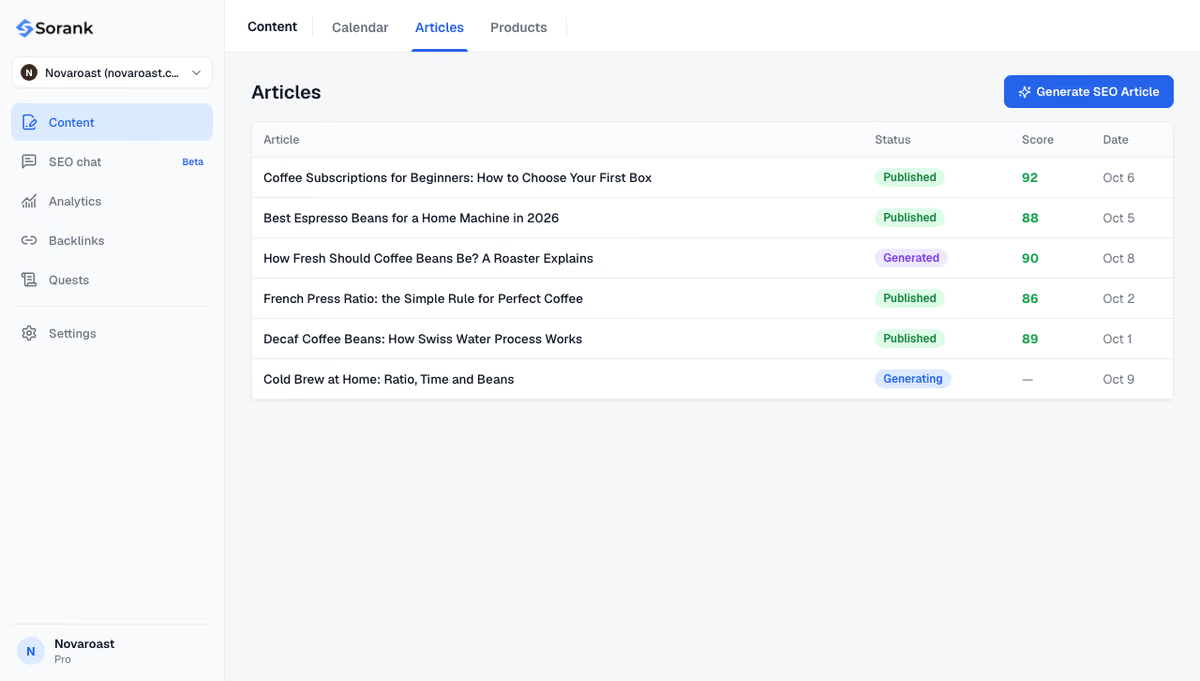
Once the content is live, AI mention tracking shows whether ChatGPT, Claude and Gemini cite your brand for the shopping questions you care about, and which competitors appear instead.
| Check | Why it matters |
|---|---|
| One specific keyword, in the first two sentences | Matches the buyer's query without stuffing |
| Unique text, not the supplier's | Avoids being filtered as a duplicate |
| Benefits backed by numbers or proof | Convinces visitors, gives AI facts to quote |
| Specifications as readable text | Indexable, comparable by AI assistants |
| Same facts in page, structured data and feed | Avoids price and stock conflicts |
| Unique title tag and meta description | Improves click-through from results |
| Reviews and answers to common questions | Adds fresh, specific content and trust |
The best descriptions are written for the buyer and structured for the machine: specific keyword, real facts, unique words, consistent data. Start with your 20 best sellers, measure the change in impressions and clicks over two to three months, then roll the method out to the rest of the catalog. To support those pages with guides that rank and get cited, see Sorank's plans, from 49 dollars per month on the annual plan, with a 3-day free trial.

There is no ideal length for ranking. Simple products need 50 to 150 words plus a specification list, while technical or expensive products often need 300 words or more because buyers compare many attributes. Write until the main buying questions are answered, then stop.
You can, but it is a weak choice for SEO. The same text appears on the brand site and on many other stores, so Google usually shows one version and filters the rest. Rewrite descriptions for your best sellers first, and at least add a unique opening and your own advice to the others.
Google does not penalize text because AI wrote it, but it treats many pages generated without value for users as scaled content abuse. AI-written descriptions work when they are based on real product data, checked for accuracy and edited to sound like your brand.
We analyse your competitors, your website and your AI visibility to create a tailored content plan for free.
 AI Content Brief Generator
 FAQ Schema Generator
 AI Blog Post Ideas Generator
 Structured Data Validator (Schema Validator)
 Alt Text Checker
 Internal Link Analyzer
 Backlink Challenge
 AI Meta Description Generator
 AI Blog Title Generator
 Google Indexability Checker
 AI Blog Outline Generator
 UTM Link Builder
 Keyword Clustering Tool
 Canonical Tag Checker
 XML Sitemap Generator
 Broken Link Checker
 AI SEO Title Generator
 Headline Analyzer
 SERP Preview Tool
 Redirect Checker
 Hreflang Tag Generator
 Heading Structure Analyzer
 HTTP Headers Checker
 Favicon Extractor
 SERP CTR Calculator
 SEO vs Paid Search Savings Calculator
 SEO Share of Voice Calculator
 SEO ROI Calculator
 SEO Traffic and Revenue Forecast Calculator
 SEO Budget Calculator
 SEO Break-Even Calculator
 SaaS SEO ROI Calculator
 ROAS Calculator
 Reading Time Calculator
 Ranking Gain Simulator
 Organic Traffic Value Calculator
 Organic Traffic Estimator and Website Traffic Checker
 LTV to CAC Ratio Calculator
 Local SEO ROI Calculator
 Link Building Cost Calculator
 Keyword Value Calculator
 Keyword Opportunity Score Calculator
 Keyword Density Calculator
 GEO ROI Calculator
 GEO Content Investment Calculator
 Ecommerce SEO ROI Calculator
 Customer Lifetime Value Calculator
 Customer Acquisition Cost Calculator
 CTR Calculator
 Cost Per Article Calculator
 Conversion Rate Calculator
 Content Marketing ROI Calculator
 ChatGPT Referral Traffic Estimator
 Bounce Rate Calculator
 Backlink ROI Calculator
 AI Visibility Score Calculator
 AI Traffic Value Calculator
 AI Share of Voice Calculator
 Cost of AI Invisibility Calculator
 AI Citation Rate Calculator
 llms.txt Validator
 AI Overview Checker and AI Overviews Rank Checker
 Robots.txt Checker
 AI SEO Audit
 LLM Readability Checker
 SearchGPT Readiness Checker
 Structured Data LLM Audit
 Website Crawlability AI Audit
 Why ChatGPT Is Not Recommending My Website
 Gemini Ranking Tool
 Perplexity Ranking Checker
 LLM Citation Checker
 Answer Engine Optimization Audit
 GEO Audit
 AI Search Visibility Test
 ChatGPT Visibility Checker
 llms.txt Generator
 URL Extractor
 Webpage to Markdown
 Sitemap Checker
 SERP Volatility Sensor
 Page Size Checker
 Word Counter
 Slug Generator
 Schema Generator
 Robots Generator
 OG Preview
 Meta Tags Generator
 Image Compressor
 Favicon Generator
 On-Page SEO Audit: SEO Checker and SEO Analyzer
 Backlink Analysis Tool
 Keyword Research Tool
 Domain Authority Checker
THEY TRIED SORANK BEFORE YOU
 “I tested Sorank on a real client site and it's insane. It does everything an agency would bill you $1500 a month for. It's going into production on that client now.”

 Guillaume Guersanguersanguillaume.com“We are an Ads agency and we wanted to get our SEO back on track once and for all. Sorank gave us a clear view of our site, helped us prioritize optimizations, and properly structure our content. The tool is easy to use, well designed for a team, and very practical for centralizing tracking without having to juggle multiple platforms. A very solid foundation to start fresh with our SEO.”
 Gaspard MadouiAds Agency
 “I just let the Sorank software do its thing, and now my DR is 25 and my page is ranking higher.”
 Lucas Flandrefoundertrace.fr“I specialized in GEO thanks to Sorank. The GEO Leaderboard allows me to show my clients their position vs competitors on ChatGPT. It’s a real commercial differentiator.”
 MélanieSEO Freelance“Great service, works well for our website and helps us understand how to improve it to rank better on Google and elsewhere. Congrats, keep going, I recommend it.”
 Hugo T.E-commerce merchant