Preferences
Privacy is important to us, so you have the option of disabling certain types of storage that may not be necessary for the basic functioning of the website. Blocking categories may impact your experience on the website. More information

Privacy is important to us, so you have the option of disabling certain types of storage that may not be necessary for the basic functioning of the website. Blocking categories may impact your experience on the website. More information

GEO for SaaS in 2026: the prompts, pages, reviews and technical checks that get your software named by ChatGPT, Gemini and Claude, plus a 90-day plan.
Tools

In short
GEO for SaaS is the work that gets a software product named when buyers ask ChatGPT, Gemini, Claude or Perplexity which tool to choose. It rests on four levers: clear pages that answer buying questions (comparisons, alternatives, pricing, use cases, documentation), consistent third-party evidence (review sites, directories, communities, press), technical access for AI crawlers, and a fixed panel of prompts measured every month. SEO remains the base, because AI assistants mostly retrieve pages that are already indexed and easy to quote.
Want to go further? Ask
Quick quiz
How should you get mentioned by ChatGPT and other AI assistants?
Sorank matches your answers


Test it for 3 days on your own site and see where you stand on Google, ChatGPT and the other AIs.
Start 3-day free trial3 days free, then stop whenever you want. 90-day results-or-refund guarantee.
Software buyers changed their first step faster than most marketing teams changed their plans. In a survey of 1,076 B2B software buyers run in March 2026, G2 found that 51% now start their research with an AI chatbot more often than with Google, up from 29% one year earlier. GEO for SaaS (generative engine optimization applied to software companies) is how you make sure your product is on the short list those chatbots write. This guide covers the prompts that matter, the pages AI assistants cite for software, the off-site signals, the technical checks and a 90-day plan. For the commercial side of the topic, see our page on SEO and GEO for SaaS companies.
Generative engine optimization is the practice of making content easy for AI assistants to find, trust and quote. The term comes from a research paper by Aggarwal and colleagues at Princeton and partner institutions, GEO: Generative Engine Optimization, accepted at the KDD 2024 conference, which reported that targeted changes to a page (adding statistics, quotations and cited sources) could boost visibility in generative answers by up to 40% in the authors' tests.
For a SaaS company, the difference with classic SEO lies in what you win. On Google, you win a position and a click. In an AI answer, you win a mention inside a list of two to five tools, often with a sentence explaining why you fit. That sentence is built from your own pages and from what others say about you, so GEO reaches beyond your website.
| Dimension | SEO for SaaS | GEO for SaaS |
|---|---|---|
| Goal | Rank a page in Google results | Be named and described correctly in AI answers |
| Unit of work | Keyword and page | Prompt, entity and passage |
| Main sources | Your site and its backlinks | Your site, review sites, directories, communities, press |
| Key metric | Positions, clicks, sign-ups | Mention rate, share of voice, accuracy of the description |
| Typical winning page | Guide, feature page | Comparison, alternatives, pricing, documentation |
The two disciplines share the same base. Google states in its documentation on AI features and your website that there are no additional requirements or special optimizations to appear in AI Overviews or AI Mode: a page must be indexed and eligible to show a snippet. A SaaS site that Google cannot crawl will not be cited by Gemini either.
Software is bought after research, often by a committee, and the question asked to an AI assistant is exactly the question a buyer used to type into Google or ask a peer: which tool should I use for this job? The same G2 study gives the scale of the shift:
The consequence for a SaaS team is direct: a product absent from AI answers loses deals it never sees, because the short list is formed before the first visit to the website. This is also why GEO belongs in your SaaS marketing strategy and not only in the SEO backlog.
Start from the questions, not from the keywords. A prompt is a full sentence with context (team size, industry, budget, stack), and AI assistants break it into several searches behind the scenes, a mechanism Google calls query fan-out. Build a panel of 30 to 100 prompts spread across seven families:
| Prompt family | Example | Page that usually gets cited |
|---|---|---|
| Category | Best project management software for agencies | Category page, review sites, roundups |
| Use case | Tool to automate invoice reminders for a 20-person company | Use-case or industry page |
| Comparison | Tool A vs Tool B for a sales team | Comparison page, review site comparisons |
| Alternatives | Cheaper alternative to Tool A | Alternatives page, communities |
| Pricing | How much does Tool A cost per user? | Public pricing page |
| Integration | CRM that integrates with Slack and HubSpot | Integration pages, marketplace listings |
| Brand | Is Tool A reliable? What do users say about it? | Review sites, documentation, status page |
Brand prompts are usually fine: the assistant knows your name. The gap sits in category, use-case and alternatives prompts, where the buyer has not chosen yet. That is where most SaaS companies discover they are missing, while two competitors appear in every answer.
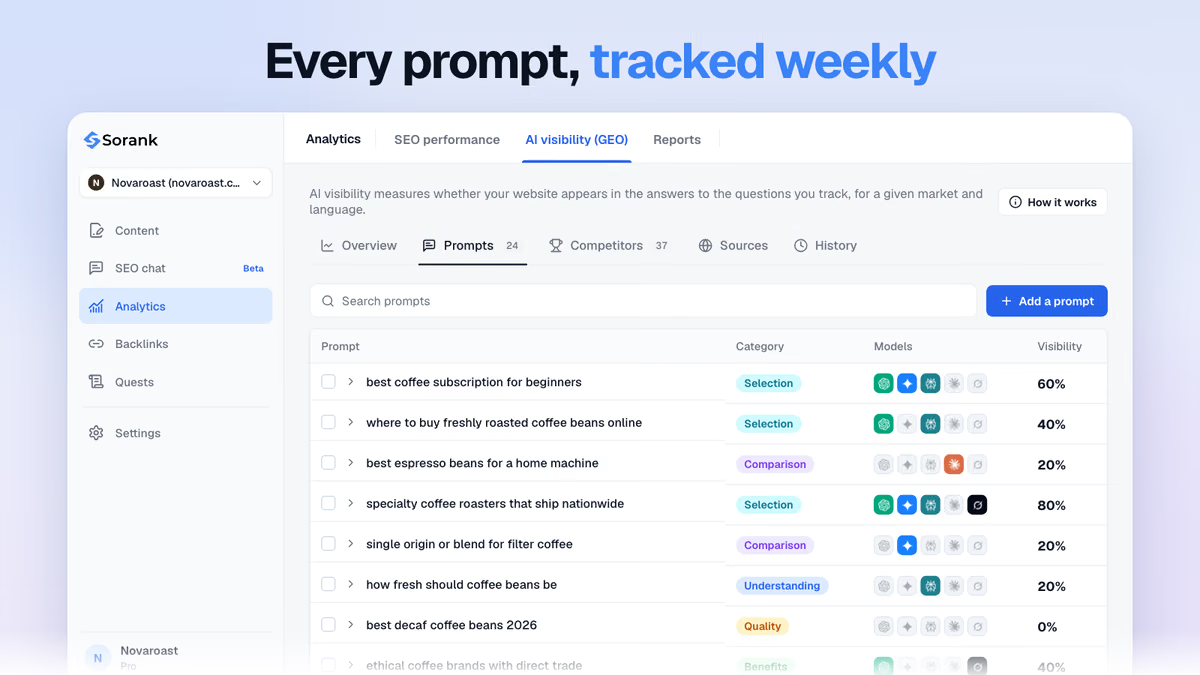
AI assistants quote passages that answer a question in a few self-contained sentences. On a typical SaaS site, five page types do most of that work.
If you do not publish an honest comparison with your main competitors, the assistant will build one from review sites and from your competitors' pages. Write one page per serious competitor, with a table of criteria, the cases where the other tool fits better, and dated prices. A balanced comparison gets quoted; a page that claims to win on every line reads as advertising and is easy to discard.
Pricing prompts are frequent and precise (price per user, free plan, annual discount). A readable pricing page in HTML, with plan names, limits and what each plan includes, gives the assistant a reliable answer.
Watch out
When the only answer on your site is a contact form, AI assistants fill the gap with third-party estimates, which are often old or wrong. Publish at least a starting price or a clear price range per plan.
Technical questions (does it support SSO, is there an API, how do I export my data) are answered from documentation. Keep it public, crawlable, organized with one question per heading and the answer in the first sentence. Documentation is also the source an assistant uses to check that a feature really exists.
One page per role, problem and outcome (for example, a tool for onboarding new employees in retail) matches long prompts word for word. Feed them with real details: workflow, setup time, the integrations involved. Our guide to SaaS content marketing explains how to plan these pages along the funnel.
Buyers often filter by stack. One page per integration, stating what syncs, in which direction and on which plan, answers prompts that combine two tools and helps the assistant link your brand to known entities.
Across all five types, the passages that get quoted share the traits studied in our analysis of how AI assistants choose their sources: a direct answer under a question heading, specific figures with a date, a named audience, and no marketing filler.
An AI assistant rarely recommends a tool on the vendor's word alone. It looks for corroboration: review platforms such as G2, Capterra or Trustpilot, software directories, Reddit threads, YouTube tutorials, press articles and analyst reports. Our AI citation study by platform shows that the mix depends on the model: some assistants lean on video and review platforms, others on encyclopedic and institutional sources.
Three rules hold for every SaaS company. Ask satisfied customers for reviews on the two or three platforms that matter in your category, regularly rather than in one burst. Keep the same product name, category and one-line description everywhere (website, directories, social profiles, app marketplaces), because inconsistent descriptions blur the entity. And answer real questions in communities where your buyers talk, under your own name. The detail of which review sites weigh most, and the rules to respect, is in our guide to review sites and AI recommendations.
Note
G2 reports that citations from a software review site are the top trust signal for buyers using chatbots. A review profile with recent, detailed reviews works for both the buyer and the assistant that reads it.
Many SaaS sites are built as JavaScript applications, which raises three checks.
Schema markup does not get you cited on its own, but it states without ambiguity what your product is, what it costs and which category it belongs to, which reduces wrong descriptions.
Tip
Ask ChatGPT, Gemini and Claude to describe your product in two sentences, with its price and main competitors. Every error in the answer points to a page to fix or a third-party listing to update.
Google Search Console does not report AI mentions, so GEO needs its own measurement. Four indicators are enough for a monthly review:
Run the same prompts every month on the same assistants, because answers vary from one run to the next. A trend over three months says more than a single snapshot.
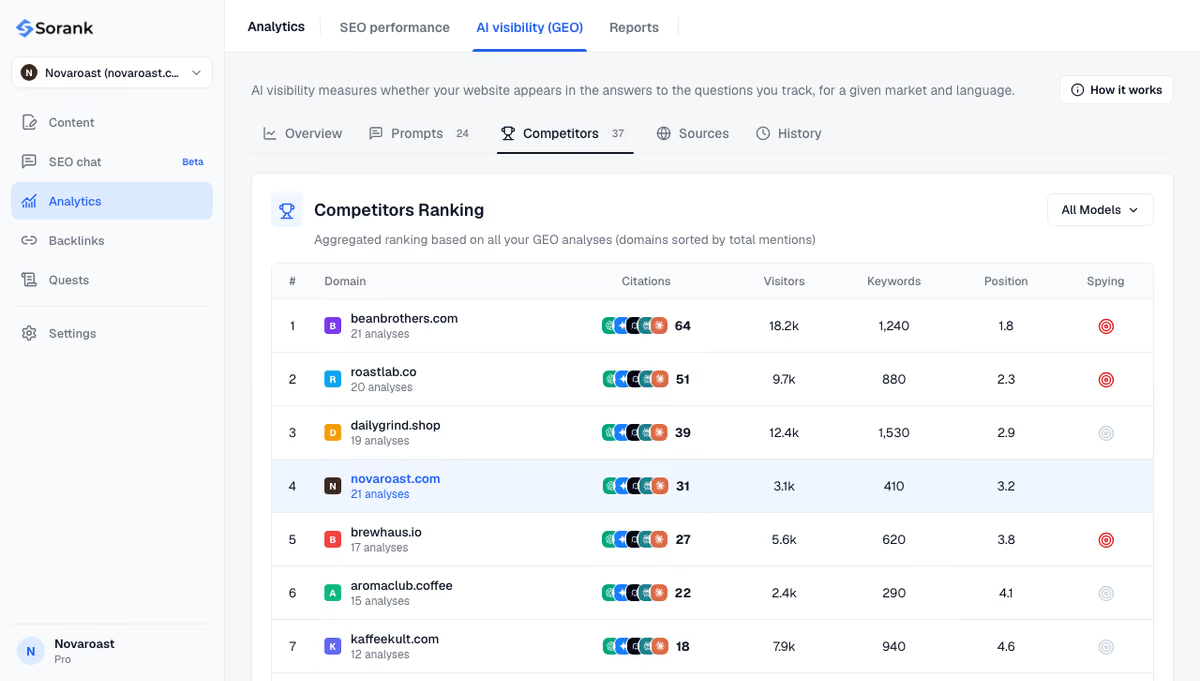
Sorank automates this part: its AI mention tracking follows 25 to 150 prompts depending on the plan on ChatGPT, Claude and Gemini (plus Perplexity and Grok from the Pro plan), shows whether your brand is cited and who is cited in its place, and the GEO leaderboard ranks the competitors that AI assistants name most often in your market.
To put a value on the work before you start, our free SaaS SEO ROI calculator turns traffic and conversion assumptions into expected revenue.
| Period | Actions | Output |
|---|---|---|
| Weeks 1-2 | Build the prompt panel, run a baseline on 3 to 5 assistants, check robots.txt, firewall and rendering | Baseline mention rate and list of gaps |
| Weeks 3-6 | Publish or rewrite pricing, top 3 comparison pages, alternatives page, add SoftwareApplication markup | Quotable pages for the prompts closest to purchase |
| Weeks 7-10 | Use-case and integration pages, documentation cleanup, review campaign, align directory listings | Coverage of long prompts and third-party proof |
| Weeks 11-12 | Second measurement, compare with baseline, list the prompts still lost and who wins them | Next quarter backlog |
After the first quarter, the work becomes a routine: one new comparison or use-case page per month, regular reviews, monthly measurement. Publishing at that rhythm is where a tool helps: Sorank's blog article generator writes and publishes articles optimized for Google and AI assistants, with sources and internal links, in autopilot or as drafts for review.
GEO for SaaS comes down to being the clearest, best-corroborated answer to the questions your buyers ask AI assistants. Start with pricing, comparisons and a measured prompt panel, then widen. To track your AI visibility and publish the content behind it, see Sorank plans, from $49 per month on annual billing, with a 3-day free trial.

Pages that AI assistants retrieve through live search can be cited within weeks of being indexed, while changes in what a model knows without searching take longer. Most SaaS teams see measurable movement in their prompt panel after one or two quarters of steady work. Measure monthly on the same prompts to separate real progress from normal answer variation.
Blocking GPTBot only stops your content from being used to train OpenAI models; it does not remove you from ChatGPT search, which relies on OAI-SearchBot. Many software companies allow OAI-SearchBot and decide on GPTBot separately. Whatever you choose, check that your firewall or CDN does not block search crawlers by mistake.
Yes, and it is a good moment to start, because the first comparison, pricing and use-case pages are cheap to publish and quick to index. Early products often win long, specific prompts (a niche use case, an integration, a budget) before broad category prompts. Collecting the first reviews on one relevant platform early also gives AI assistants the outside proof they look for.
We analyse your competitors, your website and your AI visibility to create a tailored content plan for free.
 AI Content Brief Generator
 FAQ Schema Generator
 AI Blog Post Ideas Generator
 Structured Data Validator (Schema Validator)
 Alt Text Checker
 Internal Link Analyzer
 Backlink Challenge
 AI Meta Description Generator
 AI Blog Title Generator
 Google Indexability Checker
 AI Blog Outline Generator
 UTM Link Builder
 Keyword Clustering Tool
 Canonical Tag Checker
 XML Sitemap Generator
 Broken Link Checker
 AI SEO Title Generator
 Headline Analyzer
 SERP Preview Tool
 Redirect Checker
 Hreflang Tag Generator
 Heading Structure Analyzer
 HTTP Headers Checker
 Favicon Extractor
 SERP CTR Calculator
 SEO vs Paid Search Savings Calculator
 SEO Share of Voice Calculator
 SEO ROI Calculator
 SEO Traffic and Revenue Forecast Calculator
 SEO Budget Calculator
 SEO Break-Even Calculator
 SaaS SEO ROI Calculator
 ROAS Calculator
 Reading Time Calculator
 Ranking Gain Simulator
 Organic Traffic Value Calculator
 Organic Traffic Estimator and Website Traffic Checker
 LTV to CAC Ratio Calculator
 Local SEO ROI Calculator
 Link Building Cost Calculator
 Keyword Value Calculator
 Keyword Opportunity Score Calculator
 Keyword Density Calculator
 GEO ROI Calculator
 GEO Content Investment Calculator
 Ecommerce SEO ROI Calculator
 Customer Lifetime Value Calculator
 Customer Acquisition Cost Calculator
 CTR Calculator
 Cost Per Article Calculator
 Conversion Rate Calculator
 Content Marketing ROI Calculator
 ChatGPT Referral Traffic Estimator
 Bounce Rate Calculator
 Backlink ROI Calculator
 AI Visibility Score Calculator
 AI Traffic Value Calculator
 AI Share of Voice Calculator
 Cost of AI Invisibility Calculator
 AI Citation Rate Calculator
 llms.txt Validator
 AI Overview Checker and AI Overviews Rank Checker
 Robots.txt Checker
 AI SEO Audit
 LLM Readability Checker
 SearchGPT Readiness Checker
 Structured Data LLM Audit
 Website Crawlability AI Audit
 Why ChatGPT Is Not Recommending My Website
 Gemini Ranking Tool
 Perplexity Ranking Checker
 LLM Citation Checker
 Answer Engine Optimization Audit
 GEO Audit
 AI Search Visibility Test
 ChatGPT Visibility Checker
 llms.txt Generator
 URL Extractor
 Webpage to Markdown
 Sitemap Checker
 SERP Volatility Sensor
 Page Size Checker
 Word Counter
 Slug Generator
 Schema Generator
 Robots Generator
 OG Preview
 Meta Tags Generator
 Image Compressor
 Favicon Generator
 On-Page SEO Audit: SEO Checker and SEO Analyzer
 Backlink Analysis Tool
 Keyword Research Tool
 Domain Authority Checker
THEY TRIED SORANK BEFORE YOU
 “I tested Sorank on a real client site and it's insane. It does everything an agency would bill you $1500 a month for. It's going into production on that client now.”

 Guillaume Guersanguersanguillaume.com“We are an Ads agency and we wanted to get our SEO back on track once and for all. Sorank gave us a clear view of our site, helped us prioritize optimizations, and properly structure our content. The tool is easy to use, well designed for a team, and very practical for centralizing tracking without having to juggle multiple platforms. A very solid foundation to start fresh with our SEO.”
 Gaspard MadouiAds Agency
 “I just let the Sorank software do its thing, and now my DR is 25 and my page is ranking higher.”
 Lucas Flandrefoundertrace.fr“I specialized in GEO thanks to Sorank. The GEO Leaderboard allows me to show my clients their position vs competitors on ChatGPT. It’s a real commercial differentiator.”
 MélanieSEO Freelance“Great service, works well for our website and helps us understand how to improve it to rank better on Google and elsewhere. Congrats, keep going, I recommend it.”
 Hugo T.E-commerce merchant