Preferences
Privacy is important to us, so you have the option of disabling certain types of storage that may not be necessary for the basic functioning of the website. Blocking categories may impact your experience on the website. More information

Privacy is important to us, so you have the option of disabling certain types of storage that may not be necessary for the basic functioning of the website. Blocking categories may impact your experience on the website. More information

GEO for ecommerce in 2026: optimize product pages, feeds and reviews so ChatGPT, Gemini and Google AI Mode recommend your products.
Tools

In short
GEO for ecommerce means making your products easy for AI assistants to find, understand and recommend when a shopper asks ChatGPT, Gemini, Perplexity or Google AI Mode what to buy. It rests on four levers: product pages that state every useful fact in plain words, structured data and product feeds that repeat the same facts, reviews and third-party mentions that prove them, and measurement of the questions where your store is cited or missing.
Want to go further? Ask
Quick quiz
How should you get mentioned by ChatGPT and other AI assistants?
Sorank matches your answers


Test it for 3 days on your own site and see where you stand on Google, ChatGPT and the other AIs.
Start 3-day free trial3 days free, then stop whenever you want. 90-day results-or-refund guarantee.
Shoppers now start a growing share of their research in a chat window. Adobe Analytics data reported by TechCrunch (April 2026) shows traffic from AI sources to US retail sites up 393% year over year in the first quarter of 2026, and in March 2026 that traffic converted 42% better than other traffic. GEO for ecommerce is the work that decides whether your products appear in those answers. This guide covers how AI assistants pick products, what to change on product pages and feeds, why reviews weigh so much, and how to measure the result.
Generative engine optimization (GEO) is the practice of making content easy for AI assistants to retrieve, trust and quote. Applied to a store, it means getting your products and your brand named in AI shopping answers: "best trail running shoes for wide feet", "a quiet dishwasher under $800", "is this serum safe for sensitive skin".
Classic e-commerce SEO targets a ranked list of links. GEO targets a synthesized answer that often names three to five products, compares them and links to a few merchants. The two overlap heavily (most AI assistants retrieve pages through a search index), but GEO adds new inputs: product feeds sent directly to AI platforms, and the opinions of other sites about your products. Our overview of AI in e-commerce covers the wider shift; this guide focuses on visibility.
| Aspect | E-commerce SEO | GEO for ecommerce |
|---|---|---|
| Where the shopper sees you | Blue links, Shopping results, product snippets | Product cards and recommendations inside ChatGPT, Gemini, Perplexity and Google AI Mode |
| Main inputs | Pages, links, structured data | Pages, structured data, product feeds, reviews, forum and video mentions |
| Unit of competition | A URL for a keyword | A product (and a merchant) for a conversational question |
| Success metric | Rankings, clicks | Mentions and citations per question, AI-referred traffic and sales |
An AI shopping answer draws on three sources of data, and a store needs to be present in all three.
This is why AI shopping rewards stores with consistent data everywhere. If your page says "waterproof", your feed says nothing and reviews complain about leaks, the model has three conflicting signals and usually picks a competitor with a clean record. Platform choice also matters less than data quality: in Sorank's Shopify AI citation study, the same platform was cited in 1.54% of Gemini answers but only 0.08% of Claude answers, so each assistant needs to be checked separately.
OpenAI documents its merchant program in its commerce developer guide. Merchants send a regularly refreshed product feed (CSV or JSON) covering identifiers, descriptions, pricing, inventory, media and fulfillment options. The guide states that recommended attributes "like rich media, reviews, and performance signals" improve ranking, relevance and user trust. Required fields only make a product eligible; the optional ones make it competitive.
The program has changed fast. On March 24, 2026, OpenAI said the first version of Instant Checkout (buying inside ChatGPT) "did not offer the level of flexibility that we aspire to provide" and that merchants could use their own checkout while it focuses on product discovery, as reported by Digital Commerce 360. The same announcement said Shopify Catalog would supply product data for Shopify merchants, and that retailers such as Target, Sephora and Best Buy had integrated for discovery.
Watch out
Checkout options inside AI assistants change every few months. Build your GEO work on what lasts (complete product data, clear pages, real reviews) and test any in-chat checkout as an extra channel once those basics are in place.
For a store, the practical consequences are simple. On Shopify, check that your catalog data is complete, since it travels to ChatGPT without a separate feed. On other platforms, a feed tool helps you maintain one clean source for Google, ChatGPT and marketplaces; our comparison of product feed management software lists the main options.
The product page remains the reference document. AI assistants quote it, Google reads it to build the Shopping Graph, and shoppers land on it after the recommendation.
Shoppers ask AI assistants full questions: "a carry-on backpack that fits under a plane seat and holds a 16-inch laptop". Each attribute in that question (size, use, compatibility) must appear in plain words on the page. Google said in May 2026 that strong product descriptions are "critical for brands to get discovered in the AI era" and invited retailers to update them with conversational attributes, in its Google Marketing Live announcement. Our guide to product description SEO gives templates.
Dimensions, materials, weight, compatibility, care instructions and warranty belong in a visible HTML table, not in an image or a PDF. Tables are the easiest format for a model to extract and compare.
Add three to six questions shoppers really ask (sizing, returns, who the product is not for) with short, factual answers. These passages match the follow-up questions AI assistants generate. The full list of page elements is in our guide to the e-commerce product page.
Product structured data tells machines the name, brand, GTIN, price, availability, rating, shipping and return policy. Google's product structured data documentation recommends using both on-page markup and a Merchant Center feed, because together they maximize eligibility for shopping experiences. A schema generator produces valid JSON-LD in a few minutes.
If prices, variants or reviews load only through JavaScript, some AI crawlers will never see them. Render key facts in the HTML and check that your robots.txt does not block the assistants you want to appear in; our guide to robots.txt and AI crawlers lists the user agents.
Tip
Start with your 20 best-selling products. Rewrite their descriptions, add a specification table and three buyer questions, then check the same facts in the feed. It is the fastest way to see whether GEO moves your numbers before you scale to the whole catalog.
A product feed is the machine version of your catalog. The fields below are the ones that most often decide whether a product can be matched to a detailed question.
| Field | Why it matters for AI answers |
|---|---|
| Title | Brand, product type and key attribute (size, color, model) in the first words, for exact matching |
| Description | The same conversational attributes as the page: use, audience, compatibility |
| GTIN or MPN, brand | Lets the platform merge your offer with reviews and other listings of the same product |
| Price and availability | Out-of-date prices or stock exclude the product or damage trust |
| Product category and attributes | Material, size, gender, age group, color: the filters shoppers state in their questions |
| Images and video | Rich media is one of the attributes OpenAI says improves ranking |
| Ratings and reviews | Review count and score are part of the comparison the assistant makes |
| Shipping and return policy | Answers "delivered by Friday" or "free returns" questions |
Refresh frequency matters as much as completeness: a feed updated once a week will show prices and stock that no longer match the page, and platforms penalize mismatches.
A model does not take your word for it. When it recommends a product, it looks for independent confirmation: review scores, forum discussions, video tests, marketplace listings. Sorank's retail AI citation study (29,925 AI answers measured between May and August 2026) shows which sources the AIs cite most in retail: Shopify at 5.27% of answers, YouTube at 4.12%, Trustpilot at 3.55%, Reddit at 2.23% and Amazon at 2.17%.
Three conclusions follow for a store:
Many shopping questions are not about one product: "how to choose a road bike for commuting", "merino or synthetic base layer for skiing". AI assistants answer them with guides and comparisons, then name products. Stores that publish these guides give the model both the explanation and the product to recommend.
GEO needs its own measurement, because a product mention in ChatGPT does not appear in Search Console.
| Metric | How to track it | Frequency |
|---|---|---|
| Mentions per buyer question | A fixed list of 25 to 150 shopping questions run on each assistant | Weekly |
| Competitors cited instead of you | Same question list, record every brand and store named | Weekly |
| AI-referred sessions and revenue | Analytics segment for chatgpt.com, perplexity.ai, gemini.google.com and similar referrers | Monthly |
| Share of voice on Google AI surfaces | AI performance insights in Merchant Center (rolling out in the US, Canada, Australia, India and New Zealand since May 2026) | Monthly |
| Feed and markup health | Merchant Center diagnostics, structured data validation | After each catalog change |
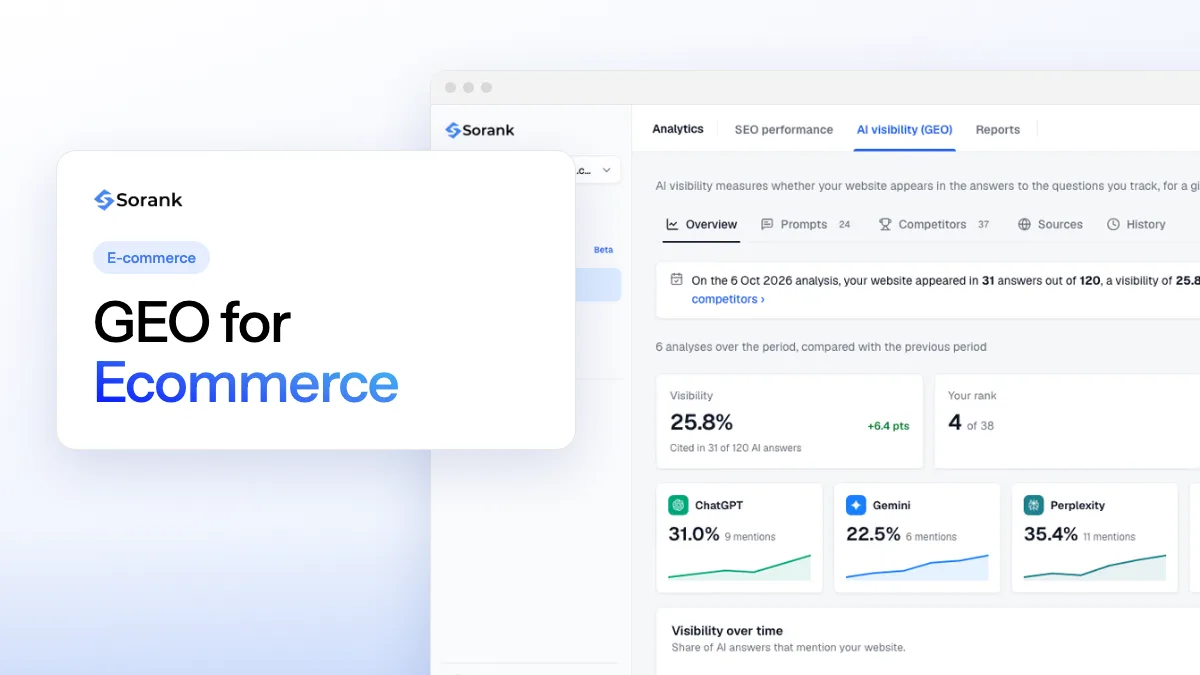
Sorank's AI mention tracking runs this question list automatically on ChatGPT, Claude and Gemini (plus Perplexity and Grok from the Pro plan) and shows which brands are cited in your place, so you can see which products and pages need work first.
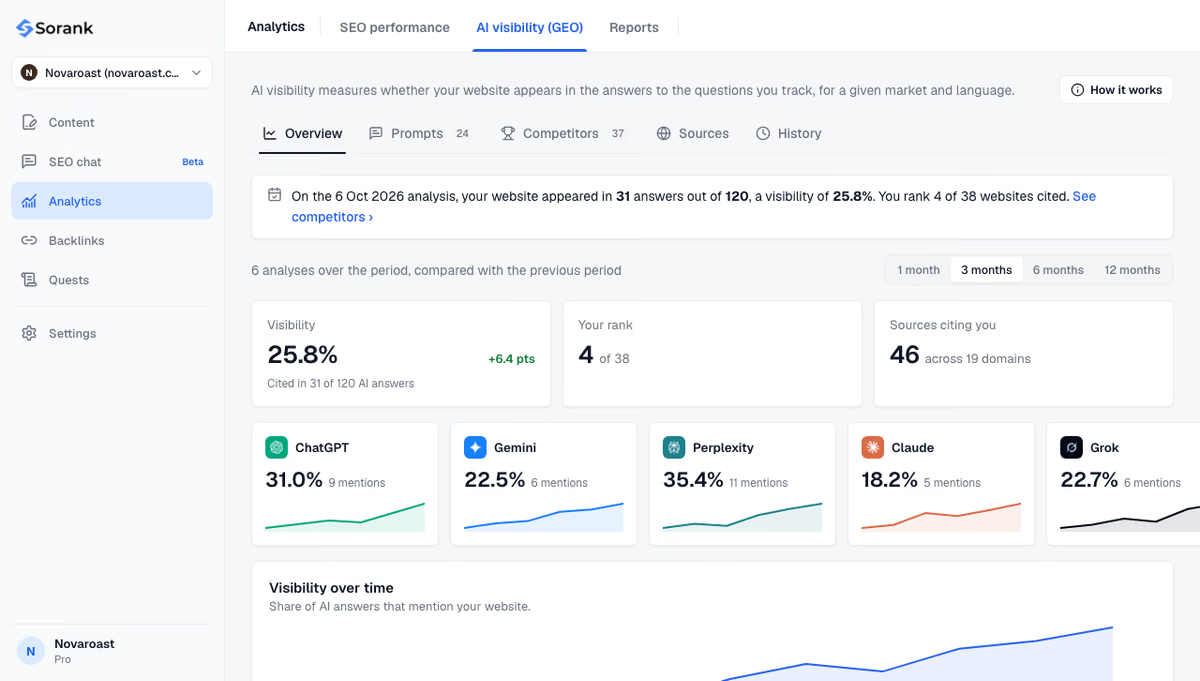
GEO extends e-commerce SEO. The same fundamentals feed both channels: crawlable pages, unique descriptions, structured data, internal links and authority. What changes is the scope (feeds, reviews and third-party mentions now count as much as your own pages) and the measurement (questions instead of keywords). A store that already does solid SEO has most of the groundwork for GEO; a store that copies supplier descriptions and ignores its feed has the same weakness in both channels.
The stores that AI assistants recommend are the ones whose product facts are complete, consistent and confirmed by others. Start with your best sellers, fix the data, collect reviews, and track a list of buyer questions every week. Sorank writes and publishes the buying guides and articles that support your products and tracks your citations in the AIs, from $49 per month; see the pricing page for plans and the 3-day free trial.

GEO builds on SEO and adds two inputs that classic SEO ignores: product feeds sent to AI platforms and third-party opinions such as reviews, forums and videos. The goal also changes, from ranking a URL for a keyword to being named in an answer to a buying question. Most SEO work on product and category pages helps both.
Shopify stores reach ChatGPT through Shopify Catalog, so they mainly need complete catalog data. Other merchants can apply to OpenAI's merchant program and send a product feed. Many stores maintain one clean master feed with a feed management tool and export it to Google Merchant Center, ChatGPT and marketplaces.
Feed and structured data fixes can be picked up within days or weeks, because platforms refresh product data often. Mentions that depend on reviews, guides and third-party content usually take two to four months to build. Track a fixed list of buyer questions weekly to see the trend.
We analyse your competitors, your website and your AI visibility to create a tailored content plan for free.
 AI Content Brief Generator
 FAQ Schema Generator
 AI Blog Post Ideas Generator
 Structured Data Validator (Schema Validator)
 Alt Text Checker
 Internal Link Analyzer
 Backlink Challenge
 AI Meta Description Generator
 AI Blog Title Generator
 Google Indexability Checker
 AI Blog Outline Generator
 UTM Link Builder
 Keyword Clustering Tool
 Canonical Tag Checker
 XML Sitemap Generator
 Broken Link Checker
 AI SEO Title Generator
 Headline Analyzer
 SERP Preview Tool
 Redirect Checker
 Hreflang Tag Generator
 Heading Structure Analyzer
 HTTP Headers Checker
 Favicon Extractor
 SERP CTR Calculator
 SEO vs Paid Search Savings Calculator
 SEO Share of Voice Calculator
 SEO ROI Calculator
 SEO Traffic and Revenue Forecast Calculator
 SEO Budget Calculator
 SEO Break-Even Calculator
 SaaS SEO ROI Calculator
 ROAS Calculator
 Reading Time Calculator
 Ranking Gain Simulator
 Organic Traffic Value Calculator
 Organic Traffic Estimator and Website Traffic Checker
 LTV to CAC Ratio Calculator
 Local SEO ROI Calculator
 Link Building Cost Calculator
 Keyword Value Calculator
 Keyword Opportunity Score Calculator
 Keyword Density Calculator
 GEO ROI Calculator
 GEO Content Investment Calculator
 Ecommerce SEO ROI Calculator
 Customer Lifetime Value Calculator
 Customer Acquisition Cost Calculator
 CTR Calculator
 Cost Per Article Calculator
 Conversion Rate Calculator
 Content Marketing ROI Calculator
 ChatGPT Referral Traffic Estimator
 Bounce Rate Calculator
 Backlink ROI Calculator
 AI Visibility Score Calculator
 AI Traffic Value Calculator
 AI Share of Voice Calculator
 Cost of AI Invisibility Calculator
 AI Citation Rate Calculator
 llms.txt Validator
 AI Overview Checker and AI Overviews Rank Checker
 Robots.txt Checker
 AI SEO Audit
 LLM Readability Checker
 SearchGPT Readiness Checker
 Structured Data LLM Audit
 Website Crawlability AI Audit
 Why ChatGPT Is Not Recommending My Website
 Gemini Ranking Tool
 Perplexity Ranking Checker
 LLM Citation Checker
 Answer Engine Optimization Audit
 GEO Audit
 AI Search Visibility Test
 ChatGPT Visibility Checker
 llms.txt Generator
 URL Extractor
 Webpage to Markdown
 Sitemap Checker
 SERP Volatility Sensor
 Page Size Checker
 Word Counter
 Slug Generator
 Schema Generator
 Robots Generator
 OG Preview
 Meta Tags Generator
 Image Compressor
 Favicon Generator
 On-Page SEO Audit: SEO Checker and SEO Analyzer
 Backlink Analysis Tool
 Keyword Research Tool
 Domain Authority Checker
THEY TRIED SORANK BEFORE YOU
 “I tested Sorank on a real client site and it's insane. It does everything an agency would bill you $1500 a month for. It's going into production on that client now.”

 Guillaume Guersanguersanguillaume.com“We are an Ads agency and we wanted to get our SEO back on track once and for all. Sorank gave us a clear view of our site, helped us prioritize optimizations, and properly structure our content. The tool is easy to use, well designed for a team, and very practical for centralizing tracking without having to juggle multiple platforms. A very solid foundation to start fresh with our SEO.”
 Gaspard MadouiAds Agency
 “I just let the Sorank software do its thing, and now my DR is 25 and my page is ranking higher.”
 Lucas Flandrefoundertrace.fr“I specialized in GEO thanks to Sorank. The GEO Leaderboard allows me to show my clients their position vs competitors on ChatGPT. It’s a real commercial differentiator.”
 MélanieSEO Freelance“Great service, works well for our website and helps us understand how to improve it to rank better on Google and elsewhere. Congrats, keep going, I recommend it.”
 Hugo T.E-commerce merchant