Preferences
Privacy is important to us, so you have the option of disabling certain types of storage that may not be necessary for the basic functioning of the website. Blocking categories may impact your experience on the website. More information

Privacy is important to us, so you have the option of disabling certain types of storage that may not be necessary for the basic functioning of the website. Blocking categories may impact your experience on the website. More information

Local GEO: how ChatGPT, Gemini and Google AI Overviews choose local businesses, and 8 steps to get yours recommended for near-me searches in 2026.
Tools

In short
Local GEO (generative engine optimization for local businesses) is the work that gets a shop, clinic, restaurant or trade recommended when someone asks ChatGPT, Gemini, Perplexity or Google AI Overviews for a business near them. AI assistants build those answers from business listings (Google Business Profile, Bing Places, Apple Maps), reviews, the business website and third-party mentions. The businesses they name are the ones whose information is complete, consistent across sources and backed by recent reviews that describe what they do and where.
Want to go further? Ask
Quick quiz
How should you get mentioned by ChatGPT and other AI assistants?
Sorank matches your answers


Test it for 3 days on your own site and see where you stand on Google, ChatGPT and the other AIs.
Start 3-day free trial3 days free, then stop whenever you want. 90-day results-or-refund guarantee.
Customers now type full questions such as "which dentist in Lyon takes emergency appointments on Saturday?" into an assistant instead of scanning ten blue links. Local business AI search rewards the same foundations as classic local SEO, but it reads them differently: it summarizes, compares and names two or three businesses. Google says plainly in its documentation on AI features and your website that no special optimization is needed to appear in AI Overviews or AI Mode, and asks site owners to keep their Business Profile information up to date. This guide explains where each assistant gets its local data, what the studies show about AI Overviews and the map pack, and the steps that make a business easy to recommend.
Local GEO applies generative engine optimization to businesses that serve a geographic area. Where local SEO aims for a place in the map pack and the organic results for "plumber near me", local GEO aims for a mention inside the answer an AI writes to "who is a reliable plumber near me who can come today?".
The two overlap heavily, because AI assistants draw on the same sources Google Maps and Bing use. The difference lies in what gets rewarded: an AI answer quotes facts (opening hours, services, price range, review themes) and needs to find them stated clearly and consistently in several places before it repeats them.
| Criterion | Local SEO | Local GEO |
|---|---|---|
| Goal | Rank in the map pack and local organic results | Be named and described in AI answers |
| Typical query | "bakery paris 11" | "best gluten-free bakery open Sunday near Bastille" |
| Main sources | Google Business Profile, website, links | Business listings, reviews, website, directories, press, forums |
| What the user sees | A list of 3 businesses plus links | A short answer that names 1 to 5 businesses with reasons |
| Measurement | Rank tracking on a map grid | Prompt tracking: is the business mentioned, and who is cited instead |
Each assistant combines a language model with a live search step. The source of that search decides which listings matter most.
Google's answers draw on its own index and on the Business Profile data that powers Maps. Google describes a "query fan-out" technique: the system issues several related searches across subtopics and data sources to build one response. For a local question, that means your Google Business Profile, your reviews and your website pages can all feed the same answer. Google's help center lists the three factors behind local results as relevance, distance and prominence, and states that businesses with complete and accurate info are more likely to show up (Google Business Profile Help, checked October 2026).
Gemini is connected to Google services, including Google Maps, so for place questions it relies on the same Business Profile data, ratings and reviews. A neglected profile weakens you in Google Search, Maps and Gemini at once.
ChatGPT search rewrites the question and sends it to third-party search providers, then shows local results with a map and business cards. OpenAI does not publish the full list of sources behind those local results. Industry tests point to the Bing index and Bing Places, plus review platforms and directories quoted on the web. That is why a verified Bing Places for Business listing deserves the same care as your Google profile.
Perplexity and Claude search the web and cite directories, review sites, local press and forum threads; Perplexity shows its sources next to each answer, which makes it a useful diagnostic tool. Siri and Apple Maps use the listing you manage in Apple Business Connect. Platforms like Tripadvisor carry real weight in hospitality and travel answers, as our Tripadvisor AI citation study shows.
| Assistant | Main local data | Priority action |
|---|---|---|
| Google AI Overviews, AI Mode | Google index, Business Profile, Google reviews | Complete profile, reviews, indexed service pages |
| Gemini | Google Maps and Business Profile | Same as Google, photos and attributes up to date |
| ChatGPT | Third-party search providers (Bing among industry findings), review sites, directories | Bing Places, consistent directory listings |
| Perplexity, Claude | Web results, directories, review sites, press, forums | Third-party mentions with accurate facts |
| Siri, Apple Maps | Apple Business Connect | Claim and complete the Apple listing |
Not for queries with clear purchase intent. Whitespark analyzed 540 searches across six local industries in Houston, Phoenix and Denver (Whitespark study, May 2025). AI Overviews appeared on 68% of local business queries on average, but the split by intent tells the real story:
| Query intent | Example | AI Overview shown | Local pack shown |
|---|---|---|---|
| Local | "dentist in Denver" | 15% | 93% |
| Informational | "how long does a crown last" | 92% | 6% |
| Hybrid | "best treatment for a cracked tooth in Denver" | 97% | 17% |
The practical reading: the local pack still dominates "service + city" searches, while Google AI Overviews take over the questions customers ask before they choose. A business that answers those questions on its own website gets a chance to be quoted at the research stage, before the competitor in the map pack is even considered.
Note
The Whitespark figures cover the United States in the second quarter of 2025. Shares vary by country, industry and month, so treat them as an order of magnitude and run your own checks on your city's queries.
AI assistants repeat what several sources agree on. Six signals come up again and again in local answers:
Start with Google Business Profile, then Bing Places (it can import a Google profile in a few clicks) and Apple Business Connect. Choose the most precise primary category, add every service with a short description and fill in attributes. Update holiday hours before each holiday: wrong hours repeated by an AI cost real visits.
List the directories that matter in your country and industry (Yelp, Tripadvisor, Pages Jaunes, trade directories, chambers of commerce) and fix every inconsistency in name, address, phone and website. Old addresses after a move are the most common problem.
Ask every satisfied customer, with a direct link or QR code, and reply to each review. Our guide on how to get more Google reviews gives ready-made templates. Never buy reviews or filter who gets asked: both break platform rules and can get a profile suspended.
Tip
When you ask for a review, suggest that customers mention the service they used and the neighborhood. You cannot dictate the text, but a light prompt produces reviews that AI assistants can quote as evidence.
A single "Services" page gives an assistant little to quote. Create a page for each service and, if you serve several towns, local landing pages with real local content: areas covered, travel times, local projects, prices. Avoid pages that only swap the city name, which Google treats as doorway pages.
The Whitespark data shows that informational and hybrid queries trigger AI Overviews most often. Publish clear answers to "how much does it cost", "how long does it take", "what to do while waiting for the plumber". A blog that covers these questions regularly is the most direct way to be cited at the research stage; an AI blog article generator can find these questions and publish optimized articles on autopilot.
Mark up name, address, geo coordinates, phone, opening hours and URL for each location, following Google's LocalBusiness documentation. Our local business schema guide includes a JSON-LD example ready to adapt.
Sponsor a local event, answer journalists, join the professional association of your trade, take part in neighborhood forums with your real identity. Each independent mention that repeats your specialty and location strengthens the consensus an assistant looks for.
Ask ChatGPT, Gemini, Perplexity and Google the questions your customers ask, with the city name in the prompt. Note who is cited, which sources appear and which facts about you are wrong, then fix the source of each error.
Watch out
Do not stuff keywords or a city name into your business name on Google Business Profile. It breaks Google's guidelines, can lead to a suspension, and a suspended profile disappears from Maps, AI Overviews and Gemini at the same time.
Manual checks are a start, but answers change from one day to the next and depend on the wording of the question. Build a fixed list of 20 to 50 prompts ("best [service] in [city]", "[service] open now in [area]", "[service] [city] price") and track the same list over time. Three metrics matter: the share of prompts where your business is named, the competitors named instead, and the sources the assistant cites.
Sorank's AI mention tracking runs this monitoring automatically: from 25 to 150 prompts depending on the plan, on ChatGPT, Claude and Gemini, plus Perplexity and Grok from the Pro plan. You see whether your brand is cited and who is cited in your place.
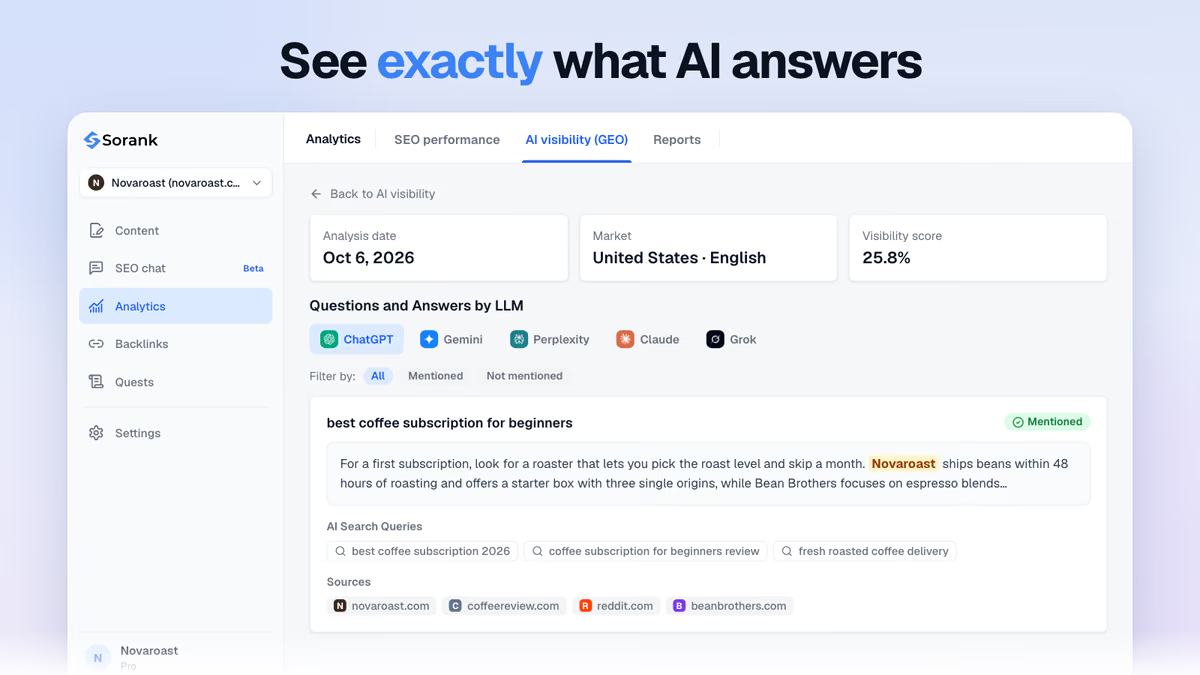
For classic local rankings, complete this with a map-grid rank tracker; our comparison of the best local SEO tools lists the options.
Priorities shift with the way customers choose:
Our page on search and AI visibility for local businesses details these priorities by sector.
Yes, because most of the work is the same as good local SEO and pays off on Google Maps too. A complete profile, consistent listings and a steady flow of reviews take a few hours a month. The extra effort specific to AI lies in content that answers customer questions and in regular checks of what the assistants say. The local businesses AI assistants recommend are those whose facts are complete, consistent and confirmed by others. To publish the content and track your AI mentions without adding hours to your week, try Sorank with its 3-day free trial.

OpenAI does not publish the full list of sources behind ChatGPT's local results. ChatGPT search relies on third-party search providers, and industry tests point mainly to Bing data, review sites and directories. Google reviews can still appear when they are quoted on pages ChatGPT reads, so keep both your Google and Bing listings complete.
Ask ChatGPT, Gemini, Perplexity and Google the questions your customers ask, including your city or neighborhood, and note whether your business appears and which sources are cited. Answers vary from day to day, so repeat the same list of prompts regularly or use a tracking tool. Fix the source of any wrong information you find, such as an old address in a directory.
Yes. Google states that review count and rating contribute to prominence in local results, and AI assistants often summarize review themes in their answers. Recent reviews that mention the specific service and location give the assistant concrete facts to repeat.
We analyse your competitors, your website and your AI visibility to create a tailored content plan for free.
 AI Content Brief Generator
 FAQ Schema Generator
 AI Blog Post Ideas Generator
 Structured Data Validator (Schema Validator)
 Alt Text Checker
 Internal Link Analyzer
 Backlink Challenge
 AI Meta Description Generator
 AI Blog Title Generator
 Google Indexability Checker
 AI Blog Outline Generator
 UTM Link Builder
 Keyword Clustering Tool
 Canonical Tag Checker
 XML Sitemap Generator
 Broken Link Checker
 AI SEO Title Generator
 Headline Analyzer
 SERP Preview Tool
 Redirect Checker
 Hreflang Tag Generator
 Heading Structure Analyzer
 HTTP Headers Checker
 Favicon Extractor
 SERP CTR Calculator
 SEO vs Paid Search Savings Calculator
 SEO Share of Voice Calculator
 SEO ROI Calculator
 SEO Traffic and Revenue Forecast Calculator
 SEO Budget Calculator
 SEO Break-Even Calculator
 SaaS SEO ROI Calculator
 ROAS Calculator
 Reading Time Calculator
 Ranking Gain Simulator
 Organic Traffic Value Calculator
 Organic Traffic Estimator and Website Traffic Checker
 LTV to CAC Ratio Calculator
 Local SEO ROI Calculator
 Link Building Cost Calculator
 Keyword Value Calculator
 Keyword Opportunity Score Calculator
 Keyword Density Calculator
 GEO ROI Calculator
 GEO Content Investment Calculator
 Ecommerce SEO ROI Calculator
 Customer Lifetime Value Calculator
 Customer Acquisition Cost Calculator
 CTR Calculator
 Cost Per Article Calculator
 Conversion Rate Calculator
 Content Marketing ROI Calculator
 ChatGPT Referral Traffic Estimator
 Bounce Rate Calculator
 Backlink ROI Calculator
 AI Visibility Score Calculator
 AI Traffic Value Calculator
 AI Share of Voice Calculator
 Cost of AI Invisibility Calculator
 AI Citation Rate Calculator
 llms.txt Validator
 AI Overview Checker and AI Overviews Rank Checker
 Robots.txt Checker
 AI SEO Audit
 LLM Readability Checker
 SearchGPT Readiness Checker
 Structured Data LLM Audit
 Website Crawlability AI Audit
 Why ChatGPT Is Not Recommending My Website
 Gemini Ranking Tool
 Perplexity Ranking Checker
 LLM Citation Checker
 Answer Engine Optimization Audit
 GEO Audit
 AI Search Visibility Test
 ChatGPT Visibility Checker
 llms.txt Generator
 URL Extractor
 Webpage to Markdown
 Sitemap Checker
 SERP Volatility Sensor
 Page Size Checker
 Word Counter
 Slug Generator
 Schema Generator
 Robots Generator
 OG Preview
 Meta Tags Generator
 Image Compressor
 Favicon Generator
 On-Page SEO Audit: SEO Checker and SEO Analyzer
 Backlink Analysis Tool
 Keyword Research Tool
 Domain Authority Checker
THEY TRIED SORANK BEFORE YOU
 “I tested Sorank on a real client site and it's insane. It does everything an agency would bill you $1500 a month for. It's going into production on that client now.”

 Guillaume Guersanguersanguillaume.com“We are an Ads agency and we wanted to get our SEO back on track once and for all. Sorank gave us a clear view of our site, helped us prioritize optimizations, and properly structure our content. The tool is easy to use, well designed for a team, and very practical for centralizing tracking without having to juggle multiple platforms. A very solid foundation to start fresh with our SEO.”
 Gaspard MadouiAds Agency
 “I just let the Sorank software do its thing, and now my DR is 25 and my page is ranking higher.”
 Lucas Flandrefoundertrace.fr“I specialized in GEO thanks to Sorank. The GEO Leaderboard allows me to show my clients their position vs competitors on ChatGPT. It’s a real commercial differentiator.”
 MélanieSEO Freelance“Great service, works well for our website and helps us understand how to improve it to rank better on Google and elsewhere. Congrats, keep going, I recommend it.”
 Hugo T.E-commerce merchant