Preferences
Privacy is important to us, so you have the option of disabling certain types of storage that may not be necessary for the basic functioning of the website. Blocking categories may impact your experience on the website. More information

Privacy is important to us, so you have the option of disabling certain types of storage that may not be necessary for the basic functioning of the website. Blocking categories may impact your experience on the website. More information

Linkable assets in 2026: 7 types that earn links (data studies, free tools, glossaries, visuals), how to build and promote one, and why AIs cite them.

Tools

In short
a linkable asset is a page built to be cited as a source: an original data study, a free tool or calculator, a glossary or reference guide, a visual, a ranking or a template. Other sites link to it because it saves them work or backs up a claim, which commercial pages rarely do. Pick the type that fits the data and skills you already have, make it the best answer on its topic, promote it to the people who write about that topic, and update it every year so the links keep coming.
Want to go further? Ask
Quick quiz
How should you get links from other websites?
Sorank matches your answers


Test it for 3 days on your own site and see where you stand on Google, ChatGPT and the other AIs.
Start 3-day free trial3 days free, then stop whenever you want. 90-day results-or-refund guarantee.
Most content never earns a single link. When BuzzSumo and Moz analyzed over one million articles, they found that over 75% of a random sample of 100,000 posts had zero external links (Moz, September 2015). The same study found that research-backed content and opinion-forming journalism were the formats that earned both shares and significantly more links. That gap is the reason linkable assets exist: instead of asking for links to pages nobody needs to cite, you build the page people need to cite.
This guide covers the seven types that work best, a comparison table of effort and payoff, a step-by-step creation method, how to promote the asset, and how the same pages get cited by ChatGPT, Gemini and Perplexity. If link building is new to you, start with the definition, then come back here.
A linkable asset is a page whose main job is to be referenced by other websites. It answers a question with something others cannot easily produce themselves: numbers, a working tool, a clear definition, a chart, a ranked list. Writers link to it because the link makes their own article more credible or more useful to their readers.
Product pages, pricing pages and sales landing pages are almost never linkable assets: nobody cites a sales page to support a point. The asset sits next to your commercial pages and passes authority to them through internal links. Three criteria separate a real asset from an ordinary blog post:
Google's own guidance points in the same direction. Its page on creating helpful, reliable, people-first content asks whether content "provide[s] original information, reporting, research, or analysis" and "substantial value when compared to other pages in search results". A good linkable asset answers yes to both questions.
Seven formats come back in every study of link earning. They differ in cost, in who links to them and in how long they keep working.
A study built on data you collected (a survey, an analysis of your product data, a scrape of public pages) is the strongest format because journalists and bloggers need numbers to support their claims. A statistics page that gathers sourced figures on one topic is the lighter version: less original, but it ranks for "[topic] statistics" queries, which are typed by the very people who write articles and need a source. Sorank publishes its own data studies on AI citations for this reason.
A calculator, checker or generator that solves a recurring problem earns links from every page that discusses that problem, often for years. Tools also attract links from resource pages and course materials. The cost is development and maintenance. Sorank's free SEO tools, such as the backlink ROI calculator, follow this model.
A clear definition, or a complete guide that becomes the reference on a topic, gets linked whenever another writer uses the term without wanting to explain it. Glossaries work well in technical niches where vocabulary changes fast. W3Schools' tutorials are the classic example of reference content that developers link to by habit.
A chart or map that summarizes a complex topic gets embedded with a credit link. Plain infographics earn far fewer links than ten years ago, so the visual needs original data or a genuinely clearer explanation. The guide to infographic SEO covers embed codes and image optimization.
A yearly ranking (best places, top companies, an index tracked over time) earns links from everyone who appears in it and from media covering the results. The Forbes billionaires list is the best-known example. The format only works if the method is transparent and the ranking is updated on schedule.
A downloadable template, a checklist or a calculator spreadsheet gets linked from tutorials and resource pages. Keep the template on an open page: a version locked behind a form collects emails, but much fewer links.
Naming a method and documenting it well (as Brian Dean did with the skyscraper technique) can earn links from everyone who later uses the name. It is the most uncertain format: the name has to catch on, which depends on reach you may not have yet.
Tip
Combine two types when you can. A statistics page with an interactive chart, or a calculator explained by a short glossary, gives writers two reasons to link and gives AI assistants more citable passages.
The table below compares the seven types on what matters before you commit time or budget. The ratings are relative and reflect typical projects.
| Type | Effort | Who links | Lifespan | Value for AI citations |
|---|---|---|---|---|
| Original data study | High | Journalists, bloggers, analysts | 1 - 2 years, longer if refreshed | Very high (figures with a named source) |
| Statistics page | Medium | Bloggers, content writers | Long if updated yearly | High |
| Free tool or calculator | High (development) | Resource pages, tutorials, forums | Several years | Medium (AIs cite the explanation more than the tool) |
| Glossary or reference guide | Medium | Writers in the niche, educators | Long if updated | High (clear definitions) |
| Visual (chart, map, infographic) | Medium | Media, bloggers, social accounts | Short to medium | Low unless the data is also in text |
| Ranking or award | Medium to high | Listed companies, local media | Recurring every year | Medium |
| Template or checklist | Low | Tutorials, resource pages | Long | Medium |
Start from evidence. Four checks narrow the choice quickly:
Publishing is half the job. The Moz and BuzzSumo study concluded that most content is ignored, partly because people are poor at amplifying it. Plan promotion before launch:
Watch out
Do not put the core of the asset behind a form. A gated study collects leads but loses most of its links and AI citations, because writers and crawlers cannot read what they cannot open. Gate an extended version if you need leads.
The pages that earn links are also the pages AI assistants quote. When ChatGPT, Gemini or Perplexity answer a question, they look for passages that state a fact clearly and attribute it to a source, which is exactly what a data study, a statistics page or a glossary provides.
Research supports this. The paper GEO: Generative Engine Optimization (Aggarwal et al., KDD 2024) tested methods to raise a source's visibility in generative answers: citing sources, adding quotations and adding statistics performed best, improving visibility by roughly 30 - 40% over the baseline. Those three elements are the building blocks of a good linkable asset.
On Google, nothing special is needed: Google states that there are no additional requirements to appear in AI Overviews or AI Mode and that SEO best practices still apply. An asset that ranks and earns links is therefore well placed for AI features too. Sorank's study of the platforms AIs cite most shows which kinds of sources come up in answers by sector.
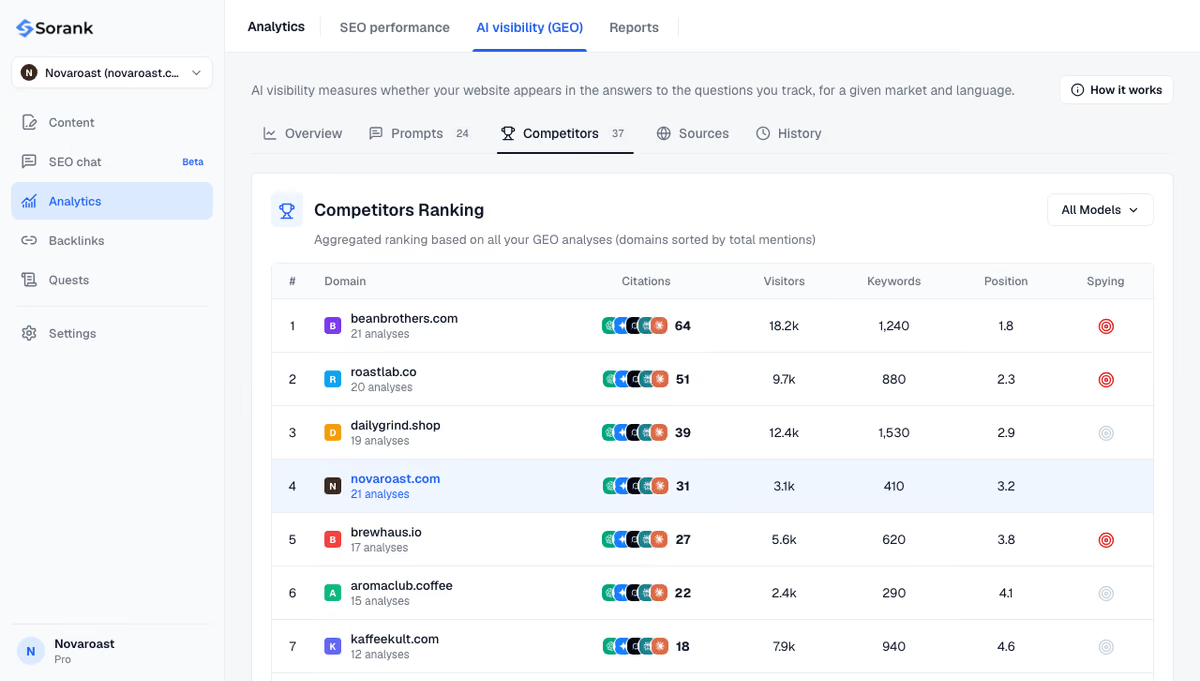
To measure the effect, track two things after launch: new referring domains to the asset, and how often your brand is cited for the questions it answers. The second is what AI mention tracking does, prompt by prompt.
The best linkable asset is the one only you can make: built on your data or expertise, answering one precise question, and promoted to the people who write about it. Start with a statistics page or a glossary if resources are tight, then move to an original study or a free tool once you know which topics earn attention. Assets bring links over time; for a steady base of links in parallel, Sorank obtains natural backlinks automatically from the sites of its 5,000+ users, alongside the articles it writes and publishes on autopilot. You can try it free for 3 days.

Link bait usually refers to content designed to go viral quickly, often through controversy or humor, with links as a side effect. A linkable asset is built to be cited as a reference over the long term, such as a data study, a tool or a glossary. Link bait can bring a spike of links, while a linkable asset keeps earning them for years when it is updated.
It varies widely by niche, format and promotion. A well-promoted study in a small niche may earn a few dozen referring domains, while reference tools and rankings in large markets can earn thousands over several years. The number depends less on the format than on how much other writers need the information and how actively you promote it.
A statistics page, glossary or template can be produced in a few days of writing and research. An original survey, a data study or an interactive tool usually requires several weeks and a budget for data collection or development. Count promotion time on top, since outreach and updates often take as long as creation.
We analyse your competitors, your website and your AI visibility to create a tailored content plan for free.
 AI Content Brief Generator
 FAQ Schema Generator
 AI Blog Post Ideas Generator
 Structured Data Validator (Schema Validator)
 Alt Text Checker
 Internal Link Analyzer
 Backlink Challenge
 AI Meta Description Generator
 AI Blog Title Generator
 Google Indexability Checker
 AI Blog Outline Generator
 UTM Link Builder
 Keyword Clustering Tool
 Canonical Tag Checker
 XML Sitemap Generator
 Broken Link Checker
 AI SEO Title Generator
 Headline Analyzer
 SERP Preview Tool
 Redirect Checker
 Hreflang Tag Generator
 Heading Structure Analyzer
 HTTP Headers Checker
 Favicon Extractor
 SERP CTR Calculator
 SEO vs Paid Search Savings Calculator
 SEO Share of Voice Calculator
 SEO ROI Calculator
 SEO Traffic and Revenue Forecast Calculator
 SEO Budget Calculator
 SEO Break-Even Calculator
 SaaS SEO ROI Calculator
 ROAS Calculator
 Reading Time Calculator
 Ranking Gain Simulator
 Organic Traffic Value Calculator
 Organic Traffic Estimator and Website Traffic Checker
 LTV to CAC Ratio Calculator
 Local SEO ROI Calculator
 Link Building Cost Calculator
 Keyword Value Calculator
 Keyword Opportunity Score Calculator
 Keyword Density Calculator
 GEO ROI Calculator
 GEO Content Investment Calculator
 Ecommerce SEO ROI Calculator
 Customer Lifetime Value Calculator
 Customer Acquisition Cost Calculator
 CTR Calculator
 Cost Per Article Calculator
 Conversion Rate Calculator
 Content Marketing ROI Calculator
 ChatGPT Referral Traffic Estimator
 Bounce Rate Calculator
 Backlink ROI Calculator
 AI Visibility Score Calculator
 AI Traffic Value Calculator
 AI Share of Voice Calculator
 Cost of AI Invisibility Calculator
 AI Citation Rate Calculator
 llms.txt Validator
 AI Overview Checker and AI Overviews Rank Checker
 Robots.txt Checker
 AI SEO Audit
 LLM Readability Checker
 SearchGPT Readiness Checker
 Structured Data LLM Audit
 Website Crawlability AI Audit
 Why ChatGPT Is Not Recommending My Website
 Gemini Ranking Tool
 Perplexity Ranking Checker
 LLM Citation Checker
 Answer Engine Optimization Audit
 GEO Audit
 AI Search Visibility Test
 ChatGPT Visibility Checker
 llms.txt Generator
 URL Extractor
 Webpage to Markdown
 Sitemap Checker
 SERP Volatility Sensor
 Page Size Checker
 Word Counter
 Slug Generator
 Schema Generator
 Robots Generator
 OG Preview
 Meta Tags Generator
 Image Compressor
 Favicon Generator
 On-Page SEO Audit: SEO Checker and SEO Analyzer
 Backlink Analysis Tool
 Keyword Research Tool
 Domain Authority Checker
THEY TRIED SORANK BEFORE YOU
 “I tested Sorank on a real client site and it's insane. It does everything an agency would bill you $1500 a month for. It's going into production on that client now.”

 Guillaume Guersanguersanguillaume.com“We are an Ads agency and we wanted to get our SEO back on track once and for all. Sorank gave us a clear view of our site, helped us prioritize optimizations, and properly structure our content. The tool is easy to use, well designed for a team, and very practical for centralizing tracking without having to juggle multiple platforms. A very solid foundation to start fresh with our SEO.”
 Gaspard MadouiAds Agency
 “I just let the Sorank software do its thing, and now my DR is 25 and my page is ranking higher.”
 Lucas Flandrefoundertrace.fr“I specialized in GEO thanks to Sorank. The GEO Leaderboard allows me to show my clients their position vs competitors on ChatGPT. It’s a real commercial differentiator.”
 MélanieSEO Freelance“Great service, works well for our website and helps us understand how to improve it to rank better on Google and elsewhere. Congrats, keep going, I recommend it.”
 Hugo T.E-commerce merchant