Preferences
Privacy is important to us, so you have the option of disabling certain types of storage that may not be necessary for the basic functioning of the website. Blocking categories may impact your experience on the website. More information
Privacy is important to us, so you have the option of disabling certain types of storage that may not be necessary for the basic functioning of the website. Blocking categories may impact your experience on the website. More information

Link building for startups: 13 methods compared by effort and risk, a 90-day plan, outreach rules and the spam lines that keep your links safe.

In short
Link building for startups is the work of earning links from relevant, editorial pages to a domain with no reputation yet. Begin with the listings you are entitled to claim, then build one original asset that writers want to cite. A few links from the right pages beat many from weak ones.
Want to go further? Ask
Quick quiz
How should you get links from other websites?
Sorank matches your answers


Test it for 3 days on your own site and see where you stand on Google, ChatGPT and the other AIs.
Start 3-day free trial3 days free, then stop whenever you want. 90-day results guarantee, conditions apply.
The first links to a new domain rarely produce a big ranking jump on their own. What they do is make the company verifiable: other sites name it, link to it, and send the first real visitors. Treat them as the base of a trust profile, not as a switch that moves rankings overnight.
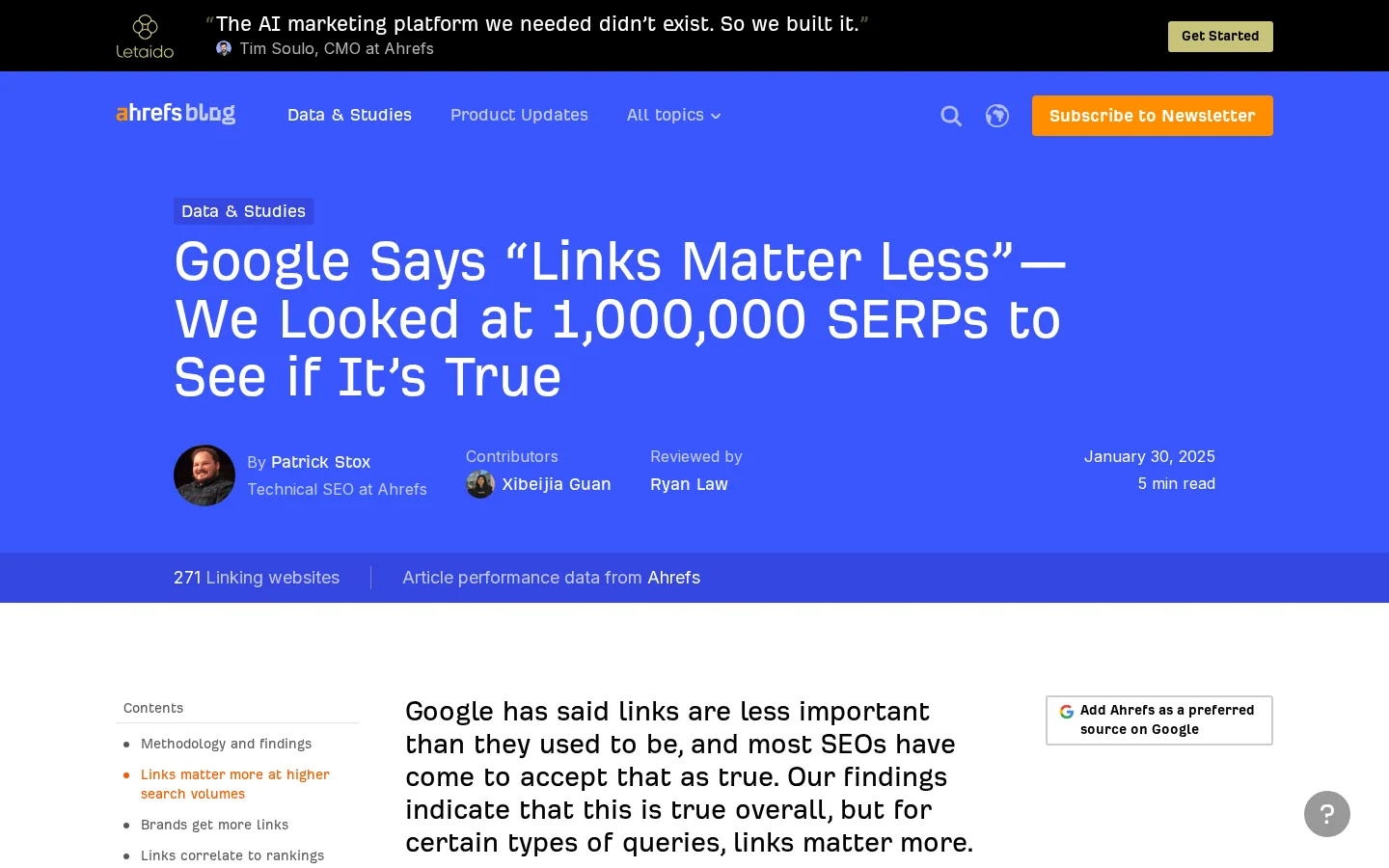
Links still matter in measurable ways. In January 2025, Ahrefs compared the top one million US keywords with their ranking data. The number of referring domains had a Spearman correlation of 0.255 with top-20 positions, while Domain Rating had 0.131. Correlation is not proof of cause, but the pattern points one way: how many different sites link to you matters more than a single authority score.
A startup usually faces three problems at once, and each one changes the method.
Each handicap has a counter-move. Claim the profiles you have never claimed, build something worth citing, and spend your time on relationships rather than on volume.
The first links do three jobs. They give crawlers a route to your pages, they put your name on sites that already have trust, and they bring referral visits from people who are already interested. A single link from a relevant trade association can do all three. Twenty links from unrelated directories do very little.
Set expectations accordingly. Judge your progress by referring domains, by the relevance of the sites that link to you, and by organic clicks to the pages you promoted. A rank jump on a competitive keyword is the last signal to arrive, not the first.
If the vocabulary is new to you, the backlink definition and the link building overview cover the basics. If your startup sells software, the SaaS link building guide goes deeper on subscription products. This article covers the whole startup stage.
A link counts when an editor, an author or a community member chose to point to you because the page is useful to their readers. Links you pay for, trade in bulk or generate automatically are not votes. They are attempts to manufacture votes, and that is where search engines step in.
Picture a scheduling tool for home clinics. A link from a physiotherapy association's member page is worth far more than a link from a general news site with high authority and no connection to healthcare. The first sends the right visitors and tells search engines what your product is for. The second sends none of those.
Check relevance on three points: does the page cover your topic, does its audience match your buyers, and does the link sit inside text that makes sense? A link in a sentence beats a link in a footer or a sidebar, because the sentence explains why it is there.
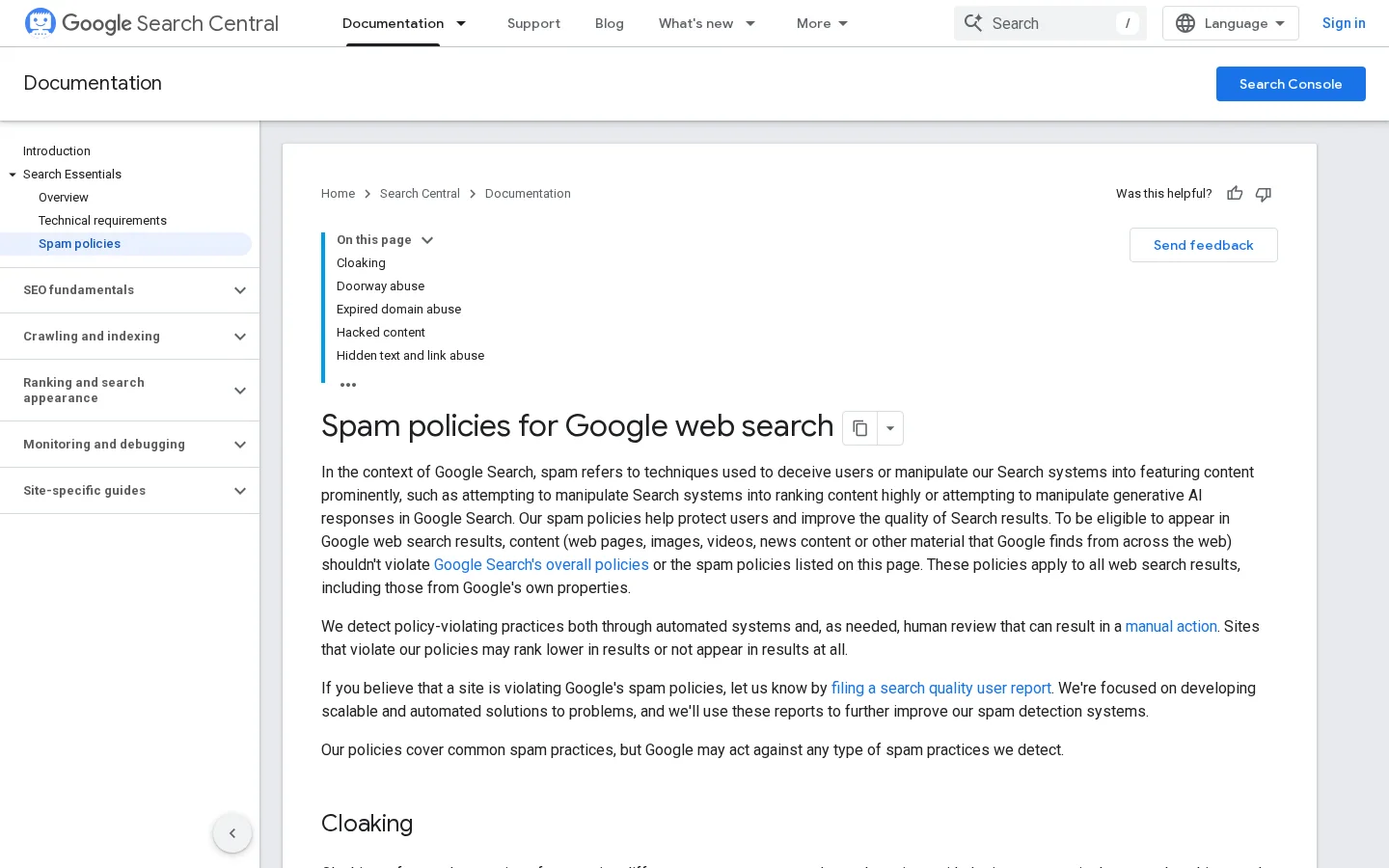
Google's spam policies define the problem in one sentence: "Link spam is the practice of creating links to or from a site primarily for the purpose of manipulating search rankings." The page lists examples that matter to startups. It names buying or selling links for ranking purposes, "excessive link exchanges" and partner pages made only for cross-linking, and "using automated programs or services to create links to your site." It also flags guest posts and press releases that carry links with optimized anchor text.
The same page makes a distinction that many founders miss. Paid links are not forbidden as such. They are acceptable when they are qualified, which means they carry a rel attribute that tells Google they are not votes. Sponsored content is the main case. Read the policy in full before you agree to any link deal.
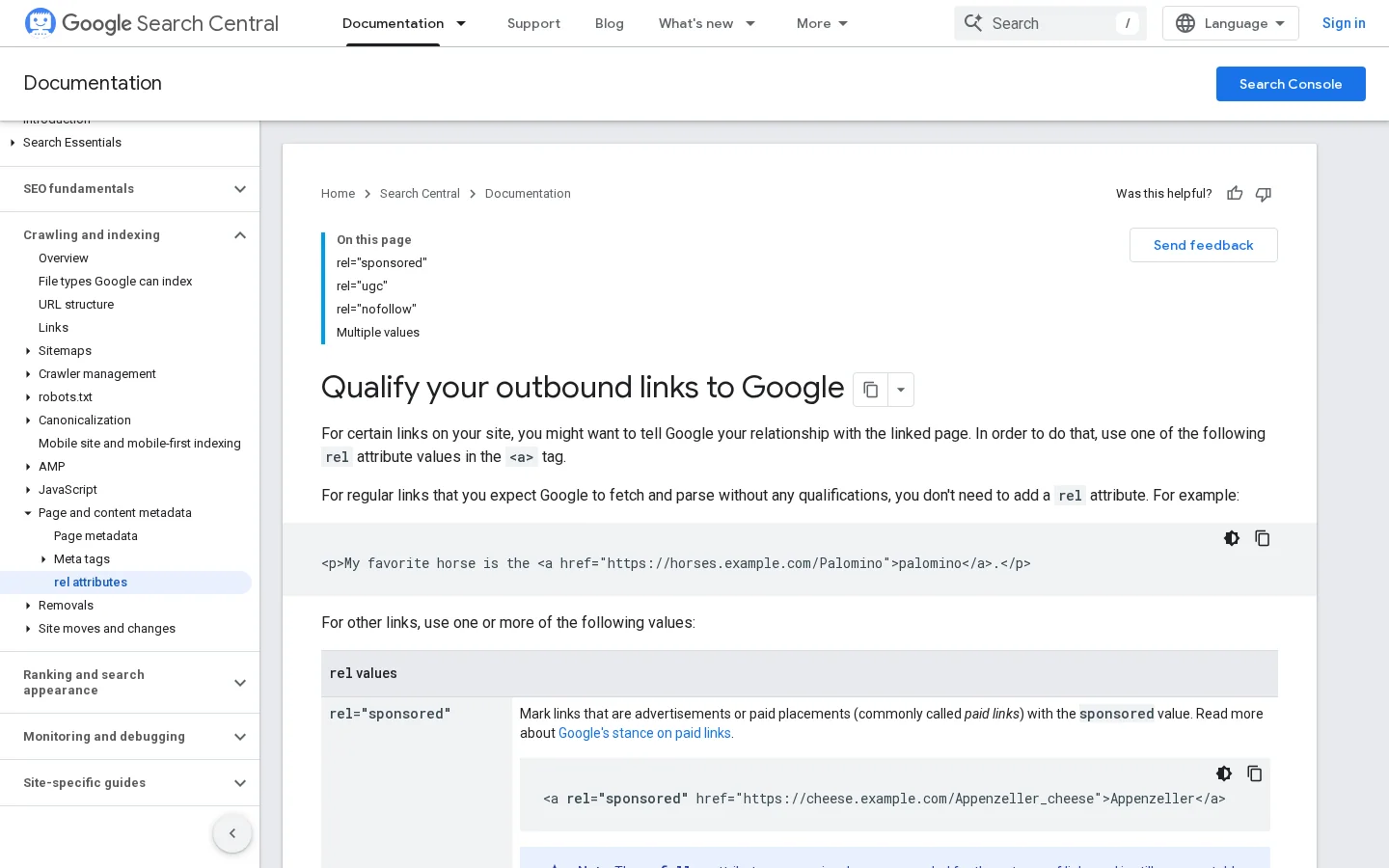
Google's guidance on outbound links defines three values for the rel attribute. Use sponsored for paid links and advertisements, ugc for links in comments and forum posts, and nofollow as a fallback when the other two do not fit. The nofollow glossary entry explains how the attribute behaves in practice.
<a href="https://partner.example.com/offer" rel="sponsored">Partner offer</a><a href="https://forum.example.com/thread/42" rel="ugc">our setup guide</a>In the first example, the link is a paid placement, so it carries sponsored. In the second, the link sits in a community thread, so it carries ugc. Never mark your own editorial links this way, because the attribute tells search engines to discount them.
Earned link or bought link

Every method below can earn links, and every one has a failure mode. Most startups should combine four or five of them, starting with the cheap ones. The methods are grouped by the kind of work they require, and the table at the end compares them side by side.
Claim listings and directories. Start with listings you are entitled to: software directories, trade associations, accelerator and investor portfolio pages, and partner or integration directories. Launch sites belong here too, but check the rel attribute before you count their links, because the value is often the referral visits and the listing itself. The principle is a complete, accurate profile on a relevant directory. Use it on day one. The limit is that a directory that accepts everyone has little value.
Unlinked mentions. Find pages that already name your company without linking to it, using brand alerts, then ask the author to add a link. The principle is that the page already wants to mention you. Use it as soon as you have a few mentions. The advantage is that the author has already decided you are worth citing, so the request is small. The limit is that you can only find what you can search for, so a brand with a common name needs tighter filters.
Founder and team profiles. Bios on conference, podcast and community sites often link back to a founder's company. The principle is a real person with real expertise. The advantage is that these links outlive any campaign. The limit is that it is slow, and every profile must be true, with no invented credentials.
Foundations: before you start
Original data. Publish numbers that exist nowhere else: anonymized patterns from your product, a survey of your customers, or pricing data for your category. The principle is that writers cite sources, so become the source. Use it once you have enough data to be representative, and state how you collected it. The advantage is that one study can attract links for years. The limit is that data you cannot explain well will be ignored or criticized.
A free tool. A calculator, checker or generator that solves one problem without a signup. The principle is that people link to tools they use at work. Use it once the tool has a clear job. The advantage is links from relevant pages plus repeat visits. The limit is that an email gate or a vague purpose earns few links, and a tool needs maintenance.
Journalist requests. Reporters post requests for expert sources on services that route them to you. The principle is a quick, specific answer from a named expert. Use it when you have a real point of view or a fresh fact. The advantage is a link from a major publication when it lands. The limit is that the hit rate is low and the time cost is high, so answer only the requests you can answer well.
Podcasts and expert interviews. Shows often publish episode notes with links to their guests. The principle is a founder with something specific to say. The advantage is a link plus an audience that trusts the host. The limit is that you must check whether the show publishes notes on its own domain, because a link on a podcast app page is worth little.
Content and PR: the order I would run it
Guest posts. Pitch one specific article to a publication your buyers read, and write it to be useful even without the link. The principle is giving an editor a piece worth publishing. The advantage is a contextual link and a new audience. The limit is that sites selling guest posts for a keyword are a different thing entirely. The guest posting guide explains how to tell them apart.
Broken link building. Find pages that link to a dead resource in your category, then offer your page as the replacement. The principle is that you fix a problem the editor already has. The advantage is a clear, helpful reason to reply. The limit is that you need a real replacement, and finding the dead links takes time. The broken link building method has the steps.
Partnerships and integrations. Partners with an integration page, a marketplace listing or a joint case study can link to you. The principle is a shared customer or a shared product. Use it once you have a live integration. The advantage is links from sites that already have a reason to mention you. The limit is that partner pages are often thin, so agree on the wording before you ask.
Communities. Answer questions on online forums, Reddit and the chat communities of your category. The principle is to be useful first, and to mention your link only where it answers the question. Do it in small amounts, every week. The advantage is real customers and real feedback. The limit is that most community links are nofollow or ugc, so count them for traffic and reputation, not for ranking. Drive-by link drops get removed and damage your name.
Relationships: before you pitch
Backlink exchanges and networks. Members place links for each other, sometimes through a credit system. The principle is reciprocal links between sites that are actually related. Use it only for small, relevant placements that you would accept even without the exchange. The advantage is volume that is easy to plan. The limit is that Google's policy names excessive link exchanges as link spam, and when the exchange is the reason a link exists, the risk is high. The backlink exchange guide explains the difference.
Paid placements and sponsorships. Newsletters, events and sponsored articles can carry links if they are clearly labeled and the links are qualified with the sponsored value. The principle is that you pay for visibility, not for a ranking. Use it when the audience is right and the price buys that audience. The advantage is real readers. The limit is that a sponsorship bought only for the link is a paid link, and it must be qualified.
The table below compares the thirteen methods on the same criteria.
| Method | Effort | Cash cost | Time to first link | Risk |
|---|---|---|---|---|
| Claim listings and directories | Low | Low | Days | Low |
| Unlinked mentions | Low | None | Days to weeks | Low |
| Founder and team profiles | Low | None | Weeks | Low |
| Original data | High | Low | Months | Low |
| A free tool | High | Medium | Months | Low |
| Journalist requests | Medium | None | Weeks | Low |
| Podcasts and expert interviews | Medium | None | Weeks | Low |
| Guest posts | Medium | Low to medium | Weeks | Medium, high if sold for a keyword |
| Broken link building | Medium | None | Weeks | Low |
| Partnerships and integrations | Medium | None | Weeks | Low |
| Communities | Medium | None | Weeks | Low, mostly nofollow |
| Backlink exchanges and networks | Low | Varies | Days | High |
| Paid placements and sponsorships | Low | High | Days | Medium, if qualified |
Work in three phases. Weeks one and two are for the links you are owed, weeks three to six for one asset, and weeks seven to twelve for outreach. Founders often want to start with outreach. Start with the asset instead, because outreach without anything worth citing is the most common waste of time in this field.
Spend the first two weeks on listings and profiles. Open the directories in your category, claim each profile, and make sure the name, website and description match your site exactly. Inconsistent details are a small problem on their own, but they make it harder for people and search engines to match your company across sources.
Next, check the links you already have. Make a list of every page that mentions your brand, and sort it into linked and unlinked. Ask for links on the relevant unlinked mentions, one short message each.
Tip
Keep the list in a shared sheet with four columns: the page, the contact, the date you wrote and the result. A list you reread every week is worth more than any tool you use once.
Choose the asset that fits what you already know. A team with a lot of customer data should publish data. A team that answers the same technical question for every prospect should build a tool. A founder who can defend a point of view in interviews should start there. Pick one, and finish it. Half-finished tools and data sets attract no links.
Publish the asset on your own domain, on a page that explains what it is, how it was built and who made it. That page is what editors will link to, so it has to stand on its own without the rest of your site.
Build a list of prospects. Start with thirty pages that already cover your topic, a mix of publications, trade sites and niche blogs. Verify each contact, then send in small weekly batches. A small batch lets you change the pitch when a line gets no reply, and it keeps your sending steady. Log each reply, and change only one thing at a time so you know what worked.
The 90-day sequence
Outreach is a writing problem more than a volume problem. An editor reads a pitch in seconds and decides whether it helps their readers. Your job is to make that decision easy, and to accept the answer gracefully when it is no.
A good pitch has four parts. The subject line names the page or the topic, not your company. The first line refers to something specific on their page, which shows you actually read it. The second part is the offer: the data point, the tool or the fact they could use. The last part is one clear question, such as whether they would add a link to the page, or whether they want to see the data first.
Keep it under about 120 words, and do not attach files. Compare the two versions below. The second one is not longer, but it gives the editor a reason to reply.
Two versions of the same pitch
Send one follow-up about a week after the first message, and make it shorter than the original. Add one new fact rather than a reminder. If there is still no reply, send one final note and then stop. Repeated messages irritate editors and push your reply rate down, and an editor who declined once is unlikely to change their mind after the fifth reminder.
Outreach email is commercial email, so the rules apply. The FTC's CAN-SPAM compliance guide states that the law "makes no exception for business-to-business email." Every message must disclose clearly that it is an advertisement, carry a valid physical postal address, and offer a working opt-out. You must honor an opt-out request within 10 business days. Read the FTC CAN-SPAM guide once, and build those three elements into your sending tool.
Your sending domain also needs basic authentication. Set up SPF and DKIM through your email provider, then publish a DMARC policy as a single DNS TXT entry:
_dmarc.yourdomain.com TXT "v=DMARC1; p=none; rua=mailto:[email protected]"Start with p=none to collect reports, then tighten the policy once your legitimate mail passes. For the full sending method, the email outreach guide walks through templates and follow-up timing.
Outreach works best when the thing you send is worth linking to. Three kinds of asset do that for startups: data no one else has, a tool with a clear job, and product pieces that other people can cite. None of them needs a large team, but all three need a plan.
Start with what your product already records. Anonymize it, aggregate it and check it for bias, then state the sample size, the period and the question you asked. A chart of how small teams use one feature is more useful to a writer than a vague claim. Publish the method on the same page, because a writer who can check the data will cite it with more confidence.
If your sample is small or not representative, say so. Writers will check, and an honest limit earns more trust than an overstated headline.
A tool earns links when it answers one question faster than the alternatives. Keep it free and without a signup wall, because gated tools lose most of the people who would have linked to them. Give it a page that explains what it does, what the inputs mean and where the numbers come from. Write that page so a reader who never uses the tool still understands the topic.
Before you build, check whether the tool answers a problem your buyers already search for. A calculator for a metric your category ignores will have few visitors and few links.
Some product pieces are natural citations. Public API documentation, a changelog, a status page, an embeddable widget and an open-source component all give developers and writers something to point at. The content marketing guide for startups shows how to turn these pieces into a publishing plan. Give each piece a stable URL, and redirect old URLs when you change them, or the links you earned will break.
What makes an asset linkable
Most link problems come from a short list of habits. Each mistake below says what it is, how to spot it in your own profile, and how to fix it. Check your recent acquisitions against this list before you add anything else.
What it is. A seller offers a monthly bundle of links for a fixed price, often promising a number of links or a domain rating. The links usually sit on unrelated sites, with keyword-rich anchors.
How to spot it. Look at the referring pages. Are they on topic, do they have real readers, and do the anchors read like a sentence or like a keyword list? A promised count or a promised rating is itself a warning sign. Google's spam policy names buying links for ranking purposes as link spam.
How to fix it. Stop the package, ask the seller to remove links you did not choose, and keep a record of each request. For links that stay up, Google's disavow tool exists, but treat it as a last resort rather than a routine cleanup.
What it is. "Link to me and I will link to you," repeated across many partners until the pattern is obvious. Google calls excessive link exchanges link spam. A few reciprocal links between partners who genuinely refer customers are not the problem. The scale and the reason are.
How to spot it. Count how many of your outbound links are reciprocated, and check whether the partner pages exist only to hold links. If a partner page lists twenty unrelated companies, it is a link page, not a resource.
How to fix it. Keep only the reciprocal links that a real visitor would use, and replace the rest with editorial pitches. Our piece on link trades explains where the line falls in more detail.
What it is. Articles on other sites that exist to place one keyword phrase as an anchor. The content is thin, and the link is the point.
How to spot it. Open your anchor report and sort by frequency. If one exact-match phrase appears in most of your links, you have a pattern. Google's policy lists links with optimized anchor text in guest posts as an example of link spam.
How to fix it. Use your brand name, the page title or a plain description as the anchor. Keep exact-match phrases for links to your own pages. The anchor text glossary entry explains the anchor types you should vary.
What it is. Quotes from customers who do not exist, reviews written by staff, or incentives for reviews that are not disclosed. Founders sometimes do this to fill a directory profile that feels empty.
How to spot it. Ask whether every quote traces back to a person who agreed to be named, and whether anyone received something in return. The FTC's FAQ on its Consumer Reviews and Testimonials Rule, dated November 2024, says a business can be liable if it "wrote or created fake or false reviews," and that incentivized reviews are treated as testimonials under the rule.
How to fix it. Use only quotes from real customers, with their permission. If you give an incentive, disclose it, and never require a particular sentiment, because the FAQ says the rule does not prohibit incentives as long as there is no requirement about what the review says. Replace any invented quote with a real one, or remove it.
What it is. Submitting your company to dozens of low-quality directories in one afternoon, usually through a paid submission service.
How to spot it. Many of those directories have no real category, no traffic and no editorial review. Your listings also show different names, descriptions or addresses from one site to the next.
How to fix it. Keep the ten or so directories that your buyers would actually use, and make every listing match the same facts. Remove the others when you can, and do not pay for submissions that promise a count.
Red flags in a link offer
The fastest way to fool yourself is to watch one keyword for a month and conclude that links did nothing. Track the signals that move first, and report them every month. Rankings follow later, and they depend on competition you do not control.
Referring domains is the count of different sites linking to you, the metric the Ahrefs study points to. Track new referring domains per month, not only the total, so you can see the trend. Next, track the relevance of each new domain: is the page on topic, and does the link sit in editorial text? Third, track organic clicks to the pages you promoted, because a link that brings readers is working even before rankings move. Finally, track branded searches for your company name, since a good placement often produces people who search for you later.
| Metric | What to record | What it tells you |
|---|---|---|
| New referring domains | Count per month, with the page that linked | Whether your outreach works |
| Relevance of new domains | Topic match, editorial context, rel attribute | Whether the links are the kind that last |
| Organic clicks to promoted pages | Clicks per page from Google, month over month | Whether the links bring readers and visibility |
| Branded searches | Searches that include your company name | Whether the placements build awareness |
Tip
To get a first list of the sites that link to you, run your domain through our free backlink checker. Sort the results by topic before you count them, and judge the program over several months rather than after the first few weeks.
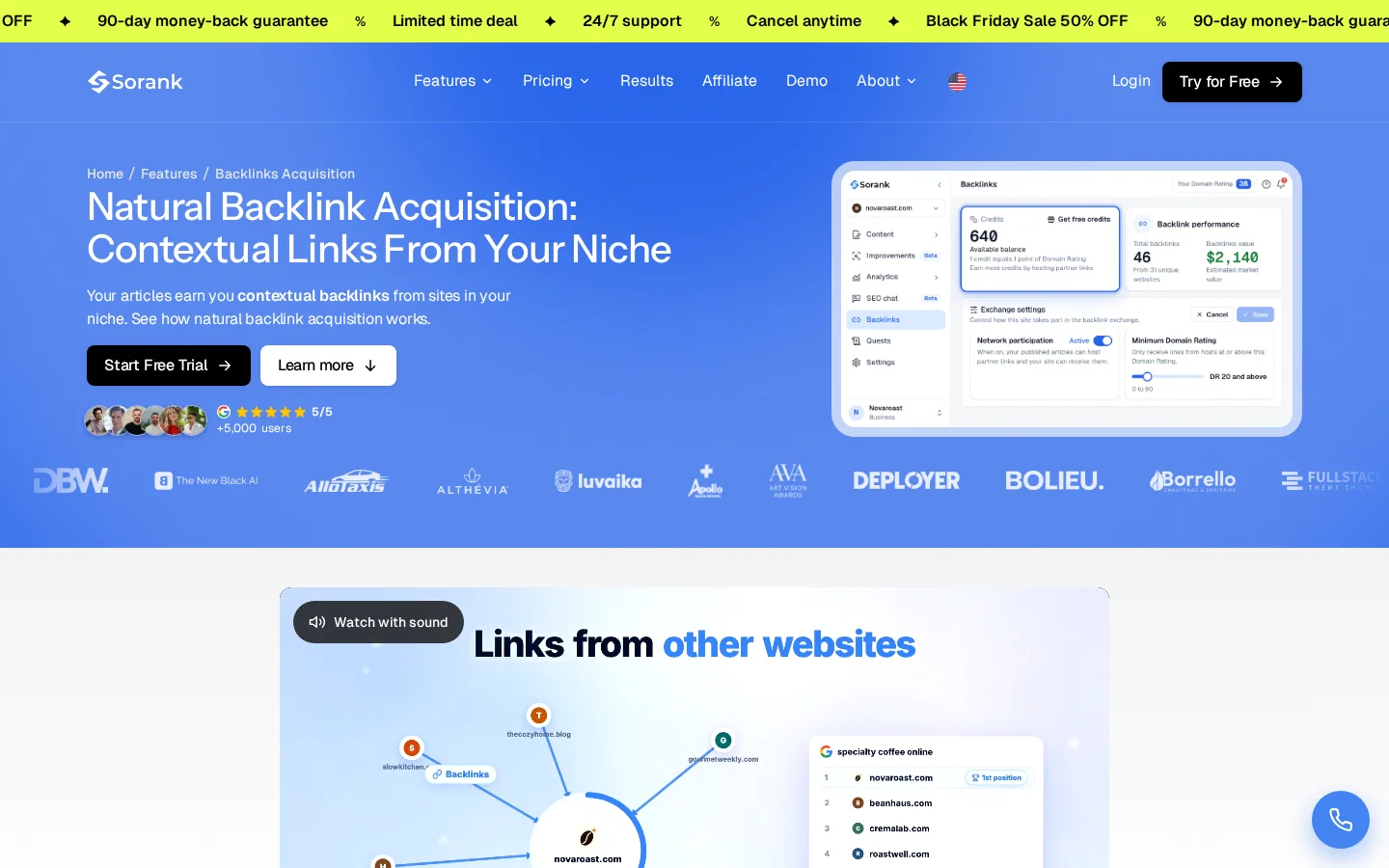
Sorank includes a feature called Natural Backlink Acquisition. It places contextual links from other members' sites in your niche, inside published articles, and it matches you only with sites in your niche rather than with direct competitors. You earn and spend credits, you can set a minimum Domain Rating for the sites that may link to you, and you can turn participation off at any time. The full description is on the natural backlink acquisition page.
Warning
Because the placements run between member sites, they fit the exchange pattern that Google's policy describes. The feature's own page says that no link building method is risk-free, and it does not promise a number of links or a ranking result. Judge every placement by the checks in this article: topic, editorial context, anchor text and the reason the link exists. You can refuse any partner link placed in your articles with one click, so use that option when a placement does not pass.
Treat the feature as one option among the methods above, not as the whole plan. The listings, the asset and the outreach still do the work that no placement can do for you.
A startup can win links without a big budget. Claim every profile you are entitled to, pick one asset your team can finish, and send a small number of specific pitches each week. Keep the spam rules in view, qualify any paid link, and measure referring domains and clicks before you judge the result.
If you want the program run for you, the SEO software for startups page explains what Sorank covers. The link building glossary entry gives a shorter reference you can share with your team.
There is no fixed number that works for everyone. Compare your referring domains with the sites that rank for your target query, and focus on how many relevant domains link to you. A few links from the right pages usually matter more than a large count from weak ones.
Only in small amounts, and only when the links are editorial and relevant. Google's spam policy names excessive link exchanges and partner pages made only for cross-linking as link spam. If the exchange is the reason the link exists, treat it as a risk.
No. Most startups get more value from listings, original data and relationships than from paid placements. If you do pay for a placement, label it and qualify the link with the sponsored value, as Google's guidance describes.
We analyse your competitors, your website and your AI visibility to create a tailored content plan for free.
 AI Content Brief Generator
 FAQ Schema Generator
 AI Blog Post Ideas Generator
 Structured Data Validator (Schema Validator)
 Alt Text Checker
 Internal Link Analyzer
 Backlink Challenge
 AI Meta Description Generator
 AI Blog Title Generator
 Google Indexability Checker
 AI Blog Outline Generator
 UTM Link Builder
 Keyword Clustering Tool
 Canonical Tag Checker
 XML Sitemap Generator
 Broken Link Checker
 AI SEO Title Generator
 Headline Analyzer
 SERP Preview Tool
 Redirect Checker
 Hreflang Tag Generator
 Heading Structure Analyzer
 HTTP Headers Checker
 Favicon Extractor
 SERP CTR Calculator
 SEO vs Paid Search Savings Calculator
 SEO Share of Voice Calculator
 SEO ROI Calculator
 SEO Traffic and Revenue Forecast Calculator
 SEO Budget Calculator
 SEO Break-Even Calculator
 SaaS SEO ROI Calculator
 ROAS Calculator
 Reading Time Calculator
 Ranking Gain Simulator
 Organic Traffic Value Calculator
 Organic Traffic Estimator and Website Traffic Checker
 LTV to CAC Ratio Calculator
 Local SEO ROI Calculator
 Link Building Cost Calculator
 Keyword Value Calculator
 Keyword Opportunity Score Calculator
 Keyword Density Calculator
 GEO ROI Calculator
 GEO Content Investment Calculator
 Ecommerce SEO ROI Calculator
 Customer Lifetime Value Calculator
 Customer Acquisition Cost Calculator
 CTR Calculator
 Cost Per Article Calculator
 Conversion Rate Calculator
 Content Marketing ROI Calculator
 ChatGPT Referral Traffic Estimator
 Bounce Rate Calculator
 Backlink ROI Calculator
 AI Visibility Score Calculator
 AI Traffic Value Calculator
 AI Share of Voice Calculator
 Cost of AI Invisibility Calculator
 AI Citation Rate Calculator
 llms.txt Validator
 AI Overview Checker and AI Overviews Rank Checker
 Robots.txt Checker
 AI SEO Audit
 LLM Readability Checker
 SearchGPT Readiness Checker
 Structured Data LLM Audit
 Website Crawlability AI Audit
 Why ChatGPT Is Not Recommending My Website
 Gemini Ranking Tool
 Perplexity Ranking Checker
 LLM Citation Checker
 Answer Engine Optimization Audit
 GEO Audit
 AI Search Visibility Test
 ChatGPT Visibility Checker
 llms.txt Generator
 URL Extractor
 Webpage to Markdown
 Sitemap Checker
 SERP Volatility Sensor
 Page Size Checker
 Word Counter
 Slug Generator
 Schema Generator
 Robots Generator
 OG Preview
 Meta Tags Generator
 Image Compressor
 Favicon Generator
 On-Page SEO Audit: SEO Checker and SEO Analyzer
 Backlink Analysis Tool
 Keyword Research Tool
 Domain Authority Checker
 “I tested Sorank on a real client site and it's insane. It does everything an agency would bill you $1500 a month for. It's going into production on that client now.”

 Guillaume Guersanguersanguillaume.com“We are an Ads agency and we wanted to get our SEO back on track once and for all. Sorank gave us a clear view of our site, helped us prioritize optimizations, and properly structure our content. The tool is easy to use, well designed for a team, and very practical for centralizing tracking without having to juggle multiple platforms. A very solid foundation to start fresh with our SEO.”
 Gaspard MadouiAds Agency
 “I just let the Sorank software do its thing, and now my DR is 25 and my page is ranking higher.”
 Lucas Flandrefoundertrace.fr“I specialized in GEO thanks to Sorank. The GEO Leaderboard allows me to show my clients their position vs competitors on ChatGPT. It’s a real commercial differentiator.”
 MélanieSEO Freelance“Great service, works well for our website and helps us understand how to improve it to rank better on Google and elsewhere. Congrats, keep going, I recommend it.”
 Hugo T.E-commerce merchant