Preferences
Privacy is important to us, so you have the option of disabling certain types of storage that may not be necessary for the basic functioning of the website. Blocking categories may impact your experience on the website. More information
Privacy is important to us, so you have the option of disabling certain types of storage that may not be necessary for the basic functioning of the website. Blocking categories may impact your experience on the website. More information

What a content marketer does day to day: the 6 core tasks, a typical week, skills, tools, salary benchmarks, career path and the mistakes to avoid.

In short
A content marketer is the person who plans, creates, distributes and measures content that attracts the right audience and turns it into customers. Day to day, they run the content calendar, brief or write articles and videos, push each piece to the right channels, then read the data to decide what to publish next.
Want to go further? Ask
Quick quiz
Which content should you focus on first?
Sorank matches your answers


Test it for 3 days on your own site and see where you stand on Google, ChatGPT and the other AIs.
Start 3-day free trial3 days free, then stop whenever you want. 90-day results guarantee, conditions apply.
A content marketer is a marketer whose main lever is useful content: articles, guides, videos, newsletters, case studies, posts. Their job is not to write for the sake of writing. It is to make content that brings in qualified visitors, earns their trust and moves them toward a purchase. If you want the bigger picture of the discipline itself, start with our guide on what content marketing is and how to start.
The simplest way to understand the role is to look at its output. A content writer delivers a text. A content marketer delivers a result: a page that ranks, a guide that collects emails, a case study that sales sends to prospects, an article that ChatGPT or Gemini quotes when a buyer asks a question. Writing is one step in a chain that also includes research, planning, distribution and measurement.
These four jobs overlap, and small companies often ask one person to do all of them. In larger teams the borders are clearer. The table below shows where each one starts and stops.
| Role | Main deliverable | Judged on | Typical horizon |
|---|---|---|---|
| Content marketer | A content program: calendar, pieces, distribution, reports | Qualified traffic, leads, pipeline, AI citations | Months to years |
| Content writer | Articles, guides, scripts | Quality, accuracy, deadlines | One piece at a time |
| Copywriter | Ads, landing pages, emails, product pages | Conversion rate, clicks, sales | One campaign |
| SEO specialist | Keyword plan, technical fixes, links | Rankings, organic traffic, indexing | Months |
The line between content and copy is thin but real: content informs first and sells later, copy sells now. We break it down with examples in content writing vs copywriting. A good content marketer knows enough of both, plus enough SEO to choose topics people actually search for.
You find them in three places. In-house, inside a brand, often reporting to a head of marketing. In agencies, running content for several clients at once. And as freelancers, usually after a few years in one of the first two. The tasks are the same; what changes is the number of topics you juggle and how close you sit to sales and product.
A content marketer does six things in a loop: research the audience, plan the calendar, create the content, distribute it, optimize it and measure it. Each loop feeds the next one: the numbers of this month decide the topics of next month. Here is the loop, then the detail of each step.
The content marketer's loop
Everything starts with knowing who you write for. A content marketer interviews customers, reads sales call notes and support tickets, and listens to the questions prospects ask. Then they check demand: which keywords people type into Google, which questions they ask AI models, which pages already rank.
The technical part is mapping each topic to a search intent (learn, compare, buy) and to a stage of the buyer journey. A topic with strong volume but the wrong intent fills the blog with visitors who never buy. A good research file has, for each topic: the main keyword, its intent, the top 3 ranking pages, what they miss, and the question a buyer would ask an AI model about it.
The calendar is the content marketer's main tool. It says what gets published, when, in which format, by whom and for which goal. Without it, content becomes a series of last-minute requests from other teams.
A solid calendar has more columns than "date" and "title": target keyword, intent, funnel stage, format, owner, status, publish date, distribution channels, and the metric that will say if it worked. The content calendar definition in our glossary covers the basics; for the full method, follow our step-by-step guide to building a content calendar your team actually follows. Many content marketers also organize the calendar around 3 to 5 content pillars, so that topics build authority on the same themes instead of scattering.
Depending on the team, the content marketer writes everything, writes some and briefs the rest, or only briefs and edits. In all three cases they own quality. The brief is where quality is won or lost: the angle, the reader, the keyword, the questions to answer, the sources to use, the internal links, the call to action. We give a full template in our guide on what to put in a content brief.
Tip
If you brief freelancers or AI tools every week, our free AI content brief generator gives you a full SEO brief (structure, questions, entities) in seconds, which you can then edit with your own angle.
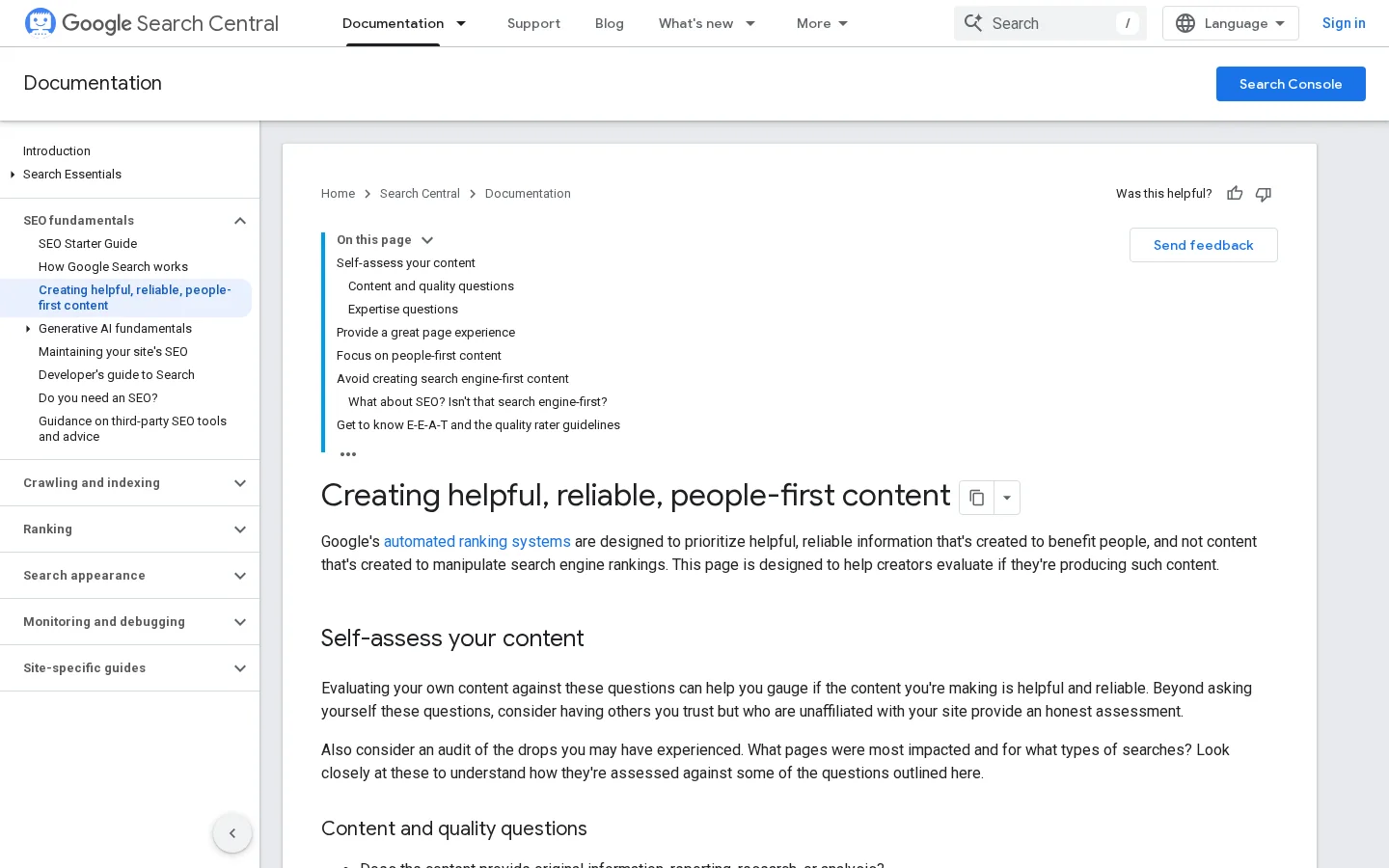
Editing is the part juniors underestimate. A senior content marketer checks facts and figures against the original source, removes filler, makes sure each section answers its title in the first sentence, and adds what only the company knows: real numbers, screenshots, customer examples. That last point matters for Google, whose guide on creating helpful, reliable, people-first content asks "who, how and why" a page was made, and warns that using automation mainly to manipulate rankings breaks its spam policies.
Publishing is not distribution. A content marketer plans, for each piece, how it will reach people: organic search, email newsletter, LinkedIn and other social networks, sales enablement, partners, communities. They also cut one big piece into several smaller ones (a guide becomes 5 posts, a short video, an email sequence). Our glossary entry on content distribution explains owned, earned and paid channels, and our channel-by-channel distribution plan shows how to schedule it.
After a year or two, the best traffic gains often come from old pages, not new ones. Pages lose rankings as competitors publish fresher answers, a slow slide called content decay. The content marketer runs regular audits, refreshes the pages that slip, merges pages that compete for the same keyword, and adds internal links from new pieces to old ones. Our step-by-step content audit method and our guide to refreshing old pages cover the process.
Since 2025, optimization also means making pages easy for AI models to quote: a direct answer under each heading, clear definitions, tables, sourced figures, and a visible author. We detail these techniques in how to optimize content for AI search.
The last task closes the loop. The content marketer tracks what each piece produced and reports it in terms the business understands: leads, demos, sales, not just page views. We come back to the metrics in detail below.

A content marketer's week mixes deep work (writing, editing, analysis) with coordination (meetings with sales, product, design, freelancers). There is no single template, but most weeks in an in-house team look roughly like this.
A typical in-house week
A junior spends most of the week creating: writing, formatting in the CMS, making visuals, scheduling posts. A mid-level content marketer splits time between creating and planning. A head of content barely writes: they set the strategy, hire and coach, defend the budget and report results to leadership. Our guide to content team structure and roles shows how these jobs fit together as a team grows.
In a 10-person company, the "content marketer" often also runs email, social and the website. In a 1000-person company, the same title can mean one narrow slice: only the blog, only product content, or only one region. When you read a job ad, look at the list of channels and the metrics, not the title: they tell you which job it really is.
Content marketing has no single career ladder, but most paths go from creating content, to running a program, to leading a team. The titles change a lot between companies; the responsibilities below are what usually sits behind them.
| Level | Common titles | What you own | What you are judged on |
|---|---|---|---|
| Entry | Content marketing assistant, junior content marketer, content coordinator | Drafts, formatting, scheduling, social posts | Output, accuracy, deadlines |
| Mid | Content marketing specialist, content marketer, content strategist | A channel or a part of the calendar, briefs, distribution | Traffic, engagement, leads per piece |
| Senior | Content marketing manager, senior content strategist, managing editor | The whole calendar, freelancers, editing, reporting | Pipeline and revenue from content |
| Lead | Head of content, content director, VP of content | Strategy, budget, team, tools | Content's share of revenue, brand visibility in search and AI |
Both are real careers, with different trade-offs. In-house gives you depth on one product and direct access to customers and data. Freelance gives you variety and control of your time, but you also have to sell, invoice and find your own clients.
In-house vs freelance content marketer
Common next steps are head of marketing, SEO lead, product marketing manager, or demand generation manager. People who learned to tie content to revenue move up fastest, because they speak the language of the leadership team.
A content marketer needs three families of skills: creating (writing, editing, storytelling), understanding (research, SEO, data), and organizing (project management, collaboration). Nobody is excellent at all of them on day one; strong content marketers are good writers who learned to read data, or analysts who learned to write.
Core skills checklist
Writing and editing. Short sentences, one idea per paragraph, an answer before the explanation. Editing means cutting 20 to 30% of a first draft without losing information.
SEO. Enough to pick topics with demand, match the intent, write a title and meta description, structure headings, and link pages together. You do not need to fix server logs, but you should know what a canonical tag or a 404 is when the SEO team mentions it. For the planning side, our keyword strategy method goes from seed keywords to an editorial plan.
Data. Read Google Analytics 4 and Search Console, build a simple dashboard, and answer "which pieces brought leads this quarter?" without asking an analyst. A content marketer who can join content data with CRM data (first touch, last touch, assisted conversions) has a real edge.
AI literacy. Know how to brief an AI tool, where it makes mistakes (invented figures, generic angles, outdated facts), and how to check its output. Also know how AI models choose which pages to cite, since a growing share of research now starts there.
Curiosity about the customer: the best topics come from sales calls, not from brainstorming. Diplomacy: every team wants "a quick blog post", and the calendar has to say no to most of them. Pedagogy: explaining to a CEO why a guide published 6 months ago now brings 20% of demos.
The tools follow the six tasks. Most teams use one or two per step; our comparison of the best content marketing tools, stage by stage goes deeper.
| Task | What the tool does | Common examples |
|---|---|---|
| Research | Keyword volumes, competitor pages, questions asked | Google Search Console, Google Trends, keyword tools |
| Plan | Calendar, statuses, owners | Trello, Asana, Airtable, spreadsheets |
| Create | Writing, design, video | Google Docs, Canva, Figma, CapCut |
| Publish | Pages, templates, metadata | WordPress, Wix, Shopify, headless CMS |
| Distribute | Newsletters, social scheduling | Brevo, Mailchimp, Buffer, LinkedIn |
| Measure | Traffic, conversions, revenue | Google Analytics 4, Looker Studio, HubSpot |
There are five common ways to run content marketing, and the content marketer's job changes a lot depending on which one the company picks. Knowing them helps you read a job offer, or choose the right setup if you are the one hiring.
Principle: one person researches, writes, publishes, distributes and reports. When to use it: startups and small businesses with less than 4 pieces a month. Advantages: cheap, fast, one consistent voice. Limits: volume is capped by one person's time, and the job disappears into "everything marketing". Example: a 12-person software company where the content marketer also writes the newsletter and the product pages.
Principle: a content lead at the center, with writers, an SEO, a designer and sometimes a video editor around them, serving several teams (sales, product, brand). When to use it: companies publishing 10 or more pieces a month in several formats. Advantages: deep expertise, quality control, close to the product. Limits: expensive and slow to hire. Example: a scale-up with a head of content, two writers and one SEO.
Principle: one content marketer owns strategy, briefs and editing; a network of freelancers writes. When to use it: when the need for volume grows faster than the budget for full-time hires. Advantages: flexible volume, access to specialists. Limits: quality depends on briefs and editing, and freelancers rarely know the product deeply. Example: a B2B company with one manager and six freelance writers, each owning a topic.
Principle: an agency runs most of the program; an in-house person validates and connects it to the business. When to use it: companies without content skills in-house, or for a fast launch. Advantages: a full team from day one. Limits: high monthly cost, slower feedback loops, knowledge leaves with the agency. Example: a retail brand that pays an agency for its blog and newsletter.
Principle: software handles the repeatable parts (keyword research, calendar, first drafts, publishing, tracking), and the content marketer steers: they set the angle, add expertise and check quality. When to use it: when you need steady SEO volume without growing the team. Advantages: volume and regularity, the person focuses on strategy and original pieces. Limits: needs a clear brand voice and real human review on key pages. Example: a content marketer who lets a tool publish the long-tail articles while they write the case studies and research pieces. This is the model behind Sorank for content teams and content marketers, which plans the calendar, writes in your brand voice and publishes on autopilot.
| Model | Best for | Main advantage | Main limit | Content marketer's role |
|---|---|---|---|---|
| Solo generalist | Startups, small businesses | Low cost, one voice | Volume capped | Does everything |
| In-house team | Scale-ups, large companies | Depth and quality | Cost, hiring time | Leads or specializes |
| Marketer plus freelancers | Growing volume, tight budget | Flexible volume | Quality varies | Briefs and edits |
| Agency | No in-house skills | Full team at once | Cost, knowledge leaves | Validates and connects |
| AI-assisted program | Steady SEO volume, small team | Volume and regularity | Needs voice and review | Steers and adds expertise |
Most companies mix two models. The most common mix today: one content marketer, an automated program for search volume, and freelancers or experts for the pieces that need original insight. For the processes behind a mixed setup, see our guide to content operations.
A content marketer is measured on what content brings to the business, in three layers: reach (traffic, impressions, AI citations), engagement (time on page, subscribers, returning visitors) and results (leads, demos, sales). Reach alone is a vanity metric; results alone hide what is working upstream.
The three layers of content metrics
Pick 1 main metric per goal and stick to it for a full quarter. For awareness: organic impressions, branded searches, mentions in AI answers. For lead generation: conversions per page and cost per lead. For sales enablement: how often sales uses each piece, and deals where it appears. We list them all with formulas in our guide to content marketing metrics and KPIs.
Content ROI compares what content brought in with what it cost, over a period long enough for SEO to work (12 months is a fair minimum).
Content ROI (%) = (Revenue attributed to content - Total content cost) / Total content cost x 100

Total content cost = salaries share + freelancers + tools + promotion
Example: (90000 - 30000) / 30000 x 100 = 200%
The hard part is attribution. A simple and honest method: count deals where a content page appears in the first touch or among the pages visited before the demo request, and report both numbers separately.
Tip
To run the numbers without a spreadsheet, use our free content marketing ROI calculator, and the cost per article calculator to know what one piece really costs you.
Buyers now ask ChatGPT, Claude, Gemini and Google's AI answers before they visit a site. A content marketer should know whether the brand is cited when someone asks the questions that matter. You can test prompts by hand each month, or track them automatically with AI mention tracking, which shows when an AI model cites your brand and which pages it uses.
"Content marketer" is not its own category in official statistics, so the best public benchmarks are the two jobs on either side of it: writers and authors, and marketing managers. Junior content marketers usually sit closer to the first figure, heads of content closer to the second.
US pay benchmarks around the content marketer role
Source: US Bureau of Labor Statistics, Occupational Outlook Handbook
According to the US Bureau of Labor Statistics, the median annual wage of writers and authors was $76910 in May 2025, with little or no change in employment expected from 2025 to 2035. For marketing managers, the median was $166790, with 7% projected growth over the same period, above the 3% average for all jobs.
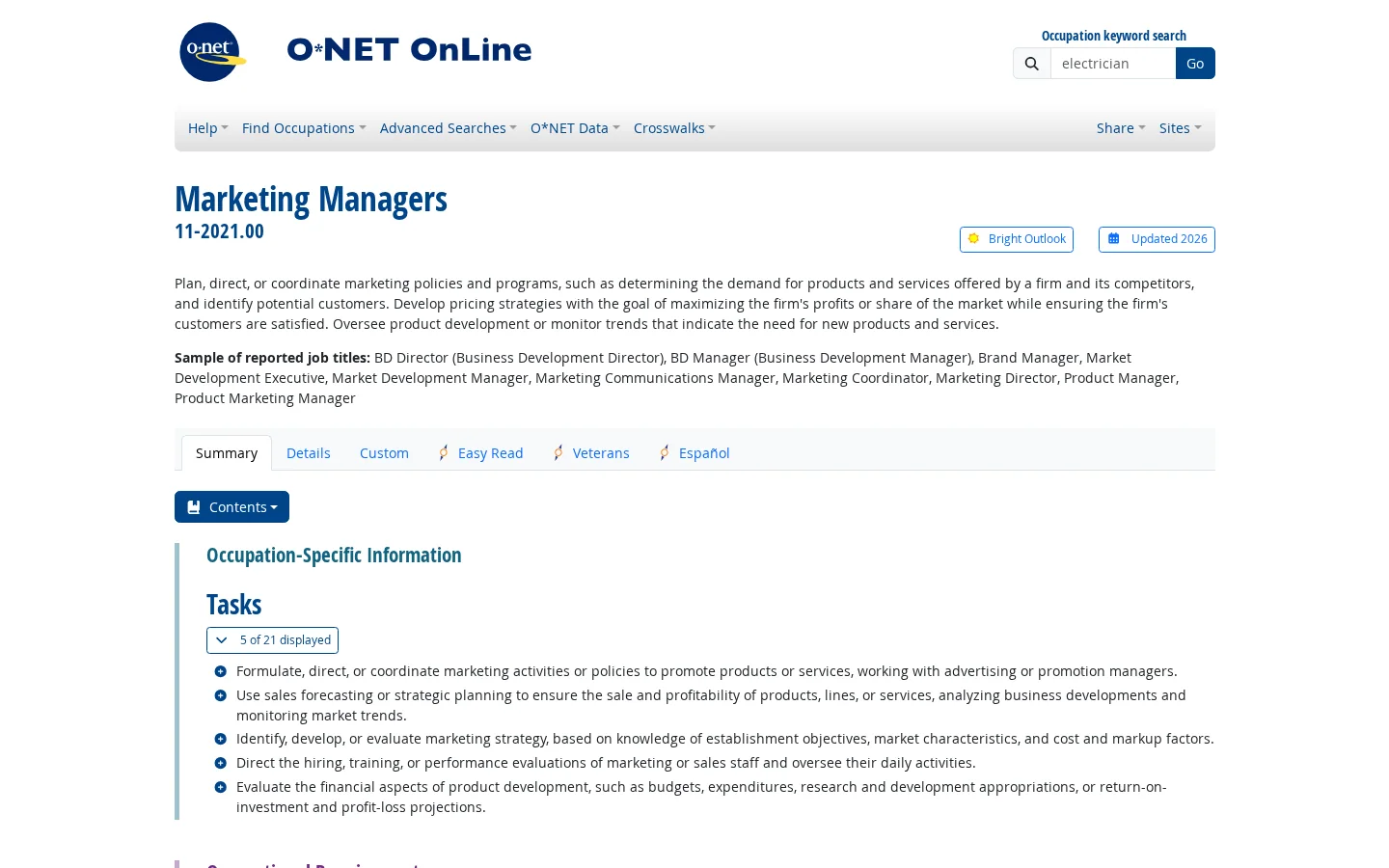
The gap between those two figures is the career path in a nutshell. Pure writing is a flat market, under pressure from AI tools. The pay and the growth sit on the strategy side: planning, distribution, data and the link to revenue. If you are a writer today, the fastest raise is to own the results of your content, not just the text.
AI has taken over a large part of drafting and repetitive production, so the content marketer's value is moving to strategy, original expertise, editing and quality control. The 2027 B2B Content and Marketing Trends report by the Content Marketing Institute and MarketingProfs, presented by Robert Rose on November 4, 2026, puts numbers on this shift.
AI in B2B content teams
Source: Content Marketing Institute and MarketingProfs, 2027 B2B Content and Marketing Trends, 861 B2B marketers
The most telling figure is what marketers say AI brings them. In the CMI 2027 trends research, speed comes first and quality comes last.

The same report lists the main challenges of AI content creation: ensuring accuracy (54%), maintaining quality control (54%) and keeping the brand voice and authenticity (52%). Those three challenges are now core parts of the job. In practice, a content marketer in 2027 spends more time on:
CMI found that 31% of B2B marketers saw website traffic rise over the past year and 31% saw it fall; among those who saw it fall, 79% blame AI-powered search. The response is not to publish less. It is to publish pages that AI models want to quote: clear answers, original data, structured sections. Tools like Sorank's AI content calendar that plans and publishes your blog take the repeatable volume off your plate, so your hours go to the pieces only you can write.
You become a content marketer by proving you can bring results with content, not by collecting diplomas. Degrees in marketing, journalism or communication help, but a portfolio of published pieces with their numbers convinces faster. Here is a plan you can start today.
From zero to your first content marketing job
Your writing is already an advantage. What you need to add is the business side: keyword research, distribution and measurement. Start by tracking the results of everything you publish, then learn to write briefs for others.
You already know the customer and the funnel. Your gap is usually writing and editing. Write one piece a week for 3 months, ask an editor or a senior colleague for feedback, and study the pages that rank first for your topics.
The next step is ownership of revenue. Connect your content to the CRM, build one report that shows content's share of leads and deals, and present it every quarter. That report is what turns a content marketer into a head of content.
Most content programs that fail do so for the same handful of reasons. For each one, here is how it shows, how to spot it in your own work, and how to fix it.
A content program before and after the fixes
What it is: topics come from internal wishes (product launches, company news) instead of customer questions. How to spot it: in Search Console, most of your articles have fewer than 100 impressions after 6 months. How to fix it: for each topic in the calendar, write down the keyword or question it answers and a real customer who asked it. No customer, no article.
What it is: a piece goes live and nothing else happens. How to spot it: in Google Analytics 4, a new article gets almost all its first-week visits from your own team. How to fix it: add a "distribution" column to the calendar with at least 3 channels per piece, and turn each guide into several smaller formats with content repurposing.
What it is: reporting page views and likes while leadership asks about revenue. How to spot it: your monthly report has no line about leads, demos or sales. How to fix it: set up conversion events on content pages, ask sales to log which content prospects mention, and report one revenue metric every month even if it is small.
What it is: publishing many thin pieces, often AI drafts with no edit, to hit a quota. How to spot it: many pages target close variants of the same keyword, have high bounce rates and no backlinks or AI citations. How to fix it: merge overlapping pages, set a quality bar (sourced figures, original example, direct answers), and keep automation for topics where a clear structure is enough.
What it is: the team only creates, never updates. How to spot it: in Search Console, compare the last 3 months with the same period a year earlier and sort by lost clicks: the top pages are decaying. How to fix it: plan one refresh for every three new pieces, starting with pages that sit in positions 5 to 15.
What it is: the calendar fills with one-off requests from other teams. How to spot it: fewer than half of last quarter's pieces map to a content pillar or a funnel stage. How to fix it: publish the calendar's rules (pillars, goals, request deadline) and route every request through them.
What it is: writing only for Google's ranking, not for the answers AI models give. How to spot it: ask ChatGPT, Claude and Gemini the 10 questions your buyers ask: if competitors are cited and you are not, you have a gap. How to fix it: put a direct answer at the top of each section, add tables and sourced figures, and track your citations every month.
A content marketer is a strategist, a writer, a distributor and an analyst in one job, and the job is shifting toward the strategy and quality side as AI takes over drafting. If you are hiring one, look for someone who can show results, not only samples. If you are one, or want to become one, pick one action from this guide and do it this week: map your calendar to search intents, add a distribution plan to your next piece, refresh one decaying page, or build your first report in leads instead of page views.
A content marketer researches what the audience searches and asks, plans the content calendar, writes or briefs content, and pushes each piece to search, email, social and sales. They also refresh old pages and read the data to decide what to publish next.
You need clear writing and editing, customer and keyword research, SEO basics, and enough analytics to read Google Analytics 4 and Search Console. Project management and the ability to check and steer AI tools are now just as important.
Yes, if you move beyond pure writing. In the United States, the median pay of writers and authors was $76910 in May 2025, against $166790 for marketing managers, whose jobs are projected to grow 7% from 2025 to 2035. Content marketers who own strategy and results move toward the second figure.
We analyse your competitors, your website and your AI visibility to create a tailored content plan for free.
 Duplicate Content Checker
 Mobile-Friendly Test
 Website Speed Test
 Subdomain Finder
 Domain Age Checker
 CMS Detector
 Googlebot Simulator
 Nofollow Link Checker
 Meta Tag Checker
 Keyword Cannibalization Checker
 Keyword Intent Checker
 Keyword Extractor
 Google Ads Cost Calculator
 CPC Calculator
 Local Citation Finder
 Reddit Threads Finder
 Disavow File Generator
 Redirect Generator
 Canonical Tag Generator
 Passive Voice Checker
 Google Location Changer
 Google Review Calculator
 Google Review Link Generator
 Keyword Combiner
 Podcast Show Notes Generator
 AI Content Rewriter
 AI Text Humanizer
 ChatGPT Prompt Generator
 Twitter Thread Generator
 Tweet Generator
 Landing Page Copy Generator
 Google Ads Copy Generator
 Pinterest Pin Description Generator
 Anchor Text Generator
 Social Media Post Generator
 LinkedIn Post Generator
 Free AI Writer
 Review Response Generator
 LSI Keyword Generator
 YouTube Video Ideas Generator
 YouTube Tag Generator
 YouTube Description Generator
 Product Description Generator
 CTA Generator
 Blog Introduction Generator
 Conclusion Generator
 Hook Generator
 AI Content Brief Generator
 FAQ Schema Generator
 AI Blog Post Ideas Generator
 Structured Data Validator (Schema Validator)
 Alt Text Checker
 Internal Link Analyzer
 Backlink Challenge
 AI Meta Description Generator
 AI Blog Title Generator
 Google Indexability Checker
 AI Blog Outline Generator
 UTM Link Builder
 Keyword Clustering Tool
 Canonical Tag Checker
 XML Sitemap Generator
 Broken Link Checker
 AI SEO Title Generator
 Headline Analyzer
 SERP Preview Tool
 Redirect Checker
 Hreflang Tag Generator
 Heading Structure Analyzer
 HTTP Headers Checker
 Favicon Extractor
 SERP CTR Calculator
 SEO vs Paid Search Savings Calculator
 SEO Share of Voice Calculator
 SEO ROI Calculator
 SEO Traffic and Revenue Forecast Calculator
 SEO Budget Calculator
 SEO Break-Even Calculator
 SaaS SEO ROI Calculator
 ROAS Calculator
 Reading Time Calculator
 Ranking Gain Simulator
 Organic Traffic Value Calculator
 Organic Traffic Estimator and Website Traffic Checker
 LTV to CAC Ratio Calculator
 Local SEO ROI Calculator
 Link Building Cost Calculator
 Keyword Value Calculator
 Keyword Opportunity Score Calculator
 Keyword Density Calculator
 GEO ROI Calculator
 GEO Content Investment Calculator
 Ecommerce SEO ROI Calculator
 Customer Lifetime Value Calculator
 Customer Acquisition Cost Calculator
 CTR Calculator
 Cost Per Article Calculator
 Conversion Rate Calculator
 Content Marketing ROI Calculator
 ChatGPT Referral Traffic Estimator
 Bounce Rate Calculator
 Backlink ROI Calculator
 AI Visibility Score Calculator
 AI Traffic Value Calculator
 AI Share of Voice Calculator
 Cost of AI Invisibility Calculator
 AI Citation Rate Calculator
 llms.txt Validator
 AI Overview Checker and AI Overviews Rank Checker
 Robots.txt Checker
 AI SEO Audit
 LLM Readability Checker
 SearchGPT Readiness Checker
 Structured Data LLM Audit
 Website Crawlability AI Audit
 Why ChatGPT Is Not Recommending My Website
 Gemini Ranking Tool
 Perplexity Ranking Checker
 LLM Citation Checker
 Answer Engine Optimization Audit
 GEO Audit
 AI Search Visibility Test
 ChatGPT Visibility Checker
 llms.txt Generator
 URL Extractor
 Webpage to Markdown
 Sitemap Checker
 SERP Volatility Sensor
 Page Size Checker
 Word Counter
 Slug Generator
 Schema Generator
 Robots Generator
 OG Preview
 Meta Tags Generator
 Image Compressor
 Favicon Generator
 On-Page SEO Audit: SEO Checker and SEO Analyzer
 Backlink Analysis Tool
 Keyword Research Tool
 Domain Authority Checker
 “I tested Sorank on a real client site and it's insane. It does everything an agency would bill you $1500 a month for. It's going into production on that client now.”

 Guillaume Guersanguersanguillaume.com“We are an Ads agency and we wanted to get our SEO back on track once and for all. Sorank gave us a clear view of our site, helped us prioritize optimizations, and properly structure our content. The tool is easy to use, well designed for a team, and very practical for centralizing tracking without having to juggle multiple platforms. A very solid foundation to start fresh with our SEO.”
 Gaspard MadouiAds Agency
 “I just let the Sorank software do its thing, and now my DR is 25 and my page is ranking higher.”
 Lucas Flandrefoundertrace.fr“I specialized in GEO thanks to Sorank. The GEO Leaderboard allows me to show my clients their position vs competitors on ChatGPT. It’s a real commercial differentiator.”
 MélanieSEO Freelance“Great service, works well for our website and helps us understand how to improve it to rank better on Google and elsewhere. Congrats, keep going, I recommend it.”
 Hugo T.E-commerce merchant