Preferences
Privacy is important to us, so you have the option of disabling certain types of storage that may not be necessary for the basic functioning of the website. Blocking categories may impact your experience on the website. More information
Privacy is important to us, so you have the option of disabling certain types of storage that may not be necessary for the basic functioning of the website. Blocking categories may impact your experience on the website. More information

Build a GEO RACI matrix with one accountable owner per AI visibility task, a template, a monthly diagnosis routine and the mistakes that stall GEO.

In short
A GEO RACI matrix is a table that lists the tasks needed to get your brand recommended by AI assistants, with one Accountable owner per task. It stops two failures: tasks nobody owns, and tasks that three people claim at once. Start with five rows, name a person in each Accountable cell, and review the matrix when roles or recurring fixes change.
Want to go further? Ask
Quick quiz
How should you get mentioned by ChatGPT and other AI assistants?
Sorank matches your answers


Test it for 3 days on your own site and see where you stand on Google, ChatGPT and the other AIs.
Start 3-day free trial3 days free, then stop whenever you want. 90-day results guarantee, conditions apply.
GEO, or generative engine optimization, is the work of getting your brand named, recommended and cited when someone asks ChatGPT, Gemini, Claude or Perplexity a question. If the term is new, the What Is GEO (Generative Engine Optimization)? guide covers the basics before you build a matrix.
GEO is not one job. A page needs a direct answer, a URL that crawlers can reach, facts that third parties confirm, and sometimes a press mention or a corrected business listing. Those pieces sit with the SEO team, the content team, PR, engineering and the people who run the brand. Each group can do its part well and still leave the whole thing unowned.
That gap is where GEO programs stall. A founder asks an assistant for the best tool in your category, and your brand is missing from the answer. The SEO lead thinks the issue is content. The content lead thinks it is off-site authority. PR waits for a brief. Engineering hears about it only when a crawl check fails. Nobody runs the check the next month, because nobody was told to.
A RACI matrix fixes this on paper, before the problem shows up. It is a responsibility assignment chart borrowed from project management. Each row is an activity, each column is a role, and each cell holds one letter. The Wikipedia article on responsibility assignment matrices describes the method and notes that some project management theories require exactly one accountable stakeholder per task. For GEO, the matrix answers four questions for each activity: who does the work, who answers for the result, who must be asked before the work starts, and who needs to hear about it afterwards.
Writing it down also makes the work visible. A GEO task that is not in a matrix gets dropped in the first busy week, and the drop is usually invisible until a competitor starts appearing in answers where you used to be named.
The matrix uses four roles. The definitions are the same as in any project, but the examples are specific to GEO, so write them down for your own team before you fill in a single cell.
Warning
The most common mistake is two people marked Accountable on the same row. If two people are accountable, nobody is. When a fix stalls, the first question should be who holds the A on that row, and whether that person knows it.
Why exactly one? Accountability has to end with a person who can say yes to a deadline, a budget or a decision. A team can be responsible for a task. Only a named person can be asked why the task did not happen.

A working GEO matrix has five rows, and they cover the full cycle from measurement to fix. The first row measures and the other four fix, because each type of fix has a different owner. Rename the titles to match your organization. The structure matters more than the labels.
| Row | What it covers | Typical example | Usual Accountable |
|---|---|---|---|
| Prompt group setup | The questions buyers ask AI, grouped by theme and buying stage | "best GEO tool for a small agency", "how to get a SaaS cited" | Marketing lead |
| Monthly diagnosis | Running the prompts in each assistant and recording mentions and citations | A log of 30 prompts across four assistants | GEO lead |
| SEO gap fixes | Crawl, indexing, structured data and page structure problems | A page blocked by a CDN rule, or missing a direct answer in its first paragraph | Head of SEO |
| Content gap fixes | Missing guides, comparisons and definitions that assistants could cite | No pricing comparison, while assistants keep answering the category question | Content lead |
| PR and off-site fixes | Third-party reviews, press mentions, directory listings and corrections | An outdated listing on a review site that assistants quote | PR lead or CMO |
The incident cases, such as a wrong answer about your prices, do not need their own row in the template. They come up unplanned, so they get a separate small RACI, covered later in this guide.
Plan one afternoon for the first version. The steps are short, but the naming step causes the most debate, so leave time for it.
Build your GEO RACI matrix in six steps
Do not build the rows from a template alone. Run a first diagnosis: ask 20 to 30 buyer questions in ChatGPT, Gemini, Claude and Perplexity, and note what happens. The gaps show up fast. A brand missing from comparison questions needs a content gap row. A brand cited with an old price needs an update to its own page first, and a PR row only if the wrong price sits on a third-party site.
Write a name, not a job title. "Marketing lead" is a role that someone may hold for two years, and the matrix has to answer "who owns this?" in the time it takes to read one line. If the company is small, one person may be A on three rows. That is fine, as long as no row has two A cells and the person knows how much work that is.
Example
A five-person SaaS company. The founder is A for the monthly diagnosis and for PR fixes. A freelance writer is R on content gap fixes, with the content lead as A. The developer is C on SEO fixes and I on every diagnosis. The founder is the bottleneck, so the first review moves the PR fixes to a freelancer who reports to them.
Keep the R column to the people who actually edit the work. Keep C to two people at most per row. A common pattern for an SEO fix: the head of SEO is A, the SEO specialist is R, engineering is C because the fix often needs a template change, and the GEO lead is C too, because they measured the gap. Marketing leadership is I.
Read the matrix column by column. Count the A cells in each row, and make sure each has exactly one. Then count how many rows each person is A on. A person who is A on all five rows is a bottleneck, so move some of those rows to R or C. Then run one test: pick a row at random and ask the named A to explain the last fix they signed off. If they cannot, the row is not really owned.
The matrix belongs in the same document as the monthly calendar, so anyone can answer "who owns this?" in under 30 seconds. A slide deck gets forgotten after the meeting where it was shown. Put the matrix at the top of the page where the monthly diagnosis is recorded, and link each gap in the log to the row that owns it.
Re-run the matrix when a new role joins, when a fix type becomes recurring (for example, grounding page creation turns into a monthly task), or when a handoff fails. A failed handoff means the matrix has a gap, not just a bad week. Plan a full review once a year, and treat the triggers as the reason to change it earlier.
Before you call the matrix finished
A RACI matrix says who does what. It does not say where the GEO work sits in the company, and that choice changes the matrix. Three models are common. A small team and a large company rarely use the same one, so the choice depends on your size and on how many teams touch your brand's answers.
The principle is simple: the head of SEO owns GEO as an extension of search work. Use it when the SEO team already runs well and most GEO fixes are technical or on-page. The advantages are no new role, one budget, and fast fixes for crawl and structured data. The limit is that PR and brand work sit outside the team, so off-site fixes stall. An example: a six-person SEO team adds a monthly prompt log to its existing reports, and the head of SEO is A on the diagnosis row.
One named GEO lead owns the diagnosis and moves each gap to the right fix owner, but does not own the fixes. Use it when several teams touch the brand's answers, or when AI answers decide which brands make a shortlist in your category. The advantage is one owner for measurement and clear escalation. The costs are a new role or a larger share of someone's time, and the risk that the lead becomes a reporting role with no authority. An example: a GEO lead reports to marketing, is A on the monthly diagnosis, and is C on every fix row.
A monthly meeting of SEO, content, PR and engineering reviews the diagnosis and assigns the fixes. The committee decides, but each row still has one A. Use it in larger organizations, with several brands or regions. The advantage is that everyone hears the same data at the same time. The limit is that committees are slow, and without one A per row, the meeting can end with no owner. An example: a 40-minute monthly review with a fixed agenda, where each gap leaves the room with a named A.
| Model | Best for | Main strength | Main risk | Who is A on the diagnosis |
|---|---|---|---|---|
| GEO inside the SEO team | Small teams with strong SEO | Fast technical fixes, no new role | Off-site fixes stall | Head of SEO |
| Dedicated GEO lead | Brands where AI answers shape shortlists | One owner for measurement and escalation | The role turns into reporting only | GEO lead |
| Shared committee | Multi-brand or multi-region companies | Everyone sees the same data | Meetings that end without a named owner | GEO lead, who chairs the meeting |
Ownership without a GEO lead, and with one
The diagnosis row decides everything that follows. It needs a fixed prompt list, the same assistants every month, and a log you can compare over time. Without those three things, you have a set of anecdotes, and anecdotes do not tell you which fix to make next.
Use 25 to 40 questions that a buyer would type, split into four groups. Category questions look like "best X for Y". Comparison questions look like "X vs Y". Problem questions look like "how do I fix Z". Brand questions look like "is [brand] any good". Keep the wording fixed from month to month, so that changes in the answers come from the market and not from your edits to the prompts.
Run each prompt in each assistant and record the date, the model, whether your brand is named, its position in the list, the URL cited, and the competitors named. Answers vary between runs, so the same prompt can name you one day and skip you the next. Run the important prompts more than once, or use a tool that repeats them, and read the results as a trend over at least three months. A log can be as simple as this:
date,model,prompt_id,prompt,brand_named,position,cited_url,competitors_named
2026-11-03,ChatGPT,P07,best GEO tool for a small SaaS,no,,,Rival A; Rival B
2026-11-03,Gemini,P07,best GEO tool for a small SaaS,yes,2,https://www.example.com/geo-guide,Rival A
The main number to track is the mention rate per assistant: the number of prompts where your brand is named, divided by the number of prompts run for that assistant. Track it every month. The GEO performance metrics entry lists the other KPIs worth adding to the log once the basics are steady.
For each prompt where you are missing, look at the cited sources. Which page did the assistant read, and why did it prefer the competitor? Then sort each gap into a row. Crawl or structure problems go to SEO. A missing comparison goes to content. A third-party source that is wrong goes to PR. Each gap gets one row, one A, and a due date. Sort the queue by the number of prompts affected, not by whoever asks loudest. The AI visibility audit guide shows how to build the first version of that log.
The diagnosis rhythm, from the first month to the yearly review
A wrong answer about your brand, such as an old price, a discontinued product or a false claim, needs its own small RACI. It is not a monthly task, so it does not fit the five template rows. The steps are the same every time: detect, find the cause, fix your own pages, fix third-party sources, and tell the team.
| Step | Responsible | Accountable | Consulted | Informed |
|---|---|---|---|---|
| Detect and reproduce the wrong answer | GEO lead | GEO lead | SEO specialist | Marketing lead |
| Find the root cause in the cited sources | SEO specialist | Head of SEO | Engineering, content lead | GEO lead |
| Correct your own page | Content writer | Content lead | GEO lead, legal if a claim is involved | Marketing lead |
| Correct a third-party source | PR specialist | PR lead | GEO lead | Marketing lead |
The GEO lead is A on detection, which matches the monthly diagnosis row, so detection never waits for a meeting. The other steps have their own owners, and the root cause step is the one most teams skip. Without it, the same wrong answer comes back the next month.
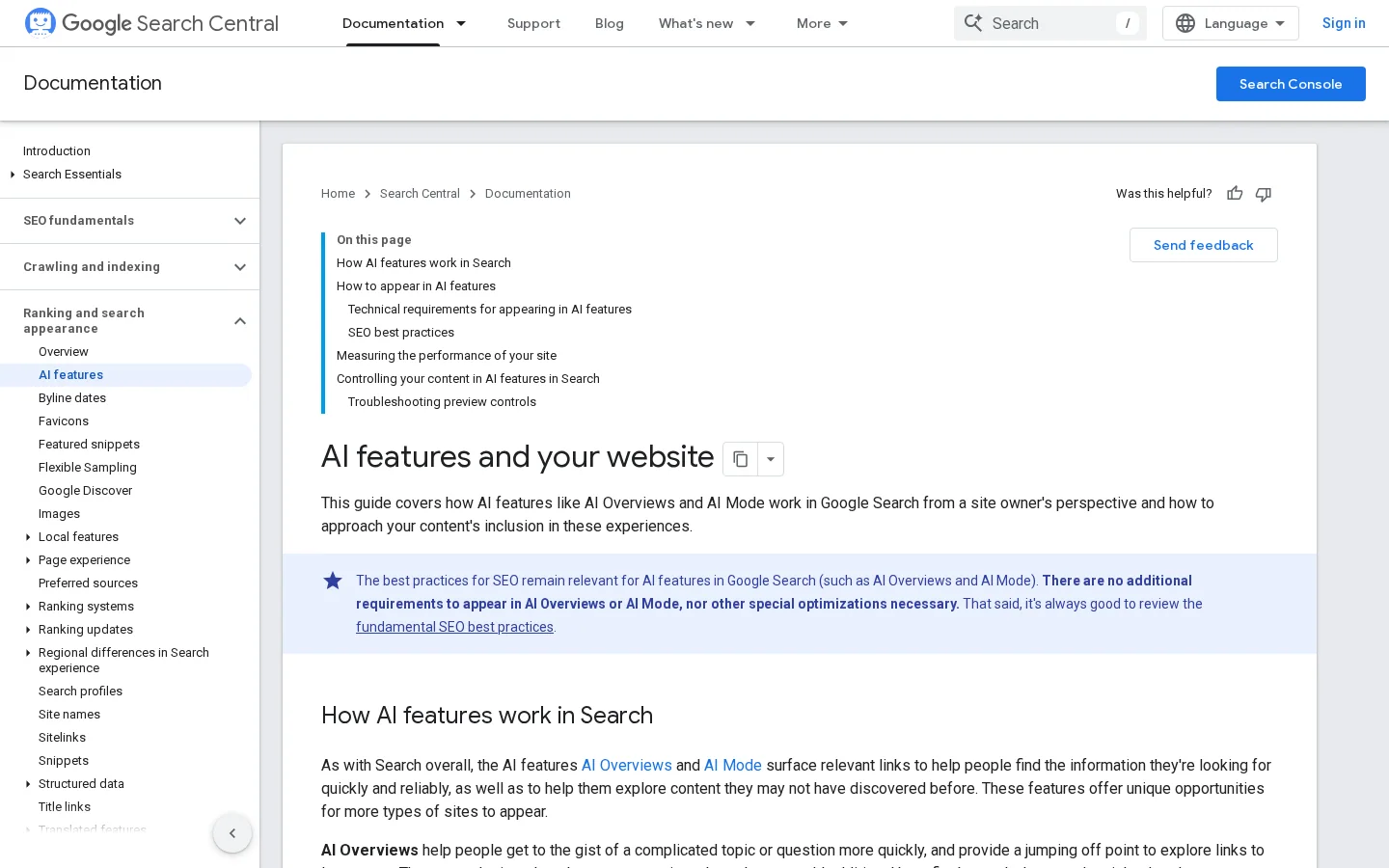
Google's own guidance sets the baseline. Its AI features and your website page from Google Search Central states that there are no additional requirements to appear in AI Overviews or AI Mode, nor other special optimizations necessary. The basics it lists are crawling allowed in robots.txt and by any CDN or hosting setup, and content that is easy to find through internal links.
That has a direct consequence for the matrix. In practice, the most damaging GEO failures are technical: a robots.txt rule or a CDN setting that blocks crawlers, or a key page that only appears after JavaScript runs. Engineering should be Informed on every diagnosis, Consulted on every SEO fix, and Accountable for crawl access. Do not wait for a launch to discover a blocked page.
User-agent: *
Disallow: /admin/
Sitemap: https://www.example.com/sitemap.xml
This file blocks only the admin area. The danger comes from a broader rule, such as a single slash under a wildcard user agent, which removes the whole site from crawling. Assign crawl access to one named person, and have them check the live file after every deployment that touches routing or the CDN.
Tip
Before you hand crawl access to engineering, check the live file. The free robots.txt checker shows whether your rules let crawlers reach your key pages.
The strongest public evidence on GEO comes from academic work. The GEO paper by Pranjal Aggarwal and co-authors was first submitted to arXiv on 16 November 2023 and was later accepted at KDD 2024. Its abstract reports that GEO can boost visibility by up to 40% in generative engine responses, measured on a benchmark of queries, domains and engines built by the authors.
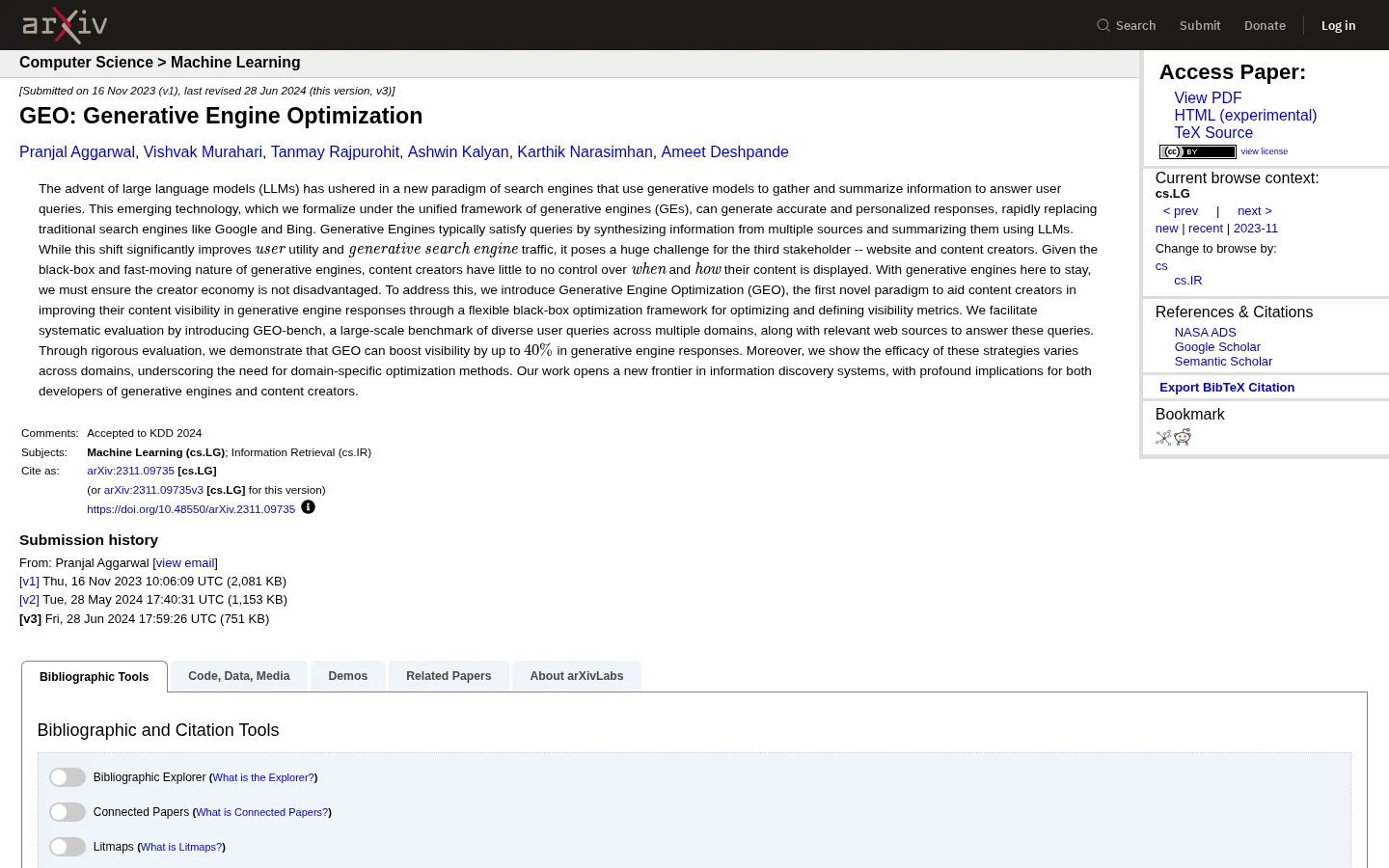
Read that figure with care. It is a ceiling measured in the authors' own setup, not a promise for your site, and the paper's results depend on the domain. What the research does show is that GEO can be measured, and measurement only works if someone owns it every month. A program without a diagnosis owner cannot tell whether a fix worked, so it cannot learn from its own results.
The ceiling reported by the research
Source: Aggarwal et al., "GEO: Generative Engine Optimization", arXiv 2311.09735
Most broken GEO matrices fail in the same five ways. Each one has a visible symptom, so you can check for it in an afternoon. The fix is usually a change of name or a change of row, not a new tool.
This is two names in the A column, usually because two leaders each feel they should decide. To spot it, ask the team who signed off the last fix on that row. If two people answer, or nobody does, the row has a problem. To fix it, keep as A the person who controls the budget or the page, move the other person to R or C, and write the decision into the matrix so it does not come back.
The A column reads "Marketing lead" and nothing else. The symptom is that the title exists, but nobody can say who holds it today, or the person changed and the file did not. To fix it, write the name next to the title, and put the date of the last check at the top of the matrix. If the person leaves, the row becomes unowned until someone updates it.
The first time engineering hears about GEO is when a template or a crawl rule has to change. The symptom is that fixes wait for weeks in the development backlog, or that the same schema error returns every month. To fix it, make engineering Informed on every diagnosis, Consulted on SEO fixes, and Accountable for crawl access. Give them the monthly log, so they see the pattern and do not have to ask for it.
The team lists fixes, but nobody owns the measurement. The symptom is a log that does not exist, or one with three entries from six months ago. To fix it, add the diagnosis row first, make the GEO lead both R and A, and set a fixed monthly date in the calendar. A fix list without a diagnosis is a guess with a budget.
The matrix lists site work but ignores the off-site sources that assistants read, such as review sites, directories, press articles and community answers. To spot it, look at the cited URLs in the log. If most of them belong to third parties, and no row in your matrix has an owner for those sources, the matrix is incomplete. To fix it, add a PR and off-site row with an A who can actually contact those sites, and review its results with the diagnosis.
Sorank automates parts of the cycle, which reduces how much of the diagnosis row is manual work. The GEO optimization feature measures your brand's mentions each month across the main AI assistants, ranks your market on a leaderboard, and publishes content written to be quoted by those assistants. The same measurement feeds the workflow described in Sorank for SEO Teams.
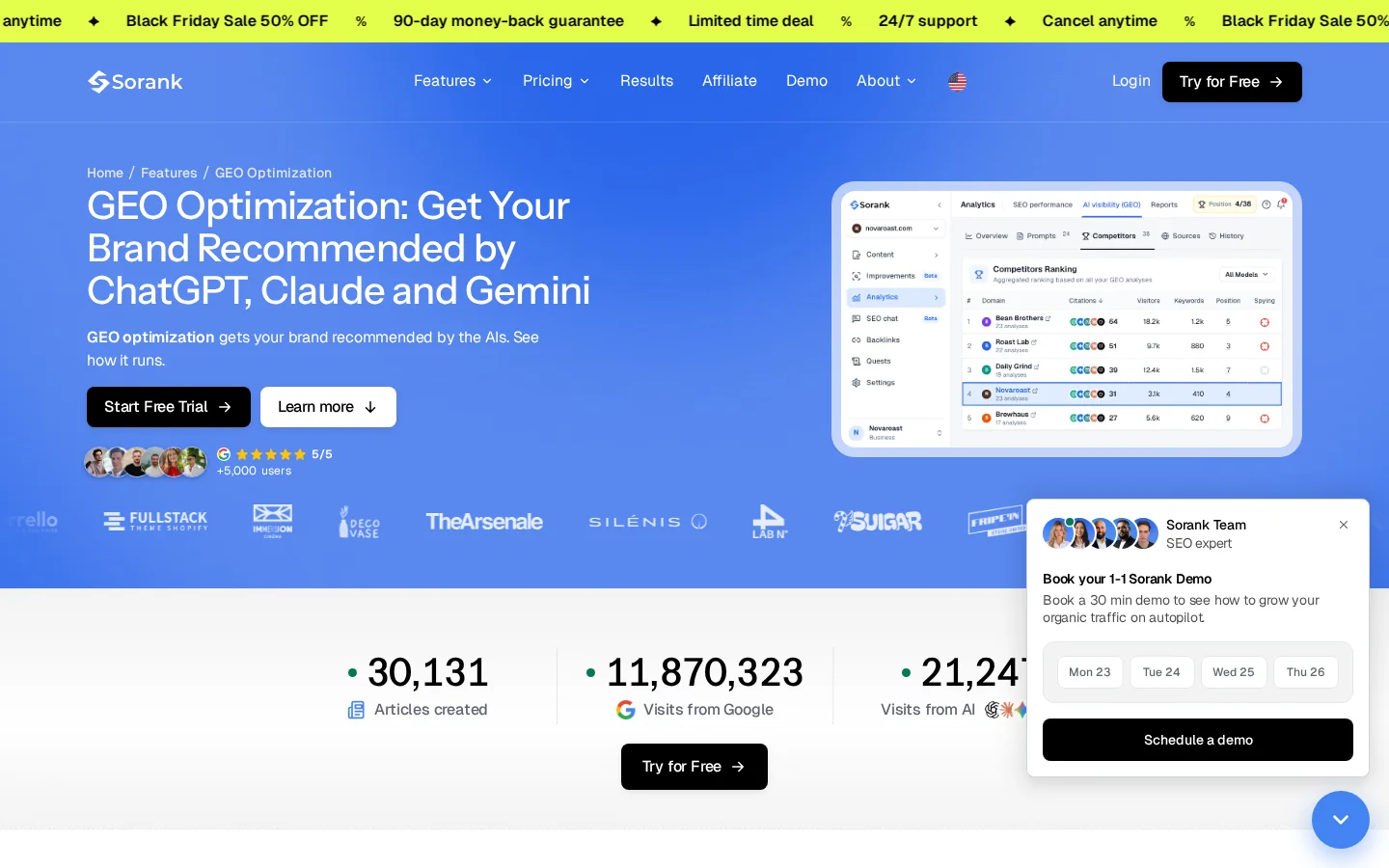
A tool does not replace the matrix. It can log the mentions and produce the articles, but a named person still has to be Accountable on each row, and that person still decides which gap comes first.
Start with the diagnosis, because it creates the list of rows. Then write the matrix, name one person per row, and store it next to the calendar. The steps below take about a week if you already have an SEO team and a content calendar.
If you are still deciding whether GEO needs its own role, the SEO team structure guide covers the roles and the order in which to hire them. The GEO strategy plan shows what the matrix should serve, so the owners you name are the ones who can move those goals. Once each row has a name, the matrix stops being a document and starts being a schedule.
A GEO RACI matrix is a responsibility chart that lists each task needed to get your brand cited by AI assistants. Each row gets one Accountable person, plus Responsible, Consulted and Informed roles. It keeps tasks from being unowned or claimed by several teams at once.
The owner depends on your structure. In a small company it is often the head of SEO or a marketing lead, and in a larger one a dedicated GEO lead owns the monthly diagnosis. Whatever the model, one named person must be Accountable on each row.
Review it at least once a year, and sooner when a new role joins, when a fix type becomes recurring, or when a handoff between teams fails. Keep the monthly diagnosis log in the same document so the matrix stays tied to real results.
We analyse your competitors, your website and your AI visibility to create a tailored content plan for free.
 Duplicate Content Checker
 Mobile-Friendly Test
 Website Speed Test
 Subdomain Finder
 Domain Age Checker
 CMS Detector
 Googlebot Simulator
 Nofollow Link Checker
 Meta Tag Checker
 Keyword Cannibalization Checker
 Keyword Intent Checker
 Keyword Extractor
 Google Ads Cost Calculator
 CPC Calculator
 Local Citation Finder
 Reddit Threads Finder
 Disavow File Generator
 Redirect Generator
 Canonical Tag Generator
 Passive Voice Checker
 Google Location Changer
 Google Review Calculator
 Google Review Link Generator
 Keyword Combiner
 Podcast Show Notes Generator
 AI Content Rewriter
 AI Text Humanizer
 ChatGPT Prompt Generator
 Twitter Thread Generator
 Tweet Generator
 Landing Page Copy Generator
 Google Ads Copy Generator
 Pinterest Pin Description Generator
 Anchor Text Generator
 Social Media Post Generator
 LinkedIn Post Generator
 Free AI Writer
 Review Response Generator
 LSI Keyword Generator
 YouTube Video Ideas Generator
 YouTube Tag Generator
 YouTube Description Generator
 Product Description Generator
 CTA Generator
 Blog Introduction Generator
 Conclusion Generator
 Hook Generator
 AI Content Brief Generator
 FAQ Schema Generator
 AI Blog Post Ideas Generator
 Structured Data Validator (Schema Validator)
 Alt Text Checker
 Internal Link Analyzer
 Backlink Challenge
 AI Meta Description Generator
 AI Blog Title Generator
 Google Indexability Checker
 AI Blog Outline Generator
 UTM Link Builder
 Keyword Clustering Tool
 Canonical Tag Checker
 XML Sitemap Generator
 Broken Link Checker
 AI SEO Title Generator
 Headline Analyzer
 SERP Preview Tool
 Redirect Checker
 Hreflang Tag Generator
 Heading Structure Analyzer
 HTTP Headers Checker
 Favicon Extractor
 SERP CTR Calculator
 SEO vs Paid Search Savings Calculator
 SEO Share of Voice Calculator
 SEO ROI Calculator
 SEO Traffic and Revenue Forecast Calculator
 SEO Budget Calculator
 SEO Break-Even Calculator
 SaaS SEO ROI Calculator
 ROAS Calculator
 Reading Time Calculator
 Ranking Gain Simulator
 Organic Traffic Value Calculator
 Organic Traffic Estimator and Website Traffic Checker
 LTV to CAC Ratio Calculator
 Local SEO ROI Calculator
 Link Building Cost Calculator
 Keyword Value Calculator
 Keyword Opportunity Score Calculator
 Keyword Density Calculator
 GEO ROI Calculator
 GEO Content Investment Calculator
 Ecommerce SEO ROI Calculator
 Customer Lifetime Value Calculator
 Customer Acquisition Cost Calculator
 CTR Calculator
 Cost Per Article Calculator
 Conversion Rate Calculator
 Content Marketing ROI Calculator
 ChatGPT Referral Traffic Estimator
 Bounce Rate Calculator
 Backlink ROI Calculator
 AI Visibility Score Calculator
 AI Traffic Value Calculator
 AI Share of Voice Calculator
 Cost of AI Invisibility Calculator
 AI Citation Rate Calculator
 llms.txt Validator
 AI Overview Checker and AI Overviews Rank Checker
 Robots.txt Checker
 AI SEO Audit
 LLM Readability Checker
 SearchGPT Readiness Checker
 Structured Data LLM Audit
 Website Crawlability AI Audit
 Why ChatGPT Is Not Recommending My Website
 Gemini Ranking Tool
 Perplexity Ranking Checker
 LLM Citation Checker
 Answer Engine Optimization Audit
 GEO Audit
 AI Search Visibility Test
 ChatGPT Visibility Checker
 llms.txt Generator
 URL Extractor
 Webpage to Markdown
 Sitemap Checker
 SERP Volatility Sensor
 Page Size Checker
 Word Counter
 Slug Generator
 Schema Generator
 Robots Generator
 OG Preview
 Meta Tags Generator
 Image Compressor
 Favicon Generator
 On-Page SEO Audit: SEO Checker and SEO Analyzer
 Backlink Analysis Tool
 Keyword Research Tool
 Domain Authority Checker
 “I tested Sorank on a real client site and it's insane. It does everything an agency would bill you $1500 a month for. It's going into production on that client now.”

 Guillaume Guersanguersanguillaume.com“We are an Ads agency and we wanted to get our SEO back on track once and for all. Sorank gave us a clear view of our site, helped us prioritize optimizations, and properly structure our content. The tool is easy to use, well designed for a team, and very practical for centralizing tracking without having to juggle multiple platforms. A very solid foundation to start fresh with our SEO.”
 Gaspard MadouiAds Agency
 “I just let the Sorank software do its thing, and now my DR is 25 and my page is ranking higher.”
 Lucas Flandrefoundertrace.fr“I specialized in GEO thanks to Sorank. The GEO Leaderboard allows me to show my clients their position vs competitors on ChatGPT. It’s a real commercial differentiator.”
 MélanieSEO Freelance“Great service, works well for our website and helps us understand how to improve it to rank better on Google and elsewhere. Congrats, keep going, I recommend it.”
 Hugo T.E-commerce merchant