Preferences
Privacy is important to us, so you have the option of disabling certain types of storage that may not be necessary for the basic functioning of the website. Blocking categories may impact your experience on the website. More information

Privacy is important to us, so you have the option of disabling certain types of storage that may not be necessary for the basic functioning of the website. Blocking categories may impact your experience on the website. More information

GEO checklist for 2026: 30 points ranked by priority to get your site read, cited and recommended by ChatGPT, Gemini, Perplexity and AI Overviews.
Tools

In short
a GEO checklist verifies that AI assistants can reach your pages, extract a clear answer from them, trust your brand and mention it. The 30 points below are grouped in five blocks and ranked by priority: access for AI crawlers first, then answer-ready content, then entity and trust signals, then presence on the third-party sites AI quotes, and finally measurement on a fixed set of prompts.
Want to go further? Ask
Quick quiz
How should you get mentioned by ChatGPT and other AI assistants?
Sorank matches your answers


Test it for 3 days on your own site and see where you stand on Google, ChatGPT and the other AIs.
Start 3-day free trial3 days free, then stop whenever you want. 90-day results-or-refund guarantee.
A GEO checklist (generative engine optimization, also called an AEO or answer engine optimization checklist) is the list of checks that decide whether ChatGPT, Gemini, Perplexity, Claude or Google's AI Overviews can use your site as a source. Most items overlap with good SEO, and Google says so plainly in its documentation on AI features: a page must be indexed and eligible for a snippet, and no special file or markup is required. What changes is the order of priorities and a few checks that classic SEO audits skip, such as the AI search crawlers and the way a passage reads once it is lifted out of the page. If you need the bigger picture first, read our GEO strategy guide; this article is the operational list.
Work through the blocks in order: a page that AI crawlers cannot fetch will never be cited, however good its content. Each point has a priority level:
| Block | Points | Priority | Typical effort |
|---|---|---|---|
| 1. Access and indexing | 1 - 7 | Critical | Hours (one-off) |
| 2. Answer-ready content | 8 - 17 | High | Days per key page |
| 3. Entity and trust | 18 - 22 | High | One to two days |
| 4. Third-party presence | 23 - 26 | Medium to high | Ongoing |
| 5. Measurement | 27 - 30 | High | One hour per week |
To score your current state before starting, run a free GEO audit on your homepage and on your most important page: it flags the technical blockers of block 1 in a few seconds.
Each assistant uses a dedicated bot to build its search index. OpenAI states in its crawler documentation that OAI-SearchBot decides which sites can appear in ChatGPT search answers; Perplexity uses PerplexityBot, Anthropic uses Claude-SearchBot, and Google AI Overviews rely on the normal Googlebot. Training bots (GPTBot, ClaudeBot, Google-Extended) are a separate decision: you can block training and still allow search. Our guide to robots.txt for AI crawlers lists every user agent with the right syntax.
Many sites allow AI bots in robots.txt but block them one layer below, in a bot protection setting of their CDN or hosting firewall. Test a few URLs with each user agent and check your server logs for 403 responses.
Most AI crawlers read the raw HTML and do not execute JavaScript. If your text, prices or FAQ only appear after a script runs, they are invisible to them. See our guide to JavaScript SEO for server rendering options.
Google AI features draw on Google's index, and Microsoft Copilot draws on Bing's. Submit an XML sitemap in both Search Console and Bing Webmaster Tools, and use IndexNow to push new URLs to Bing quickly.
Google uses the same preview controls for AI features as for classic results: nosnippet, data-nosnippet and max-snippet limit what can be quoted. Check that no template applies them by mistake to your key pages.
Assistants fetch pages in real time for many questions and give up on slow or failing ones. Keep server response time low, remove 5xx errors and avoid interstitials that hide the content.
An llms.txt file summarizes your site for language models. No major assistant has publicly confirmed using it to choose sources, and Google says it is not needed, so treat it as low priority. If you publish one, check its format with the free llms.txt validator.
Watch out
Blocking GPTBot does not remove you from ChatGPT search, but blocking OAI-SearchBot does. Read each user agent's purpose before copying a robots.txt template found online.
AI assistants rarely quote a whole page. They retrieve passages, compare them and assemble an answer. The checks below make each passage useful on its own. Our guide on how to optimize content for AI search goes deeper on each one.
Start the page with a two to four sentence summary that fully answers the main question, and open each section with a direct answer before the details.
Write H2s the way people ask assistants: "How much does X cost?", "Is X safe for Y?". A heading that matches the prompt helps the retrieval system pick the right passage.
A passage lifted out of the page must still make sense: repeat the subject instead of writing "it" or "this tool", and avoid references such as "as seen above".
For every key term, one sentence of the form "X is a... that...". Definitions are among the passages assistants reuse most often.
Comparisons, steps, prices and specifications are easier to extract from a table or a list than from a paragraph.
The research paper that named the field, GEO: Generative Engine Optimization (Princeton University and partners, presented at KDD 2024), found that adding citations, quotations and statistics could raise a source's visibility in generated answers by up to 40% on its benchmark. Name the source and the date next to each number.
A short quote from an identified person (your founder, a customer, a researcher) adds a verifiable voice that generic content lacks.
First-party data, test results, real prices, screenshots and field experience give an assistant a reason to cite you rather than the ten pages that say the same thing.
Behind one prompt, assistants run several searches, a process called query fan-out. A page that also answers the obvious follow-ups (price, alternatives, limits, how to start) matches more of those searches.
Show a visible "updated" date, refresh figures at least once a year and remove outdated statements. Content freshness matters most for prices, tools and statistics.
Tip
Paste one of your sections alone into a blank document. If a stranger cannot understand what it is about and what it answers, an AI system will not either: rewrite it until it stands on its own.
Use one name, one short description and the same key facts (category, location, founding year, offer) on your site, social profiles, directories and partner pages. Consistent descriptions help models connect all mentions to one entity.
Organization schema with sameAs links to your official profiles, Article schema with an author, and Product or LocalBusiness where relevant. Our guide to structured data for AI search shows the useful types.
Google insists on it: structured data must match what the visitor sees. Hidden or inflated markup is ignored at best.
Name, role, experience and links to other work. They support the experience and expertise signals that Google and assistants look for on advice content.
Assistants recommend products by comparing facts: price, features, coverage, guarantees. A clear pricing page, an about page and a comparison page answer the questions they ask about you.
Forums, video platforms, review sites and encyclopedias appear often among AI sources. Our study of Reddit citations in AI answers shows how often discussions are reused; a helpful answer in the right thread can be quoted for months.
For "best X for Y" prompts, assistants lean on third-party rankings. List the articles that rank for your category and contact their authors with useful facts.
Ratings and review content on independent sites feed both local results and product recommendations.
Links from sites in your field still drive Google rankings, and pages that rank well are retrieved more often by assistants that search the web.
Write 20 to 50 questions your buyers really ask, and run the same set every week on ChatGPT, Gemini, Perplexity and Claude. Answers vary from one run to the next, so read trends over several weeks, never a single result.
A mention names your brand; a citation links to your page. Note both, and above all note who is cited in your place: those pages show what to improve. A full method is in our AI visibility audit guide.
Create a channel in your analytics tool that groups visits from chatgpt.com, perplexity.ai, gemini.google.com, claude.ai and copilot.microsoft.com, then follow their conversions.
Google counts AI Overviews and AI Mode traffic inside the Search Console Performance report (Web search type). Since February 2026, Bing Webmaster Tools has an AI Performance report that counts citations of your pages in Copilot and Bing AI summaries, with the grounding queries behind them.
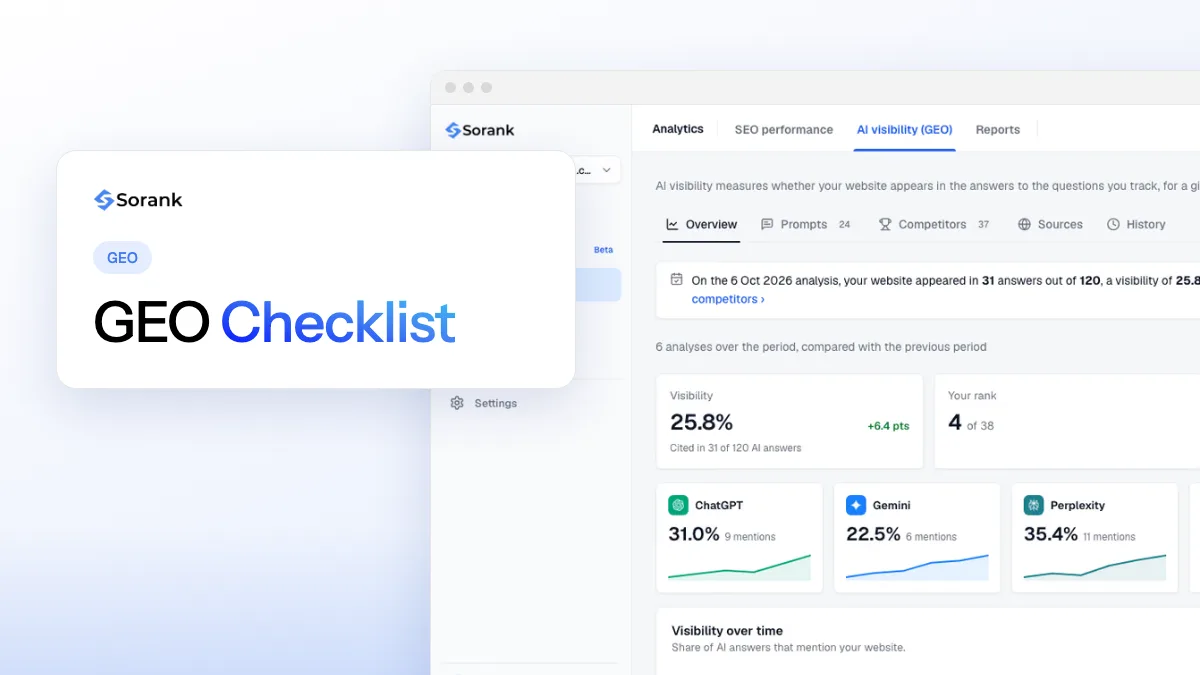
Blocks 2 and 5 take the most time, week after week. Sorank's AI mention tracking follows 25 to 150 prompts depending on the plan on ChatGPT, Claude and Gemini (plus Perplexity and Grok from the Pro plan), shows whether your brand is cited and which competitors appear instead.
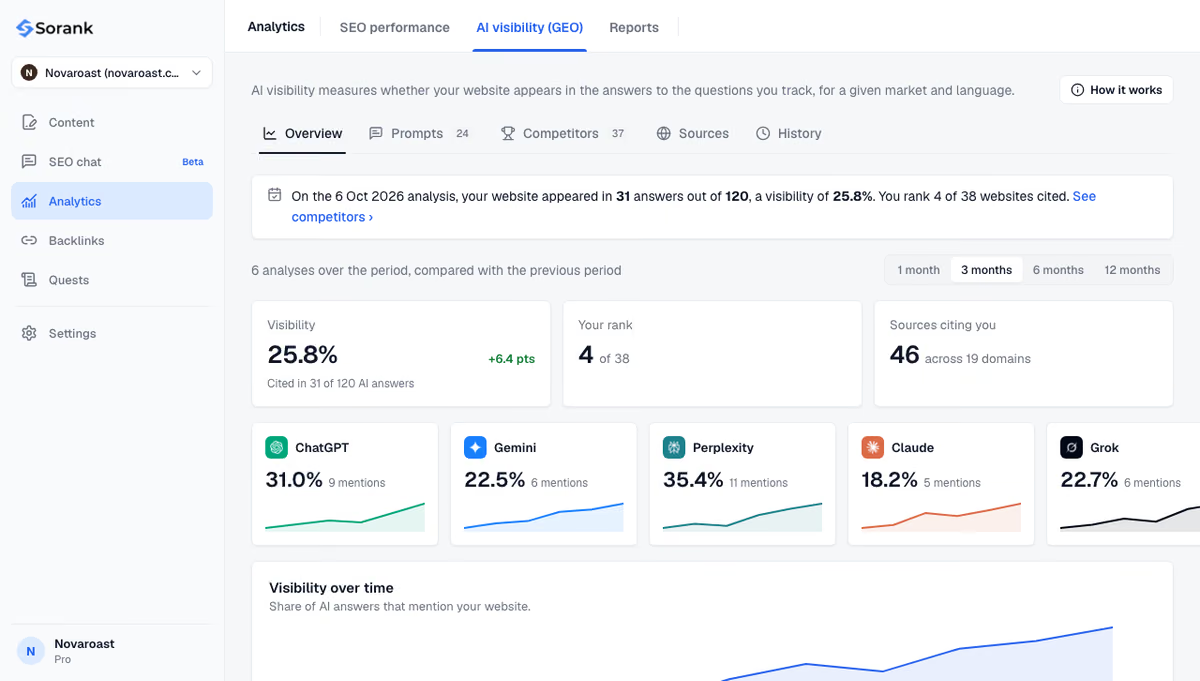
On the content side, the blog article generator writes and publishes answer-first articles with sources, tables, FAQ and internal links, in autopilot or as drafts for review.
Run the 30 points in order, fix block 1 before anything else, and measure the same prompts every week: that is how a site goes from invisible to cited. To automate the tracking and the content, see Sorank plans (3-day free trial, 90-day money-back guarantee).

Yes, in practice both terms cover the same work. GEO (generative engine optimization) and AEO (answer engine optimization) both aim to get a site quoted or recommended in answers written by AI assistants such as ChatGPT, Gemini, Perplexity or Google AI Overviews. Some authors keep AEO for featured snippets and voice answers, but the checks are the same.
Technical fixes such as unblocking AI crawlers can change citations within a few weeks, once pages are crawled again. Content and reputation work usually needs two to four months, similar to SEO, because assistants rely on search indexes and third-party mentions that take time to build. Measure on a fixed prompt panel over several weeks before judging.
Run the full checklist once, then check access and indexing after every site change or redesign. Content points should be reviewed when a page is updated, and prompt tracking should run every week. A full review every quarter catches new crawlers, new platforms and outdated figures.
We analyse your competitors, your website and your AI visibility to create a tailored content plan for free.
 AI Content Brief Generator
 FAQ Schema Generator
 AI Blog Post Ideas Generator
 Structured Data Validator (Schema Validator)
 Alt Text Checker
 Internal Link Analyzer
 Backlink Challenge
 AI Meta Description Generator
 AI Blog Title Generator
 Google Indexability Checker
 AI Blog Outline Generator
 UTM Link Builder
 Keyword Clustering Tool
 Canonical Tag Checker
 XML Sitemap Generator
 Broken Link Checker
 AI SEO Title Generator
 Headline Analyzer
 SERP Preview Tool
 Redirect Checker
 Hreflang Tag Generator
 Heading Structure Analyzer
 HTTP Headers Checker
 Favicon Extractor
 SERP CTR Calculator
 SEO vs Paid Search Savings Calculator
 SEO Share of Voice Calculator
 SEO ROI Calculator
 SEO Traffic and Revenue Forecast Calculator
 SEO Budget Calculator
 SEO Break-Even Calculator
 SaaS SEO ROI Calculator
 ROAS Calculator
 Reading Time Calculator
 Ranking Gain Simulator
 Organic Traffic Value Calculator
 Organic Traffic Estimator and Website Traffic Checker
 LTV to CAC Ratio Calculator
 Local SEO ROI Calculator
 Link Building Cost Calculator
 Keyword Value Calculator
 Keyword Opportunity Score Calculator
 Keyword Density Calculator
 GEO ROI Calculator
 GEO Content Investment Calculator
 Ecommerce SEO ROI Calculator
 Customer Lifetime Value Calculator
 Customer Acquisition Cost Calculator
 CTR Calculator
 Cost Per Article Calculator
 Conversion Rate Calculator
 Content Marketing ROI Calculator
 ChatGPT Referral Traffic Estimator
 Bounce Rate Calculator
 Backlink ROI Calculator
 AI Visibility Score Calculator
 AI Traffic Value Calculator
 AI Share of Voice Calculator
 Cost of AI Invisibility Calculator
 AI Citation Rate Calculator
 llms.txt Validator
 AI Overview Checker and AI Overviews Rank Checker
 Robots.txt Checker
 AI SEO Audit
 LLM Readability Checker
 SearchGPT Readiness Checker
 Structured Data LLM Audit
 Website Crawlability AI Audit
 Why ChatGPT Is Not Recommending My Website
 Gemini Ranking Tool
 Perplexity Ranking Checker
 LLM Citation Checker
 Answer Engine Optimization Audit
 GEO Audit
 AI Search Visibility Test
 ChatGPT Visibility Checker
 llms.txt Generator
 URL Extractor
 Webpage to Markdown
 Sitemap Checker
 SERP Volatility Sensor
 Page Size Checker
 Word Counter
 Slug Generator
 Schema Generator
 Robots Generator
 OG Preview
 Meta Tags Generator
 Image Compressor
 Favicon Generator
 On-Page SEO Audit: SEO Checker and SEO Analyzer
 Backlink Analysis Tool
 Keyword Research Tool
 Domain Authority Checker
THEY TRIED SORANK BEFORE YOU
 “I tested Sorank on a real client site and it's insane. It does everything an agency would bill you $1500 a month for. It's going into production on that client now.”

 Guillaume Guersanguersanguillaume.com“We are an Ads agency and we wanted to get our SEO back on track once and for all. Sorank gave us a clear view of our site, helped us prioritize optimizations, and properly structure our content. The tool is easy to use, well designed for a team, and very practical for centralizing tracking without having to juggle multiple platforms. A very solid foundation to start fresh with our SEO.”
 Gaspard MadouiAds Agency
 “I just let the Sorank software do its thing, and now my DR is 25 and my page is ranking higher.”
 Lucas Flandrefoundertrace.fr“I specialized in GEO thanks to Sorank. The GEO Leaderboard allows me to show my clients their position vs competitors on ChatGPT. It’s a real commercial differentiator.”
 MélanieSEO Freelance“Great service, works well for our website and helps us understand how to improve it to rank better on Google and elsewhere. Congrats, keep going, I recommend it.”
 Hugo T.E-commerce merchant