Preferences
Privacy is important to us, so you have the option of disabling certain types of storage that may not be necessary for the basic functioning of the website. Blocking categories may impact your experience on the website. More information
Privacy is important to us, so you have the option of disabling certain types of storage that may not be necessary for the basic functioning of the website. Blocking categories may impact your experience on the website. More information

Build a content governance framework for SEO: owners, standards, a page map, refresh rules and the checks that stop cannibalization and duplicate pages.
In short
A content governance framework is the written set of rules that decides who owns each page, how articles are structured, what each article must check before it goes live, and when pages get updated or removed. For SEO, it stops the problems that come from many writers working without shared rules: pages that compete with each other, duplicate URLs, stale articles and content nobody reviews. You can build a first version in a week, with five parts: ownership, standards, a page map, a workflow and a lifecycle.
Want to go further? Ask
Quick quiz
Which way of finding customers online fits you best?
Sorank matches your answers


Test it for 3 days on your own site and see where you stand on Google, ChatGPT and the other AIs.
Start 3-day free trial3 days free, then stop whenever you want. 90-day results guarantee, conditions apply.
Content governance is the layer between your strategy and your daily work. Strategy says what you should publish and why. Operations is the work itself: briefs, drafts, edits, publishing. Governance is the set of decisions that keeps that work consistent: who approves, which rules apply, and how a page moves from idea to retirement.
| Layer | Question it answers | Typical document |
|---|---|---|
| Strategy | What should we publish, and for whom? | Keyword map, topic list |
| Governance | Who decides, and by which rules? | Owners, style guide, page map, approval rules |
| Operations | How does a page get made and checked? | Brief template, pre-publish checklist, calendar |
With two writers and 40 articles, you can run this from memory. With ten contributors, a CMS and an AI writing tool, memory fails. Each person makes small choices. One writer titles a post "autopilot SEO", another writes "automated SEO". One targets "content audit template" in a new article while an old one already ranks for it. Nobody decided that, and nobody can see it. A framework makes those decisions once, in writing, so they stop depending on who wrote the draft.
A framework is also short on purpose. A 90-page policy that nobody opens governs nothing. A few pages of rules that every writer and editor follows does. If a rule cannot be checked, rewrite it. "Write with authority" is a wish. "Every article links to its pillar page before publication" is a rule you can check in thirty seconds.
Most ranking problems in a content library come from structure, not from one weak article. Governance catches structure problems before they are published. Two numbers show why it matters.
In December 2023, Ahrefs reported that 96.55% of the pages in its Content Explorer index get zero organic traffic from Google. The sample was about 14 billion pages from many sites, so it describes the web in general, not your site. It still shows that publishing without a rule for what goes live, and why, is how most content ends up unused.
In July 2025, Ahrefs found that pages cited by ChatGPT, Perplexity, Copilot and Gemini were on average 25.7% fresher than pages in organic Google results, measured in days since publication. The study does not cover Google AI Overviews. It matters for governance because review dates become a visibility question, not just housekeeping. We come back to it in the lifecycle section.
What the data says about content without rules
Sources: Ahrefs, search traffic study (December 2023); Ahrefs, AI assistants and fresh content (July 2025)
Five failure modes show up again and again:
For the planning side of the same problem, read our SEO content strategy guide. This article stays on the rules that keep a library clean once the plan exists.

A workable framework has five parts. Each one answers a question the others cannot answer, so a gap in one shows up in the rest. Here is what each part contains, with a checklist for each.
Every topic cluster and every page needs one named owner. The owner approves changes, answers for the page's results, and decides when it is refreshed or retired. Shared ownership usually means nobody owns the page at all.
Ownership: what to define
Three documents keep the words consistent. The style guide covers grammar, headings, numbers and formatting. The voice guide covers tone, formality and who the reader is being talked to by. The terms list covers preferred names and words to avoid. For SEO, the terms list does the most work. If one writer calls your product a "SEO platform", another calls it a "search tool" and a third uses its old name, readers and search engines see three different subjects.
Standards: what to write down
If you use an AI writer, load the voice guide and the terms list into it before the first draft. A human owner still approves each result.
The page map is a list of every URL you own, with its topic, primary keyword, parent page and status. It is the one document that says which page should answer which query. The next section explains how to build it and check it.
Structure: what the page map holds
Every article follows the same path: brief, draft, review, publication, then a check 30 days later. The brief matters most. It names the primary keyword, the existing pages the article must link to, the question the reader arrives with, and the owner. If the brief cannot name those four things, the article does not start. The content brief generator and the content brief guide give you a template to begin with.
Workflow: what a brief must hold
Each page gets a review date when it goes live. Triggers, such as falling clicks or a changed product, send it back to its owner. Most sites skip this part, so the library grows every year and gets slightly worse. The lifecycle section below sets out the rules.
Lifecycle: what to set on day one
A governance model decides where decision power sits. Three models come up in most guides on the topic. None is better in general. Pick the one that matches your team size and your monthly volume.
One team makes every content decision, from topic choice to publication. It is the fastest model to set up and gives the most consistency. A four-person SaaS blog where the founder approves each article is a clean example.
Each team owns its own content. Product, sales and regional teams publish what they know best. This suits large companies with separate product lines or markets, where domain experts matter more than a shared voice.
A central team sets the standards, the templates and the page map. Teams write inside those rules. The central team reviews only high-visibility pages, such as pillar pages and pages aimed at buying queries. Routine pieces ship without waiting in the central queue.
| Model | Who decides | Best for | Main risk |
|---|---|---|---|
| Centralized | One team | One to ten people | Bottleneck |
| Decentralized | Each team | Several product lines or markets | Duplicate pages |
| Hybrid | Central standards, local writing | Ten to 100 people | Vague definition of high-visibility |
Central review of every article, or review of high-visibility pages only
For most SEO blogs, start centralized, then move to hybrid once the review queue slows publication. Teams that start hybrid without a written definition usually end up centralized again, with more meetings.
The page map is the most useful SEO document in the framework. It answers one question: which page should exist for each query? Once that answer is written down, two articles stop competing for the same query, and you know where a new article belongs before you write it.
Keep it in a spreadsheet, or in your CMS if it supports custom fields. Each column has a rule.
| Column | What it holds | Rule |
|---|---|---|
| URL | The live address, in full and in lowercase | One row per URL |
| Primary keyword | The query the page must rank for | Never in two rows |
| Parent | The pillar page the article supports | Every cluster page has one |
| Status | Live, refresh, merge or retire | Changed only by the owner |
| Owner and review date | Who acts, and when | Both filled before publication |
Do not wait for rankings to drop. Open the Search Console performance report, set the date range to the last 90 days, and export queries and pages. Then:
For example, two posts target "content audit template". The older one gets most of the clicks, and the newer one gets almost none. Merge the new post into the old one, redirect the new URL, and link the merged page from the pillar. A reasonable starting rule is to merge when the weaker URL gets less than a tenth of the clicks of the stronger one over 90 days. That is a working threshold you set yourself, not a Google number. Write it in the framework so every owner makes the same call.
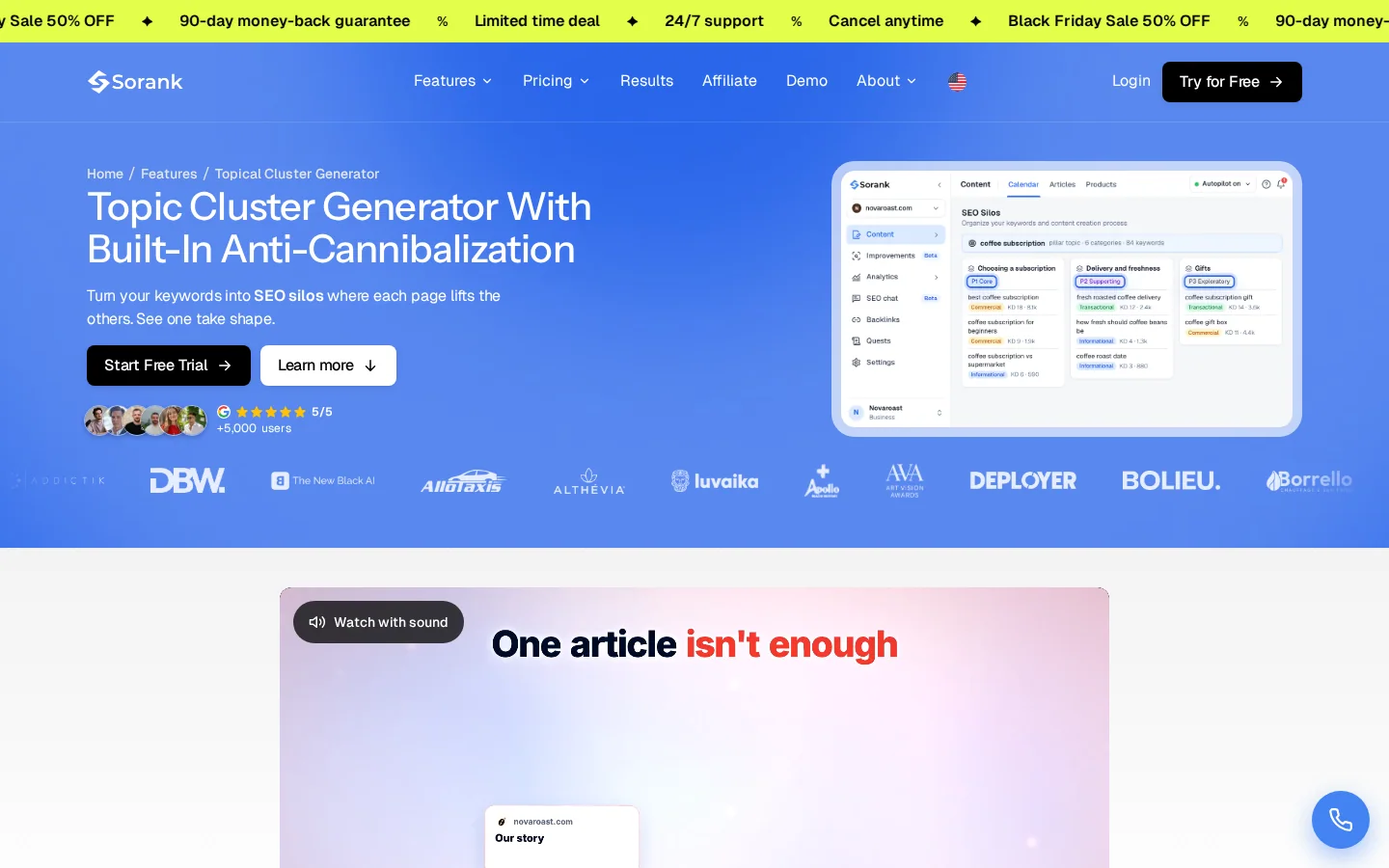
Software can flag overlaps for you. Sorank's topic cluster generator checks each keyword against the ones already grouped before it joins a cluster. You still decide which overlap to merge.
Google's guidance on consolidating duplicate URLs lists three methods, from strongest to weakest: a permanent redirect, a rel="canonical" link (or the equivalent HTTP header), and inclusion in your sitemap. Use a redirect when the duplicate should disappear. Use a canonical tag when both URLs must stay live, such as a print version or a filtered view. Google advises against using robots.txt or noindex for this job, and notes that using two methods at once is more error prone, so pick one per duplicate.
<link rel="canonical" href="https://www.example.com/">Place the tag in the head of each duplicate, pointing to the one URL you keep. That kept page should carry a self-referential canonical too. The canonical URL glossary entry covers the mechanics, and the duplicate without user-selected canonical guide covers the case where Google picks a different URL than you intended.
Note
A 301 redirect is the strongest signal of the three methods, so use it whenever the duplicate has no reason to exist. Reserve canonical tags for pages that must remain reachable.
The page map also sets the internal link rules. Pillar pages link to their cluster pages, and cluster pages link back to the pillar. Cluster pages link to each other when the reader needs the next step. Put the rule in the framework as a number: every new article gets at least three links from existing pages, and at least three links out to its pillar and related pages. Check both before publication.
The internal linking strategy and the site architecture guide go deeper into the structure itself.
Tip
Before you publish, check how many internal links already point to the page with the free internal link analyzer. A page with zero inbound links is an orphan, and the fastest fix is a link from the pillar page.
Before and after a page map
This is the order that works for a small team. A team of two or three can finish the first pass in a week. Each step ends with a document you can point to. The steps follow the same logic as the model in TechTarget's guide to building a content governance model (Laurence Hart, October 2023), adapted here for SEO.
Six steps to a working framework
Illustrative example
A three-person team runs a 60-article blog. In week one, they write a one-page terms list, export 90 days of Search Console queries, and find four overlaps. Two pages merge, one is redirected, and one new brief is rejected because its keyword already sits in the page map. The whole pass takes about two working days.
Pages age, and most governance frameworks forget that part. The Ahrefs figure above shows that AI assistants cite fresher pages on average. Freshness alone does not save a weak page, though. The framework decides which action to take, based on triggers the owner reviews.
| Trigger | What it means | Action |
|---|---|---|
| Clicks fall for three months in a row | The page lost relevance, or a competitor overtook it | Update facts, examples and headings |
| The product or tool changed | Screenshots, steps and claims are out of date | Rewrite the affected sections the same week |
| A date or figure in the page is old | Readers and AI systems see stale facts | Replace it with a dated, verified source |
| Two pages now overlap | Cannibalization | Merge into the stronger page |
| No clicks and no links for 12 months | The page has no role left | Retire it, or redirect to the closest page |
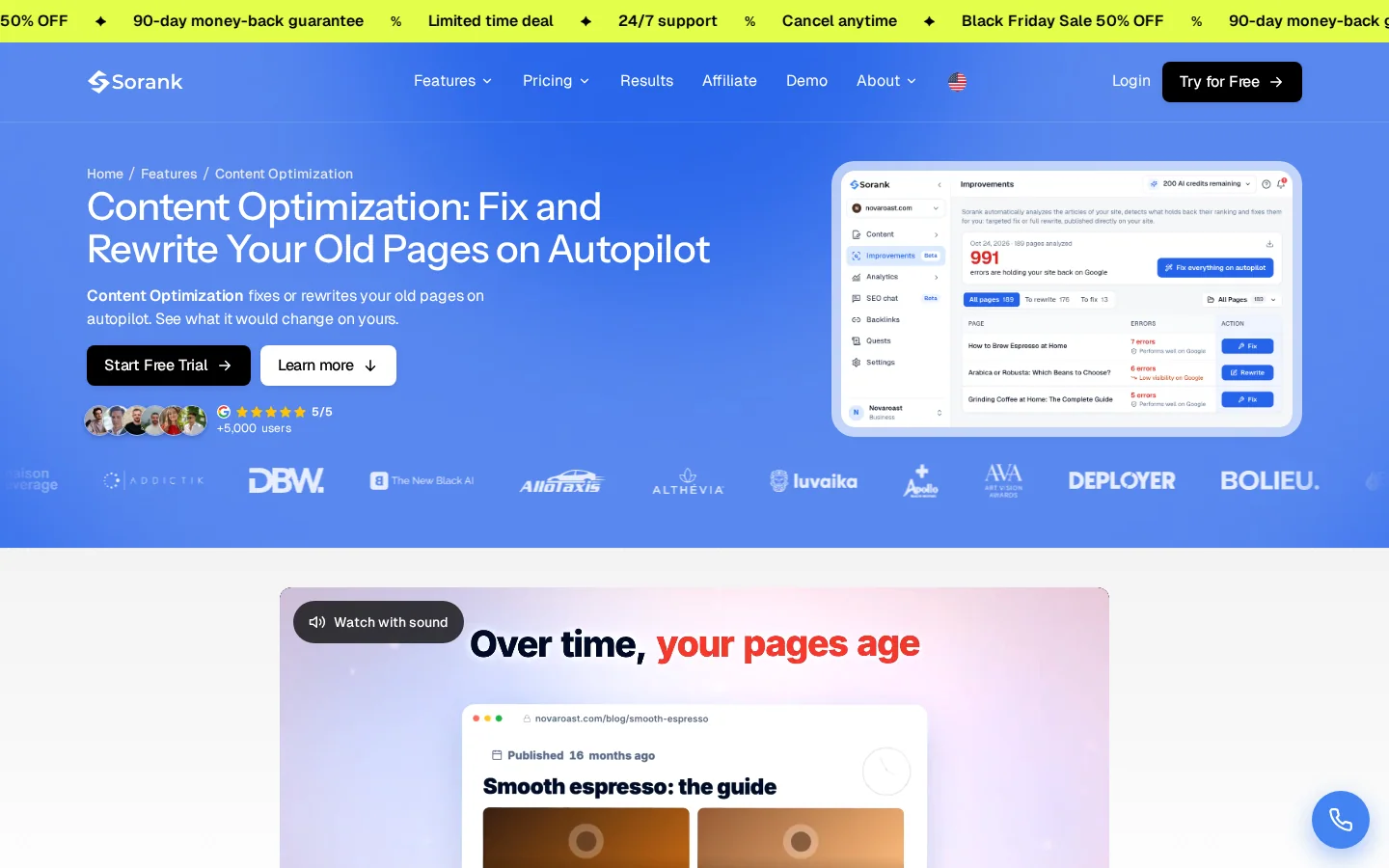
Refreshing well means changing the page, not adding a new date. A rewrite that keeps the same thin content and only changes the date is still thin. The content refresh guide and the content audit guide walk through the process step by step. If you want software to handle rewrites of existing pages, Sorank's content optimization feature is built for that job.
Retiring a page takes three checks. First, list its inbound links from other sites and from your own pages. Second, if the page still has links or traffic, redirect it with a 301 to the closest page that answers the same question. Third, if no page is close, remove it and log the decision in the page map. On an Apache server, one line in the .htaccess file does the redirect:
Redirect 301 /blog-geo-seo/old-article /blog-geo-seo/new-articleThen update the internal links that still point to the old URL. A redirect is a fallback, not a substitute for fixing your own links.
These four mistakes cause most of the damage in content libraries. The table gives the quick version. Each subsection explains how to spot the mistake and how to fix it.
| Mistake | How to spot it | Fix |
|---|---|---|
| Rules nobody can find | The same questions come up in chat every week | One document, linked from the brief template |
| Owners without authority | Pages sit in review for weeks | Give owners approve and retire rights, in writing |
| A page map nobody updates | Live articles missing from the map | Make a map row a condition of the brief |
| Volume rules without quality rules | Many thin articles, low impressions, no internal links | Set a minimum standard for every article |
What it is: the style guide lives in a PDF in someone's drive, and each writer has a different copy.
How to spot it: drafts follow different conventions, and the same formatting question comes back every week.
How to fix it: keep one version in one place, and link it from the brief template and the CMS. Cut it to a few pages. Review it once a quarter, and log each change with a date.
What it is: the page has an owner on paper, but the owner cannot approve, edit or retire anything.
How to spot it: reviews stall, and the owner has no access to the CMS. Ask the owner to retire one page this week. If they cannot, the role is not real.
How to fix it: write down what the owner can approve, change and retire, and give them the access to do it.
What it is: the map was built once, then left alone while the site grew.
How to spot it: live articles that are not in the map, and review dates that are months old.
How to fix it: make a map row a condition of the brief, so no article starts without one. Review the map in a 30-minute monthly meeting, and keep that meeting on decisions, not on reading the list.
What it is: a target like "four articles a week" with no check on whether each article deserves to exist.
How to spot it: thin articles with near-identical headings, low impressions and no internal links. This is the pattern Google's spam policies describe: many pages made to rank rather than to help people.
How to fix it: set a minimum for every article: a real reader question, a checked source for each figure, at least three internal links, and a page map row. An article that fails one of these waits. It does not ship.
Software is good at the repetitive parts: exporting queries, grouping keywords, flagging overlaps and sending reminders about review dates. It cannot decide which topic matters to your business, approve a claim, or know what your customers object to. Keep those decisions with the owners you named.
| Task | Software can do it | A person must decide |
|---|---|---|
| Export and group queries | Yes, from Search Console and keyword data | Which topics matter to the business |
| Flag overlaps | Yes, before a keyword joins a cluster | Which page to merge or keep |
| Draft an article | Yes, when the terms and voice are loaded | Whether the claims are true and the owner approves |
| Send review reminders | Yes, from the page map dates | Whether the page is refreshed or retired |
Sorank's brand voice feature writes articles in your tone, with your words, and its blog planner puts them on a calendar. Even with that help, a human owner approves each result. For the drafting side of the same question, see our guide to AI content for SEO.
A framework nobody measures slowly turns into a document in a drawer. Track these five numbers each month, in the same sheet as the page map. None of them needs a paid tool, and the direction matters more than the exact value.
| Number | How to get it | Healthy direction |
|---|---|---|
| Pages with a future review date | Count the rows in the page map | Up, toward all pages |
| Queries with two or more overlapping URLs | Search Console export, grouped by query | Down, toward zero |
| Orphan pages | Pages with no inbound internal link | Down, toward zero |
| Days from brief to publication | Dates in the calendar or the CMS | Down, then stable; a sudden jump means a rule is blocking |
| Pages per status | Count the status column | Merges and retirements rise after the first audit, then settle |
Read the numbers together. Fewer overlaps with much slower publication can mean the review step is too heavy. Find which rule causes the delay before you remove it.
Start small. These five tasks take one afternoon for a blog of up to 100 articles, and they give you the first version of the framework.
This week
When the list is done, run a full content audit to find the pages that need a rule. Governance is not a document you finish once. It is the set of decisions you keep making, in the same place, with the same owners.
A content governance framework is a short set of written rules. It names who owns each page, which standards every article must meet, and when pages are refreshed or retired. For SEO, it keeps the site from publishing pages that compete with each other.
Five parts: ownership, standards, a page map with URL rules, a publishing workflow and a lifecycle with review dates. Start with the page map, because it stops duplicate and overlapping articles before they are written. Keep the whole document to a few pages that people will actually read.
Google's spam policies target pages made mainly to manipulate rankings, so the rule is value per page, not volume. Require a real reader question, a checked source for each figure, at least three internal links and a page map row before publishing. An owner with the authority to reject a draft reviews every AI output.
We analyse your competitors, your website and your AI visibility to create a tailored content plan for free.
 Duplicate Content Checker
 Mobile-Friendly Test
 Website Speed Test
 Subdomain Finder
 Domain Age Checker
 CMS Detector
 Googlebot Simulator
 Nofollow Link Checker
 Meta Tag Checker
 Keyword Cannibalization Checker
 Keyword Intent Checker
 Keyword Extractor
 Google Ads Cost Calculator
 CPC Calculator
 Local Citation Finder
 Reddit Threads Finder
 Disavow File Generator
 Redirect Generator
 Canonical Tag Generator
 Passive Voice Checker
 Google Location Changer
 Google Review Calculator
 Google Review Link Generator
 Keyword Combiner
 Podcast Show Notes Generator
 AI Content Rewriter
 AI Text Humanizer
 ChatGPT Prompt Generator
 Twitter Thread Generator
 Tweet Generator
 Landing Page Copy Generator
 Google Ads Copy Generator
 Pinterest Pin Description Generator
 Anchor Text Generator
 Social Media Post Generator
 LinkedIn Post Generator
 Free AI Writer
 Review Response Generator
 LSI Keyword Generator
 YouTube Video Ideas Generator
 YouTube Tag Generator
 YouTube Description Generator
 Product Description Generator
 CTA Generator
 Blog Introduction Generator
 Conclusion Generator
 Hook Generator
 AI Content Brief Generator
 FAQ Schema Generator
 AI Blog Post Ideas Generator
 Structured Data Validator (Schema Validator)
 Alt Text Checker
 Internal Link Analyzer
 Backlink Challenge
 AI Meta Description Generator
 AI Blog Title Generator
 Google Indexability Checker
 AI Blog Outline Generator
 UTM Link Builder
 Keyword Clustering Tool
 Canonical Tag Checker
 XML Sitemap Generator
 Broken Link Checker
 AI SEO Title Generator
 Headline Analyzer
 SERP Preview Tool
 Redirect Checker
 Hreflang Tag Generator
 Heading Structure Analyzer
 HTTP Headers Checker
 Favicon Extractor
 SERP CTR Calculator
 SEO vs Paid Search Savings Calculator
 SEO Share of Voice Calculator
 SEO ROI Calculator
 SEO Traffic and Revenue Forecast Calculator
 SEO Budget Calculator
 SEO Break-Even Calculator
 SaaS SEO ROI Calculator
 ROAS Calculator
 Reading Time Calculator
 Ranking Gain Simulator
 Organic Traffic Value Calculator
 Organic Traffic Estimator and Website Traffic Checker
 LTV to CAC Ratio Calculator
 Local SEO ROI Calculator
 Link Building Cost Calculator
 Keyword Value Calculator
 Keyword Opportunity Score Calculator
 Keyword Density Calculator
 GEO ROI Calculator
 GEO Content Investment Calculator
 Ecommerce SEO ROI Calculator
 Customer Lifetime Value Calculator
 Customer Acquisition Cost Calculator
 CTR Calculator
 Cost Per Article Calculator
 Conversion Rate Calculator
 Content Marketing ROI Calculator
 ChatGPT Referral Traffic Estimator
 Bounce Rate Calculator
 Backlink ROI Calculator
 AI Visibility Score Calculator
 AI Traffic Value Calculator
 AI Share of Voice Calculator
 Cost of AI Invisibility Calculator
 AI Citation Rate Calculator
 llms.txt Validator
 AI Overview Checker and AI Overviews Rank Checker
 Robots.txt Checker
 AI SEO Audit
 LLM Readability Checker
 SearchGPT Readiness Checker
 Structured Data LLM Audit
 Website Crawlability AI Audit
 Why ChatGPT Is Not Recommending My Website
 Gemini Ranking Tool
 Perplexity Ranking Checker
 LLM Citation Checker
 Answer Engine Optimization Audit
 GEO Audit
 AI Search Visibility Test
 ChatGPT Visibility Checker
 llms.txt Generator
 URL Extractor
 Webpage to Markdown
 Sitemap Checker
 SERP Volatility Sensor
 Page Size Checker
 Word Counter
 Slug Generator
 Schema Generator
 Robots Generator
 OG Preview
 Meta Tags Generator
 Image Compressor
 Favicon Generator
 On-Page SEO Audit: SEO Checker and SEO Analyzer
 Backlink Analysis Tool
 Keyword Research Tool
 Domain Authority Checker
 “I tested Sorank on a real client site and it's insane. It does everything an agency would bill you $1500 a month for. It's going into production on that client now.”

 Guillaume Guersanguersanguillaume.com“We are an Ads agency and we wanted to get our SEO back on track once and for all. Sorank gave us a clear view of our site, helped us prioritize optimizations, and properly structure our content. The tool is easy to use, well designed for a team, and very practical for centralizing tracking without having to juggle multiple platforms. A very solid foundation to start fresh with our SEO.”
 Gaspard MadouiAds Agency
 “I just let the Sorank software do its thing, and now my DR is 25 and my page is ranking higher.”
 Lucas Flandrefoundertrace.fr“I specialized in GEO thanks to Sorank. The GEO Leaderboard allows me to show my clients their position vs competitors on ChatGPT. It’s a real commercial differentiator.”
 MélanieSEO Freelance“Great service, works well for our website and helps us understand how to improve it to rank better on Google and elsewhere. Congrats, keep going, I recommend it.”
 Hugo T.E-commerce merchant