Preferences
Privacy is important to us, so you have the option of disabling certain types of storage that may not be necessary for the basic functioning of the website. Blocking categories may impact your experience on the website. More information

Privacy is important to us, so you have the option of disabling certain types of storage that may not be necessary for the basic functioning of the website. Blocking categories may impact your experience on the website. More information

Build an SEO content strategy step by step: business goals, keyword universe, topical map, pillar and cluster pages, calendar, internal links and measurement.

Tools


In short
An SEO content strategy is a plan that decides which topics your site will cover, in which order and in what format, so that each page answers a real search and supports your business goals. You build it in seven steps: set goals, map the keyword universe, group it into a topical map, organise pillar and cluster pages, plan a publishing calendar, connect everything with internal links, then measure and refresh. In 2026 the same plan must also make your pages easy for AI assistants to quote.
Want to go further? Ask
Most blogs fail for a simple reason: they publish what the team feels like writing, then hope Google will find an audience for it. A SEO content strategy reverses the order. It starts from the questions your buyers already ask, and it turns them into a structured body of pages where every article has a job. This guide shows how SEO and content marketing fit together, then walks through the full method.
Content marketing decides what is worth saying, SEO decides which questions to answer first and how to package the answer. The two disciplines share the same raw material (articles, guides, comparisons, tools) and the same goal (attracting qualified visitors who become customers).
Content marketing brings the editorial angle: your expertise, your opinions, your proof, the tone that makes a reader trust you. SEO brings the demand data: what people type, how often, with which intent, and which pages already win. A strategy built on content marketing alone tends to produce good articles nobody finds. A strategy built on SEO alone tends to produce findable pages that convince nobody. For the broader editorial side, see our guide to content marketing strategy; this page focuses on the search side.
The goals come from the business, never from the keyword list. Before any research, write down what the content must produce and for whom.
Each goal changes the priorities. A company that needs leads this quarter starts with commercial and comparison queries close to purchase. A company building authority starts with the core definitions and guides of its field. Write one sentence per goal and one main metric, so every later decision can be checked against it.
List every question your buyers ask along the journey, then qualify each one by intent, volume and difficulty. Start from your products, your customers' vocabulary and your competitors' best pages, then expand with a keyword tool and Google's own suggestions ("People also ask", related searches).
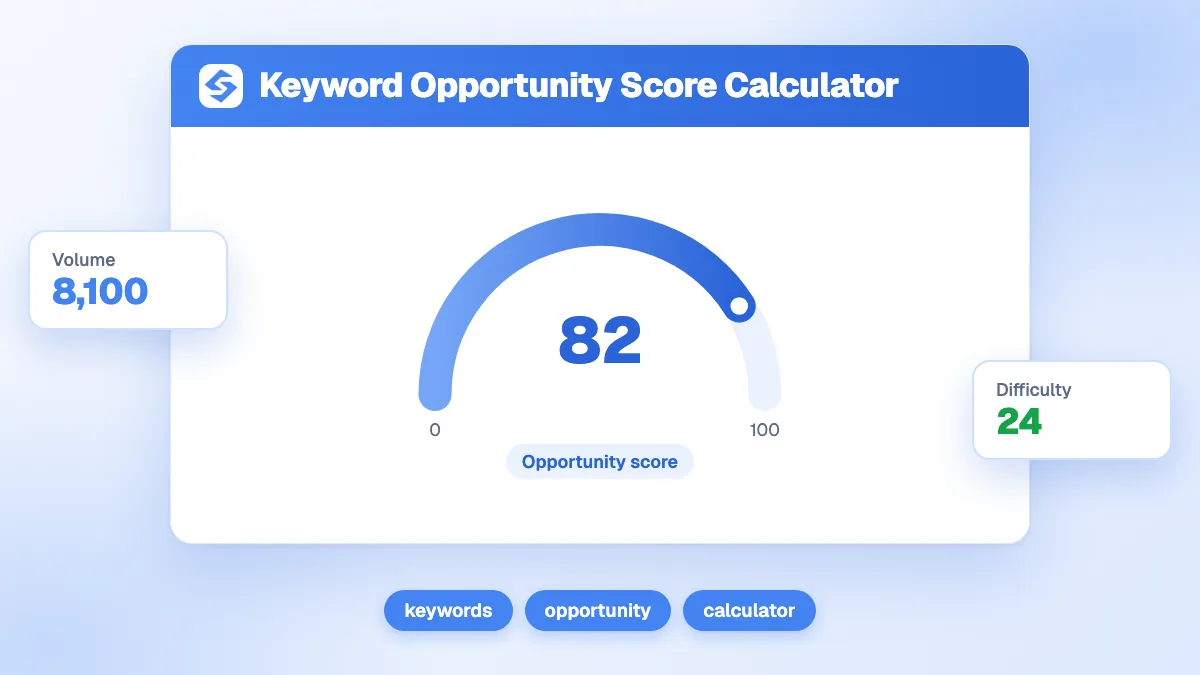
For each keyword, note four things: the search intent (informational, commercial, transactional, navigational), the monthly volume, the difficulty, and the business value for you. A long-tail query with 50 searches a month and strong purchase intent is often worth more than a generic term with 10'000. Our free keyword opportunity score calculator combines volume, difficulty and value into one score so you can sort the list objectively.
Group keywords that share the same intent into one page, then group pages into topics. This step prevents the most common strategic mistake: writing three articles that compete for the same query.
A topical map is the result: a tree of topics, subtopics and pages that shows what you must cover to be complete on your subject. The quick test for grouping is the results page itself. If two keywords return mostly the same top ten results, they belong on the same page. If the results differ, they deserve separate pages.
| Level | Role | Example (project management software) |
|---|---|---|
| Topic | A theme you want to own | Project planning |
| Pillar page | Broad guide covering the whole theme | Project planning: the complete guide |
| Cluster pages | One precise question each | How to build a Gantt chart, how to estimate a project timeline |
| Conversion pages | Product, comparison or pricing pages | Best project planning tools, your feature page |
A pillar page covers a broad topic and links to cluster pages that each answer one specific question in depth, and every cluster page links back to the pillar. This structure, often called a topic cluster, tells search engines that your site covers the subject thoroughly, and it gives readers an obvious path from a general question to a precise answer.
Practical rules that keep the model clean:
Order the pages by business value and by how easily you can rank, then publish at a pace you can sustain for at least six months. Regularity beats volume: a site that publishes every week for a year builds more than a site that publishes fifty articles in one month and then stops.
Teams that lack the time to keep this pace can automate it. Sorank's content planner analyses your site and competitors, finds the keywords and builds the calendar, then writes and publishes one article a day with internal links and cannibalisation checks.
Write pages whose passages make sense on their own, because ChatGPT, Gemini, Perplexity, Claude and Google's AI Overviews quote passages, not whole pages. The same topical map that helps you rank also helps you get cited, provided each section is built to be extracted.
Then check the result: track the questions your buyers ask the AIs and see whether your brand is cited, and who is cited in your place. Those gaps become new pages in the map.
Measure at the level of the topic cluster, not only the single article, and tie every metric to the goals you wrote at the start. One article can stay flat while the cluster as a whole grows, and the cluster is what you are building.
| Metric | What it tells you | Where to find it |
|---|---|---|
| Impressions per cluster | Whether Google considers you relevant on the topic | Google Search Console |
| Clicks and average position | Whether you win the visit | Google Search Console |
| Conversions from organic traffic | Whether content serves the business | Your analytics tool |
| AI citations | Whether the AIs quote you on your buyers' questions | An AI visibility tracker |
Review every month, then act: refresh pages that lose positions, merge pages that cannibalise each other, and add the missing questions that competitors cover and you do not.
A strong SEO content strategy is a chain of simple decisions: goals first, then a qualified keyword universe, a topical map, pillar and cluster pages, a steady calendar, deliberate internal links and monthly measurement. Results usually appear in two to four months for a site that publishes consistently. If you want this plan executed in autopilot, from keyword research to daily publishing and AI visibility tracking, see Sorank's plans, with a 3-day free trial.

SEO makes pages findable for the queries people type or ask, while content marketing creates material that attracts and convinces an audience. They overlap almost entirely on a blog: content marketing decides what is worth saying to buyers, SEO decides which questions to answer first and how to structure the page so search engines and AI assistants can use it.
There is no fixed number. A useful benchmark is the number of distinct questions in your topical map: a focused niche may need 30 to 60 pages to cover a topic properly, a broad one several hundred. Publishing regularly matters more than a big launch, because each new page strengthens the cluster around it and gives the site more chances to rank.
Expect the first meaningful movements after two to four months on a site that publishes consistently, and longer on a brand new domain or a very competitive market. Early signs are impressions in Google Search Console on long-tail queries, followed by clicks, then rankings on broader terms once the cluster becomes dense.
 AI Content Brief Generator
 FAQ Schema Generator
 AI Blog Post Ideas Generator
 Structured Data Validator
 Alt Text Checker
 Internal Link Analyzer
 Backlink Challenge
 AI Meta Description Generator
 AI Blog Title Generator
 Google Indexability Checker
 AI Blog Outline Generator
 UTM Link Builder
 Keyword Clustering Tool
 Canonical Tag Checker
 XML Sitemap Generator
 Broken Link Checker
 AI SEO Title Generator
 Headline Analyzer
 SERP Preview Tool
 Redirect Checker
 Hreflang Tag Generator
 Heading Structure Analyzer
 HTTP Headers Checker
 Favicon Extractor
 SERP CTR Calculator
 SEO vs Paid Search Savings Calculator
 SEO Share of Voice Calculator
 SEO ROI Calculator
 SEO Traffic and Revenue Forecast Calculator
 SEO Budget Calculator
 SEO Break-Even Calculator
 SaaS SEO ROI Calculator
 ROAS Calculator
 Reading Time Calculator
 Ranking Gain Simulator
 Organic Traffic Value Calculator
 Organic Traffic Estimator
 LTV to CAC Ratio Calculator
 Local SEO ROI Calculator
 Link Building Cost Calculator
 Keyword Value Calculator
 Keyword Opportunity Score Calculator
 Keyword Density Calculator
 GEO ROI Calculator
 GEO Content Investment Calculator
 Ecommerce SEO ROI Calculator
 Customer Lifetime Value Calculator
 Customer Acquisition Cost Calculator
 CTR Calculator
 Cost Per Article Calculator
 Conversion Rate Calculator
 Content Marketing ROI Calculator
 ChatGPT Referral Traffic Estimator
 Bounce Rate Calculator
 Backlink ROI Calculator
 AI Visibility Score Calculator
 AI Traffic Value Calculator
 AI Share of Voice Calculator
 Cost of AI Invisibility Calculator
 AI Citation Rate Calculator
 llms.txt Validator
 AI Overview Checker
 Robots.txt Checker
 AI SEO Audit
 LLM Readability Checker
 SearchGPT Readiness Checker
 Structured Data LLM Audit
 Website Crawlability AI Audit
 Why ChatGPT Is Not Recommending My Website
 Gemini Ranking Tool
 Perplexity Ranking Checker
 LLM Citation Checker
 Answer Engine Optimization Audit
 GEO Audit
 AI Search Visibility Test
 ChatGPT Visibility Checker
 llms.txt Generator
 URL Extractor
 Webpage to Markdown
 Sitemap Checker
 SERP Volatility Sensor
 Page Size Checker
 Word Counter
 Slug Generator
 Schema Generator
 Robots Generator
 OG Preview
 Meta Tags Generator
 Image Compressor
 Favicon Generator
 On-Page SEO Audit
 Backlink Analysis Tool
 Keyword Research Tool
 Domain Authority Checker
THEY TRIED SORANK BEFORE YOU
 “I tested Sorank on a real client site and it's insane. It does everything an agency would bill you $1500 a month for. It's going into production on that client now.”

 Guillaume Guersanguersanguillaume.com“We are an Ads agency and we wanted to get our SEO back on track once and for all. Sorank gave us a clear view of our site, helped us prioritize optimizations, and properly structure our content. The tool is easy to use, well designed for a team, and very practical for centralizing tracking without having to juggle multiple platforms. A very solid foundation to start fresh with our SEO.”
 Gaspard MadouiAds Agency
 “I just let the Sorank software do its thing, and now my DR is 25 and my page is ranking higher.”
 Lucas Flandrefoundertrace.fr“I specialized in GEO thanks to Sorank. The GEO Leaderboard allows me to show my clients their position vs competitors on ChatGPT. It’s a real commercial differentiator.”
 MélanieSEO Freelance“Great service, works well for our website and helps us understand how to improve it to rank better on Google and elsewhere. Congrats, keep going, I recommend it.”
 Hugo T.E-commerce merchant