Preferences
Privacy is important to us, so you have the option of disabling certain types of storage that may not be necessary for the basic functioning of the website. Blocking categories may impact your experience on the website. More information
Privacy is important to us, so you have the option of disabling certain types of storage that may not be necessary for the basic functioning of the website. Blocking categories may impact your experience on the website. More information

Choose an SEO agency with proof, a written proposal, clear access rules and a paid pilot. Spot guarantees, cheap links and cold outreach before you sign.


Tools

In short
A good SEO agency explains its method in plain terms, shows results you can check yourself, and commits to outcomes it can influence, such as organic clicks, indexed pages and conversions. It never promises a fixed position on Google. It also leaves you owning your accounts and gives you a clear way out. Before you sign, define the business goal, test the agency with a short paid pilot, and read the exit terms. Most poor choices come from skipping one of those three steps.
Want to go further? Ask
Quick quiz
Is SEO right for you, and how should you start?
Sorank matches your answers


Test it for 3 days on your own site and see where you stand on Google, ChatGPT and the other AIs.
Start 3-day free trial3 days free, then stop whenever you want. 90-day results guarantee, conditions apply.
Most agency searches begin with a search engine and a list of ten firms. That order is backwards. An agency can only be judged against a job you have defined, and without that definition every proposal looks reasonable.
Before the first call, write down four things. The business outcome SEO must serve, such as more qualified demo requests or more sales of one product line. The pages that already earn revenue, because those are the pages you will protect. What your own team can review and approve each month. And the budget you can keep for at least six months. Organic results take time to build, so a budget you cut in the third month will rarely produce the results you were paying for.
Write this down before the first call
"SEO agency" covers very different businesses. A full-service agency runs strategy, content, technical work and links under one contract. A specialist handles one bounded problem well, such as a site migration or a technical audit. A freelance consultant suits a single site with a limited scope. Some companies pair software with an internal owner who acts on the recommendations every week.
The in-house route has its own trade-offs, which we covered in SEO agency vs in-house SEO. This article assumes you have already decided to buy outside help and need to choose the right partner.
| Partner type | Best when | Watch out for | Typical contract |
|---|---|---|---|
| Full-service agency | You want one accountable team across strategy, content and technical work | Junior staff run the account while the senior person sells it | Monthly retainer, often with a minimum term |
| Specialist (technical or links) | You have a clear, bounded problem such as a migration or a broken internal linking structure | Gaps outside the specialty that nobody covers | Project fee with defined deliverables |
| Freelance consultant | One site, limited scope, and you want direct access to the decision maker | Capacity: one person, one holiday, one illness | Hourly or small monthly retainer |
| Software plus internal owner | You have someone who can act on recommendations every week | The owner has no time left to execute | Software subscription plus internal salary |

Ask for three client references you can call. Ask at least one of them a question the agency did not prepare them for: what went slower than promised, and how the agency handled it. Then ask the agency to show Google Search Console data from a past client, anonymized if needed: clicks, impressions, average position by query and the date range. An agency that is confident in its method will show this without hesitation. One that only sends slides with percentage increases has not told you what those percentages measure.
Next, check the agency's own search footprint. Search for the services it sells and see whether its site appears, and for which pages. A strong position on competitive service terms is a good sign. A missing position on the terms it sells to you is a warning, though not a verdict, since many good agencies rely on referrals.
Finally, look at how the agency earns links, because a backlink profile reveals a lot about its methods. Run its domain through a backlink checker and look at who links to it. Are those links from relevant sites that editors chose, or from directories and pages created only to host links?
Tip
Sorank's free backlink checker lists the referring domains of any site. Run it on the agency's domain and on one of your competitors' sites, then compare the two link profiles side by side.
A proposal should answer five questions in writing: what work is included, who does it, what you receive each month, how success is measured, and how you can leave. If one answer is missing, the proposals cannot be compared fairly, whatever their prices suggest.
Start with the deliverables. "Monthly SEO optimization" describes effort, not output. "Four articles per month, each with a brief, a target query, an internal link plan and a draft in your CMS by the 10th" describes something you can check. Then read the reporting section and ask what a report contains. A useful report lists pages, queries and the changes made, and says what the next month's work will be. Our guide to SEO reporting shows a full structure you can ask for.
The same retainer, written two ways
Google's own guidance on hiring SEO help is short and worth reading before any sales call. It says that no one can guarantee a number one ranking on Google, and it tells you to be wary of firms that email you out of the blue. The page is Do I need an SEO?, and the screenshot below shows the section.
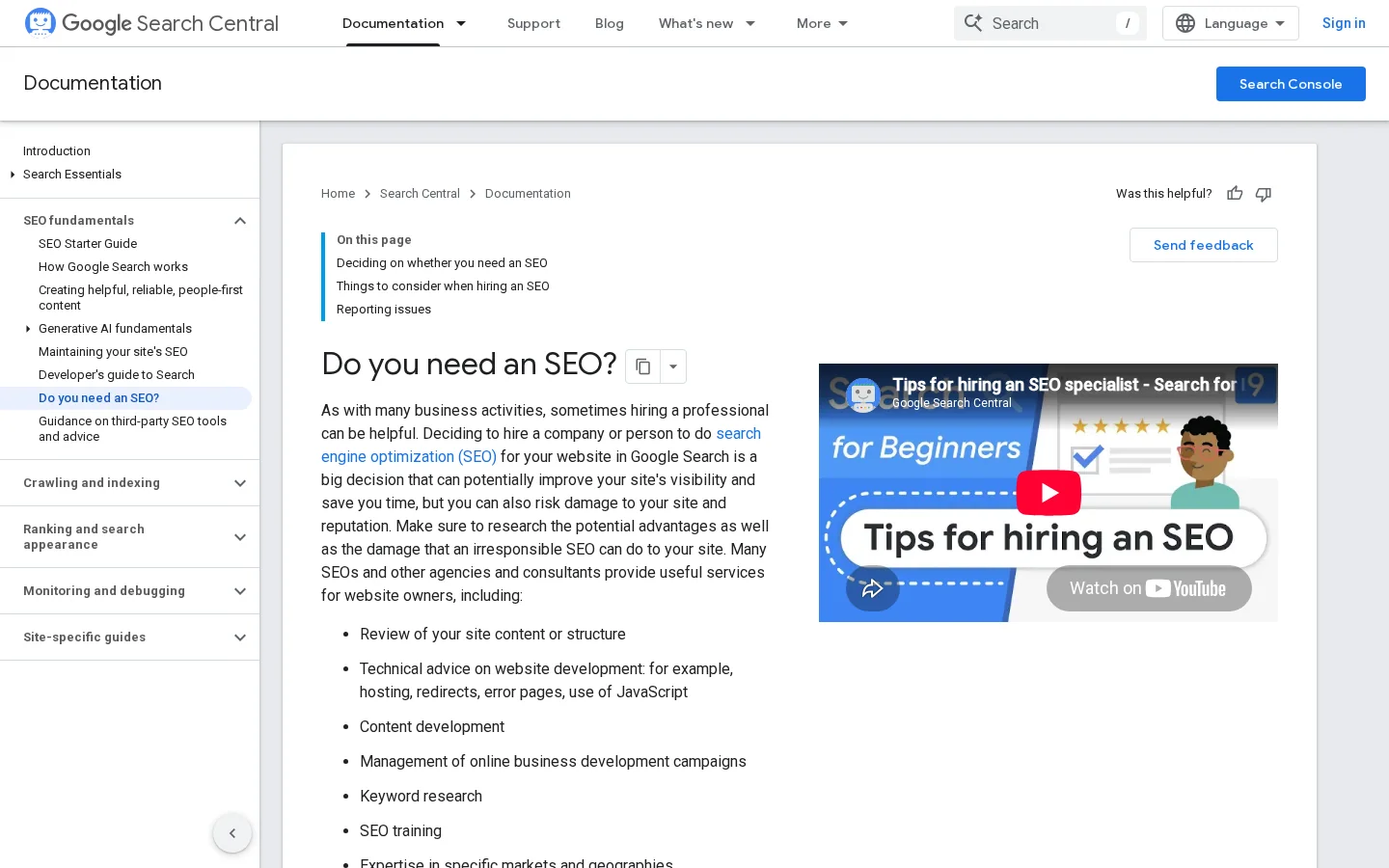
The red flag is a promise of a position on a set date, or of a fixed number of visits. Google decides how it ranks pages, and nobody outside Google controls that. What you can ask for is a commitment the agency does control: the pages it will optimize, the content it will publish, the technical issues it will fix, and the date by which each one ships.
If you hear a guarantee, ask what happens when the target is missed. A refund for the last month tells you the promise was about the agency's invoices, not your results.
Warning
A promised first-page position is the end of the conversation, not the start of a negotiation. Thank the agency and move to the next candidate.
An email that says it has found errors on your site, often with a free audit attached, is a common opening move for low-quality firms. Good agencies do send audits, but usually after you have engaged them or asked for one. Check the sender's domain, search for the firm's name next to the word reviews, and reply with a short list of questions. Their answers will tell you more than the audit does.
Google's spam policies classify buying or selling links for ranking purposes as link spam, and they also list excessive link exchanges. A proposal that promises a large number of placements for a low price is therefore not an asset. It is a risk that can end in a manual action against your site. Ask for the list of linking domains and for the editorial process behind each placement. Our article on backlink exchange explains the difference between a legitimate exchange and a scheme.
The rule itself is in Google's spam policies, shown below.
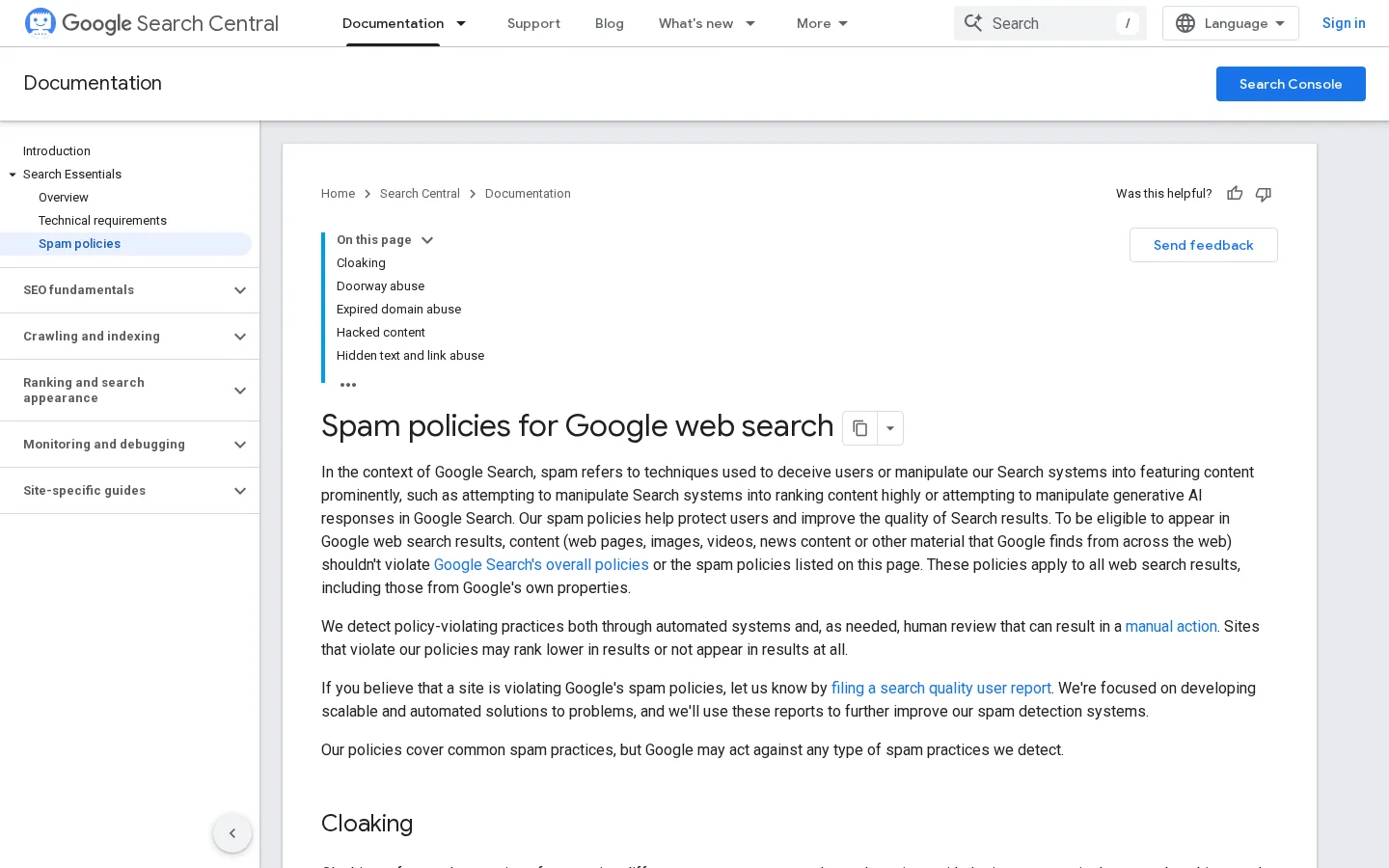
Google does not evaluate or endorse third-party SEO tools, and its guidance warns against tools that claim to be "approved" or "acceptable" by Google Search. Treat any reference to a Google approval, certificate or partner status as a claim to verify, not as a credential. Ask the agency what each tool measures, and whether you can export its data without the agency present.
An agency that will not describe its methods in writing is asking you to trust it blindly. Ask for a short description of each stage: how it chooses target queries, how it briefs writers, how it checks technical issues and how it earns links. A good agency is glad to explain this, and the explanation also shows you whether its team knows what it is doing.
Many agency relationships go wrong on access, not on advice. Keep ownership of every account that holds your data: your Google Search Console property, your Google Analytics property, your tag manager container, your CMS and your domain registrar. Give the agency a manager or editor role, and keep the owner role yourself. If the agency owns the account, the data and the history leave with the agency when the contract ends.
Keep these accounts in your name
Then ask the agency to check the health of your most important pages and to show each check in writing. A simple first test is the HTTP status and redirect of a page you want to rank. Run this in a terminal:
curl -sI https://www.example.com/services/ | grep -iE "^(HTTP|location)"The first line shows the status code. A 200 means the page loads. A 301 to another address is normal when a page has moved, but the target must be the final version of the page, not the start of a redirect chain. A 404 or a 5xx on a page you want to rank is a problem to fix before any content work starts. Then ask the agency to show the Manual actions report in Search Console, which tells you whether Google has applied a manual action to your site. Our technical SEO checklist lists the next checks in order of impact.
A pilot tests the working relationship and the first results, not the final outcome. Choose one group of pages, such as one product line or one service, and agree on three targets the agency can influence: the number of those pages indexed in Search Console, the impressions and clicks for an agreed list of target queries, and the number of pieces delivered on time and approved by your team. Write down the baseline before the first day, using the last few months of Search Console data, so nobody argues about the starting point later.
The funnel below shows how the choice narrows. Most of your time should go to the middle stages, where you can compare written proposals and listen to how the team answers questions.
How the choice narrows
Keep the pilot short enough to end cleanly and long enough to show a trend. Search results move slowly, so judge the trend in indexing and impression data rather than a single week's clicks. At the end, you should be able to answer one question: would you pay for the next period on the same terms, with the same people?
Four pricing models are common, and each one moves risk to a different party. A monthly retainer pays for ongoing team time, which suits sites that need continuous work. A fixed project fee pays for a defined deliverable, such as an audit or a migration plan, and fits a bounded problem. An hourly rate is easy to start but hard to budget, and it gives little incentive to finish quickly. A performance-based fee ties payment to results, which sounds fair until you have to agree on what caused a result.
| Pricing model | What you pay for | Main risk |
|---|---|---|
| Monthly retainer | Ongoing team time and output | Scope drifts, and the hours are hard to see |
| Fixed project fee | One defined deliverable | Too narrow, and any new work needs a new contract |
| Hourly rate | Time spent | Hard to forecast, with little pressure to finish |
| Performance-based fee | A share of a measured result | Disputes over attribution, and an incentive to chase easy wins |
The main drivers of price are the size of the site, the number of languages, the amount of technical debt, the volume of content to write and edit, how competitive the target queries are, and how links are earned. Two agencies quoting different prices may be quoting different work, so compare scope first. You can estimate your own budget with the SEO budget calculator, and our SEO cost guide explains the pricing logic in more depth.
Note
Ask for the price per deliverable in every proposal. If the total cannot be split by deliverable, you cannot compare it with anything.
You should be able to verify three things yourself each month, using accounts you already own. In Search Console, the performance report shows clicks and impressions for your target queries and pages. The indexing report shows which pages Google has indexed and which it has excluded, with reasons. In Google Analytics, the organic search channel shows the conversions that started from search. If the agency's monthly report cannot be reproduced from these sources, ask why.
Search Console keeps performance data for a limited period, so export the data every month and store it yourself. The routine below takes less than an hour and keeps the relationship honest.
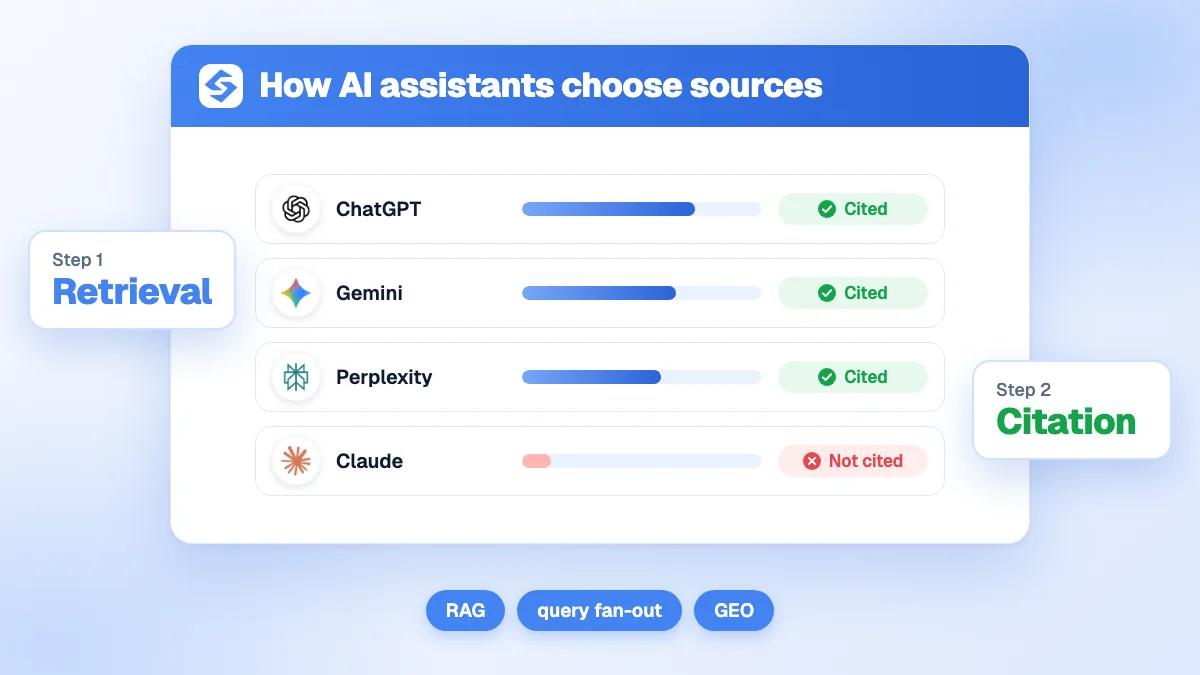
Google rankings are only part of the picture. Buyers now ask ChatGPT, Claude, Gemini and Perplexity to recommend suppliers, and those assistants answer with sources. An agency that covers this should explain how it tests prompts, what it records (the brands mentioned, the sources cited, and where your brand appears in the answer), how often it re-runs the tests, and how it handles answers that change from one day to the next. Ask for this method in writing.
The two disciplines overlap but measure different things, as the comparison below shows. Our article on GEO vs SEO explains the overlap, and the GEO strategy guide describes how to plan the work.
What each discipline measures
If you would rather run part of this work in-house, Sorank is built for that case. Its SEO teams page describes keyword research, article production, link exchange and AI visibility tracking in one tool, so the in-house owner can act on the data without waiting for a monthly report.
What it is: picking the lowest number without comparing what each number buys. How to spot it: proposals with different deliverables but similar totals, and no price split by deliverable. How to fix it: rewrite each proposal into the same five answers from earlier, then compare them line by line. The cheapest option is often the one with the fewest deliverables.
What it is: letting the agency create your Search Console property or your Analytics account under its own login. How to spot it: when you ask for access, you receive a login from the agency's domain instead of an invitation. How to fix it: create the accounts yourself, add the agency as a manager or editor, and keep the owner role. If the agency has already created them, ask for ownership to be transferred in writing before work starts.
What it is: a contract that renews automatically with no practical way out, or with no handover of content, redirects and reports. How to spot it: the contract says nothing about notice, and nothing about what you receive when the work ends. How to fix it: require a short notice period, a handover of every content file and redirect list, and a copy of every report produced.
What it is: putting articles live because the agency delivered them on time. How to spot it: claims with no source, figures you cannot trace, and advice so generic it could apply to any site. How to fix it: have one person on your team check each article against its sources before publishing. Our guide to SEO mistakes lists the on-page errors to look for during that review.
Check these every month
Use this sequence to go from a shortlist to a decision in about a month. The order matters: proof and access come before price, and the pilot comes before the long contract.
If you can complete all six steps, you will know more about each agency than most buyers do. The choice then becomes a question of fit, not of who sounds most confident in the first call.
Monthly retainers vary widely with site size, the number of languages, content volume and the link strategy. Compare proposals by deliverable first, because two prices only mean something when the scope matches.
Hire an agency when you need specialist skills you cannot staff, and keep the strategy owner in-house either way. An in-house owner who reviews the work every month is what makes an agency relationship succeed.
No. Google decides how it ranks pages, so no agency can guarantee a position. A credible agency commits to the work it controls, such as pages optimized and content published, and reports results honestly.
We analyse your competitors, your website and your AI visibility to create a tailored content plan for free.
 AI Content Brief Generator
 FAQ Schema Generator
 AI Blog Post Ideas Generator
 Structured Data Validator (Schema Validator)
 Alt Text Checker
 Internal Link Analyzer
 Backlink Challenge
 AI Meta Description Generator
 AI Blog Title Generator
 Google Indexability Checker
 AI Blog Outline Generator
 UTM Link Builder
 Keyword Clustering Tool
 Canonical Tag Checker
 XML Sitemap Generator
 Broken Link Checker
 AI SEO Title Generator
 Headline Analyzer
 SERP Preview Tool
 Redirect Checker
 Hreflang Tag Generator
 Heading Structure Analyzer
 HTTP Headers Checker
 Favicon Extractor
 SERP CTR Calculator
 SEO vs Paid Search Savings Calculator
 SEO Share of Voice Calculator
 SEO ROI Calculator
 SEO Traffic and Revenue Forecast Calculator
 SEO Budget Calculator
 SEO Break-Even Calculator
 SaaS SEO ROI Calculator
 ROAS Calculator
 Reading Time Calculator
 Ranking Gain Simulator
 Organic Traffic Value Calculator
 Organic Traffic Estimator and Website Traffic Checker
 LTV to CAC Ratio Calculator
 Local SEO ROI Calculator
 Link Building Cost Calculator
 Keyword Value Calculator
 Keyword Opportunity Score Calculator
 Keyword Density Calculator
 GEO ROI Calculator
 GEO Content Investment Calculator
 Ecommerce SEO ROI Calculator
 Customer Lifetime Value Calculator
 Customer Acquisition Cost Calculator
 CTR Calculator
 Cost Per Article Calculator
 Conversion Rate Calculator
 Content Marketing ROI Calculator
 ChatGPT Referral Traffic Estimator
 Bounce Rate Calculator
 Backlink ROI Calculator
 AI Visibility Score Calculator
 AI Traffic Value Calculator
 AI Share of Voice Calculator
 Cost of AI Invisibility Calculator
 AI Citation Rate Calculator
 llms.txt Validator
 AI Overview Checker and AI Overviews Rank Checker
 Robots.txt Checker
 AI SEO Audit
 LLM Readability Checker
 SearchGPT Readiness Checker
 Structured Data LLM Audit
 Website Crawlability AI Audit
 Why ChatGPT Is Not Recommending My Website
 Gemini Ranking Tool
 Perplexity Ranking Checker
 LLM Citation Checker
 Answer Engine Optimization Audit
 GEO Audit
 AI Search Visibility Test
 ChatGPT Visibility Checker
 llms.txt Generator
 URL Extractor
 Webpage to Markdown
 Sitemap Checker
 SERP Volatility Sensor
 Page Size Checker
 Word Counter
 Slug Generator
 Schema Generator
 Robots Generator
 OG Preview
 Meta Tags Generator
 Image Compressor
 Favicon Generator
 On-Page SEO Audit: SEO Checker and SEO Analyzer
 Backlink Analysis Tool
 Keyword Research Tool
 Domain Authority Checker
5/5 from 5 reviews
 “I tested Sorank on a real client site and it's insane. It does everything an agency would bill you $1500 a month for. It's going into production on that client now.”

 Guillaume Guersanguersanguillaume.com“We are an Ads agency and we wanted to get our SEO back on track once and for all. Sorank gave us a clear view of our site, helped us prioritize optimizations, and properly structure our content. The tool is easy to use, well designed for a team, and very practical for centralizing tracking without having to juggle multiple platforms. A very solid foundation to start fresh with our SEO.”
 Gaspard MadouiAds Agency
 “I just let the Sorank software do its thing, and now my DR is 25 and my page is ranking higher.”
 Lucas Flandrefoundertrace.fr“I specialized in GEO thanks to Sorank. The GEO Leaderboard allows me to show my clients their position vs competitors on ChatGPT. It’s a real commercial differentiator.”
 MélanieSEO Freelance“Great service, works well for our website and helps us understand how to improve it to rank better on Google and elsewhere. Congrats, keep going, I recommend it.”
 Hugo T.E-commerce merchant