Preferences
Privacy is important to us, so you have the option of disabling certain types of storage that may not be necessary for the basic functioning of the website. Blocking categories may impact your experience on the website. More information

Privacy is important to us, so you have the option of disabling certain types of storage that may not be necessary for the basic functioning of the website. Blocking categories may impact your experience on the website. More information

SEO agency vs in-house: real costs, time to results, control and risks compared, plus freelancers, software and hybrid setups, and how to pick an agency.

Tools

In short
an in-house SEO gives you full control and deep product knowledge, but costs a full salary plus benefits and tools, and takes months to hire and ramp up. An SEO agency brings a team of specialists and proven processes for a monthly retainer, with less control and less knowledge of your business. A freelancer is the cheapest human option for a defined scope, and SEO software automates the repetitive work (keywords, articles, tracking) for a fraction of either. Most growing companies end up with a hybrid: one internal owner plus an agency, freelancers or software for execution.
Want to go further? Ask
Quick quiz
Is SEO right for you, and how should you start?
Sorank matches your answers


Test it for 3 days on your own site and see where you stand on Google, ChatGPT and the other AIs.
Start 3-day free trial3 days free, then stop whenever you want. 90-day results-or-refund guarantee.
The SEO agency vs in-house decision is mostly a question of volume, budget and how central organic search is to your growth. Google's own guide, Do you need an SEO?, lists what an SEO can do for you (site review, technical advice, content, keyword research, training, optimizing for generative AI) without saying who should do it. This guide compares the four realistic options on cost, speed, control and risk, then gives a decision grid and a checklist for choosing an agency.
In-house SEO means one or more employees on your payroll own search: they sit with product, content and development teams and work only on your site. An SEO agency is an outside company that runs your SEO under a contract, usually a monthly retainer, with a team (strategist, technical SEO, writers, link builders) shared across several clients.
Two other options complete the picture. A freelance SEO consultant works alone, often on a fixed scope such as an audit or a migration. SEO software automates part of the execution: keyword research, writing and publishing articles, rank and AI visibility tracking. Our guide on freelance, employee and partner agency models looks at the same choice from the agency side.
| Criterion | In-house SEO | SEO agency | Freelancer | SEO software |
|---|---|---|---|---|
| Typical cost | Salary + benefits + tools | Monthly retainer | Hourly, daily or per project | Monthly subscription |
| Time to start | Weeks to months (hiring) | A few weeks (onboarding) | Days to weeks | Same day |
| Business knowledge | Deep | Limited, grows over time | Limited | Learns from your site and settings |
| Range of skills | One person's profile | Several specialists | One person's profile | Fixed set of automated tasks |
| Control and priority | Full | Shared with other clients | Shared with other clients | Full, within the tool's scope |
| Scaling up or down | Slow (hire or let go) | Change the contract | Change the scope | Change the plan |
| Main risk | Single point of failure | Generic work, lock-in | Availability | No strategy or judgment |
The salary is only part of the cost of an employee. The U.S. Bureau of Labor Statistics puts the median annual wage for market research analysts and marketing specialists, the category that includes most SEO specialists, at $78,760 (May 2025). Its Employer Costs for Employee Compensation release shows that in private industry, benefits made up 30.0% of total compensation in June 2026, wages the other 70%.
Example
Take the median wage of $78,760. If wages are 70% of total compensation, the employer cost is about $78,760 / 0.70 = $112,500 a year, before SEO tools, training, recruiting fees and management time. A senior SEO lead in a large city costs more; a junior hire costs less but needs supervision.
Agency retainers vary widely with scope, country and site size, from a few hundred dollars a month for a small local business to several thousand for a large site with content and link building included. Our breakdown of what SEO costs and what drives the price covers the ranges in detail, and the guide to retainer, hourly and performance pricing explains how agencies build their quotes.
The fair comparison is total cost against output. A retainer usually includes the agency's tools and several people's time; a salary buys one person's full attention. Before deciding, estimate what organic traffic is worth to you with an SEO ROI calculator: if the expected return does not cover a full-time salary, an employee is premature.
SEO takes months whoever does it, because pages need to be crawled, indexed and earn trust before they rank. Our honest SEO timeline sets out what to expect month by month. What changes between options is the delay before work starts and the pace once it does.
Note
Google advises that a good time to bring in SEO help is when you are considering a site redesign, the earlier the better. Fixing structure and redirects after a launch costs more than planning them before.
An internal team pays off when search is a core acquisition channel and the work is continuous. Typical signs:
The main weakness is concentration: one person rarely masters technical SEO, content, links and data equally, and their departure takes the knowledge with them. If you hire, our evaluation grid for SEO hires helps structure interviews, and a written SEO strategy keeps the work going if the person leaves.
An agency fits when you need several skills at once without the volume to justify several hires: a technical audit, a migration, a content plan and link building in the same quarter. It also helps when nobody internally can judge SEO work, because the agency brings its own methods and benchmarks from other clients.
The trade-off is attention and context. Your account shares a team with other clients, the people doing the work may change, and the agency knows your customers less well than your staff. Keep ownership of everything: the Search Console property, the analytics, the content and any accounts created for you. A useful first step is a one-off engagement, such as an audit, before a long retainer; our guide to what an SEO audit agency delivers and charges shows what to expect.
Google's guide suggests asking every candidate for examples of past work, the results they expect and in what timeframe, how they measure success, whether they follow Google Search Essentials, and how they will explain each change. Add these checks:
Watch out
Google is explicit: no one can guarantee a #1 ranking. An agency that promises first place, claims a special relationship with Google or will not explain what it does should be ruled out.
A large part of SEO execution is repetitive: finding keywords, writing and publishing articles, adding internal links, checking positions. Software now handles these tasks, which changes the comparison for small teams. Instead of choosing between a salary and a retainer, many companies keep one person (often a marketer with other duties) in charge of priorities and let tools produce the volume.
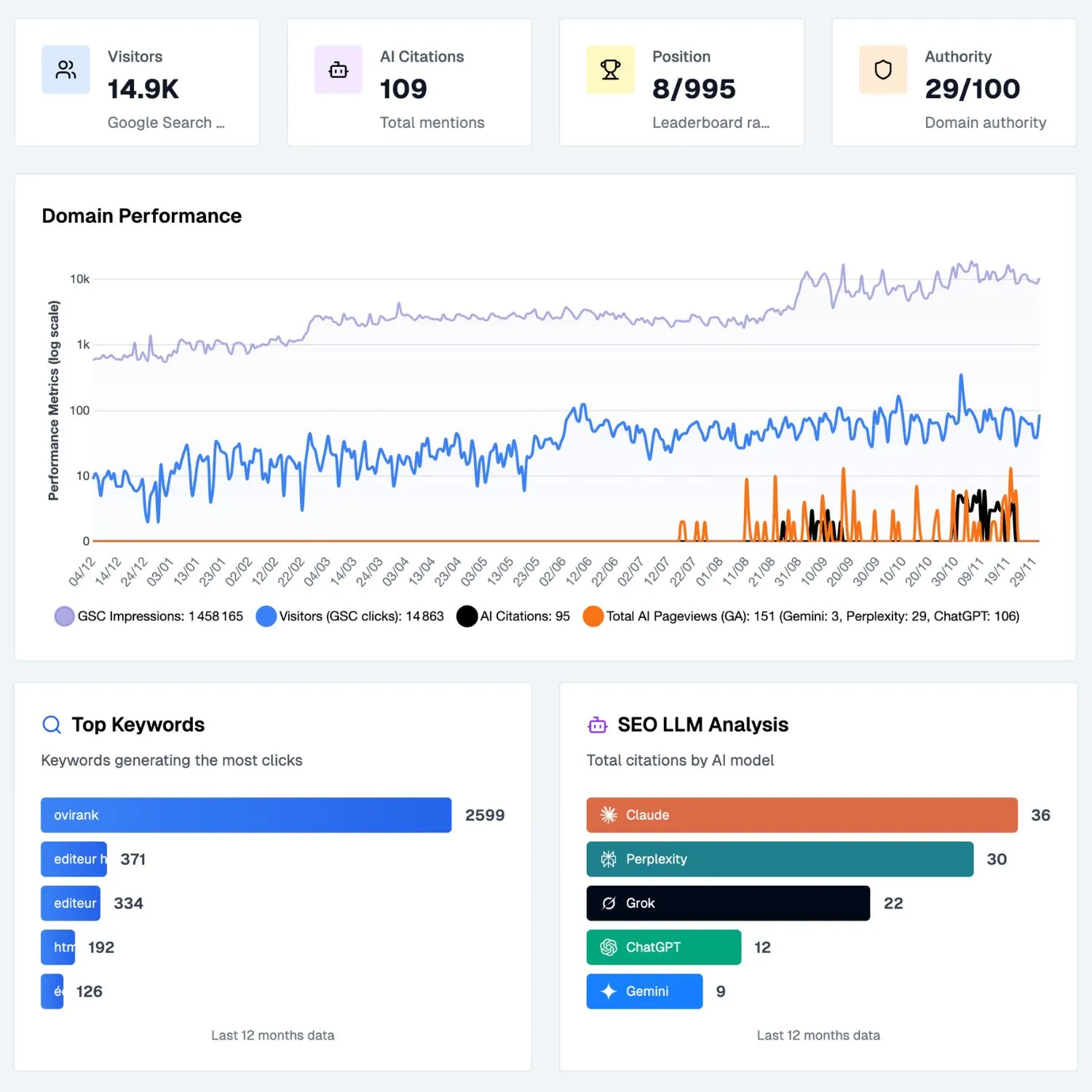
Sorank, our product, is SEO and GEO software that runs on autopilot: it researches keywords from your site, then the article generator writes and publishes 20 to 120 optimized articles a month, and AI mention tracking shows whether ChatGPT, Claude and Gemini cite your brand. It does not replace an agency's judgment on a migration or a complex technical problem; it replaces the hours spent on recurring production. Our page for in-house SEO teams shows how it fits next to internal staff.
The common hybrid setups:
Search now has two outputs: rankings on Google and mentions in AI answers. GEO (generative engine optimization) relies on the same foundations as SEO (indexed, well-structured pages, a site other sites cite), plus regular tracking of a fixed list of prompts. Whoever runs your SEO must cover both. Ask an agency how it measures AI visibility; for an internal owner, plan the tracking tool from day one. A free GEO audit shows where your site stands before you choose.
| Your situation | Best fit |
|---|---|
| Small business, small budget, steady content needs | Software, plus a freelancer for one-off audits |
| Growing company, no SEO expertise internally | Agency or freelancer, with one internal owner |
| Search is a core channel, frequent site changes | In-house lead, with software or an agency for volume |
| One-off project (migration, redesign, penalty) | Specialist agency or freelancer |
| Large site, many markets | In-house team plus specialist partners |
The rule that holds in every case: keep one person inside the company accountable for SEO, even part time, and buy execution from whichever mix fits your budget. To compare the software option with a salary or a retainer, see the Sorank plans: from $49 a month on the annual plan, with a 3-day free trial and a 90-day money-back guarantee.

For most small and mid-sized companies, an agency or freelancer costs less than a full-time employee, because a salary comes with benefits, tools, recruiting and management time. In the United States, benefits alone made up 30% of private-sector compensation in June 2026 according to the Bureau of Labor Statistics. An employee becomes cheaper per hour of work only when there is enough SEO work to fill a full-time role.
Yes. A small business can handle the basics itself: a clean technical setup, a page per service, regular articles that answer customer questions and a Google Business Profile. Software can automate keyword research, writing and tracking, and a freelancer can step in for an audit or a technical issue.
Plan on several months, since pages need time to be indexed and to earn trust before they rank. Within the first weeks you should already see an audit, a plan and work being delivered. Judge progress on agreed indicators such as impressions, positions for target queries and conversions, and ask for the reasons behind any delay.
We analyse your competitors, your website and your AI visibility to create a tailored content plan for free.
 AI Content Brief Generator
 FAQ Schema Generator
 AI Blog Post Ideas Generator
 Structured Data Validator (Schema Validator)
 Alt Text Checker
 Internal Link Analyzer
 Backlink Challenge
 AI Meta Description Generator
 AI Blog Title Generator
 Google Indexability Checker
 AI Blog Outline Generator
 UTM Link Builder
 Keyword Clustering Tool
 Canonical Tag Checker
 XML Sitemap Generator
 Broken Link Checker
 AI SEO Title Generator
 Headline Analyzer
 SERP Preview Tool
 Redirect Checker
 Hreflang Tag Generator
 Heading Structure Analyzer
 HTTP Headers Checker
 Favicon Extractor
 SERP CTR Calculator
 SEO vs Paid Search Savings Calculator
 SEO Share of Voice Calculator
 SEO ROI Calculator
 SEO Traffic and Revenue Forecast Calculator
 SEO Budget Calculator
 SEO Break-Even Calculator
 SaaS SEO ROI Calculator
 ROAS Calculator
 Reading Time Calculator
 Ranking Gain Simulator
 Organic Traffic Value Calculator
 Organic Traffic Estimator and Website Traffic Checker
 LTV to CAC Ratio Calculator
 Local SEO ROI Calculator
 Link Building Cost Calculator
 Keyword Value Calculator
 Keyword Opportunity Score Calculator
 Keyword Density Calculator
 GEO ROI Calculator
 GEO Content Investment Calculator
 Ecommerce SEO ROI Calculator
 Customer Lifetime Value Calculator
 Customer Acquisition Cost Calculator
 CTR Calculator
 Cost Per Article Calculator
 Conversion Rate Calculator
 Content Marketing ROI Calculator
 ChatGPT Referral Traffic Estimator
 Bounce Rate Calculator
 Backlink ROI Calculator
 AI Visibility Score Calculator
 AI Traffic Value Calculator
 AI Share of Voice Calculator
 Cost of AI Invisibility Calculator
 AI Citation Rate Calculator
 llms.txt Validator
 AI Overview Checker and AI Overviews Rank Checker
 Robots.txt Checker
 AI SEO Audit
 LLM Readability Checker
 SearchGPT Readiness Checker
 Structured Data LLM Audit
 Website Crawlability AI Audit
 Why ChatGPT Is Not Recommending My Website
 Gemini Ranking Tool
 Perplexity Ranking Checker
 LLM Citation Checker
 Answer Engine Optimization Audit
 GEO Audit
 AI Search Visibility Test
 ChatGPT Visibility Checker
 llms.txt Generator
 URL Extractor
 Webpage to Markdown
 Sitemap Checker
 SERP Volatility Sensor
 Page Size Checker
 Word Counter
 Slug Generator
 Schema Generator
 Robots Generator
 OG Preview
 Meta Tags Generator
 Image Compressor
 Favicon Generator
 On-Page SEO Audit: SEO Checker and SEO Analyzer
 Backlink Analysis Tool
 Keyword Research Tool
 Domain Authority Checker
THEY TRIED SORANK BEFORE YOU
 “I tested Sorank on a real client site and it's insane. It does everything an agency would bill you $1500 a month for. It's going into production on that client now.”

 Guillaume Guersanguersanguillaume.com“We are an Ads agency and we wanted to get our SEO back on track once and for all. Sorank gave us a clear view of our site, helped us prioritize optimizations, and properly structure our content. The tool is easy to use, well designed for a team, and very practical for centralizing tracking without having to juggle multiple platforms. A very solid foundation to start fresh with our SEO.”
 Gaspard MadouiAds Agency
 “I just let the Sorank software do its thing, and now my DR is 25 and my page is ranking higher.”
 Lucas Flandrefoundertrace.fr“I specialized in GEO thanks to Sorank. The GEO Leaderboard allows me to show my clients their position vs competitors on ChatGPT. It’s a real commercial differentiator.”
 MélanieSEO Freelance“Great service, works well for our website and helps us understand how to improve it to rank better on Google and elsewhere. Congrats, keep going, I recommend it.”
 Hugo T.E-commerce merchant