Preferences
Privacy is important to us, so you have the option of disabling certain types of storage that may not be necessary for the basic functioning of the website. Blocking categories may impact your experience on the website. More information
Privacy is important to us, so you have the option of disabling certain types of storage that may not be necessary for the basic functioning of the website. Blocking categories may impact your experience on the website. More information

SEO salary data from O*NET, Payscale and SEO surveys: median pay by experience, job title, country and employer type, plus how to negotiate yours.

In short
An SEO salary is the yearly pay of a search engine optimization professional. In the United States, the median is $78760 per year according to 2025 government wage data, and the middle half of earners make between $58350 and $108310. Global surveys put the median lower, around $51680, because pay depends heavily on country, title and employer type.
Want to go further? Ask
Quick quiz
Is SEO right for you, and how should you start?
Sorank matches your answers


Test it for 3 days on your own site and see where you stand on Google, ChatGPT and the other AIs.
Start 3-day free trial3 days free, then stop whenever you want. 90-day results guarantee, conditions apply.
The short answer: a typical SEO professional in the United States earns between $60000 and $80000 a year, a beginner earns around $45000, and senior or management roles pass $100000. Outside the United States, salaries are lower in absolute terms, but the same ladder applies.
No single source gives "the" SEO salary. Each one measures something slightly different, so the honest way to answer is to put the main sources side by side and read them together.
SEO salary: four reference numbers
Sources: O*NET OnLine (BLS OEWS 2025), Payscale (updated November 2026), SE Ranking (July 2025), Ahrefs (November 2024)
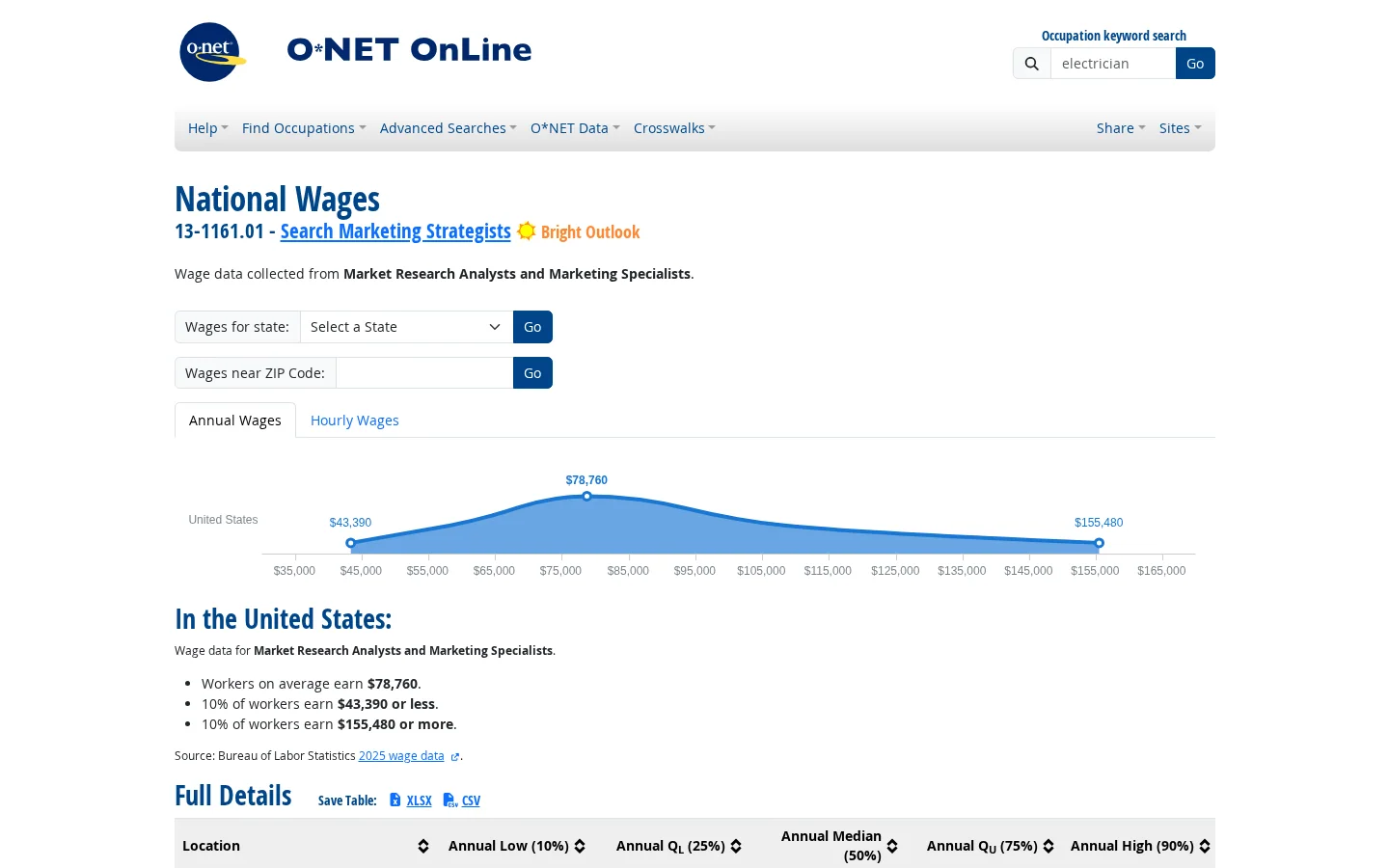
The most robust figure comes from the US Department of Labor. Its O*NET wage page for search marketing strategists (occupation code 13-1161.01, 2025 wage data from the Bureau of Labor Statistics) gives a national median of $78760 per year, or $37.87 per hour. The 10th percentile sits at $43390 and the 90th at $155480.
| Percentile (US, 2025) | Annual pay | Hourly pay | Who is typically here |
|---|---|---|---|
| 10th | $43390 | $20.86 | Juniors, small local firms, low cost of living areas |
| 25th | $58350 | $28.05 | Specialists with 1 to 4 years of experience |
| 50th (median) | $78760 | $37.87 | Confirmed specialists and strategists |
| 75th | $108310 | $52.07 | Senior specialists, managers, technical SEOs |
| 90th | $155480 | $74.75 | Heads of SEO, directors, enterprise roles in expensive cities |
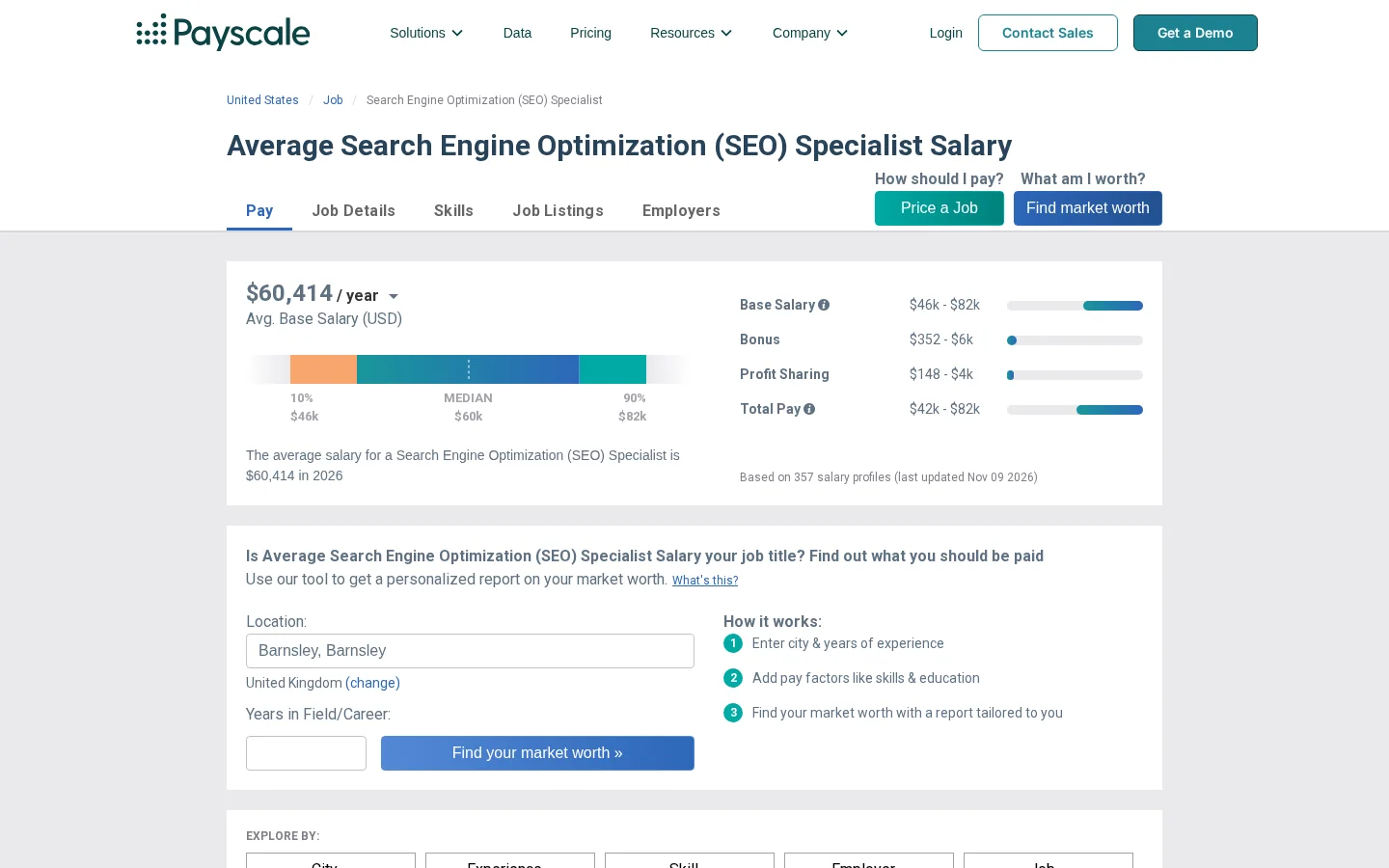
Payscale, which collects self-reported pay profiles, shows a lower picture for the job title "SEO specialist". Its US SEO specialist salary page, updated on November 9, 2026 from 357 profiles, gives an average base salary of $60414, with a range from $46000 (10th percentile) to $82000 (90th percentile). Bonuses add between $352 and $6000 a year.
The gap between $60414 and $78760 is not a contradiction. The two sources do not count the same people, which is the subject of the next section.
SEO salary figures disagree because each source uses a different population, a different definition of pay and a different sample size. Pick the source that matches your situation: government data for a broad market view, salary sites for a precise title, surveys for niche comparisons like freelance versus in-house.
There is no official "SEO specialist" occupation in US statistics. O*NET states that its wage data for search marketing strategists is collected from the wider group "Market Research Analysts and Marketing Specialists". This pulls the figure toward general marketing pay, which includes many analysts in large companies.
Salary sites like Payscale rely on people who fill in a form. The data is precise by title and experience, but the samples are small. Industry surveys from SEO tool vendors reach real SEO practitioners, but often a few hundred people, sometimes concentrated in one country. Job listings show what employers offer, not what people earn, and they lean toward senior roles that companies struggle to fill.
| Type of source | Example | What it measures | Strength | Main bias |
|---|---|---|---|---|
| Government statistics | BLS data via O*NET | Wages reported by employers | Very large sample, official method | Groups SEO with all marketing specialists |
| Salary sites | Payscale | Self-reported pay profiles | Exact job title, experience bands | Small samples per country |
| Industry surveys | SE Ranking, Ahrefs | Answers from SEO practitioners | Real SEO roles, freelance included | A few hundred answers, regional skew |
| Job listings | Salary ranges in job ads | What employers offer | Fresh, shows demand | Overweights hard-to-fill senior roles |
Before you quote any SEO salary number, check four things on the page: the date of the last update, the number of profiles or answers, whether the figure is base salary or total pay, and whether it is an average or a median. A median is safer, because a handful of very high earners can pull an average up by thousands of dollars.
Note
On the O*NET page, you can pick a US state in the drop-down menu to see local wages for the same occupation. This is the fastest way to adjust the national median to the place where you live or hire.

Experience moves SEO pay most in the first five years: an entry-level SEO specialist earns roughly a quarter less than the average, and the jump to mid-career adds about 15%. After that, the curve flattens for people who keep the same title, and the next raises come from a change of role.
US SEO specialist pay by career stage (approximate)
Source: Payscale, US SEO specialist, 2026 (computed from the $60414 average and the gaps Payscale gives per stage)
Payscale puts the average total pay of an entry-level SEO specialist at $44597, which is 26% below the average for the title. At this stage, you are paid for execution: writing title tags and meta descriptions, checking pages in Search Console, building reports, doing keyword research under supervision. If you are starting out, our guide to the daily tasks of an SEO specialist shows what employers expect you to handle in your first months.
Between one and four years, pay climbs close to the average (Payscale shows early career only 1% below it). Mid career, from about five years, sits 15% above the average. This is the stage where you own a site or a set of clients, you choose priorities yourself and you can show results in traffic and revenue.
Payscale shows experienced specialists 13% above the average and late-career specialists 14% above it, almost the same as mid career. The lesson is clear: staying "SEO specialist" for 15 years caps your pay. The people who earn $100000 and more change title, scope or employer type, which the next sections detail.
Warning
Experience bands on salary sites are often built on very few profiles. On Payscale's US page, the entry-level figure rests on 61 salaries. Use these bands as a direction, not as a contract clause.
Job title is the strongest driver of SEO pay: in the Ahrefs survey, a head of SEO earns about 80% more than an SEO specialist, and an SEO director more than twice as much. Each step up the ladder adds scope (more pages, more people, more budget) rather than more of the same tasks.
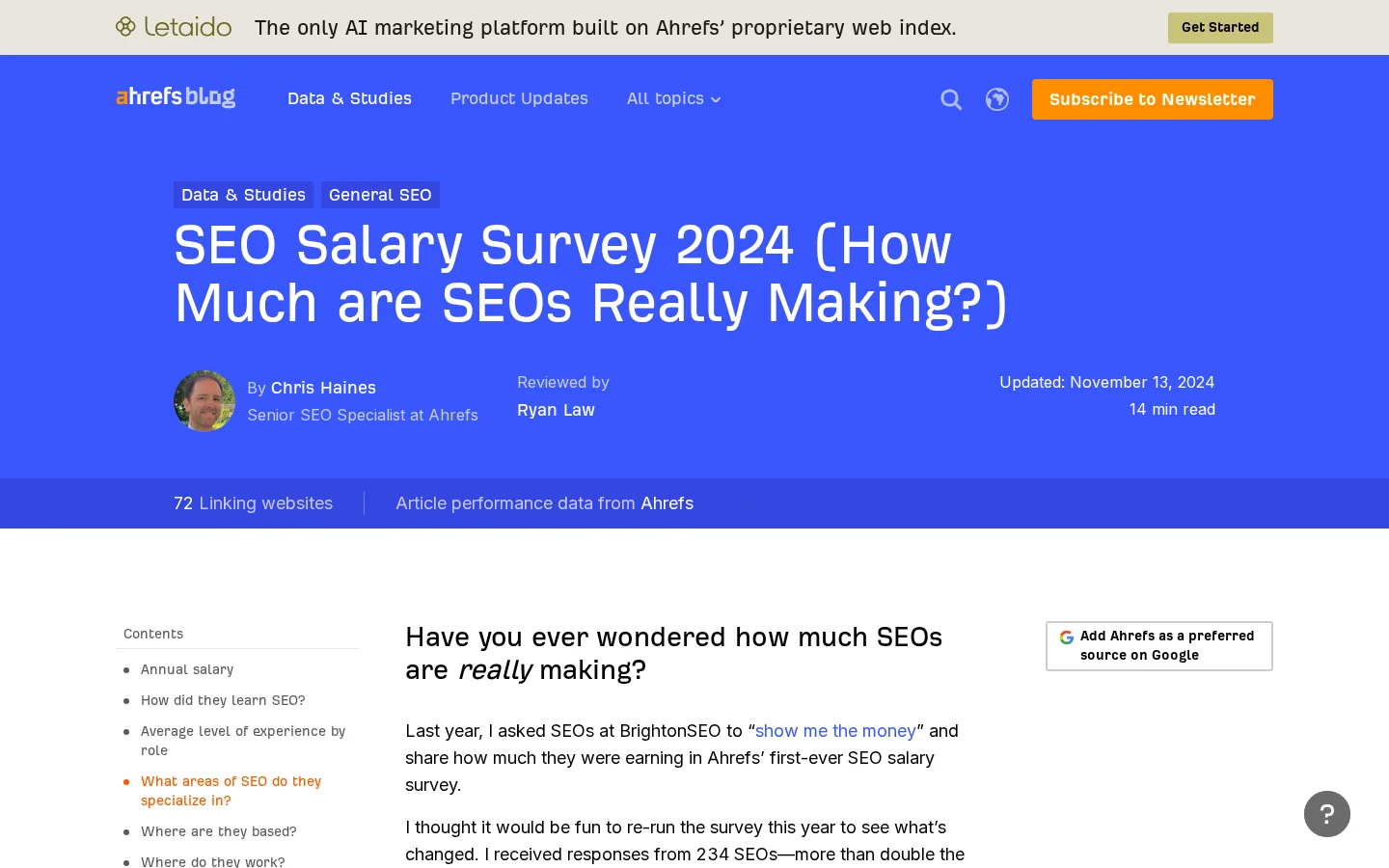
These medians come from the Ahrefs SEO salary survey by Chris Haines (updated November 13, 2024). The overall median was $58288, up 18.4% from $49211 the year before. Keep in mind that two thirds of respondents were in the UK, where pay is lower than in the United States: the ranking between titles is more useful than the absolute figures.
For US-only figures by title, Payscale gives an average base salary of $71857 for a senior SEO specialist and $82672 for an SEO manager (range $59000 to $116000, 279 profiles, updated September 30, 2026).
The Ahrefs survey also asked respondents how long they had worked in SEO. The averages per title draw a realistic timeline of an SEO career.
Average years of experience per SEO title
A specialist is judged on tasks done well. A manager is judged on results: traffic, leads, revenue from organic search. A head of SEO is judged on decisions: what to build, what to drop, who to hire, how to explain SEO to the board. If you want to climb, start reporting on business outcomes now, not on rankings alone. Our guide to the SEO metrics to track at each stage helps you pick the numbers leadership cares about.
Location changes SEO pay more than any skill: the median in the United States is about 60% higher than in the European Union in the same survey. Within one country, big cities and high cost of living states pay more, and remote jobs usually follow the employer's location bands.
These regional medians come from the SE Ranking survey of SEO salaries published on July 28, 2025. The same survey shows that 55% of respondents earn between $30000 and $75000 a year, and only 5% earn more than $150000.
How SEO pay is spread worldwide
Source: SE Ranking, SEO salaries survey, 279 respondents, 2025
Converting every salary to dollars hides what it is worth locally. The table below keeps each figure in its own currency, from Payscale's country pages for the title "SEO specialist".
| Country | Average base salary | 10th to 90th percentile | Profiles | Last update |
|---|---|---|---|---|
| United States | $60414 | $46000 to $82000 | 357 | November 2026 |
| Canada | C$58365 | C$45000 to C$72000 | 38 | March 2026 |
| Australia | AU$67635 | AU$45000 to AU$93000 | 21 | July 2026 |
| United Kingdom | £27514 | £21000 to £43000 | 38 | October 2025 |
| India | ₹353178 | ₹175000 to ₹771000 | 148 | April 2026 |
Look at the "Profiles" column before you use a number. A UK figure built on 38 profiles is a hint. The UK-weighted Ahrefs survey, with its higher medians for managers and heads of SEO, shows that the Payscale average mostly reflects junior and specialist profiles.
Inside the United States, use the state selector on O*NET to compare. As a rule, coastal tech hubs pay above the national median and rural states below it. For remote roles, many companies apply pay bands by location: the same job can pay differently depending on where you live. Others pay one national rate, which is where remote work becomes a real raise for people outside big cities. Always ask which model the employer uses before you negotiate.
For employees, in-house and startup roles pay slightly more than agencies in both major surveys. Freelancers have the widest spread: some earn far less than employees, and a minority earns far more, because their income depends on rates, utilization and client mix.
| Employer type | Median (SE Ranking, 2025) | Median (Ahrefs, 2024) | What you trade |
|---|---|---|---|
| Startup | $61329 | Not reported | Higher pay and equity, less stability |
| In-house | $53100 | $57737 | One site, depth, internal politics |
| Agency | $50000 | $44762 | Fast learning on many sites, lower pay |
| Self-employed | Not reported | $46436 | Freedom, no benefits, irregular income |
Principle: you work for one company and its site. When it fits: you like depth, long projects and seeing results on revenue. Pros: the best median salary for employees in the Ahrefs survey, benefits, a clear career ladder toward head of SEO. Limits: you depend on developers and content teams you do not manage, and your growth slows if the company stops investing. Example: an ecommerce SEO who spends a year fixing category pages and faceted navigation, then owns organic revenue.
Principle: you serve several clients for an agency. When it fits: at the start of a career, to see many sites and many problems fast. Pros: training, variety, mentors. Limits: the lowest employee median in both surveys, time sheets, and client churn. Example: a junior who handles audits for ten local businesses in their first year. To understand the business side, read our comparison of agency and in-house SEO setups.
Principle: you sell your time or a monthly retainer to clients. When it fits: after a few years, with a network and a niche. Pros: no ceiling, choice of clients. Limits: no paid leave, no employer contributions, time spent selling. Example: a technical SEO consultant who runs migrations for three clients a quarter.
Rates vary a lot. In the Ahrefs SEO pricing poll of 439 providers (updated August 15, 2024), freelancers charged an average of $71.59 per hour, agencies $98.90 and consultants $171.18. Average monthly retainers were $1348 for freelancers, $3209 for agencies and $3250 for consultants. Experience counted: providers with 2 years or less charged $73.05 per hour on average, those with 10 years or more $118.35.
Salaried SEO vs freelance SEO
If you are weighing the jump, our guide on becoming an SEO consultant and finding your first clients covers positioning and pricing in detail.
The skills that pay the most in SEO are those that connect search to money and to code: management, technical SEO, data analysis and, more and more, visibility in AI answers. In the SE Ranking survey, SEOs with management duties had a median of $73880, which is 41.5% more than those without.
Managing people or a budget is the clearest raise in every dataset. You do not need the title to start: own a project, coordinate a developer and a writer, and present the result. That is what the next employer will pay for.
Companies with large sites pay a premium for people who can read server logs, debug JavaScript rendering, write a regex for a crawl filter or fix structured data. If these words feel vague, start with the basics of crawlability, indexing and Core Web Vitals. A simple test of your level: can you write and explain this filter, which isolates Googlebot hits on product pages in a log file?
grep -E "Googlebot" access.log | grep -E "GET /product/[a-z0-9-]+ " | awk '{print $9}' | sort | uniq -c | sort -rnIt counts the status codes Googlebot received on product URLs. If you see many 404 or 301 codes, you have found crawl budget waste, and you can quantify it in a report.
The roles at the top of the market mix SEO with data and automation: SQL, Python, Looker Studio dashboards, APIs. Some companies now call this hybrid profile a marketing engineer. A newer skill is generative engine optimization: making a brand cited by ChatGPT, Claude and Gemini. Read what GEO is and how it differs from SEO if you want to add it to your profile; few candidates can show real results on it yet.
Skills that move you into a higher pay band
To negotiate an SEO salary, build a range from two or three sources that match your title, country and employer type, then defend the top of that range with results expressed in money. The method below takes about an hour.
The 6-step SEO salary benchmark
Leadership rarely buys "rankings up 20%". It buys money. A simple formula turns organic traffic into a value you can quote:
Organic value = extra organic sessions × conversion rate × average order value (or lead value)

Example: 12000 extra sessions × 1.5% × $80 = $14400 of extra revenue per month
The example numbers above are an illustration: plug in your own analytics data. To check the result, our free SEO ROI calculator does the math and projects it over a year.
A freelance rate is not a salary divided by 2080 hours. You must cover non-billable time, taxes, tools and the benefits an employer would pay. Work backward from what you want to earn:
Hourly rate = (target yearly income + yearly business costs) / billable hours per year

Billable hours = working weeks × billable hours per week
Example: 46 weeks × 25 hours = 1150 billable hours
With that example, a target income of $70000 and $10000 of costs gives a minimum rate of about $70 per hour. Compare it with the averages from the Ahrefs poll above, then adjust to your niche and your proof of results.
For a company, the cost of an SEO employee is the salary plus everything around it: employer taxes, benefits, tools, training and the time of the people who manage and support them. The total is always higher than the figure in the job ad, and it should be compared with what the hire is expected to bring in.
Total yearly cost = base salary + bonus + employer taxes and benefits + SEO tools + training + content and development budgetAn SEO alone does not publish content or ship code. Budget the writers, developers and links they will need, or the salary buys analysis with no execution. Our breakdown of SEO pricing models and what changes the price helps you compare this with agency and freelance quotes.
Tip
Before you open a position, run your numbers in the free SEO budget calculator: it shows the monthly and yearly spend for each option, so you can see whether a full-time hire, a freelancer or a mix fits your stage.
A large part of an SEO's week goes to tasks that repeat: keyword lists, content briefs, drafts, internal links, rank and AI visibility tracking. Automating them lets one person cover the scope of a small team. That is what Sorank for SEO teams does: it researches keywords, writes and publishes articles, acquires natural backlinks and tracks your brand in ChatGPT, Claude and Gemini, while your SEO decides priorities and checks quality. The idea of running SEO on autopilot is not to replace expertise, but to stop paying an expert salary for manual work.
An SEO specialist's week, before and after automation
Most salary mistakes come from comparing numbers that do not measure the same thing. Each mistake below costs money, either to the candidate who asks too little or to the company that pays the wrong price.
What it is: putting a base salary next to a total compensation figure that includes bonus and profit sharing. How to spot it: the source says "total pay" or "total compensation", or quotes ranges for bonus. How to fix it: compare base with base, then discuss the variable part separately.
What it is: treating an average as the typical salary. How to spot it: the SE Ranking survey shows a worldwide average of $66340 against a median of $51680; a gap that size means a few high earners. How to fix it: use the median as "typical" and the 75th percentile as your negotiation anchor.
What it is: quoting a country figure built on a handful of profiles. How to spot it: Payscale's German page for SEO specialists rests on 12 profiles, with a range from €10000 to €78000. How to fix it: cross the figure with another source, or use the national figure for the broader marketing occupation.
What it is: concluding that an Indian or British SEO is "underpaid" because the dollar figure is lower. How to spot it: a comparison table in one currency for many countries. How to fix it: compare within a country, or against local median pay.
What it is: assuming an "SEO manager" in a 5-person agency does the same job as an "SEO manager" at a large retailer. How to spot it: the job ad lists execution tasks only, or the team has no budget. How to fix it: benchmark on scope (sites, revenue, people managed), as in step 1 of the method above.
What it is: dividing a target salary by 2080 hours to set a rate. How to spot it: you are busy all month yet earn less than your former salary. How to fix it: use the billable hours formula and include taxes, tools and unpaid weeks.
What it is: setting a technical SEO salary from the broad marketing specialist median. How to spot it: good candidates decline offers, or leave within a year. How to fix it: benchmark technical and senior roles on the 75th percentile and on SEO-specific surveys.
Before you quote an SEO salary figure
Yes, SEO remains a well-paid career, and O*NET classifies search marketing strategists as a "Bright Outlook" occupation. What is changing is the content of the job: less manual production, more strategy, technical work, data and visibility in AI answers.
Ahrefs measured a median up 18.4% in one year among its respondents. The professionals who gain the most are those who connect search to revenue and who learn how AI models choose their sources. If you want to see how the discipline is evolving, start with the fundamentals of search engine optimization, then build one skill from the checklist above each quarter.
What to do today: open the O*NET wage page for your state, note the 25th, 50th and 75th percentiles, place yourself honestly on that scale by scope, and write down the one result from the last year that you can express in money. That number is your next negotiation.
In the United States, the median for search marketing strategists is $78760 per year according to 2025 government wage data shown on O*NET. Payscale puts the average base salary for the exact title SEO specialist at $60414. Worldwide, the SE Ranking survey found a median of $51680.
Some do, but income varies far more for freelancers. In the Ahrefs survey, self-employed SEOs had a lower median than in-house employees, while freelancers charged an average of $71.59 per hour and consultants $171.18 in the Ahrefs pricing poll. Your rate, niche and billable hours decide the result.
Management roles pay the most: in the Ahrefs survey, SEO directors had a median of $97468 and heads of SEO $81522, against $45090 for SEO specialists. Technical SEO, data skills and management duties also raise pay; SE Ranking found a 41.5% higher median for SEOs who manage others.
We analyse your competitors, your website and your AI visibility to create a tailored content plan for free.
 Duplicate Content Checker
 Mobile-Friendly Test
 Website Speed Test
 Subdomain Finder
 Domain Age Checker
 CMS Detector
 Googlebot Simulator
 Nofollow Link Checker
 Meta Tag Checker
 Keyword Cannibalization Checker
 Keyword Intent Checker
 Keyword Extractor
 Google Ads Cost Calculator
 CPC Calculator
 Local Citation Finder
 Reddit Threads Finder
 Disavow File Generator
 Redirect Generator
 Canonical Tag Generator
 Passive Voice Checker
 Google Location Changer
 Google Review Calculator
 Google Review Link Generator
 Keyword Combiner
 Podcast Show Notes Generator
 AI Content Rewriter
 AI Text Humanizer
 ChatGPT Prompt Generator
 Twitter Thread Generator
 Tweet Generator
 Landing Page Copy Generator
 Google Ads Copy Generator
 Pinterest Pin Description Generator
 Anchor Text Generator
 Social Media Post Generator
 LinkedIn Post Generator
 Free AI Writer
 Review Response Generator
 LSI Keyword Generator
 YouTube Video Ideas Generator
 YouTube Tag Generator
 YouTube Description Generator
 Product Description Generator
 CTA Generator
 Blog Introduction Generator
 Conclusion Generator
 Hook Generator
 AI Content Brief Generator
 FAQ Schema Generator
 AI Blog Post Ideas Generator
 Structured Data Validator (Schema Validator)
 Alt Text Checker
 Internal Link Analyzer
 Backlink Challenge
 AI Meta Description Generator
 AI Blog Title Generator
 Google Indexability Checker
 AI Blog Outline Generator
 UTM Link Builder
 Keyword Clustering Tool
 Canonical Tag Checker
 XML Sitemap Generator
 Broken Link Checker
 AI SEO Title Generator
 Headline Analyzer
 SERP Preview Tool
 Redirect Checker
 Hreflang Tag Generator
 Heading Structure Analyzer
 HTTP Headers Checker
 Favicon Extractor
 SERP CTR Calculator
 SEO vs Paid Search Savings Calculator
 SEO Share of Voice Calculator
 SEO ROI Calculator
 SEO Traffic and Revenue Forecast Calculator
 SEO Budget Calculator
 SEO Break-Even Calculator
 SaaS SEO ROI Calculator
 ROAS Calculator
 Reading Time Calculator
 Ranking Gain Simulator
 Organic Traffic Value Calculator
 Organic Traffic Estimator and Website Traffic Checker
 LTV to CAC Ratio Calculator
 Local SEO ROI Calculator
 Link Building Cost Calculator
 Keyword Value Calculator
 Keyword Opportunity Score Calculator
 Keyword Density Calculator
 GEO ROI Calculator
 GEO Content Investment Calculator
 Ecommerce SEO ROI Calculator
 Customer Lifetime Value Calculator
 Customer Acquisition Cost Calculator
 CTR Calculator
 Cost Per Article Calculator
 Conversion Rate Calculator
 Content Marketing ROI Calculator
 ChatGPT Referral Traffic Estimator
 Bounce Rate Calculator
 Backlink ROI Calculator
 AI Visibility Score Calculator
 AI Traffic Value Calculator
 AI Share of Voice Calculator
 Cost of AI Invisibility Calculator
 AI Citation Rate Calculator
 llms.txt Validator
 AI Overview Checker and AI Overviews Rank Checker
 Robots.txt Checker
 AI SEO Audit
 LLM Readability Checker
 SearchGPT Readiness Checker
 Structured Data LLM Audit
 Website Crawlability AI Audit
 Why ChatGPT Is Not Recommending My Website
 Gemini Ranking Tool
 Perplexity Ranking Checker
 LLM Citation Checker
 Answer Engine Optimization Audit
 GEO Audit
 AI Search Visibility Test
 ChatGPT Visibility Checker
 llms.txt Generator
 URL Extractor
 Webpage to Markdown
 Sitemap Checker
 SERP Volatility Sensor
 Page Size Checker
 Word Counter
 Slug Generator
 Schema Generator
 Robots Generator
 OG Preview
 Meta Tags Generator
 Image Compressor
 Favicon Generator
 On-Page SEO Audit: SEO Checker and SEO Analyzer
 Backlink Analysis Tool
 Keyword Research Tool
 Domain Authority Checker
 “I tested Sorank on a real client site and it's insane. It does everything an agency would bill you $1500 a month for. It's going into production on that client now.”

 Guillaume Guersanguersanguillaume.com“We are an Ads agency and we wanted to get our SEO back on track once and for all. Sorank gave us a clear view of our site, helped us prioritize optimizations, and properly structure our content. The tool is easy to use, well designed for a team, and very practical for centralizing tracking without having to juggle multiple platforms. A very solid foundation to start fresh with our SEO.”
 Gaspard MadouiAds Agency
 “I just let the Sorank software do its thing, and now my DR is 25 and my page is ranking higher.”
 Lucas Flandrefoundertrace.fr“I specialized in GEO thanks to Sorank. The GEO Leaderboard allows me to show my clients their position vs competitors on ChatGPT. It’s a real commercial differentiator.”
 MélanieSEO Freelance“Great service, works well for our website and helps us understand how to improve it to rank better on Google and elsewhere. Congrats, keep going, I recommend it.”
 Hugo T.E-commerce merchant