Preferences
Privacy is important to us, so you have the option of disabling certain types of storage that may not be necessary for the basic functioning of the website. Blocking categories may impact your experience on the website. More information

Privacy is important to us, so you have the option of disabling certain types of storage that may not be necessary for the basic functioning of the website. Blocking categories may impact your experience on the website. More information

Agentic commerce explained: AI agents that find and buy products, the ACP and UCP protocols behind ChatGPT and Google checkout, and how merchants prepare.

Tools

In short
agentic commerce is shopping in which an AI agent searches, compares and sometimes completes the purchase for the shopper, inside ChatGPT, Google AI Mode, Gemini or other assistants. Two open protocols structure it: the Agentic Commerce Protocol (ACP), co-developed by OpenAI and Stripe and live in ChatGPT since September 2025, and the Universal Commerce Protocol (UCP), launched by Google with major retailers in January 2026. Merchants stay the seller of record. To prepare: rich, accurate product data and feeds, an integration through your e-commerce platform when eligible, and strong visibility in the sources agents read.
Want to go further? Ask
Quick quiz
How should you get mentioned by ChatGPT and other AI assistants?
Sorank matches your answers


Test it for 3 days on your own site and see where you stand on Google, ChatGPT and the other AIs.
Start 3-day free trial3 days free, then stop whenever you want. 90-day results-or-refund guarantee.
Agentic commerce moved from concept to checkout in less than a year. Buyers ask an assistant for "a waterproof hiking jacket under 200 euros that ships before Friday", the agent shortlists products and, where supported, completes the order with a saved payment method. For e-commerce brands, this creates a new storefront that they do not design and where product data, reviews and reputation decide who gets chosen. This guide explains the protocols, what is live and what to do.
In classic e-commerce, the shopper searches, compares and buys on each site. In agentic commerce, an AI agent does part or all of that work: it interprets the need, searches catalogs, compares offers on price, availability and reviews, and, if the user agrees, pays. The agent can act inside a chat (ChatGPT), inside a search surface (Google AI Mode, Gemini) or as an autonomous assistant connected to several services.
| Step | Classic e-commerce | Agentic commerce |
|---|---|---|
| Discovery | Search results, ads, marketplaces | The agent reads feeds, product pages and reviews |
| Comparison | Tabs, comparison sites | The agent shortlists two to five products |
| Checkout | On the merchant's site | In the assistant, through a protocol, or handed to the merchant's cart |
| After sale | Merchant | Merchant (seller of record) |
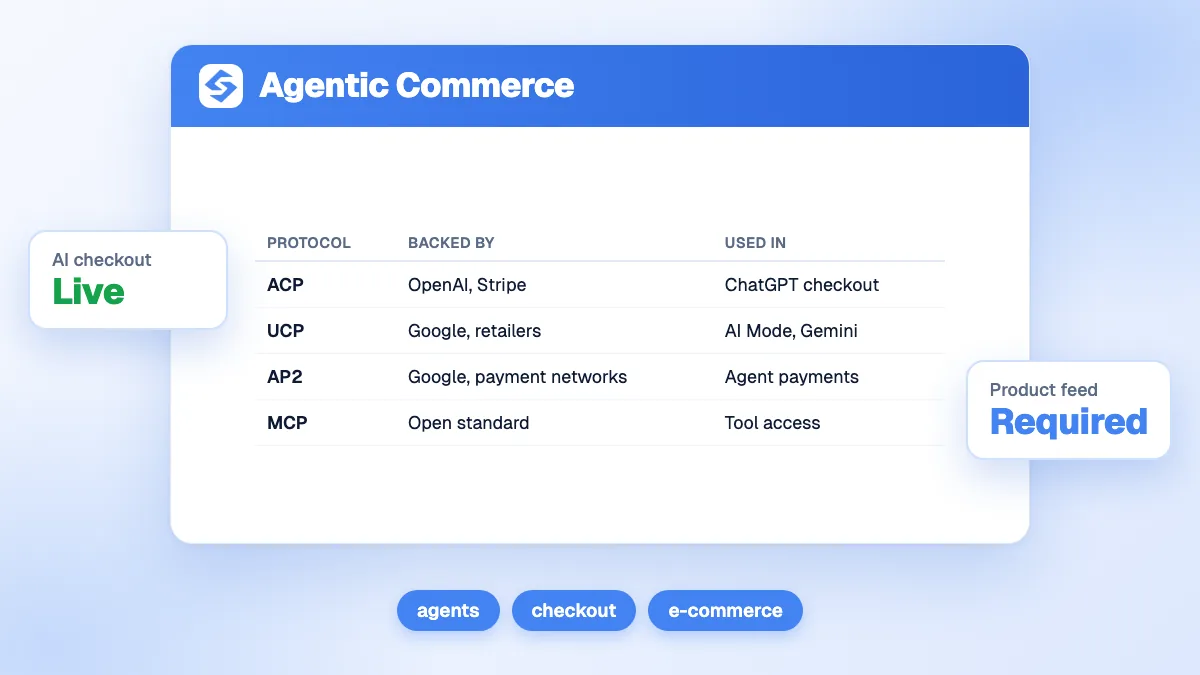
Co-developed by OpenAI and Stripe, the Agentic Commerce Protocol powers Instant Checkout in ChatGPT, launched on September 29, 2025 with US Etsy sellers and Shopify merchants announced next, according to Stripe. Payments use a token scoped to one merchant and one amount, so the assistant never sees card details. The merchant keeps fulfillment, customer service and returns. Our guide to ChatGPT shopping covers how products are recommended.
Announced by Google on January 11, 2026, the Universal Commerce Protocol is described as an open standard for agentic commerce across the whole shopping journey. It was co-developed with Shopify, Etsy, Wayfair, Target and Walmart, endorsed by more than 20 companies including Visa, Mastercard and Stripe, and is compatible with A2A, AP2 and MCP. Its first use case was checkout on eligible product listings in AI Mode and the Gemini app for US shoppers. In October 2026, Google launched Universal Cart in the US, a cart across retailers on Search and Gemini whose checkout runs on UCP.
The Agent Payments Protocol (AP2), introduced by Google Cloud in September 2025 with payment partners, frames how agents are authorized to pay. The Model Context Protocol (MCP) lets assistants use tools and data from external services, and many commerce integrations rely on it.
Note
Eligibility for these checkouts depends on the country, the platform and the merchant program, and it changes often. Check the current status with your e-commerce platform and in the merchant documentation of each assistant before planning a launch.
Agents choose from structured data. Fill every attribute: exact titles, variants, sizes, materials, compatibility, price, stock, shipping times, return policy. Google announced new attributes for conversational discovery (common product questions, compatible accessories, substitutes) in Merchant Center; a clean feed serves every agent.
An agent that finds a wrong price or an out-of-stock product drops the offer. Real-time or frequent feed updates matter more than before (see product feed management software).
Shopify, Etsy and large retailers are part of these protocols. For most merchants, enabling agentic checkout will be a setting or an app in their platform rather than a custom build. Follow your platform's announcements.
Agents weigh ratings, review volume and what trusted sites say. Our Trustpilot AI citation study shows how often review platforms are cited by assistants.
Buying guides, comparisons, size guides and use-case pages give agents precise passages to justify a choice. They also rank on Google and feed AI answers (see GEO vs SEO).
Tip
Test your own products: ask ChatGPT and Google AI Mode for the product you sell with three constraints (budget, size, delivery date). If you do not appear, compare your product data and reviews with those of the products that do.
Product pages and feeds become the main input of a new channel. Classic product SEO (clear titles, structured data, fast pages, unique descriptions) remains the base, and the work extends to the sources agents read and to conversational queries. Our guides to e-commerce product pages and AI in e-commerce go further, and our e-commerce SEO audit covers the site side.
Watch out
Agentic checkout does not remove your obligations as a seller: consumer law, returns and data protection still apply. Check what data the protocol shares with you and how disputes are handled before enabling it.
Agentic commerce rewards merchants whose products agents can understand, trust and buy without friction. Complete data, live feeds, real reviews and buying content are the preparation that works whatever protocol wins. Sorank, SEO and GEO software that runs on autopilot, publishes the buying guides and comparisons agents and AI answers draw on, connects to Shopify and other platforms, and tracks your brand in ChatGPT, Claude and Gemini with AI mention tracking. See Sorank for e-commerce or the Sorank plans, with a 3-day free trial.

ACP (Agentic Commerce Protocol) was co-developed by OpenAI and Stripe and powers checkout in ChatGPT. UCP (Universal Commerce Protocol) was launched by Google with retailers such as Shopify, Walmart and Target and powers checkout on Google surfaces like AI Mode and Gemini. Both are open standards that keep the merchant as seller of record.
Usually not. Large e-commerce platforms such as Shopify and Etsy take part in these protocols, so small merchants will typically enable agentic checkout through their platform. What every merchant controls directly is the quality of product data, feeds and reviews.
At launch, both ChatGPT Instant Checkout and Google's UCP checkout were limited to shoppers in the United States. Availability is expanding over time, so check the current status in each assistant's merchant documentation and with your platform.
We analyse your competitors, your website and your AI visibility to create a tailored content plan for free.
 AI Content Brief Generator
 FAQ Schema Generator
 AI Blog Post Ideas Generator
 Structured Data Validator (Schema Validator)
 Alt Text Checker
 Internal Link Analyzer
 Backlink Challenge
 AI Meta Description Generator
 AI Blog Title Generator
 Google Indexability Checker
 AI Blog Outline Generator
 UTM Link Builder
 Keyword Clustering Tool
 Canonical Tag Checker
 XML Sitemap Generator
 Broken Link Checker
 AI SEO Title Generator
 Headline Analyzer
 SERP Preview Tool
 Redirect Checker
 Hreflang Tag Generator
 Heading Structure Analyzer
 HTTP Headers Checker
 Favicon Extractor
 SERP CTR Calculator
 SEO vs Paid Search Savings Calculator
 SEO Share of Voice Calculator
 SEO ROI Calculator
 SEO Traffic and Revenue Forecast Calculator
 SEO Budget Calculator
 SEO Break-Even Calculator
 SaaS SEO ROI Calculator
 ROAS Calculator
 Reading Time Calculator
 Ranking Gain Simulator
 Organic Traffic Value Calculator
 Organic Traffic Estimator and Website Traffic Checker
 LTV to CAC Ratio Calculator
 Local SEO ROI Calculator
 Link Building Cost Calculator
 Keyword Value Calculator
 Keyword Opportunity Score Calculator
 Keyword Density Calculator
 GEO ROI Calculator
 GEO Content Investment Calculator
 Ecommerce SEO ROI Calculator
 Customer Lifetime Value Calculator
 Customer Acquisition Cost Calculator
 CTR Calculator
 Cost Per Article Calculator
 Conversion Rate Calculator
 Content Marketing ROI Calculator
 ChatGPT Referral Traffic Estimator
 Bounce Rate Calculator
 Backlink ROI Calculator
 AI Visibility Score Calculator
 AI Traffic Value Calculator
 AI Share of Voice Calculator
 Cost of AI Invisibility Calculator
 AI Citation Rate Calculator
 llms.txt Validator
 AI Overview Checker and AI Overviews Rank Checker
 Robots.txt Checker
 AI SEO Audit
 LLM Readability Checker
 SearchGPT Readiness Checker
 Structured Data LLM Audit
 Website Crawlability AI Audit
 Why ChatGPT Is Not Recommending My Website
 Gemini Ranking Tool
 Perplexity Ranking Checker
 LLM Citation Checker
 Answer Engine Optimization Audit
 GEO Audit
 AI Search Visibility Test
 ChatGPT Visibility Checker
 llms.txt Generator
 URL Extractor
 Webpage to Markdown
 Sitemap Checker
 SERP Volatility Sensor
 Page Size Checker
 Word Counter
 Slug Generator
 Schema Generator
 Robots Generator
 OG Preview
 Meta Tags Generator
 Image Compressor
 Favicon Generator
 On-Page SEO Audit: SEO Checker and SEO Analyzer
 Backlink Analysis Tool
 Keyword Research Tool
 Domain Authority Checker
THEY TRIED SORANK BEFORE YOU
 “I tested Sorank on a real client site and it's insane. It does everything an agency would bill you $1500 a month for. It's going into production on that client now.”

 Guillaume Guersanguersanguillaume.com“We are an Ads agency and we wanted to get our SEO back on track once and for all. Sorank gave us a clear view of our site, helped us prioritize optimizations, and properly structure our content. The tool is easy to use, well designed for a team, and very practical for centralizing tracking without having to juggle multiple platforms. A very solid foundation to start fresh with our SEO.”
 Gaspard MadouiAds Agency
 “I just let the Sorank software do its thing, and now my DR is 25 and my page is ranking higher.”
 Lucas Flandrefoundertrace.fr“I specialized in GEO thanks to Sorank. The GEO Leaderboard allows me to show my clients their position vs competitors on ChatGPT. It’s a real commercial differentiator.”
 MélanieSEO Freelance“Great service, works well for our website and helps us understand how to improve it to rank better on Google and elsewhere. Congrats, keep going, I recommend it.”
 Hugo T.E-commerce merchant