Preferences
Privacy is important to us, so you have the option of disabling certain types of storage that may not be necessary for the basic functioning of the website. Blocking categories may impact your experience on the website. More information

Privacy is important to us, so you have the option of disabling certain types of storage that may not be necessary for the basic functioning of the website. Blocking categories may impact your experience on the website. More information

Etsy vs Shopify in 2026: verified fees, a worked cost example, SEO settings side by side, AI visibility and a clear verdict for each type of seller.
Tools

In short
Etsy is a marketplace: you pay per listing and per sale (US: $0.20 per listing, 6.5% transaction fee, 3% + $0.25 payment processing, plus 15% on orders from Offsite Ads) and Etsy brings the buyers. Shopify is your own store: you pay a subscription (Basic from $29 per month billed yearly) plus card fees of about 2.9% + 30¢, and you bring the traffic. Etsy wins for testing handmade or vintage products with no audience; Shopify wins above roughly 13 orders a month, and whenever you want to own the brand, the customer list and your visibility on Google and in AI answers.
Want to go further? Ask
Quick quiz
Where should your online shop find its next customers?
Sorank matches your answers


Test it for 3 days on your own site and see where you stand on Google, ChatGPT and the other AIs.
Start 3-day free trial3 days free, then stop whenever you want. 90-day results-or-refund guarantee.
Most comparisons of Etsy vs Shopify stop at fees and ease of use. This guide adds what decides your traffic for the next five years: who controls the pages Google indexes, which technical SEO settings you can change, who owns the customer relationship, and what ChatGPT, Gemini and Perplexity can cite when a shopper asks for a recommendation. Every Etsy fee below comes from the official Etsy Fees & Payments Policy (checked October 2026), and every Shopify price from Shopify's own pricing page.
Etsy is a marketplace: buyers come to etsy.com, search, compare dozens of shops on one results page and pay through Etsy. Your shop is a section of someone else's website, with Etsy's layout, Etsy's checkout and Etsy's rules. Shopify is a store builder: it hosts your own website on your own domain, with your theme, your checkout and your customer list, but nobody visits it unless you send them there.
That single difference explains everything else. On Etsy you rent access to existing demand and pay for it on every order. On Shopify you pay a flat fee for the infrastructure, then invest in traffic that becomes an asset you keep. The scale of that existing demand is real: Etsy's shareholder letter for the third quarter of 2026, filed with the US Securities and Exchange Commission, reports approximately 88 million active buyers over twelve months and $2.6 billion of marketplace sales in the quarter, up 8.8% year over year. A Shopify store starts with none of those buyers.
The table below sums up the comparison for a US seller. Each line is detailed in its own section further down.
| Criterion | Etsy | Shopify |
|---|---|---|
| Model | Marketplace: your shop lives inside etsy.com | Store builder: your shop lives on your own domain |
| Fixed cost (US, checked October 2026) | $0, optional Etsy Plus at $10 per month | Basic $39 per month, or $29 per month billed yearly |
| Per-sale cost (US) | 6.5% transaction + 3% + $0.25 processing | About 2.9% + 30¢ card rate on Basic |
| Listing fee | $0.20 per listing, renewed every 4 months | None |
| Advertising fee | Offsite Ads: 15% or 12% of attributed orders, capped at $100 per order | None imposed (you choose your own ads) |
| What you can sell | Handmade, seller-designed, vintage and craft supplies | Almost anything legal, including resale and dropshipping |
| Built-in traffic | Yes, about 88 million active buyers | No, you build it (SEO, email, social, ads) |
| Customer data | Limited to fulfilling the order | Yours: emails, segments, retargeting |
| SEO control | Titles, tags, attributes; pages rank as etsy.com | Titles, meta descriptions, URLs, redirects, blog, structured data |
| Best for | Testing demand with no audience | Building a brand and a long-term channel |
Etsy has no monthly subscription but charges on every listing and every sale. For a seller with a US bank account, the fees in force in October 2026 are the following.
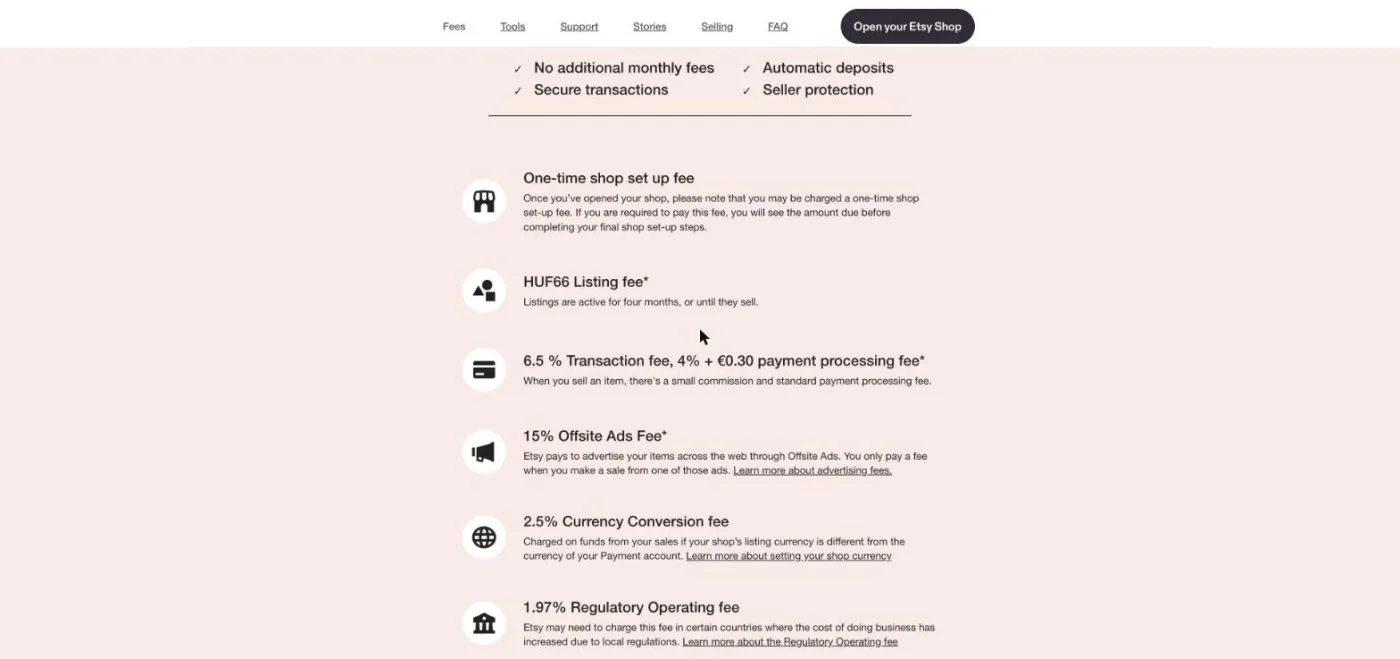
Add those lines up and a typical US order costs about 9.5% plus $0.45 in fees before any advertising. On an order that came from Offsite Ads, the total climbs to roughly 25%, which is why the share of Offsite Ads sales in your Etsy stats matters more than the headline rate.
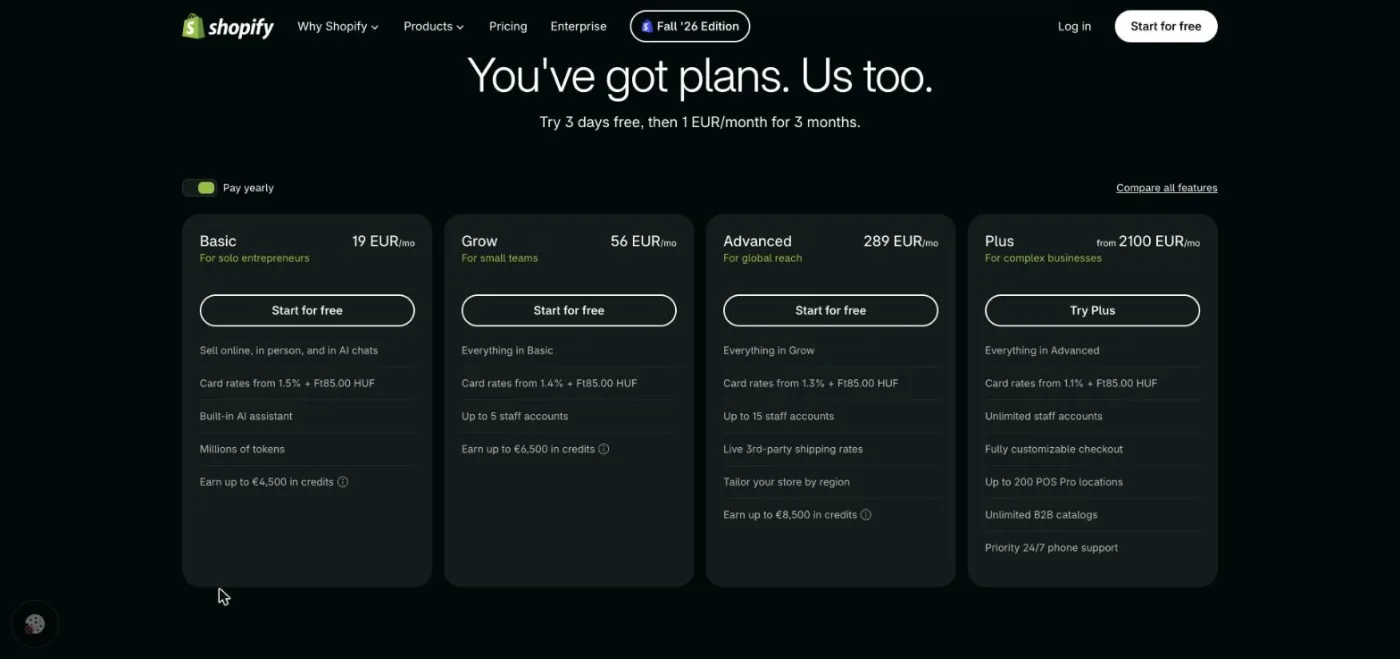
Shopify charges a monthly subscription and no listing fee, with a lower card rate on higher plans. The prices below are Shopify's US list prices; the Shopify pricing page displays the local currency of each visitor, and the euro column shows what it displayed from Europe (checked October 2026).
| Plan | US price, monthly billing | US price, yearly billing | Shown in Europe (yearly billing) | Fee if you do not use Shopify Payments |
|---|---|---|---|---|
| Basic | $39 per month | $29 per month | 19 EUR per month | 2% |
| Grow | $105 per month | $89 per month | 56 EUR per month | 1% |
| Advanced | $399 per month | $359 per month | 289 EUR per month | 0.6% |
| Plus | From $2,300 per month | On contract | From 2,100 EUR per month | 0.2% |
New stores get a 3-day trial, then $1 per month for the first three months on Basic, Grow and Advanced. In the US, the online card rate with Shopify Payments is 2.9% + 30¢ on Basic, 2.7% + 30¢ on Grow, 2.5% + 30¢ on Advanced and 2.25% + 30¢ on Plus. Shopify's pricing page also lists selling in AI chats as included on every plan, and an Agentic plan at $0 per month that only charges a fee per sale made through AI channels. Budget for a paid theme (often a one-time purchase) and apps if you need them.
Note
Shopify's "Starter" plan (sales through social media and links, without a full online store) does not appear on every regional pricing page. Compare Etsy with the Basic plan: it is the cheapest plan that gives you a real store with its own pages for Google.
For a few orders a month, Etsy is cheaper because it has no subscription. Shopify becomes cheaper once the difference in per-order fees covers its monthly price. Take one $40 order with $5 shipping (a $45 total, before sales tax) for a US seller.
| Fee | Etsy | Shopify Basic |
|---|---|---|
| Listing | $0.20 | $0 |
| Transaction fee | $2.93 (6.5% of $45) | $0 |
| Payment processing | $1.60 (3% of $45 + $0.25) | $1.61 (2.9% of $45 + $0.30) |
| Total per order | $4.73 (10.5%) | $1.61 (3.6%) |
| If the sale came from Offsite Ads (15%) | +$6.75, total $11.48 | Not applicable |
| Monthly subscription | $0 | $39 ($29 yearly) |
The gap is about $3.12 per order. Shopify's $39 monthly fee is covered after roughly 13 orders a month of this size (about $585 in sales), or 10 orders on yearly billing. The table below extends the calculation to three volumes, without Offsite Ads.
| Orders per month ($45 each) | Etsy fees | Shopify Basic (monthly billing) | Cheaper option |
|---|---|---|---|
| 5 | $23.65 | $47.05 | Etsy |
| 20 | $94.60 | $71.20 | Shopify |
| 50 | $236.50 | $119.50 | Shopify |
This comparison only counts platform fees. On Shopify, the real extra cost is the traffic you must bring yourself: content, email, social media or ads. On Etsy, the real extra cost is Offsite Ads and the 12% that becomes mandatory above $10,000 in yearly sales.
Tip
Run this calculation with your own average order value and your share of Offsite Ads sales, both visible in your Etsy stats. A shop where a quarter of orders come from Offsite Ads pays well above 10% on average.
On a $100 order (item and shipping) from a US seller, Etsy keeps about $9.95: $0.20 listing fee, $6.50 transaction fee and $3.25 payment processing (3% + $0.25). If the buyer clicked an Offsite Ad in the previous 30 days, add $15 (or $12 for larger shops), for a total of $24.95. The same $100 order on Shopify Basic costs about $3.20 in card fees with Shopify Payments, before the share of the monthly subscription.
On Etsy, the buyer is an Etsy customer first. You receive what you need to ship the order, but you cannot freely add buyers to a mailing list, retarget them or move them to another site: the fee policy states that any action to move a transaction off the Etsy platform is strictly prohibited. Your shop can also be suspended under Etsy's policies, and your listings appear next to similar items from other shops on the same page.
On Shopify, the customer list, the email consent, the analytics and the domain belong to you. That is what makes repeat sales and a recognizable brand possible, and it matters for search too: a domain you own accumulates links, reviews and mentions that keep working for you, while the authority built by an Etsy shop mostly strengthens etsy.com. If you ever sell the business, a domain with rankings and a customer list is a transferable asset; an Etsy shop is much harder to transfer.
Shopify gives you far more SEO control; Etsy gives you the authority of etsy.com but very few settings. Etsy listings do appear on Google under the etsy.com domain. Within Etsy, ranking depends on how well titles, tags and attributes match the query, on listing quality and on shop performance, as detailed in our guide to Etsy SEO. Shopify gives you the levers that Google describes in its SEO best practices for ecommerce sites: URL structure, structured data, crawlable category pages.
| SEO setting | Etsy | Shopify |
|---|---|---|
| URL | Fixed by Etsy (etsy.com/listing/number/title), no custom domain except through Pattern | Your domain; editable handle, fixed prefixes (/products/, /collections/, /blogs/) |
| Title tag and meta description | Derived from the listing title and description, no separate fields | Editable on every product, collection, page and article |
| 301 redirects | None: a deleted listing cannot be redirected | Built-in URL redirects, created automatically when you change a handle |
| XML sitemap | Managed by Etsy for the whole marketplace | Generated automatically at /sitemap.xml and updated with each product, collection or post |
| robots.txt | No access | Sensible default, editable through the robots.txt.liquid template |
| Structured data | Added by Etsy, not editable | Product markup output by most themes, extendable with apps or code |
| Canonical | Set by Etsy | Canonical tags added automatically, including on filtered collection URLs |
| Speed | Etsy's infrastructure, out of your hands | Global CDN; the theme and the number of apps make the difference |
| Multilingual | Etsy translates listings for buyers, with optional manual translations | Markets and the Translate & Adapt app, language subfolders with hreflang |
| Blog | None | Built in, with its own URLs and editable meta tags |
The limits on Etsy are structural: no real blog, no 301 redirects, no control over the XML sitemap, and a visitor who lands on your listing from Google sees links to competing shops. On Shopify, you can add schema markup, write collection texts, publish buying guides and fix technical issues with the best Shopify SEO apps. The catch: a new domain starts with no authority, so Shopify SEO is a long-term investment of several months before the store ranks on competitive queries.
Product pages remain the core on both platforms: clear titles, real photos, unique descriptions and answers to buyers' questions. The checklist of an ecommerce product page that ranks applies to Etsy listings and Shopify products alike.
Both platforms can now put a product in front of a shopper who asks an AI assistant. On September 29, 2025, OpenAI launched Instant Checkout in ChatGPT, starting with US Etsy sellers and announcing over a million Shopify merchants next. OpenAI said at the time that more than 700 million people use ChatGPT each week, and that product results are organic and unsponsored, ranked on relevance to the user. Etsy's Chief Product and Technology Officer, Rafe Colburn, summed up the marketplace's view in the same announcement: "ChatGPT helps us meet buyers where they are."
"Bringing Shopify merchants into ChatGPT lets indie brands to household names reach customers in entirely new ways, meeting high-intent shoppers in relevant conversations."
Vanessa Lee, VP of Product, Shopify, OpenAI announcement
The difference lies in what an AI can cite to justify a recommendation. An Etsy listing is one product card among millions on a domain Etsy controls. A Shopify store can publish what generative answers quote: buying guides, comparison pages, size and material explanations, and FAQs with direct answers. Our Shopify AI citation study looks at which store pages the AIs reference, and our overview of AI in ecommerce covers the new AI shopping channel.
Example
Ask ChatGPT "best handmade ceramic mugs for a gift". The answer cites product cards and the pages that explain materials, sizes and care. A store with a buying guide on its own domain can be one of those cited pages; an Etsy listing can only be one of the cards.
Etsy only accepts handmade items, items you designed, vintage items (at least 20 years old) and craft supplies. Print on demand is allowed when you create the design yourself and disclose your production partner. Resale of goods made by others, dropshipping of generic products and most private-label catalogues do not belong on Etsy and can get a shop suspended.
Shopify accepts almost any legal product: physical goods, digital downloads, services, subscriptions, wholesale and dropshipping. That flexibility is the main reason growing brands move: once the catalogue mixes handmade pieces with sourced products, only an independent store can hold everything. Our comparison of the best ecommerce platforms for SEO covers the other options when Shopify is not the right fit.
Yes, and many sellers do: Etsy for discovery, Shopify for the brand and repeat buyers. Apps from the Shopify App Store sync products, inventory and orders between the two, so a sale on one channel updates stock on the other. Etsy remains a separate marketplace with its own rules: you cannot redirect Etsy buyers to your store during a transaction, but your packaging, your brand name and your social accounts can make your own site known.
Moving from Etsy to Shopify has two limits to plan for. Your Etsy reviews do not transfer automatically (you can import them into a reviews app, with Etsy's display rules in mind), and since Etsy offers no redirects, the rankings of your Etsy listings stay on etsy.com. The same logic applies to other marketplaces, as our guide to Amazon SEO shows: the marketplace keeps the authority, your domain keeps what you build on it.
Watch out
Do not copy your Etsy descriptions word for word onto your Shopify product pages. Google then sees two near-identical pages and usually ranks the etsy.com version, which has more authority. Rewrite each description for your own store.
The right choice depends on your audience, your catalogue and how long you plan to build. The table gives the verdict for the most common seller profiles.
| Your profile | Best choice | Why |
|---|---|---|
| Shop just starting, handmade or vintage, no audience | Etsy | Buyers already there, no monthly cost while you test demand |
| Large catalogue (hundreds of products, variants, resale) | Shopify | No listing fees, collections, bulk editing, and products Etsy refuses |
| Local business selling in person and online | Shopify | Point of sale and online store share one inventory and one customer list |
| Creator with an audience (Instagram, newsletter, YouTube) | Shopify | You already bring the traffic, so marketplace fees are wasted |
| Print on demand with your own designs | Both | Etsy for discovery, Shopify for margins and personalization tools |
| Agency or freelancer building stores for clients | Shopify | The client owns the domain, data and SEO; an Etsy shop cannot be designed |
| Steady Etsy sales above about 13 orders a month | Both | Keep Etsy for new buyers, move repeat buyers and content to your store |
The weak point of Shopify is the empty store on day one. The durable fix is content that ranks and gets cited: collection pages with useful text, product pages that answer real questions, and articles that target what your buyers search on Google and ask the AIs. Our Shopify SEO and GEO page lists the settings to check first.
Sorank, our product, is an SEO and GEO software that does this work in autopilot: it finds the keywords, writes and publishes optimized articles with the blog article generator, connects to Shopify in minutes and tracks whether ChatGPT, Claude and Gemini mention your store with AI mention tracking. Plans start at $49 per month billed yearly, with a 3-day free trial; see pricing. First effects on Google usually appear within 2 to 4 months.
Etsy is the cheapest way to find out whether strangers will buy your product: no subscription, millions of buyers, fees of about 10% per order. Shopify is the way to build a business that owns its customers, its domain and its search visibility, and it costs less per order from about 13 orders a month. Start on Etsy to validate, move to Shopify to grow, and keep both while Etsy still brings new buyers. Whatever you choose in 2026, the traffic you build on your own domain is the only part that compounds.

For a few orders a month, Etsy is cheaper because it has no subscription: a US seller pays $0.20 per listing, 6.5% per transaction and 3% + $0.25 for processing. Shopify Basic costs $39 per month ($29 billed yearly) plus about 2.9% + 30¢ per card payment. With a $45 order, Shopify becomes cheaper above roughly 13 orders a month, provided you bring the traffic yourself.
Not automatically. Etsy reviews stay on etsy.com, and Etsy offers no redirect from a listing to another site. You can export your shop data and import past reviews into a Shopify reviews app, then ask your new customers for reviews on your own store.
No, not by itself. Shopify hosts your store but sends no marketplace buyers to it, so traffic comes from SEO, content, email, social media and ads. Shopify can list your products in AI chats such as ChatGPT, and a store with useful content can rank on Google, but expect several months before organic traffic builds up.
We analyse your competitors, your website and your AI visibility to create a tailored content plan for free.
 AI Content Brief Generator
 FAQ Schema Generator
 AI Blog Post Ideas Generator
 Structured Data Validator (Schema Validator)
 Alt Text Checker
 Internal Link Analyzer
 Backlink Challenge
 AI Meta Description Generator
 AI Blog Title Generator
 Google Indexability Checker
 AI Blog Outline Generator
 UTM Link Builder
 Keyword Clustering Tool
 Canonical Tag Checker
 XML Sitemap Generator
 Broken Link Checker
 AI SEO Title Generator
 Headline Analyzer
 SERP Preview Tool
 Redirect Checker
 Hreflang Tag Generator
 Heading Structure Analyzer
 HTTP Headers Checker
 Favicon Extractor
 SERP CTR Calculator
 SEO vs Paid Search Savings Calculator
 SEO Share of Voice Calculator
 SEO ROI Calculator
 SEO Traffic and Revenue Forecast Calculator
 SEO Budget Calculator
 SEO Break-Even Calculator
 SaaS SEO ROI Calculator
 ROAS Calculator
 Reading Time Calculator
 Ranking Gain Simulator
 Organic Traffic Value Calculator
 Organic Traffic Estimator and Website Traffic Checker
 LTV to CAC Ratio Calculator
 Local SEO ROI Calculator
 Link Building Cost Calculator
 Keyword Value Calculator
 Keyword Opportunity Score Calculator
 Keyword Density Calculator
 GEO ROI Calculator
 GEO Content Investment Calculator
 Ecommerce SEO ROI Calculator
 Customer Lifetime Value Calculator
 Customer Acquisition Cost Calculator
 CTR Calculator
 Cost Per Article Calculator
 Conversion Rate Calculator
 Content Marketing ROI Calculator
 ChatGPT Referral Traffic Estimator
 Bounce Rate Calculator
 Backlink ROI Calculator
 AI Visibility Score Calculator
 AI Traffic Value Calculator
 AI Share of Voice Calculator
 Cost of AI Invisibility Calculator
 AI Citation Rate Calculator
 llms.txt Validator
 AI Overview Checker and AI Overviews Rank Checker
 Robots.txt Checker
 AI SEO Audit
 LLM Readability Checker
 SearchGPT Readiness Checker
 Structured Data LLM Audit
 Website Crawlability AI Audit
 Why ChatGPT Is Not Recommending My Website
 Gemini Ranking Tool
 Perplexity Ranking Checker
 LLM Citation Checker
 Answer Engine Optimization Audit
 GEO Audit
 AI Search Visibility Test
 ChatGPT Visibility Checker
 llms.txt Generator
 URL Extractor
 Webpage to Markdown
 Sitemap Checker
 SERP Volatility Sensor
 Page Size Checker
 Word Counter
 Slug Generator
 Schema Generator
 Robots Generator
 OG Preview
 Meta Tags Generator
 Image Compressor
 Favicon Generator
 On-Page SEO Audit: SEO Checker and SEO Analyzer
 Backlink Analysis Tool
 Keyword Research Tool
 Domain Authority Checker
THEY TRIED SORANK BEFORE YOU
 “I tested Sorank on a real client site and it's insane. It does everything an agency would bill you $1500 a month for. It's going into production on that client now.”

 Guillaume Guersanguersanguillaume.com“We are an Ads agency and we wanted to get our SEO back on track once and for all. Sorank gave us a clear view of our site, helped us prioritize optimizations, and properly structure our content. The tool is easy to use, well designed for a team, and very practical for centralizing tracking without having to juggle multiple platforms. A very solid foundation to start fresh with our SEO.”
 Gaspard MadouiAds Agency
 “I just let the Sorank software do its thing, and now my DR is 25 and my page is ranking higher.”
 Lucas Flandrefoundertrace.fr“I specialized in GEO thanks to Sorank. The GEO Leaderboard allows me to show my clients their position vs competitors on ChatGPT. It’s a real commercial differentiator.”
 MélanieSEO Freelance“Great service, works well for our website and helps us understand how to improve it to rank better on Google and elsewhere. Congrats, keep going, I recommend it.”
 Hugo T.E-commerce merchant