Preferences
Privacy is important to us, so you have the option of disabling certain types of storage that may not be necessary for the basic functioning of the website. Blocking categories may impact your experience on the website. More information

Privacy is important to us, so you have the option of disabling certain types of storage that may not be necessary for the basic functioning of the website. Blocking categories may impact your experience on the website. More information

Ecommerce content strategy for 2026: product pages, category copy, buying guides, reviews and AI shopping content mapped to each buying stage, with KPIs.

Tools

In short
An ecommerce content strategy decides which content a store publishes for each stage of the buyer journey and on which page type: buying guides and articles to be discovered, comparisons and category pages to help shoppers choose, product pages, reviews and clean product data to close the sale. Start by fixing product and category pages, which already carry purchase intent, then add guides that link to them, and keep product data complete so Google and AI shopping assistants can recommend your products.
Want to go further? Ask
Quick quiz
Where should your online shop find its next customers?
Sorank matches your answers


Test it for 3 days on your own site and see where you stand on Google, ChatGPT and the other AIs.
Start 3-day free trial3 days free, then stop whenever you want. 90-day results-or-refund guarantee.
Most online stores publish content in the wrong order: a blog first, product pages last. A good ecommerce content strategy reverses that. It starts from the catalog, maps every search a buyer makes to one page, and treats product descriptions, category copy, reviews and product feeds as content in their own right. Google says it plainly in its e-commerce site structure documentation: the ultimate e-commerce SEO best practice is to create useful and interesting content that is valuable to users. This guide shows what to publish, where, in what order, and how to measure it.
An ecommerce content strategy is the plan that links a store's catalog to the questions its buyers ask. It covers five content families:
It differs from a general SEO content strategy in one respect: most of the revenue comes from pages that already exist (products and categories), so the editorial calendar serves the catalog instead of running alongside it.
Each search has a search intent, and each intent has a page type that answers it best. Mapping one to the other prevents the classic problem of a blog article competing with a category page for the same query.
| Stage | Typical query | Best page type | Main KPI |
|---|---|---|---|
| Discovery (problem) | "how to choose a running shoe for flat feet" | Buying guide, how-to article | Organic sessions, clicks to categories |
| Consideration (options) | "best trail running shoes", "brand A vs brand B" | Comparison, ranked selection, category page | Clicks to products, assisted conversions |
| Decision (product) | "brand A model X size 43" | Product page with reviews | Conversion rate, add-to-cart rate |
| After purchase | "how to clean trail shoes" | Care guide, FAQ, email content | Repeat purchase rate, fewer returns |
Our guide to the SEO funnel details the keywords and KPIs of each stage. For a store, the rule of thumb is simple: transactional queries go to category and product pages, informational queries go to guides, and every guide links to the category or products it recommends.
Export your product and category URLs, then compare them with Google Search Console data: impressions, clicks and average position per page. Flag product pages with manufacturer descriptions copied by other retailers, categories with no introduction, and blog posts that receive traffic but no clicks to products. These are your first quick wins.
Group keywords into topic clusters, one per product family. In each cluster, assign one keyword per page: the generic query to the category, the model query to the product page, the questions to a guide. One keyword, one page: this avoids cannibalization between a category and an article.
Start with your top 20% of products by revenue or margin. Write unique descriptions that answer real questions (use, fit, materials, compatibility, maintenance), add specifications in a table, real photos and a short FAQ. Our checklist of the elements of an ecommerce product page lists the 15 points that help a page rank and convert.
Category pages target the most valuable queries of a store and often carry no text at all. Add a short introduction above the grid, a buying advice block below it, and links to sub-categories and guides. Google also notes that category pages should link directly to every product you want indexed. The full method is in our guide to ecommerce category page SEO.
Guides capture the discovery and consideration stages, when the buyer has not chosen a brand yet. Google's guidance on writing high quality reviews sets the bar: evidence of firsthand experience, quantitative measurements, what sets a product apart from its competitors, and pros and cons based on original research. A guide written from your own testing, returns data and customer questions is hard to copy.
Tip
Ask your customer service team for the ten questions they answer most often before a purchase. Each one is a guide, a product page FAQ or a category advice block waiting to be written.
Reviews are content that buyers write for you. The Spiegel Research Center at Northwestern University found that a product with five reviews is 270% more likely to be purchased than a product with none (first published in 2017, updated December 2025), with the strongest effect on higher-priced items. Send a review request after delivery, display buyer photos and answer questions publicly: user-generated content adds fresh, specific wording to product pages.
An ecommerce calendar follows sales peaks, launches and stock. Publish seasonal guides six to eight weeks before the peak so they have time to be indexed, update last year's guides instead of creating new URLs, and refresh product pages when a model changes. A content calendar such as Sorank's blog planner keeps these dates visible for the whole year.
Buyers now ask ChatGPT, Gemini, Perplexity or Google's AI Mode to recommend products. Google announced on November 13, 2025 that its Shopping Graph holds more than 50 billion product listings, 2 billion of which are updated every hour, and that AI Mode answers shopping questions with prices, reviews and stock information, then can complete checkout on eligible merchant sites. OpenAI launched Instant Checkout in ChatGPT in September 2025, starting with Etsy sellers and Shopify merchants in the United States. Our page on AI shopping explains how these assistants pick products.
For your content strategy, this means three things:
Note
Product videos count twice: they help shoppers on the product page and give AI assistants another source to cite. Embed the video on the page and publish it on YouTube with the product name in the title.
Our guide to AI in ecommerce covers the other uses of AI for a store, from search to customer service.
Measure each page type against the job it has in the journey. A buying guide that brings few direct sales but sends many visitors to categories is doing its job.
| Page type | What to track | Where |
|---|---|---|
| Product pages | Clicks, conversion rate, add-to-cart rate, return rate | Search Console, analytics, store admin |
| Category pages | Impressions and position on generic queries, clicks to products | Search Console, analytics |
| Guides and articles | Organic sessions, clicks to categories and products, assisted conversions | Analytics |
| Reviews | Number of reviews per product, average rating, conversion rate with and without reviews | Review app, analytics |
| AI visibility | Share of tracked questions where the brand or products are cited | AI visibility tracking |
Review these numbers every month and every quarter decide what to update, merge or remove. Updating a guide that already ranks on page two is usually faster than publishing a new one.
Search engines rank pages, and AI assistants cite passages. The same content work serves both: product and category pages that answer real questions, guides that compare honestly and link to the catalog, and consistent product data everywhere. The difficulty for most stores is volume and regularity, since a catalog of a few hundred products already calls for dozens of guides.
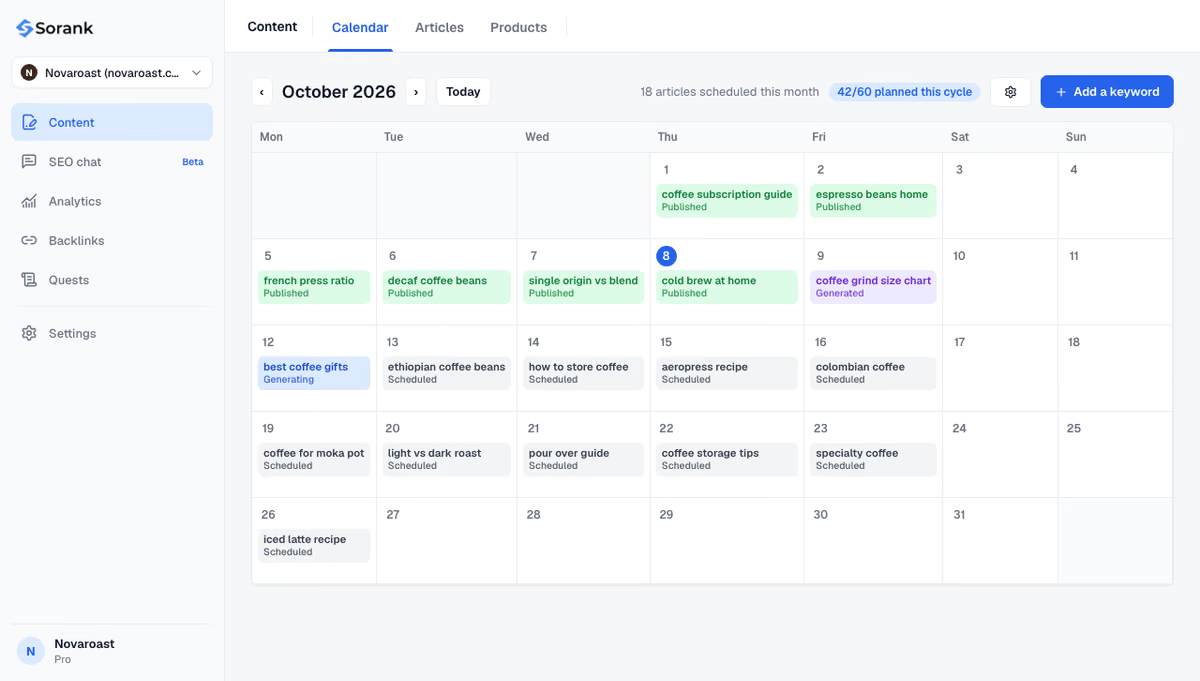
Sorank is an SEO and GEO software that runs on autopilot: it finds the keywords of your store, writes and publishes optimized guides with the blog article generator, links them to your pages, and connects to Shopify, WordPress, Webflow or Wix in a few minutes. AI mention tracking then shows whether ChatGPT, Claude and Gemini cite your brand for the questions your buyers ask, and who they cite instead.
The most profitable ecommerce content strategy starts with the pages that already sell, then adds guides that send buyers to them. Fix your top product and category pages this month, plan your seasonal guides for the next quarter, and if you want the publishing part to run on its own, compare the Sorank plans, with a 3-day free trial.

Product pages with unique descriptions and specifications, category pages with short useful copy, buying guides and comparisons, customer reviews and product videos. Product pages and categories drive most sales because they match purchase intent, while guides attract buyers earlier and send them to those pages.
A store needs editorial content more than a blog in the classic sense. Buying guides, comparisons and care guides capture searches that product pages cannot answer, and they help AI assistants understand your products. They only pay off if each article links to the relevant categories and products.
There is no fixed number; it depends on the size of the catalog and the competition. Many stores start with two to four guides per month around their best-selling product families, then increase once those guides bring traffic to categories. Regular publishing and updating existing guides matter more than a burst of articles.
We analyse your competitors, your website and your AI visibility to create a tailored content plan for free.
 AI Content Brief Generator
 FAQ Schema Generator
 AI Blog Post Ideas Generator
 Structured Data Validator (Schema Validator)
 Alt Text Checker
 Internal Link Analyzer
 Backlink Challenge
 AI Meta Description Generator
 AI Blog Title Generator
 Google Indexability Checker
 AI Blog Outline Generator
 UTM Link Builder
 Keyword Clustering Tool
 Canonical Tag Checker
 XML Sitemap Generator
 Broken Link Checker
 AI SEO Title Generator
 Headline Analyzer
 SERP Preview Tool
 Redirect Checker
 Hreflang Tag Generator
 Heading Structure Analyzer
 HTTP Headers Checker
 Favicon Extractor
 SERP CTR Calculator
 SEO vs Paid Search Savings Calculator
 SEO Share of Voice Calculator
 SEO ROI Calculator
 SEO Traffic and Revenue Forecast Calculator
 SEO Budget Calculator
 SEO Break-Even Calculator
 SaaS SEO ROI Calculator
 ROAS Calculator
 Reading Time Calculator
 Ranking Gain Simulator
 Organic Traffic Value Calculator
 Organic Traffic Estimator and Website Traffic Checker
 LTV to CAC Ratio Calculator
 Local SEO ROI Calculator
 Link Building Cost Calculator
 Keyword Value Calculator
 Keyword Opportunity Score Calculator
 Keyword Density Calculator
 GEO ROI Calculator
 GEO Content Investment Calculator
 Ecommerce SEO ROI Calculator
 Customer Lifetime Value Calculator
 Customer Acquisition Cost Calculator
 CTR Calculator
 Cost Per Article Calculator
 Conversion Rate Calculator
 Content Marketing ROI Calculator
 ChatGPT Referral Traffic Estimator
 Bounce Rate Calculator
 Backlink ROI Calculator
 AI Visibility Score Calculator
 AI Traffic Value Calculator
 AI Share of Voice Calculator
 Cost of AI Invisibility Calculator
 AI Citation Rate Calculator
 llms.txt Validator
 AI Overview Checker and AI Overviews Rank Checker
 Robots.txt Checker
 AI SEO Audit
 LLM Readability Checker
 SearchGPT Readiness Checker
 Structured Data LLM Audit
 Website Crawlability AI Audit
 Why ChatGPT Is Not Recommending My Website
 Gemini Ranking Tool
 Perplexity Ranking Checker
 LLM Citation Checker
 Answer Engine Optimization Audit
 GEO Audit
 AI Search Visibility Test
 ChatGPT Visibility Checker
 llms.txt Generator
 URL Extractor
 Webpage to Markdown
 Sitemap Checker
 SERP Volatility Sensor
 Page Size Checker
 Word Counter
 Slug Generator
 Schema Generator
 Robots Generator
 OG Preview
 Meta Tags Generator
 Image Compressor
 Favicon Generator
 On-Page SEO Audit: SEO Checker and SEO Analyzer
 Backlink Analysis Tool
 Keyword Research Tool
 Domain Authority Checker
THEY TRIED SORANK BEFORE YOU
 “I tested Sorank on a real client site and it's insane. It does everything an agency would bill you $1500 a month for. It's going into production on that client now.”

 Guillaume Guersanguersanguillaume.com“We are an Ads agency and we wanted to get our SEO back on track once and for all. Sorank gave us a clear view of our site, helped us prioritize optimizations, and properly structure our content. The tool is easy to use, well designed for a team, and very practical for centralizing tracking without having to juggle multiple platforms. A very solid foundation to start fresh with our SEO.”
 Gaspard MadouiAds Agency
 “I just let the Sorank software do its thing, and now my DR is 25 and my page is ranking higher.”
 Lucas Flandrefoundertrace.fr“I specialized in GEO thanks to Sorank. The GEO Leaderboard allows me to show my clients their position vs competitors on ChatGPT. It’s a real commercial differentiator.”
 MélanieSEO Freelance“Great service, works well for our website and helps us understand how to improve it to rank better on Google and elsewhere. Congrats, keep going, I recommend it.”
 Hugo T.E-commerce merchant