
Preferences
Privacy is important to us, so you have the option of disabling certain types of storage that may not be necessary for the basic functioning of the website. Blocking categories may impact your experience on the website. More information
Privacy is important to us, so you have the option of disabling certain types of storage that may not be necessary for the basic functioning of the website. Blocking categories may impact your experience on the website. More information

B2B2C ecommerce is a model where a brand sells to consumers through a partner's platform. Learn how it works, its advantages, its risks and how to start.







Founder Sorank, 7+ years in SEO.
Summary
B2B2C ecommerce, or business-to-business-to-consumer ecommerce, is a model where a company sells its products to consumers through another company's platform or channel. The brand makes the product, and the partner brings the shoppers, the checkout and often the delivery. Amazon sellers and grocery brands sold through Instacart are common examples.
Want to go further? Ask
B2B2C ecommerce has three parties. The brand makes or owns the product. The partner sells to the shopper. The shopper is the consumer who buys. TechTarget's definition describes the model as B2B selling extended to consumer ecommerce. If you sell to companies first, our B2B marketing definition explains that side of the work.
The difference is who the brand sells to, and who the shopper buys from. In a B2C sale, the brand sells straight to the shopper. In B2B2C, a partner stands between them.
| Model | Who the brand sells to | Who the shopper buys from | Example |
|---|---|---|---|
| B2B | Other companies | Not a consumer sale | A software vendor sells to a hotel chain |
| B2C | Shoppers directly | The brand | A clothing brand sells on its own website |
| B2B2C | Shoppers, through a partner | The partner, on the brand's behalf | A brand sells on a marketplace |
A B2B2C sale follows a clear flow. The brand lists its products, the partner shows them to shoppers, and the partner takes the order. In practice, the steps look like this:
Step 2 usually runs on a product feed, a file that lists every product with its price, stock and details. If the feed is wrong, the partner shows wrong prices, and the sale fails.
Shopify's B2B2C guide lists Instacart, Shop Pay and OpenTable as examples. The same model appears in marketplaces, delivery apps and booking platforms.
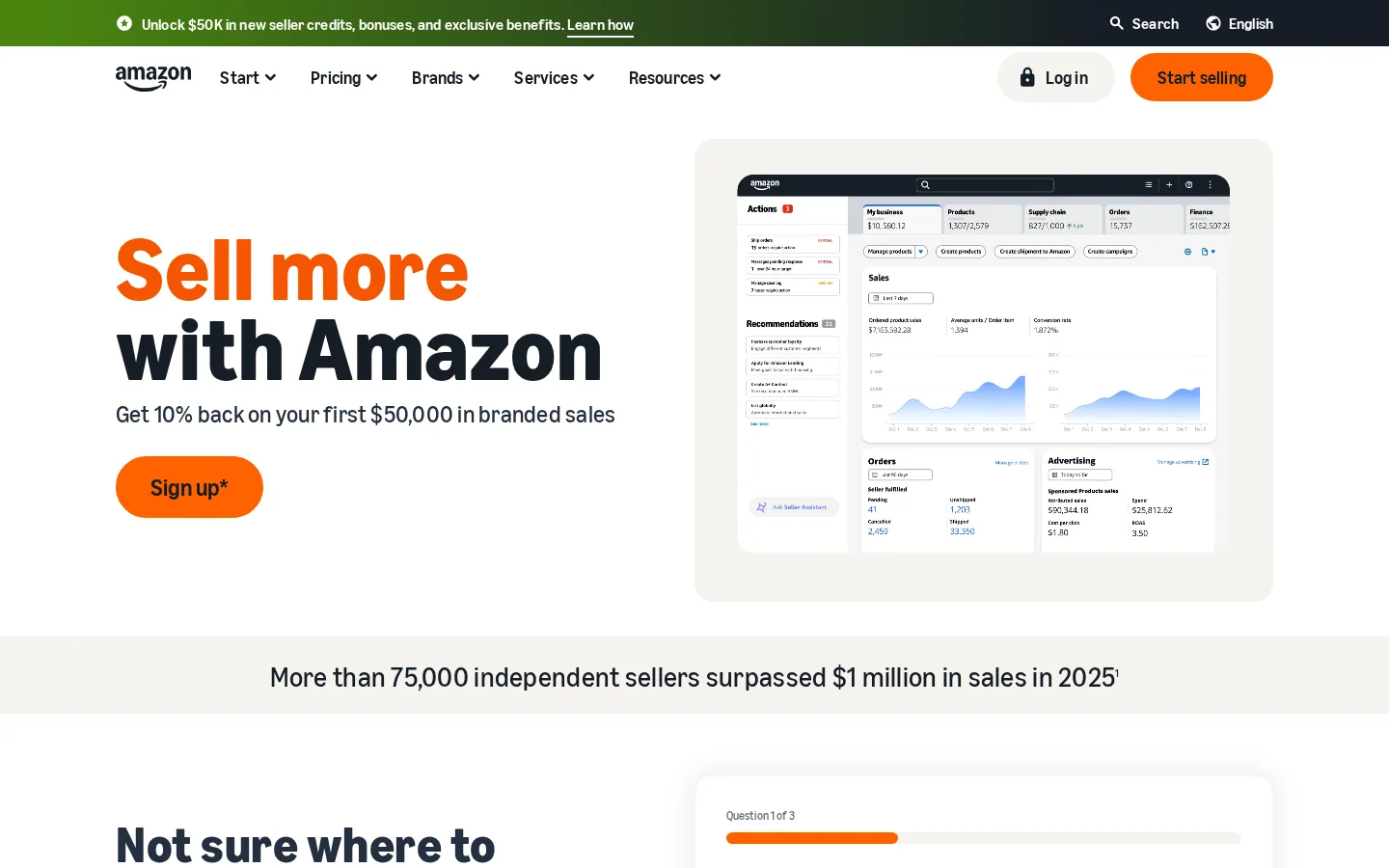
The Amazon example shows the model at its clearest. The brand keeps its product and its brand name. The marketplace brings the shoppers, the checkout and the delivery service.
The main advantage is reach. A brand can sell to shoppers it could not find alone, and the partner earns from the sale too. Four advantages come up most often:
TechTarget says the arrangement can improve market reach, make better use of resources and drive revenue growth for both parties.
The main challenges are margin, control and systems. Each one can cost you money if you ignore it at the start.
Warning
Read the contract before you list a single product. Check who owns the customer data, how returns work and what happens to the sale if the partner changes its fees.
Start with one partner and one product line. Test the sales before you move your full catalog. For the marketplace side of this work, our marketplace SEO guide covers how listings and seller pages rank.
Most mistakes come from signing before you understand the numbers. These are the three that cost brands the most.
What it is: You set a price, then the partner's fee, shipping and returns cut your profit. How to spot it: Your sales grow, but your profit does not. How to fix it: Calculate your margin after the partner's fee, shipping and expected returns, and only then set the price.
What it is: The partner keeps all shopper accounts, reviews and order history. How to spot it: You cannot see who bought or why they came back. How to fix it: Write data access, reporting and review rules into the contract before you launch.
What it is: Listings with missing sizes, wrong prices or old stock levels. How to spot it: More returns, more cancelled orders and weak reviews. How to fix it: Check each listing against your own stock system every week, and fix the feed before you add new products.
When a partner sells your product, the product page may sit on the partner's domain, not yours. The partner's page may rank on Google, while your brand gets no credit. The same problem appears in AI answers. When a shopper asks an AI model which product to buy, the model may name the partner, not you.
Ask for product pages that name your brand and link back to your own site. Keep your own site current with clear product and brand information, so AI models have a source that names you. For AI shopping, the basics are covered in our AI shopping definition.
Sorank's GEO optimization page explains how to get your brand recommended by ChatGPT, Claude and Gemini. That helps shoppers who ask an AI model still find your brand, not only the partner's listing.
B2B2C ecommerce gives a brand reach it could not build alone. The cost is lower margin, less control and more technical work. Start with one partner, read the contract closely, and keep your own site visible on Google and in AI answers.
Sources
Not exactly. A marketplace is one type of B2B2C model, where sellers list products on a platform that serves shoppers. B2B2C also covers brands that sell through a delivery app, a checkout partner or a retailer's shop.
The contract decides. Often the partner keeps the shopper's account and order history, so the brand sees less data. Agree on data access and reporting before you launch.
It can be, because a partner gives you reach you could not afford alone. The trade-off is lower margin and less control over the shopping experience. Test one channel before you commit your full catalog.
 “I tested Sorank on a real client site and it's insane. It does everything an agency would bill you $1500 a month for. It's going into production on that client now.”

 Guillaume Guersanguersanguillaume.com“We are an Ads agency and we wanted to get our SEO back on track once and for all. Sorank gave us a clear view of our site, helped us prioritize optimizations, and properly structure our content. The tool is easy to use, well designed for a team, and very practical for centralizing tracking without having to juggle multiple platforms. A very solid foundation to start fresh with our SEO.”
 Gaspard MadouiAds Agency
 “I just let the Sorank software do its thing, and now my DR is 25 and my page is ranking higher.”
 Lucas Flandrefoundertrace.fr“I specialized in GEO thanks to Sorank. The GEO Leaderboard allows me to show my clients their position vs competitors on ChatGPT. It’s a real commercial differentiator.”
 MélanieSEO Freelance“Great service, works well for our website and helps us understand how to improve it to rank better on Google and elsewhere. Congrats, keep going, I recommend it.”
 Hugo T.E-commerce merchant



















