
Preferences
Privacy is important to us, so you have the option of disabling certain types of storage that may not be necessary for the basic functioning of the website. Blocking categories may impact your experience on the website. More information
Privacy is important to us, so you have the option of disabling certain types of storage that may not be necessary for the basic functioning of the website. Blocking categories may impact your experience on the website. More information

Structured content breaks information into labeled, reusable pieces with fields and metadata, so search engines and AI systems can read and cite it.








Founder Sorank, 7+ years in SEO.
Summary
Structured content is information broken into small, labeled, reusable pieces, each stored with fields and metadata, so that people and machines can find, extract, reuse and cite it across many channels instead of locking it inside one long page. This makes answers easier to keep accurate and up to date.
Want to go further? Ask
Structured content is the practice of treating content like data. Instead of writing one long block of text with the key facts buried in the eighth paragraph, you split information into modular pieces. Each piece is labeled and tagged, so a system knows what it is: a title, an author, a publish date, a price or an answer. Those pieces can then be navigated, extracted and reused by both humans and machines.
This matters more now that discovery is not limited to a list of blue links. AI tools such as Google AI Overviews, ChatGPT and Perplexity read pages to assemble their answers. A page whose key facts are clearly labeled and placed early is easier for these systems to extract and cite, which is why structured content is a practical part of AI search visibility.
Structured content works on two levels. The first is how content is written: clear hierarchies, labeled sections and self-contained chunks rather than a flowing narrative. The second is how content is stored: typed fields inside a content management system, where a title is a title and a publish date is a date, not just text on a page.
The classic contrast is with unstructured content. An email or a social post is free text, usually used once and hard to reuse without manual work. Structured content is modular, tagged and searchable, so it can be adapted to many formats. A useful way to think about it is as building blocks you can recombine, rather than a finished page you can only copy and paste.
The mechanics rest on three ideas:
The payoff is simple. When a fact lives in one field and is referenced in many places, one update reaches every page. With unstructured content, the same change can mean dozens of manual edits across pages. Well-built fields also make content chunking easier, because each part already exists as a discrete, addressable unit.
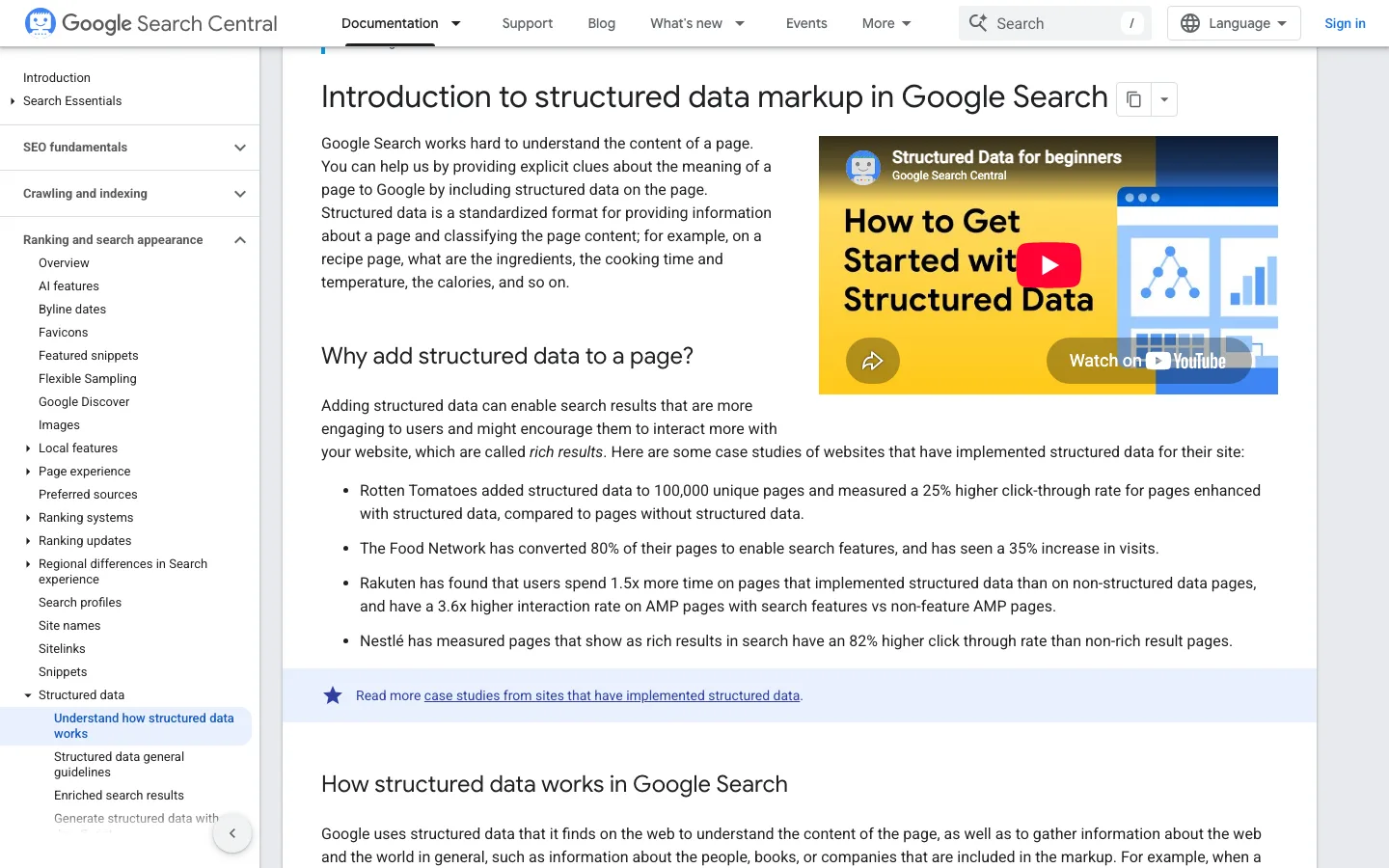
These two terms are often confused. Structured content describes how information is organized inside your content system, through components and fields. Structured data is markup added to the published page, usually schema markup written in JSON-LD, so that search engines can interpret the page. Google's introduction to structured data explains that Google uses this markup to understand a page's content, although markup does not guarantee a rich result. schema.org, the shared vocabulary behind most of this markup, describes its mission as creating, maintaining and promoting schemas for structured data.
The two layers work together. If your system already stores the author, the date and the question and answer pairs as fields, generating accurate Article or FAQPage markup becomes straightforward. Disorganized content turns correct markup into a manual task that is easy to get wrong.
Yes, for a clear reason. AI assistants extract a clean answer more easily from labeled fields and consistent headings than from buried prose. A short direct answer at the top of each section, a clear heading and a labeled place for each key fact all make extraction simpler, and they make the page easier to cite.
Sorank's case study of LV3D, a 3D printing training company, reports that its organic traffic was multiplied by 4 over five months. The study does not isolate the effect of structured content alone, so treat it as an example of results, not as proof of a single cause. If your team plans pages this way, the Sorank page for content teams shows how the tool fits into that work.
No, but it helps. A headless content management system stores content as structured data and delivers it through an API to any front end, such as a website, a mobile app or a chatbot. That separation is what makes real reuse possible. You can still apply the principles in a traditional CMS by defining reusable components, typed fields and a clear content model. The key is treating content as modular data, not as one long block of formatted text.
One caveat matters for AI visibility. AI systems read rendered pages, not your CMS. The structure must reach the published HTML through semantic headings, clean text and schema markup, so that AI crawlers can see it. A clean content model is necessary, but it is not sufficient on its own.
On the writing side, answer each question early, use clear headings and keep every section self-contained so it can stand alone as a chunk. For a deeper look at the search side, read Structured Data for AI Search: What Actually Helps.
Structured content shines in omnichannel delivery, where the same product description or article must appear consistently on a website, in an app, in an email and on social channels. It also powers personalization and localization, because swapping a field for a different audience or region is simple. It speeds up collaboration, since marketers and developers share one source of truth rather than passing documents back and forth.
The headline benefits are reusability, faster production, consistent brand voice and better discoverability for both search engines and AI. For teams that publish across many markets, these gains add up, turning content from a series of one-off pages into a reusable library that supports an LLM ready content approach.
Structured content requires upfront investment. Building a content model, training the team and migrating legacy assets takes time, and an over-engineered model can make simple edits feel bureaucratic. The right granularity is a balance: too coarse and you lose reuse, too fine and editors drown in fields.
It also demands governance. Tags and taxonomies drift without discipline, and inconsistent metadata weakens the machine readability that makes structured content valuable in the first place. The model is only as reliable as the consistency with which the team fills it, so editorial standards matter as much as the technical setup.
Each of these mistakes is easier to avoid when the model is designed around real pages and reviewed on a regular schedule.
For traditional SEO, structured content improves consistency, internal organization and the reliability of schema markup, all of which support ranking. For generative engine optimization, the stakes are higher, because an AI system must extract a clear and trustworthy answer before it cites a page. Labeled fields and a logical hierarchy make that extraction more dependable.
Structured content turns information into modular, labeled and reusable pieces that people and machines can navigate and trust. For SEO it improves consistency and schema reliability, and for GEO it gives AI assistants a clean base to extract and cite from. Teams that model their content carefully, place answers and key facts early, and carry that structure through to the rendered page will be the easiest to find and cite. To go further, connect this with knowledge graphs and with an AI content strategy.
AI assistants now send real visits to retail sites, and the growth is fast. Adobe data, reported by Digital Commerce 360 on January 13, 2026, shows that traffic from generative AI sources to US retail sites rose 769% year over year in November 2025 and 673% in December.
When a shopper asks an assistant whether a jacket is in stock, the assistant answers only from what it can read. If your price, stock, and variants sit in a script that runs after the page loads, the assistant may skip your product or guess.
More copy rarely fixes this. The fix is to put the facts buyers ask about into the HTML your server sends.
Start with the basics. Google's merchant listing guidance requires a product name, an image, and an offer, and the offer needs a price and a currency. Google also recommends putting Product structured data in the initial HTML, because markup generated by JavaScript can be crawled less often and less reliably. Then cover the questions buyers ask next.
| Buyer question | Fact to expose | Where it should live |
|---|---|---|
| How much does it cost? | Price and currency | Visible text and offer markup |
| Can I get it now? | Stock status | Visible text and availability in the markup |
| Which version is it? | Size, color, and material for each variant | A crawlable URL per variant, or a clear variant list in the HTML |
| What if it does not fit? | Return window and shipping cost | Visible text on the page |
Tip
Ask the buyer's question out loud, for example “is this in stock in size M?” If the answer is not in the HTML, no assistant can quote it.
For the on-page layout, see the elements of an ecommerce product page. To see how shoppers meet products inside AI answers, read AI shopping. If your product data only appears after scripts run, JavaScript SEO explains how rendering affects what crawlers index.
Sources
Structured content describes how you organize information inside your content management system, using labeled fields and modular components such as title, author, body and metadata. Structured data is markup, usually JSON-LD schema, added to the published page so search engines can interpret it. Well modeled structured content makes it far easier to generate accurate structured data automatically.
Yes, indirectly. Clearly labeled fields and consistent headings make it easier for AI assistants to extract a clean answer and cite your page. Structured data markup helps search engines interpret the same facts, but it does not replace clear writing.
No. A headless CMS makes structured content easier because it separates content from presentation and delivers it through an API to any channel. You can still apply the same principles in a traditional CMS by defining reusable components, typed fields and a clear content model.
 “I tested Sorank on a real client site and it's insane. It does everything an agency would bill you $1500 a month for. It's going into production on that client now.”

 Guillaume Guersanguersanguillaume.com“We are an Ads agency and we wanted to get our SEO back on track once and for all. Sorank gave us a clear view of our site, helped us prioritize optimizations, and properly structure our content. The tool is easy to use, well designed for a team, and very practical for centralizing tracking without having to juggle multiple platforms. A very solid foundation to start fresh with our SEO.”
 Gaspard MadouiAds Agency
 “I just let the Sorank software do its thing, and now my DR is 25 and my page is ranking higher.”
 Lucas Flandrefoundertrace.fr“I specialized in GEO thanks to Sorank. The GEO Leaderboard allows me to show my clients their position vs competitors on ChatGPT. It’s a real commercial differentiator.”
 MélanieSEO Freelance“Great service, works well for our website and helps us understand how to improve it to rank better on Google and elsewhere. Congrats, keep going, I recommend it.”
 Hugo T.E-commerce merchant



















