Preferences
Privacy is important to us, so you have the option of disabling certain types of storage that may not be necessary for the basic functioning of the website. Blocking categories may impact your experience on the website. More information

Privacy is important to us, so you have the option of disabling certain types of storage that may not be necessary for the basic functioning of the website. Blocking categories may impact your experience on the website. More information

Social media search engines in 2026: how TikTok, YouTube, Reddit, Instagram and Pinterest rank results, and which ones ChatGPT and Gemini cite.
Tools

In short
A social media search engine is a social platform people use to look things up, the way they use Google: TikTok, YouTube, Reddit, Instagram and Pinterest all have their own search bar, ranking signals and audience. Social search adds to Google more than it replaces it: in Adobe's January 2026 survey, 49% of US consumers had used TikTok as a search engine, yet only 4% of Gen Z rely on it more than Google. For visibility in AI answers, the platforms are far from equal: in Sorank's study of 301,025 AI answers, YouTube and Reddit are cited regularly, while TikTok and Pinterest almost never are.
Want to go further? Ask
Quick quiz
Which social network should you focus on?
Sorank matches your answers


Test it for 3 days on your own site and see where you stand on Google, ChatGPT and the other AIs.
Start 3-day free trial3 days free, then stop whenever you want. 90-day results-or-refund guarantee.
The phrase social media search engine covers two things. Most often it means a social network used as a search tool: someone types "best running shoes for flat feet" into TikTok or adds "reddit" to a Google query because they want real experiences, not brand pages. Less often it means a tool that searches across several social networks at once. This guide covers both, with most of the space on the first, because that is where brands win or lose discovery. It relies on Adobe Express's survey of 807 US consumers and 200 small business owners (published February 17, 2026), on the platforms' own documentation, and on Sorank's citation data.
A social media search engine is any platform where users type a query and get ranked results drawn from posts, videos or threads created by other users. The difference with Google lies in the index: Google ranks web pages from the whole web, while TikTok ranks only TikTok videos and Reddit ranks only Reddit discussions. The answer is a person showing or telling, which is why people use social search for tutorials, reviews, recipes, travel ideas and "is it worth it" questions.
For a brand, this means each platform is a separate search channel with its own keywords and its own competition. The discipline of being findable on all of them at once has a name: search everywhere optimization. It treats Google, social platforms and AI assistants as one discovery system rather than separate silos.
Five platforms carry most social search. The table sums up how each one is searched, what it rewards and how often AI assistants cite it, using the citation rates from Sorank's social media AI citation study (share of AI answers that cite the platform, August 2025 to August 2026).
| Platform | What people search for | Main ranking signals | Visible on Google | Cited in AI answers |
|---|---|---|---|---|
| YouTube | Tutorials, reviews, explanations | Title, description, video content, watch time, channel expertise | Yes, video results | 2.35% (highest of social platforms) |
| Honest opinions, comparisons, troubleshooting | Upvotes, comments, community relevance | Yes, prominently | 1.48% | |
| Places, products, visual inspiration | Captions, keywords in profile, engagement | Professional accounts' public posts | 0.42% | |
| TikTok | Quick how-tos, products, restaurants, trends | Captions, sounds, hashtags, user interactions | Partly | 0.09% |
| Ideas, recipes, home, fashion | Pin titles, descriptions, board relevance, visual match | Yes, images and pins | 0% in the panel |
YouTube is the most established social search engine and the most useful for long answers. Its own help page on how YouTube search works names three elements: relevance (how well the title, tags, description and video content match the query), engagement (for example how long people watch a video for a given query) and quality (signals of expertise, authoritativeness and trustworthiness on a topic). Our YouTube SEO and GEO guide details titles, chapters and descriptions.
TikTok search is driven by the same system as the For You feed. In its explanation of how it recommends videos, TikTok lists user interactions (likes, shares, comments), video information (captions, sounds and hashtags) and device and account settings such as language and country. The TikTok algorithm article goes deeper, and the TikTok SEO and GEO guide covers keywords on screen, in speech and in captions.
Reddit is a search engine people reach mostly through Google. Its threads rank for countless "best X" and "X vs Y" queries, and Google formalized the relationship on February 22, 2024, when it announced an expanded partnership with Reddit giving it structured, real-time access to Reddit content through the Data API. Our Reddit guide explains how to take part without being banned.
Instagram search works on keywords in names, bios and captions, and public posts from professional accounts can also appear in Google results; the Instagram SEO guide covers both. Pinterest behaves like a visual search engine for planning: people search months ahead for weddings, renovations or seasonal recipes, and pins keep bringing traffic long after publication. The Pinterest guide details titles, boards and rich pins.
Tip
Say your main keyword out loud in the first seconds of a video and write it in the caption. TikTok and YouTube both read the words in a video, and a spoken keyword helps the video match the query people type.
No. The data shows people adding platforms, not switching. In Adobe's 2026 survey (consumer data collected in January 2026):
Two limits apply: the survey is run by Adobe, which sells content creation tools, and its sample skews toward millennials (53% of consumers, against 15% Gen Z). The direction is still clear. Each query lands where the best format lives: a recipe on TikTok, a repair on YouTube, an opinion on Reddit, a fact on Google, a summary in ChatGPT.
This is where social search meets GEO (generative engine optimization). ChatGPT, Gemini, Perplexity, Claude and Grok cite sources in their answers, and some of those sources are social platforms. Sorank measured it across 301,025 AI answers collected between August 2025 and August 2026 (79% of the questions in French, the rest in English):
The split by model matters more than the average. The YouTube AI citation study shows YouTube cited in 3.69% of Gemini answers and 3.46% of Perplexity answers, but in 0.04% of ChatGPT answers and never by Claude. Reddit peaks on Grok (4.11%) and Gemini (2.5%). A brand that invests in YouTube is working mostly for Gemini and Perplexity; a brand that wants ChatGPT citations needs strong pages on its own site and on review platforms.
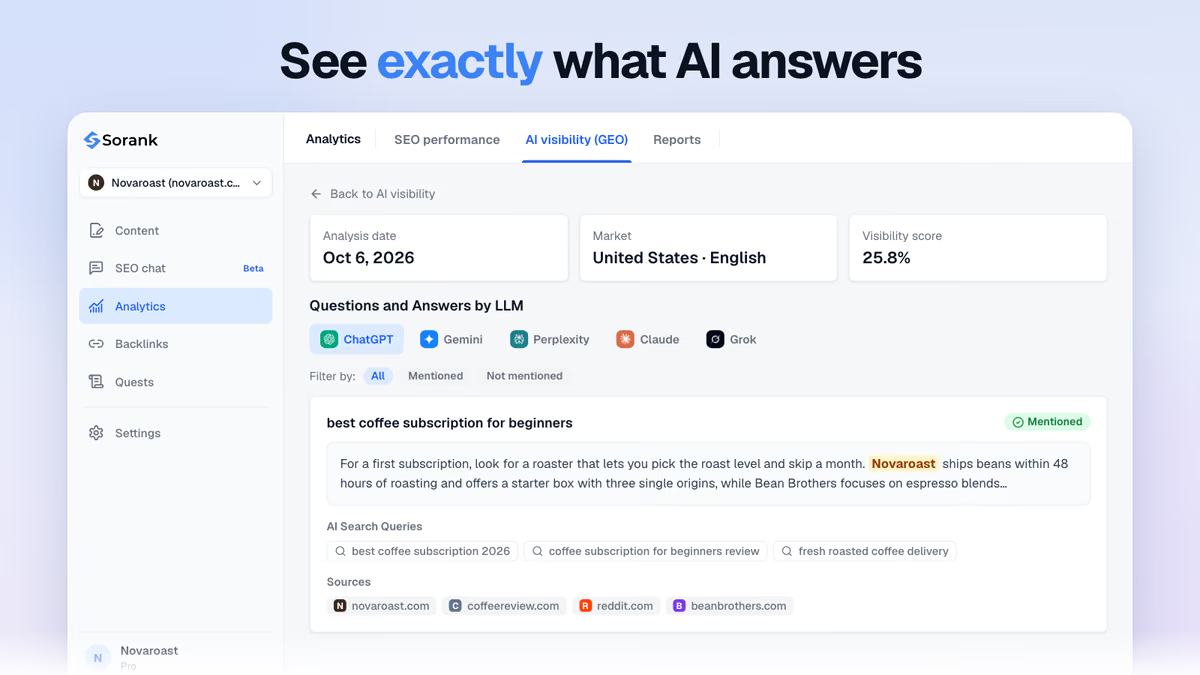
Why YouTube and not TikTok? AI assistants work from text. A YouTube video comes with a title, a description, chapters and a transcript that can be read and quoted; that is the logic behind YouTube transcript citations. A short TikTok clip carries little text an AI can quote, and much of its content stays inside the app.
Note
A citation rate of 2% means the platform is cited in 2 answers out of 100. The figures cover a fixed panel of questions across many sectors: in entertainment, media or education, YouTube weighs more than its average.
The same habits serve the platform's search bar, Google and AI assistants. Seven steps, in order of return:
Type your topic into the search bar of TikTok, YouTube and Reddit and note the suggested searches. They show the wording real users use, which often differs from Google keywords. Keep one list per platform.
Write the main query in the title or caption, say it in the first seconds and show it on screen. On YouTube, fill the description with two or three sentences that answer the question, and add chapters.
Open each video or post with the answer, then the detail. People leave fast, and an answer stated in the first sentence is also the easiest one for an AI to quote.
Check the automatic captions on YouTube and correct brand and product names. A transcript with the right names is what turns a video into a source an AI can cite.
Answer the questions where your expertise helps, disclose your affiliation and follow each subreddit's rules. Promotional posts get removed and downvoted, and they do not earn citations.
Social posts bring attention, but your own pages carry the full answer, the structured data and the links. A YouTube video that points to a detailed article on your site serves both channels. A tool such as Sorank's AI article generator keeps those pages coming, with sources and internal links, on the same keywords you cover in video.
Track a list of prompts and check which sources the answers cite: your site, your YouTube channel, a Reddit thread or a competitor. Sorank's AI mention tracking does this on ChatGPT, Claude and Gemini, plus Perplexity and Grok from the Pro plan.
Watch out
Do not judge a platform by its in-app search volume alone. TikTok is a strong search channel for young audiences, yet it is almost never cited by AI assistants. If AI visibility is a goal, put the same effort into YouTube and into your own site.
The second meaning of the phrase covers tools that search several social networks at once, mostly for brand monitoring, recruiting or journalism. Three approaches exist:
None of these shows how AI assistants talk about you: that requires asking the AI questions and reading the sources they cite, which is what AI visibility tracking does.
Social media search engines are real search channels with their own keywords and ranking rules, and they sit next to Google rather than in its place. For AI visibility, YouTube and Reddit matter most, TikTok and Pinterest barely count, and each AI assistant has its own preferences. Build content that answers clearly on the platforms your audience uses, connect it to strong pages on your site, and measure which sources the AI assistants cite. Sorank automates the site part, from keywords to published articles, and tracks your brand in AI answers: see the plans, with a 3-day free trial.

TikTok works as a search engine for many users: in Adobe's January 2026 survey, 49% of US consumers had used it to look something up. Its search ranks videos using captions, sounds, hashtags and user interactions. It complements Google rather than replacing it, since only 4% of Gen Z said they rely on TikTok more than Google.
People turn to social platforms for formats Google rarely offers: short video tutorials, honest reviews from real users and personal experiences. Adobe's survey found that people prefer video tutorials, product reviews and personal stories in TikTok results. For facts, comparisons of many sources and local information, most people still use Google.
It depends on the platform. In Sorank's study of 301,025 AI answers, YouTube was cited in 2.35% of answers and Reddit in 1.48%, while TikTok and Pinterest were almost never cited. Videos with clear titles, descriptions and transcripts, and genuine Reddit answers, are the social content most likely to be quoted by AI assistants.
We analyse your competitors, your website and your AI visibility to create a tailored content plan for free.
 AI Content Brief Generator
 FAQ Schema Generator
 AI Blog Post Ideas Generator
 Structured Data Validator (Schema Validator)
 Alt Text Checker
 Internal Link Analyzer
 Backlink Challenge
 AI Meta Description Generator
 AI Blog Title Generator
 Google Indexability Checker
 AI Blog Outline Generator
 UTM Link Builder
 Keyword Clustering Tool
 Canonical Tag Checker
 XML Sitemap Generator
 Broken Link Checker
 AI SEO Title Generator
 Headline Analyzer
 SERP Preview Tool
 Redirect Checker
 Hreflang Tag Generator
 Heading Structure Analyzer
 HTTP Headers Checker
 Favicon Extractor
 SERP CTR Calculator
 SEO vs Paid Search Savings Calculator
 SEO Share of Voice Calculator
 SEO ROI Calculator
 SEO Traffic and Revenue Forecast Calculator
 SEO Budget Calculator
 SEO Break-Even Calculator
 SaaS SEO ROI Calculator
 ROAS Calculator
 Reading Time Calculator
 Ranking Gain Simulator
 Organic Traffic Value Calculator
 Organic Traffic Estimator and Website Traffic Checker
 LTV to CAC Ratio Calculator
 Local SEO ROI Calculator
 Link Building Cost Calculator
 Keyword Value Calculator
 Keyword Opportunity Score Calculator
 Keyword Density Calculator
 GEO ROI Calculator
 GEO Content Investment Calculator
 Ecommerce SEO ROI Calculator
 Customer Lifetime Value Calculator
 Customer Acquisition Cost Calculator
 CTR Calculator
 Cost Per Article Calculator
 Conversion Rate Calculator
 Content Marketing ROI Calculator
 ChatGPT Referral Traffic Estimator
 Bounce Rate Calculator
 Backlink ROI Calculator
 AI Visibility Score Calculator
 AI Traffic Value Calculator
 AI Share of Voice Calculator
 Cost of AI Invisibility Calculator
 AI Citation Rate Calculator
 llms.txt Validator
 AI Overview Checker and AI Overviews Rank Checker
 Robots.txt Checker
 AI SEO Audit
 LLM Readability Checker
 SearchGPT Readiness Checker
 Structured Data LLM Audit
 Website Crawlability AI Audit
 Why ChatGPT Is Not Recommending My Website
 Gemini Ranking Tool
 Perplexity Ranking Checker
 LLM Citation Checker
 Answer Engine Optimization Audit
 GEO Audit
 AI Search Visibility Test
 ChatGPT Visibility Checker
 llms.txt Generator
 URL Extractor
 Webpage to Markdown
 Sitemap Checker
 SERP Volatility Sensor
 Page Size Checker
 Word Counter
 Slug Generator
 Schema Generator
 Robots Generator
 OG Preview
 Meta Tags Generator
 Image Compressor
 Favicon Generator
 On-Page SEO Audit: SEO Checker and SEO Analyzer
 Backlink Analysis Tool
 Keyword Research Tool
 Domain Authority Checker
THEY TRIED SORANK BEFORE YOU
 “I tested Sorank on a real client site and it's insane. It does everything an agency would bill you $1500 a month for. It's going into production on that client now.”

 Guillaume Guersanguersanguillaume.com“We are an Ads agency and we wanted to get our SEO back on track once and for all. Sorank gave us a clear view of our site, helped us prioritize optimizations, and properly structure our content. The tool is easy to use, well designed for a team, and very practical for centralizing tracking without having to juggle multiple platforms. A very solid foundation to start fresh with our SEO.”
 Gaspard MadouiAds Agency
 “I just let the Sorank software do its thing, and now my DR is 25 and my page is ranking higher.”
 Lucas Flandrefoundertrace.fr“I specialized in GEO thanks to Sorank. The GEO Leaderboard allows me to show my clients their position vs competitors on ChatGPT. It’s a real commercial differentiator.”
 MélanieSEO Freelance“Great service, works well for our website and helps us understand how to improve it to rank better on Google and elsewhere. Congrats, keep going, I recommend it.”
 Hugo T.E-commerce merchant