Discover the top 10 automated content generation AI tools for 2025. Compare features, pricing, and use cases to scale your content strategy.


Thibault Besson Magdelain
Expert SEO GEO
Summary: Automated content generation tools use AI to produce text, images, and video at scale; the market is projected to reach $80 billion by 2030.
The generative AI content creation market was valued at $14.8 billion in 2024 and is growing at a staggering 32.5% CAGR, according to Grand View Research. For B2B marketing teams under constant pressure to publish more, faster, and better, automated content generation is no longer a nice to have. It is the infrastructure of modern content operations.
According to HubSpot's 2025 AI Trends report, 55% of marketers already use AI for text-based content creation, making it the single most common use case in the field. Meanwhile, McKinsey's state of AI research shows that marketing and sales remains one of the top business functions where companies deploy generative AI. The question is no longer whether to adopt these tools, but which ones will deliver measurable results without sacrificing quality or brand consistency.
AI-powered content generation refers to the use of algorithms, large language models, and natural language processing to produce written, visual, or multimedia content with minimal human intervention. These technologies generate, curate, or enhance various forms of content, including text, images, videos, and audio.
Why does this matter in 2025? The growing emphasis on automation and efficiency in content creation is a key driver behind market expansion, as businesses strive to produce high-quality content at scale across various platforms. Traditional manual processes simply cannot keep pace with the volume that modern search engines, AI answer engines, and social platforms demand.
The benefits are tangible. McKinsey estimates that the marketing function could see productivity increases valued between 5% and 15% of total marketing spending globally. For a mid-size company spending €500,000 annually on marketing, that translates to €25,000 to €75,000 in recovered value. Tools that handle content automation free teams to focus on strategy, brand building, and creative direction.

Most AI writing tools rely on a combination of natural language generation (NLG) and natural language processing (NLP). NLP techniques such as language modelling, sentiment analysis, and text summarization empower AI systems to understand, interpret, and generate written content with greater accuracy and fluency.
In practical terms, a marketer provides an input (a keyword, a brief, or an outline) and the AI produces a draft. More advanced tools go further: they optimize for SEO, insert internal links, source references, and adapt tone to match brand guidelines. The most capable platforms integrate keyword research, topic clustering, and publishing into a single workflow, eliminating the need for five or six separate subscriptions.
This is precisely the approach we built into our blog article generator, which produces fully sourced, internally linked articles from a single keyword input, rather than requiring you to stitch outputs from multiple disconnected tools.
Below is our curated ranking of the ten most relevant AI content creation tools available today. Each tool is evaluated on its content output quality, SEO integration, ease of use, and overall value for B2B marketers.
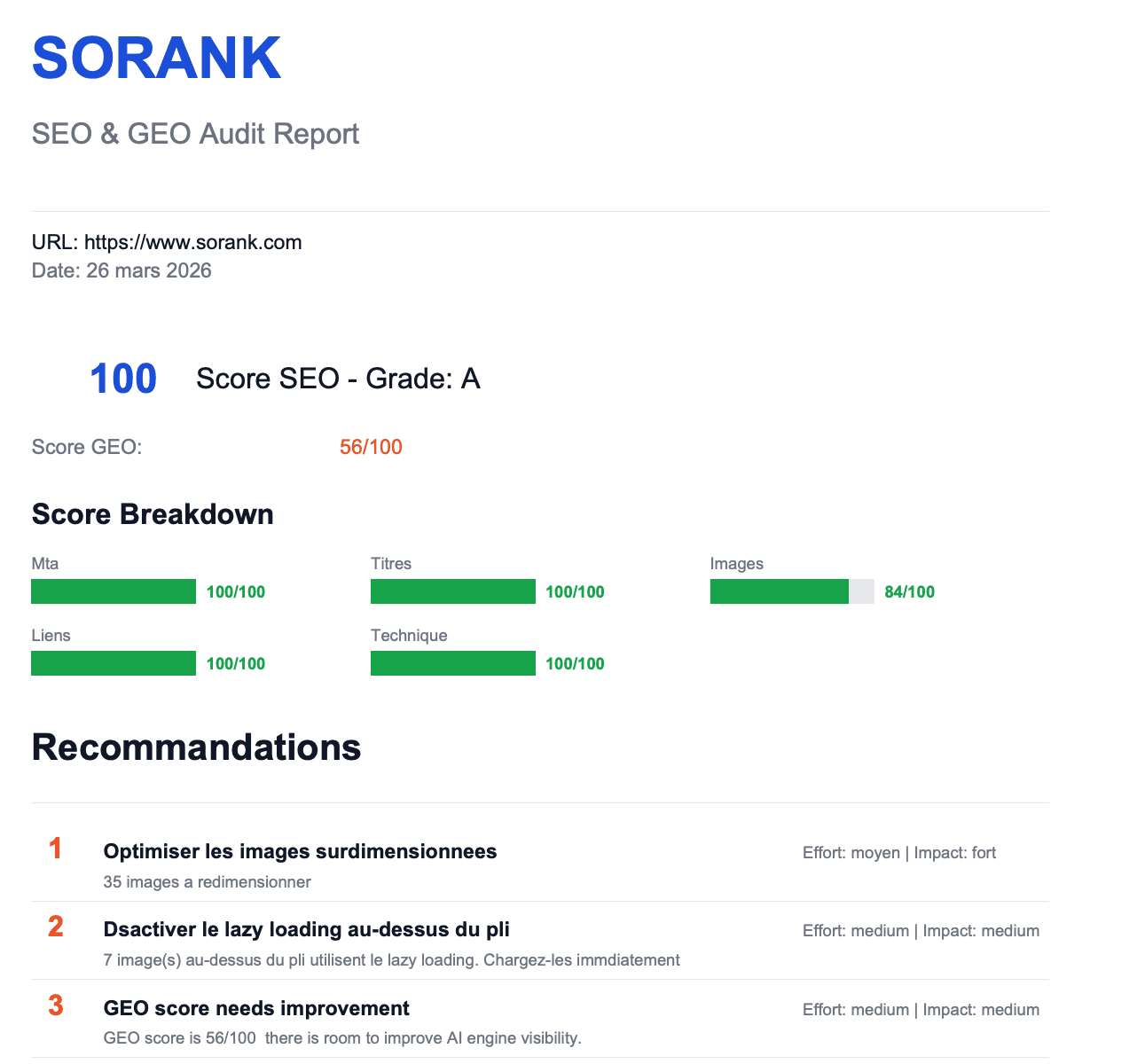
An all-in-one, AI-first platform purpose-built for GEO and SEO. It combines audit, keyword research, blog generation, backlink acquisition, and AI mention tracking in a single €99/website package. Unlike point solutions that handle only one step of the content pipeline, our approach covers the entire workflow on autopilot: from scanning and patching technical errors to generating optimized articles with internal links and images, then acquiring backlinks through a built-in exchange network. For teams that want to be cited by AI engines like ChatGPT, Perplexity, and Gemini, this is the most integrated option available.
Jasper is known for its extensive template library covering blog posts, ad copy, and social media captions. It offers collaborative features and tone-of-voice controls. However, it does not include SEO auditing, backlink tools, or AI visibility optimization, so users typically need to pair it with additional platforms.

Copy.ai focuses on short-form marketing copy, including ad text, product descriptions, and email subject lines. Its workflow automation features provide quick turnaround on sales collateral. It lacks built-in SEO or content distribution capabilities.
As a general-purpose large language model, ChatGPT AI model is used by marketers for brainstorming, drafting, and research. The most common task that marketers use generative AI for is text-based content creation (52%), such as blogs, eBooks, and marketing email copy. ChatGPT is versatile but requires significant manual effort to optimize content for search and lacks any publishing or backlink features.
Writesonic offers multilingual text generation built on GPT-4, along with AI image generation. It provides a reasonable starting point for quick drafts, though teams report needing to edit heavily for brand alignment and factual accuracy.
Grammarly focuses on editing and proofreading rather than full content generation. Its AI suggestions cover spelling, grammar, tone, and readability. It integrates with WordPress, Google Docs, and MS Word, making it a useful complement to, rather than a replacement for, a content generation platform.
Surfer SEO provides content scoring and on-page optimization based on SERP analysis. It helps writers structure articles to match competitor benchmarks. It does not generate complete articles on its own and requires a separate writing tool or human writer.
Copymatic offers API access and multiple content templates for automated generation. While it provides a user-friendly interface and multilingual support, users note that output quality can be inconsistent, often requiring substantial revision before publication.
Frase combines content brief generation with AI writing assistance. It analyzes top SERP results to create detailed outlines, then offers an AI writer to fill them in. Useful for research-heavy workflows, it nonetheless lacks broader SEO stack features like auditing or backlinks.
Scoop.it takes a different approach, focusing on content curation and distribution rather than generation. It helps teams discover trending topics, organize them into topic pages, and share via newsletters and social channels. It does not produce original articles.
Tool | Full Article Generation | SEO Audit | Backlink Acquisition | AI Visibility Optimization | Starting Price |
|---|---|---|---|---|---|
Sorank | Yes | Yes | Yes (auto-exchange) | Yes (GEO/SEO) | €99/website |
Jasper | Yes | No | No | No | $49/mo |
Copy.ai | Partial (short-form) | No | No | No | Free tier available |
ChatGPT | Yes (manual) | No | No | No | Free / $20/mo |
Writesonic | Yes | No | No | No | $16/mo |
Grammarly | No (editing only) | No | No | No | Free tier available |
Surfer SEO | No (optimization only) | Partial | No | No | $89/mo |
Copymatic | Yes | No | No | No | $29/mo |
Frase | Yes | No | No | No | $15/mo |
Scoop.it | No (curation only) | No | No | No | Free tier available |
Most content generation tools optimize for one thing: traditional search rankings. But in 2025, a growing share of product research and decision-making happens inside AI answer engines. The overall generative AI adoption rate rose 10 percentage points in a single year to 54.6% of U.S. adults aged 18 to 64, according to the Federal Reserve Bank of St. Louis. When half the adult population is consulting AI assistants, your content strategy must account for generative engine optimization (GEO), not just SEO.
This is the gap most standalone writing tools fail to address. They produce text, but they do not ensure that text gets cited by ChatGPT, Perplexity, or Gemini when users ask questions in your niche. Being visible to AI requires structured content, authoritative sourcing, entity optimization, and domain authority signals like backlinks. To build a holistic strategy, you can start with our GEO SEO audit, which identifies exactly where your site falls short in AI visibility.

Adopting a tool is only half the equation. How you integrate it into your workflow determines results. In McKinsey's 2024 Global Survey on AI, 65% of respondents reported that their organizations are regularly using gen AI, nearly double the percentage from their previous survey just ten months earlier. Yet McKinsey's state of AI report paints a picture of steadily growing generative AI adoption with modest financial gains, but four in five companies are not seeing tangible bottom-line impact on their business as a whole. The difference between leaders and laggards comes down to implementation discipline.
Start with a content strategy, not a tool. Define your target topics, audience segments, and publishing cadence before generating a single article. Tools like our topical cluster generator can help you map out pillar pages and supporting content in a structured way.
Always review and edit AI output. Even the most advanced models require human oversight for factual accuracy, brand voice, and nuance. Only 4% of marketers use AI to write entire pieces of content for them. The majority use it for drafts, outlines, and inspiration.
Integrate SEO from day one. Generating well-written content that no one finds is a waste of resources. Pair your content generation with our keyword research tool to target high-volume, low-competition terms.
Measure and iterate. Track which AI-generated pieces drive organic traffic, backlinks, and conversions. Use performance data to refine your prompts, topics, and content templates over time.
Plan for AI engine visibility. Optimize content not only for Google but also for AI assistants. This means adding structured data, citing authoritative sources, and building domain authority through consistent backlink acquisition.
No technology is without trade-offs. AI algorithms require access to vast amounts of data, including personal information and behavioural patterns, to generate targeted content. The collection and processing of such data raise privacy concerns regarding unauthorized access, misuse, and potential breaches.
There is also the risk of content homogeneity. When thousands of marketers use the same models with similar prompts, the output converges toward bland, undifferentiated text. According to HubSpot's 2026 State of Marketing report, more content is now generated by AI than by humans, but it is mostly average, and consumers are seeking human-created content. The antidote is to treat AI as a first-draft accelerator, not a final-draft publisher.
Algorithmic bias is another concern. Automated systems may inadvertently perpetuate stereotypes or discriminate against certain demographics based on flawed or incomplete data sets. Responsible use requires regular audits of AI output and clear editorial guidelines.
Automated content generation has moved from experimental to essential. The market is projected to reach $80.12 billion by 2030, and 66% of marketing and sales teams using gen AI already report revenue increases, according to McKinsey's state of AI research. But the tools that win are those that go beyond text generation to cover the full content lifecycle: from keyword discovery and article creation to technical optimization, backlink growth, and AI engine visibility.
For B2B teams looking to consolidate their stack and move faster without sacrificing quality, our AI-first approach combines every step of that lifecycle into a single, automated platform priced to replace multiple subscriptions.
Ready to see how it works? Try our AI-powered blog article generator and turn your next keyword into a fully optimized, ready-to-publish article in minutes.
Yes. Google has stated that it rewards helpful, high-quality content regardless of how it was produced. The key is ensuring that AI output is reviewed for accuracy, optimized for search intent, and enriched with original insights. Our blog article generator is designed to produce articles that meet these criteria out of the box.
Absolutely. B2B buyers conduct extensive online research before engaging with sales. Automated tools allow marketing teams to cover more topics, target long-tail keywords, and maintain a consistent publishing cadence, all of which are critical for building organic pipeline.
Evaluate tools based on three factors: output quality (does it produce content that needs minimal editing?), workflow integration (does it connect with your CMS and SEO stack?), and scope (does it handle only writing, or does it cover auditing, keyword research, and distribution too?). Tools that consolidate multiple functions into one platform tend to deliver better ROI and lower operational friction.