
Preferences
Privacy is important to us, so you have the option of disabling certain types of storage that may not be necessary for the basic functioning of the website. Blocking categories may impact your experience on the website. More information
Privacy is important to us, so you have the option of disabling certain types of storage that may not be necessary for the basic functioning of the website. Blocking categories may impact your experience on the website. More information

IndexNow is a free protocol that tells search engines right away when a page changes. How it works, how to set up the key file and where its limits are.








Founder Sorank, 7+ years in SEO.
Summary
IndexNow is a free, open-source protocol that lets a website tell participating search engines right away when a page is added, updated or deleted. Instead of waiting for a crawler to find the change, the site sends an HTTP request with the changed URL and its key, which the engine checks against a key file hosted on the site.
Want to go further? Ask
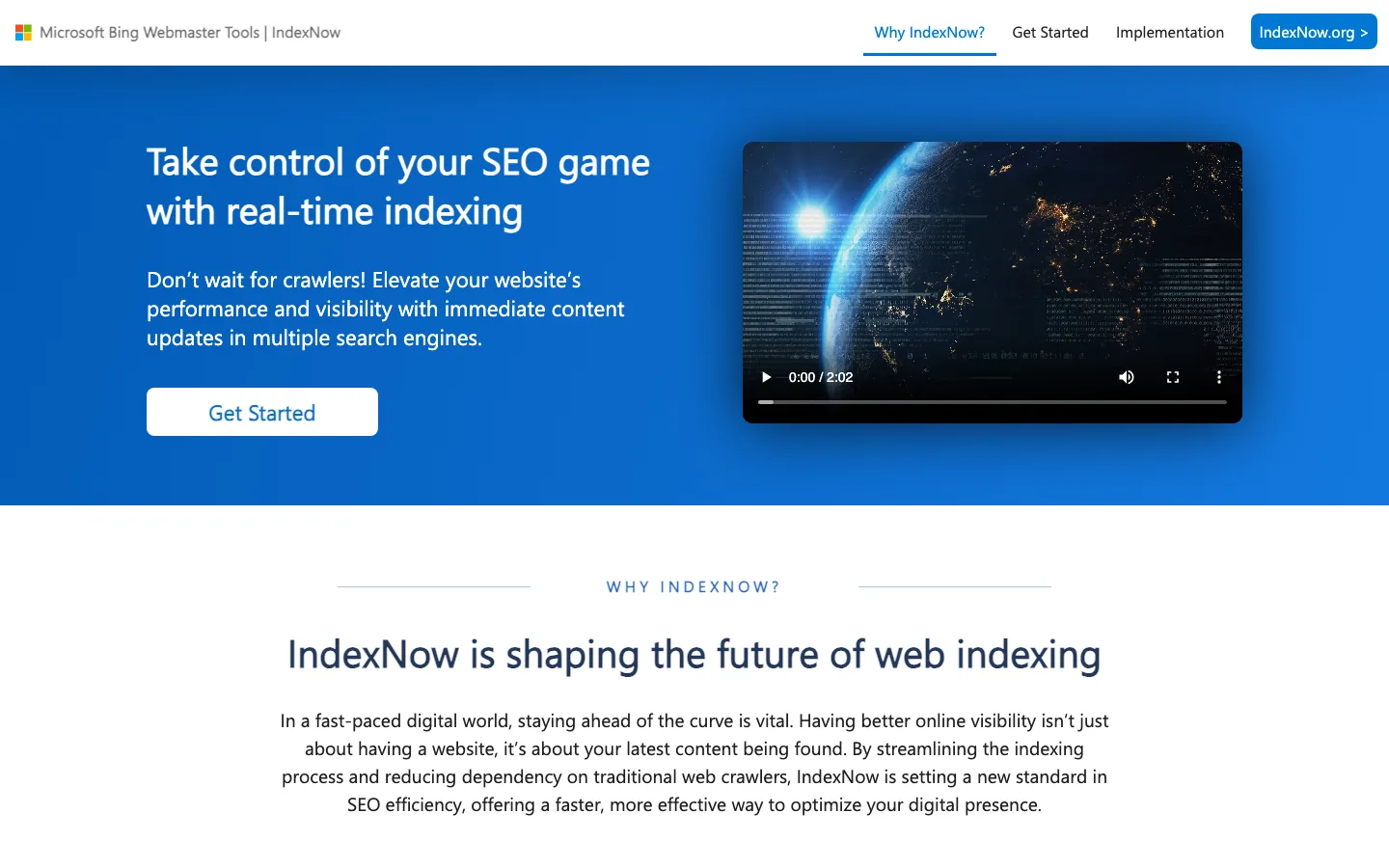
IndexNow is a push protocol between a website and search engines. Most engines find changes by crawling: they revisit a page on their own schedule, which can take days or weeks for a new or updated page. IndexNow reverses that order, because the site announces the change as it happens. Bing's IndexNow page describes it as a free, open-source protocol that notifies multiple search engines of content changes as soon as they happen.
Traditional discovery is pull-based. A search engine decides when to crawl your site, so a new or changed page can stay hidden for a long time. With IndexNow, your site starts the contact and names the URL that changed. Bing's page says the protocol covers adding, updating and deleting content, so removed pages can be reported too.
The mechanism is a plain HTTP request. You send the changed URL and your key to the endpoint of the search engine you want to reach. The IndexNow documentation shows one URL passed as a parameter, and a POST request with a JSON list for several URLs. A successful call returns HTTP status 200, which only confirms that the engine received the URL, not that the page is indexed.
Each list can hold up to 10000 URLs, and it may mix http and https addresses. The key must be between 8 and 128 characters long and may contain only letters, numbers and dashes.
Setup takes four steps. The key file is what proves ownership, so do not skip it. The full guide to submitting a website covers the other routes next to it.
Search engines fetch the key file to verify that you control the host, then reuse the key until you change it. Keep the key stable, change it only when you need to, and make sure the file stays reachable at the address your notifications name. If the file returns an error, the engine cannot verify the key, so check it after each deployment.
Many content systems and cloud delivery networks already offer built-in support, so a plugin or a simple API call may be enough. Check the setup with a test URL before you rely on it.
Bing's page presents IndexNow as a way to notify several search engines with one change, and each engine exposes its own endpoint, so read its documentation before relying on it. Google is the notable case. Its documented submission route, the Google Indexing API quickstart, says the API can only be used for pages with JobPosting or BroadcastEvent markup. For other pages, Google still finds changes through normal crawling, so IndexNow should not be counted as a shortcut to Google.
The main benefit is speed on the engines that accept the protocol. It matters most for fast-changing content, where an old copy in the index can mislead readers. This ties into content freshness, since a quick notification helps the engine's copy match the live page.
Bing's page also says the protocol reduces the need for costly exploratory crawls, which lowers server load and energy use. Those are Bing's claims, not measured results on your site, so check your own server logs before counting on them.
For SEO, IndexNow helps the engines that accept it learn about new, changed and removed pages sooner. That is useful for time-sensitive articles and for large sites that change often, because the engine's view stays closer to the live version. Sorank's free Google Indexability Checker tests whether a page can be indexed at all, which is worth doing before you send any notification.
For GEO, the benefit is indirect. The IndexNow documentation says nothing about AI answers, so a fresher index on the engines that accept the protocol only means your updates are seen sooner. Measure the effect on your own pages instead of assuming it.
IndexNow is a free, open-source protocol that lets a site tell participating search engines about added, updated or deleted pages right away. It speeds discovery and can cut wasted crawling on the engines that support it, but it does not raise rankings, and Google's documented route is limited. Set up the key file correctly, notify only real changes, and keep a clean indexing foundation for everything else.
Sources
Google's documented submission route, the Indexing API, only accepts pages with JobPosting or BroadcastEvent markup. For other pages, Google still finds changes by crawling, so IndexNow is not a general shortcut to Google.
No, not directly. IndexNow speeds up notification but does not judge quality or relevance. A weak page does not rank better because it was submitted, although a faster update can help time-sensitive content appear sooner.
Generate a key of 8 to 128 characters, host it as a text file at your site's root, then send a request with each added, changed or deleted URL. Many content systems and CDNs offer built-in support, which makes setup largely automatic.
 “I tested Sorank on a real client site and it's insane. It does everything an agency would bill you $1500 a month for. It's going into production on that client now.”

 Guillaume Guersanguersanguillaume.com“We are an Ads agency and we wanted to get our SEO back on track once and for all. Sorank gave us a clear view of our site, helped us prioritize optimizations, and properly structure our content. The tool is easy to use, well designed for a team, and very practical for centralizing tracking without having to juggle multiple platforms. A very solid foundation to start fresh with our SEO.”
 Gaspard MadouiAds Agency
 “I just let the Sorank software do its thing, and now my DR is 25 and my page is ranking higher.”
 Lucas Flandrefoundertrace.fr“I specialized in GEO thanks to Sorank. The GEO Leaderboard allows me to show my clients their position vs competitors on ChatGPT. It’s a real commercial differentiator.”
 MélanieSEO Freelance“Great service, works well for our website and helps us understand how to improve it to rank better on Google and elsewhere. Congrats, keep going, I recommend it.”
 Hugo T.E-commerce merchant



















