
Preferences
Privacy is important to us, so you have the option of disabling certain types of storage that may not be necessary for the basic functioning of the website. Blocking categories may impact your experience on the website. More information
Privacy is important to us, so you have the option of disabling certain types of storage that may not be necessary for the basic functioning of the website. Blocking categories may impact your experience on the website. More information

Paid traffic is the visitors you buy through search, social and display ads. Learn how it works, what it costs and when it beats organic traffic.







Founder Sorank, 7+ years in SEO.
Summary
Paid traffic is website visitors who arrive through paid advertising, such as search ads on Google or Microsoft Advertising, paid social ads, or display banners. You pay the platform, usually per click, to put your content in front of a chosen audience. It works fast and can be measured, but it stops as soon as the spending stops.
Want to go further? Ask
Paid traffic is the audience you buy rather than earn. When someone clicks a sponsored result at the top of a search page, an ad in a social feed, or a banner on a news site, that visit is paid traffic. The defining feature is simple: the platform charges you to show your content, and the visits stop when the budget stops. This sets it apart from organic traffic, the visits that search engines send for free once your pages rank.
Paid traffic is any visit bought through online advertising. The most common model on search is pay-per-click, where you pay each time someone clicks your ad. The mechanics of that model are explained in our PPC glossary entry. Other models charge per thousand impressions or per action, but the principle is the same: visibility in exchange for spend.
Paid traffic spans several channels, and each one reaches people at a different moment. Paid search places your ad on the results page for chosen keywords, mainly through Google Ads and Microsoft Advertising. Microsoft Advertising says its search ads reach users who are actively searching on Bing, Yahoo, DuckDuckGo and other search engines in its network. Paid social places ads in feeds on platforms such as Facebook, Instagram and LinkedIn, and targets people by interest and demographics rather than by query. Display advertising shows banners and native ads on partner websites, which suits awareness and retargeting.
Google labels paid results with an "Ads" marker and shows them in separate positions, usually along the top, side or bottom of the page. In the layout Google publishes, ads are marked 1 and search results are marked 2. Google's help page on how search results differ from ads also states that its search results are independent of its advertising programs.
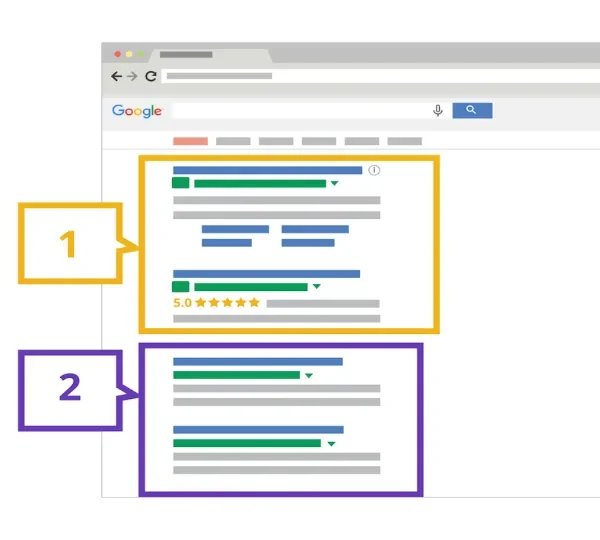
Ads are not sold at a flat price per position. Google explains in its Ad Rank documentation that the ranking is calculated in each auction from factors such as competition, the context of the search and the quality of your ad at that moment. Your bid is one input, so ad quality counts alongside what you pay.
The clearest contrast is durability. Paid traffic starts as soon as a campaign goes live, and you can read its results from the first days. Organic traffic is slower to build, but once a page ranks it keeps arriving without a cost per click. The table below sets out the main differences.
| Question | Paid traffic | Organic traffic |
|---|---|---|
| How fast does it start? | As soon as the campaign is live | Slower, because pages must earn rankings |
| What happens when you stop? | The visits stop | Pages can keep ranking and sending visits |
| What does each visit cost? | The price of each click or action | No cost per click, but content and SEO work |
Organic growth can be large. LV3D, a French 3D printing specialist, multiplied its organic traffic by 4 in 5 months, reaching 102500 clicks and 4.36M impressions on Google over the period. Sorank produced that content on autopilot, with articles that answer each buying question. You can read the full figures in how LV3D quadrupled its organic traffic in 5 months.
Paid traffic costs are set by the auction. In search, you pay a cost per click, which depends on how many advertisers compete for the same keywords and how much they bid. Because every visit is bought, the cost of acquiring each customer must be watched closely, and a campaign that converts poorly can lose money quickly. The discipline that keeps paid profitable is steady work on targeting, ad copy and landing pages, which is the core of conversion rate optimization.
Paid traffic makes sense when you need results on a schedule. A product launch, a time-limited promotion, an entry into a new market or a test of demand for an offer are all cases where waiting months for rankings is not an option. It is also useful for retargeting visitors who came to your site and did not buy. To check whether the spend pays off, compare what a click costs with what the same clicks would cost through rankings, using our free SEO vs paid search savings calculator. For a deeper view of the search side, read paid search: what it is, how it works and what it costs.
For SEO, paid traffic is a fast way to test keywords and messages. The clicks show which queries convert before you invest in articles for them, and that data guides what you write for organic search. For GEO, paid traffic is a channel you control: your reach follows your budget, not the way AI assistants summarize results. Paid visits leave no lasting asset, though, so the two channels work best together.
Paid traffic is the visibility you buy through advertising. It is fast, controllable and measurable, but it lasts only as long as the budget does. Use it for launches, promotions and retargeting, and let organic traffic build the lower-cost base that keeps working between campaigns.
Sources
Paid traffic is the visits you buy through advertising, such as search ads on Google Ads or Microsoft Advertising, paid social ads and display banners. You pay the platform, usually per click, and the visits stop when the budget stops.
Paid traffic starts as soon as a campaign is live but stops when you stop paying. Organic traffic takes longer to build, then keeps arriving without a cost per click. Google states that its search results are independent of its advertising programs.
Use paid traffic for launches, time-limited promotions, new markets and retargeting, when you need visits on a schedule. Organic traffic is the better base for long-term, lower-cost demand, so combining both usually works best.
 “I tested Sorank on a real client site and it's insane. It does everything an agency would bill you $1500 a month for. It's going into production on that client now.”

 Guillaume Guersanguersanguillaume.com“We are an Ads agency and we wanted to get our SEO back on track once and for all. Sorank gave us a clear view of our site, helped us prioritize optimizations, and properly structure our content. The tool is easy to use, well designed for a team, and very practical for centralizing tracking without having to juggle multiple platforms. A very solid foundation to start fresh with our SEO.”
 Gaspard MadouiAds Agency
 “I just let the Sorank software do its thing, and now my DR is 25 and my page is ranking higher.”
 Lucas Flandrefoundertrace.fr“I specialized in GEO thanks to Sorank. The GEO Leaderboard allows me to show my clients their position vs competitors on ChatGPT. It’s a real commercial differentiator.”
 MélanieSEO Freelance“Great service, works well for our website and helps us understand how to improve it to rank better on Google and elsewhere. Congrats, keep going, I recommend it.”
 Hugo T.E-commerce merchant



















