Preferences
Privacy is important to us, so you have the option of disabling certain types of storage that may not be necessary for the basic functioning of the website. Blocking categories may impact your experience on the website. More information
Privacy is important to us, so you have the option of disabling certain types of storage that may not be necessary for the basic functioning of the website. Blocking categories may impact your experience on the website. More information

With SEO software for coaches, everything starts with the sentence someone types before they know they want a coach: "how to change careers at 40", "how to stop micromanaging my team", "mentor or executive coach". Sorank finds those questions for your niche, publishes the answers on your site with links to your discovery call page, and checks every month which coaches ChatGPT, Claude and Gemini name.
Sessions, offers and client relationships stay yours. Plans start at $49 a month per website, and you can tell the software never to mention an income figure or a guaranteed transformation.















































30,206
Articles created
11,890,367
Visits from Google
21,318
Visits from AI
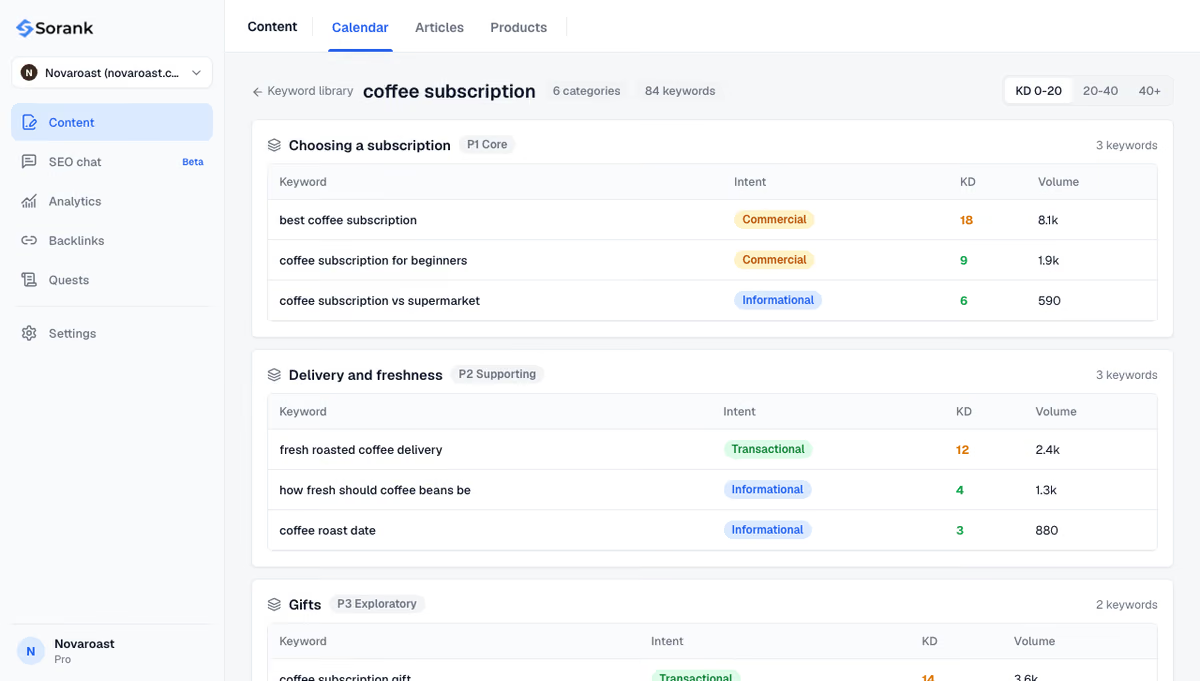
They search for the problem: "how to prepare for a promotion conversation", "feeling stuck in my career at 35", "how to delegate as a founder". The word "coach" comes later, if at all. Sorank builds a research topic for each niche you serve, split into core, supporting and exploratory groups with intent, difficulty and volume, so every article starts from a problem you solve in sessions.
See how topics are organized in the topical cluster generator.
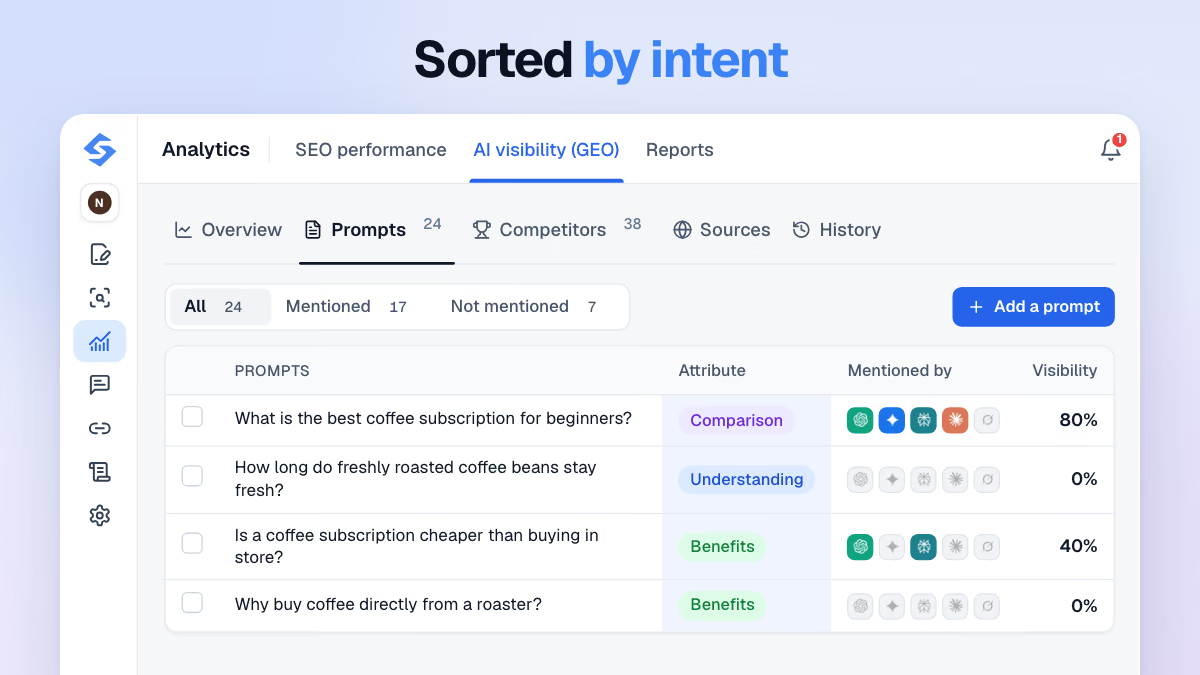
"Best career coach for engineers moving into management", "leadership coach for first-time managers", "is a life coach worth the money": these are personal questions, and people now ask them in private to an assistant. Sorank puts the prompts you choose to ChatGPT, Claude and Gemini every month (plus Grok on Pro) and shows where you appear, where you don't, and what each prompt is after.
Build the list in AI prompt research.
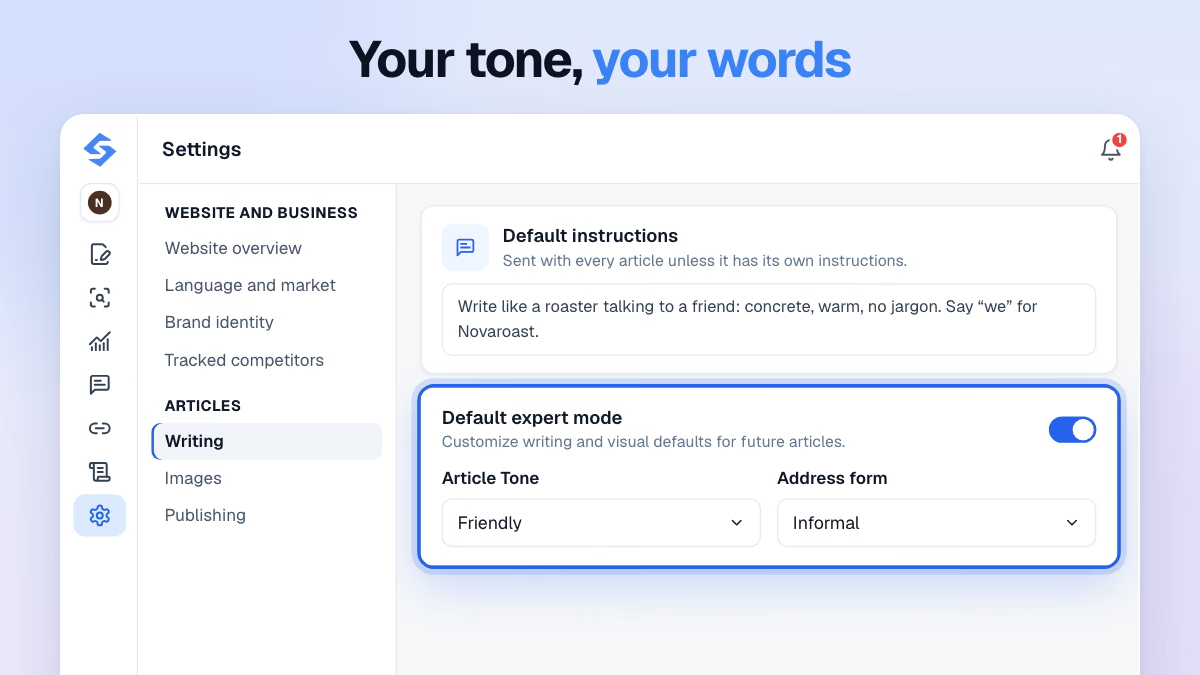
A coach sells trust, so a generic tone or a bold promise costs more than a missing article. Write your method, your vocabulary and your limits into the writing settings: "no income figures", "no promise of a result", "refer health questions to a professional". Sorank applies those instructions to each article, and you can hold every piece as a draft and add your own client stories, anonymized.
Set it up in brand voice.

WordPress, Wix and Webflow connect directly. If you run on Squarespace, Showit, Kajabi or a coaching platform, ask the provider whether it accepts a webhook before you start. Search Console then shows the phrases that already lead people to you.

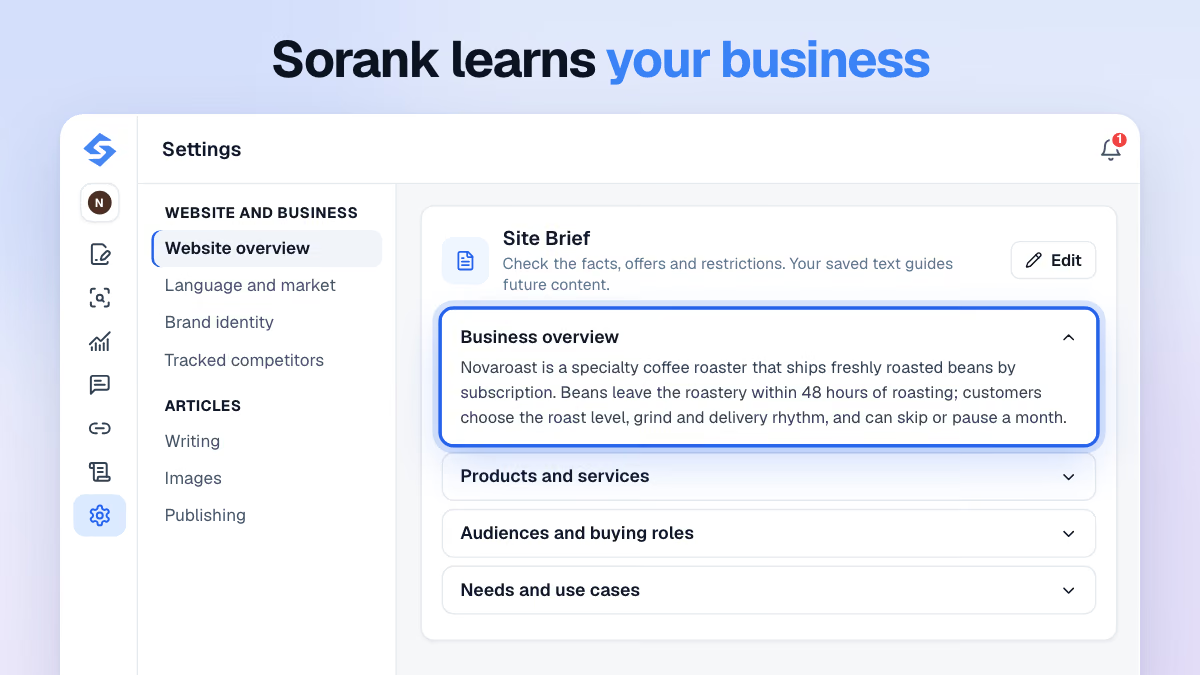
Who you coach, what they are stuck on, the program you sell and what you refuse to claim. Sorank follows that brief when it proposes questions to answer, each with its intent, difficulty and volume.

Read a draft when you have a story to add, or let articles go live on the days you pick. Each one links to your discovery call or program page, and the monthly report shows which assistants mention you.
“I tested Sorank on a real client site and it's insane. It does everything an agency would bill you $1500 a month for. It's going into production on that client now.”
 Guillaume Guersanguersanguillaume.com
 “I just let the Sorank software do its thing, and now my DR is 25 and my page is ranking higher.”
 Lucas Flandrefoundertrace.fr“Great service, works well for our website and helps us understand how to improve it to rank better on Google and elsewhere. Congrats, keep going, I recommend it.”
 Hugo T.E-commerce merchant“…In 4 months, I generate 15 organic leads per month without posting anything. It’s not 50/50 with LinkedIn yet, but I sleep better knowing I now have a second lead source growing on autopilot.”

 Valentin Thomyoffbound.fr
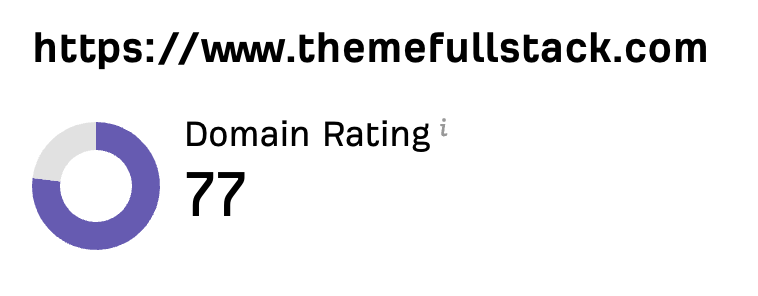 “…With Sorank I finally understood how to structure my SEO and write articles to rank. The audit showed my product page was too slow. In 2 months, my organic traffic doubled and I’m starting to appear in ChatGPT answers when people search for Shopify themes. All of that with about 2 hours per week.”
 Thème FullStackgo.themefullstack.com“Great solution to manage SEO without headaches. Audits are fast, the interface is clear, and you quickly see which actions to implement. It has become an essential tool to track and improve the SEO of my sites. I highly recommend it.”
 XavEntrepreneur“I used Sorank for a client who needed SEO and it clearly made my life easier. I can quickly audit a site, track my projects, and keep a clear overview without multiplying tools. The onboarding is fast and the interface is great.”
 Céline MaurinFreelance CM
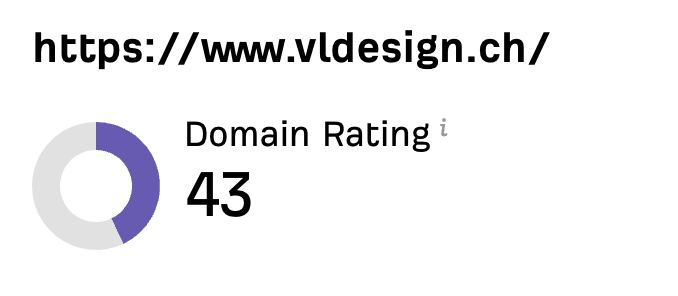 “Blown away by Sorank’s performance. After testing many solutions on the market, I was amazed by how quickly our articles started ranking in the SERP. The results are concrete and much faster than anything we’ve experienced so far. It has been an excellent surprise for our team. We are confidently renewing our trust and highly recommend Sorank to agencies that demand fast and measurable results.”
 Patrick PerretFreelance Webdesign SEO“We’re a development agency and we use Sorank to run on-page audits on our clients’ Shopify stores. It helps us quickly identify optimization opportunities, structure fixes, and collaborate more easily with clients on the SEO side. Very useful to complement our technical support 🔥”

 Younes Yahyaluvaika.com“Sorank has transformed the results we deliver to our clients. We now identify the keywords AI really uses, understand why certain competitors get cited, and spot opportunities we were completely missing before. Our clients see faster rankings, better visibility in AI answers, and clearer ROI on every action we take.”

 Benjamin Rouxovirank.com“We are an Ads agency and we wanted to get our SEO back on track once and for all. Sorank gave us a clear view of our site, helped us prioritize optimizations, and properly structure our content. The tool is easy to use, well designed for a team, and very practical for centralizing tracking without having to juggle multiple platforms. A very solid foundation to start fresh with our SEO.”
 Gaspard MadouiAds Agency“I specialized in GEO thanks to Sorank. The GEO Leaderboard allows me to show my clients their position vs competitors on ChatGPT. It’s a real commercial differentiator.”
 MélanieSEO Freelance“I manage our dealership’s website and it had dozens of issues: slow pages, 404 errors, missing tags. We were losing rankings every month without understanding why. The Sorank audit detected everything in 5 minutes. I sent the report to our web provider with the priority fixes. We regained our rankings and traffic picked back up. Perfect for someone non-technical like me!”
 Xavier BreullMarketing Manager“I’m a CMO for a SaaS and I manage acquisition in a very competitive market. We were investing heavily in our product but not working on our SEO. No visibility on our real competitors, no tracking of our presence in AI. Sorank showed us our positioning vs competitors, which keywords to target, and GEO opportunities we had completely ignored!”
 Louis RAPPCMO SaaS
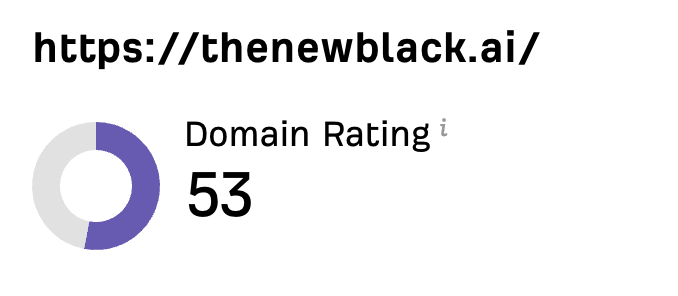 “Very good version 2, I recommend it.”

 Antoine Verhillethenewblack.ai“I was skeptical at first, but this is the best SEO tool I’ve ever used. The interface is clear, audits are fast, and the recommendations are easy to implement. I’ve saved hours and hours managing SEO and tracking performance. I recommend it to all my entrepreneur friends who run an agency or work independently.”
 NoahEntrepreneur“Sorank completely changed the way our SEO agency operates. We now spend far less time on each client because everything is centralized and automated. What used to take hours now takes minutes, which finally allows us to stop working in the business and start working on the business.”

 Océane Bondismaison-leverage.com
Founder’s Note.
I ran my own SEO agency for years. I built Sorank to deliver the same results to every business, at scale.
Everything I know about Google rankings and Generative Engine Optimization (GEO) is coded into this software, and it runs on autopilot for you.
Try for Free
SEO for coaches is the work that gets a career, executive, business or life coach found by people who have a problem and have not yet decided to pay for help. Unlike a dentist or a plumber, a coach is rarely searched for by job title alone, and the same person may read about a problem for months before booking a call. The articles do the patient part: they show how you think, long before the sales conversation.
That is also why a coaching site needs more than a home page and an about page. Those two pages answer "who are you". Nobody searches for that until they already know your name.
They look for someone who has already understood their situation, then check that person's background. The word "coach" says little about training, so a stated credential helps. The International Coaching Federation publishes what stands behind its levels: ACC, PCC and MCC call for 60+, 125+ and 200+ hours of coaching education and 100+, 500+ and 2,500+ hours of experience. If you hold one, say so and explain it in a sentence. If you don't, describe your training and your former career precisely.
Assistants read professional profiles and reviews as well as your site. We have no coaching-only study, but two are close. In our LinkedIn citation study, Grok cites LinkedIn in 1.88% of answers and Gemini in 0.98%, against 0.39% for ChatGPT. In the wellness study, Trustpilot reaches 7.91% on Gemini and 5.07% on ChatGPT (3375 answers, 83.2% in French, so read it as a signal). Keep your name, niche and method identical everywhere you appear; our guide to personal branding goes further.
Our guide to buying intent keywords explains how to sort them, and the search intent entry covers the theory. Skip "coach" on its own: the results mix sports teams, buses and handbags.
In the United States, only what you can back up. In September 2023 the Federal Trade Commission ordered online coaching company Lurn to stop misleading or unsubstantiated earnings claims and to hand over $2.5 million for refunds. In January 2025 it proposed covering business coaching in its Business Opportunity Rule, with written proof required for any earnings claim; check where that proposal stands before you rely on it.
Testimonials count too. The FTC's endorsement guides say that without proof a client's experience is representative, an ad should clearly disclose what people can generally expect, and one example treats "Results not typical" as insufficient. So a client story describes one person and one context, and an article never turns it into a forecast. Rules differ by country, and Sorank gives no legal advice.
Clearly, and in writing. The ICF guide on referring a client to therapy states that a coach neither diagnoses nor offers treatment, and that a coach should refer when a client needs help beyond their qualifications. Queries such as "how to cope with anxiety at work" attract readers who may need a clinician. An article on that subject stays on what you do, says when to see a professional, and never suggests that coaching replaces care.
Google also holds health and money topics to a higher standard (see YMYL). Put your instruction in the writing settings once, and read those drafts yourself.
A direct answer in the first lines, then what you see in sessions. Name the pattern, give one exercise a reader can try tonight, say who the advice does not suit, and end with one clear next step rather than three offers. Add a line about yourself under the title with a link to your bio: clients want to know who is talking (see author authority).
Software writes a solid base; a real, anonymized story from your practice is what no competing article can copy.
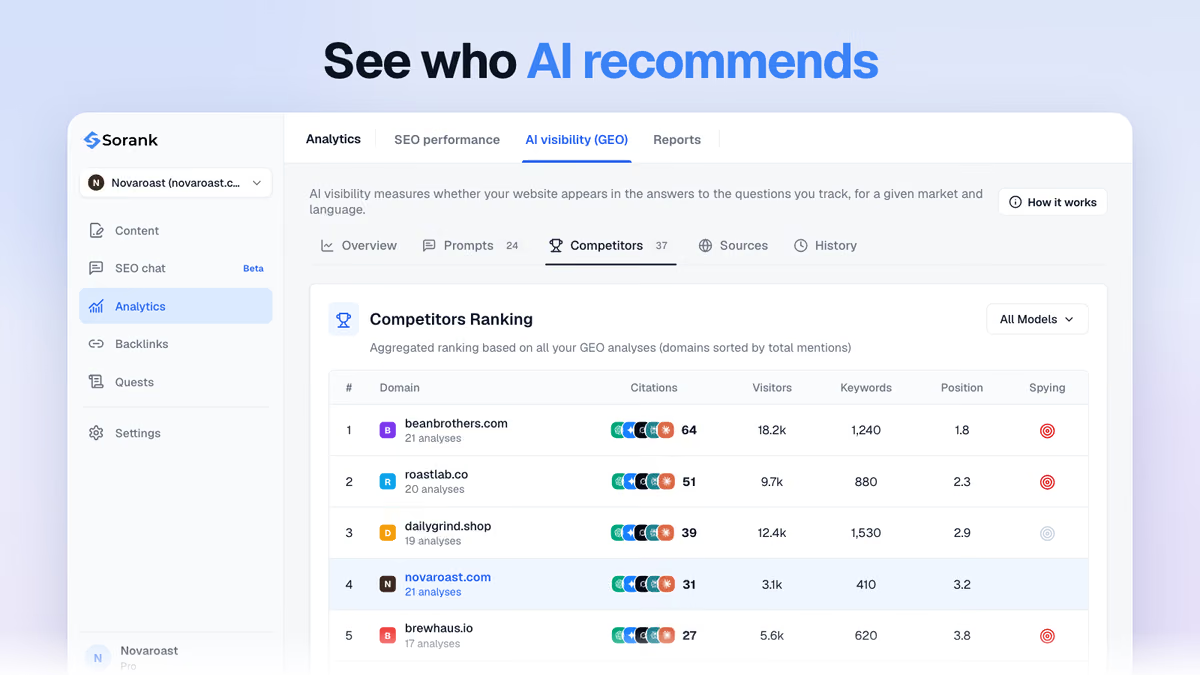
Sorank finds keywords per niche, writes and publishes articles with sources, internal links and images, tracks your prompts each month, earns backlinks between client sites and gathers Search Console, Analytics and visits from assistants in one dashboard. It does not manage your Google Business Profile, your reviews, your booking links or your social profiles.
You keep the coaching, the program pages, testimonials and their consent, LinkedIn, and the profile if you see clients in person (see Google Business Profile). Close trades have their own pages: course creators if your program is the product, personal trainers for fitness coaching and consulting firms for corporate work.
For a solo practice, the lowest plan is usually enough: Essential is $49 a month billed yearly, or $99 with no commitment, for 20 articles a month on one website. A coach with several audiences or a team can look at Pro ($129 yearly, $249 monthly, 60 articles, with Grok tracking) or Business ($249 yearly, $499 monthly, 120 articles). Prices and the 90-day results-or-refund guarantee are on the pricing page, and you can try it free for 3 days.
Expect months rather than weeks, and no fixed date: Google gives none, and neither do we. Niche phrases tend to move first. Watch impressions in Search Console during the first quarter, then the visits to your discovery call page. Because a reader may take a long time to decide, ask each new client what they read before booking: that answer tells you more than any dashboard.
It suits coaches who can wait a few months and who have a clear niche. If you sell mainly through referrals and a waiting list, it matters less. A broad offer such as "life coaching for everyone" is the hardest to rank.
A profile is meant for businesses that meet clients in person, at their address or at the client's. A coach who only works by video usually has no place there and relies on articles and professional profiles. Sorank does not manage profiles in any case.
State your niche, method and background the same way on your site, LinkedIn and any directory, and publish precise answers to your clients' questions. Then track prompts such as "career coach for nurses leaving the profession" to see who is named. Nobody can guarantee a mention.
No. Tell it in the writing settings never to state income figures or guaranteed results. Client stories come from you, with their consent, and you can hold each article as a draft to add them.
It publishes directly on WordPress, Wix, Webflow and Shopify. For anything else, publication goes through a webhook, so ask your provider whether it accepts one before subscribing.
From $49 a month per site on the yearly plan, or $99 month to month, for 20 articles. Allow several months, since niche phrases usually move first. You get 3 free days to try it and a 90-day results-or-refund guarantee.
We don't. Sorank isn't trying to be another Semrush or Ahrefs. Those tools are built for data, Sorank is built to do the work. Instead of more dashboards to check, it turns SEO and GEO insights into actions: articles written and published, backlinks earned, technical fixes and AI visibility tracking. Less complexity, more results.
From $49/month per website on a yearly plan, with a 3-day free trial and a 90-day money-back guarantee (conditions apply). Every plan includes articles, AI visibility tracking and access to natural backlink acquisition; higher plans add more articles, more AI prompts tracked and more backlinks. No setup fees, no paying for seats you don't use.
You shouldn't need a full marketing team or expensive tools to grow. Sorank handles your entire SEO and AI visibility, so you save time and money.