
Preferences
Privacy is important to us, so you have the option of disabling certain types of storage that may not be necessary for the basic functioning of the website. Blocking categories may impact your experience on the website. More information
Privacy is important to us, so you have the option of disabling certain types of storage that may not be necessary for the basic functioning of the website. Blocking categories may impact your experience on the website. More information

A link connects one web page to another and passes relevance and authority. Learn link types, how search engines crawl links, and why they matter.







Founder Sorank, 7+ years in SEO.
Summary
A link is a clickable connection that takes a reader from one web page to another. In SEO, links also tell search engines which pages exist, how they relate to each other, and which ones deserve attention. Google uses links to discover new pages and to judge their relevance.
Want to go further? Ask
A link connects one page to another, and it does two jobs at once. For people, it moves them to related content. For search engines, it reveals how a site is organized and which pages the site considers important. The value of a link depends on how it is built, where it sits on the page, and what the anchor text says, which is why links deserve more attention than they usually get.
A link is built from an HTML anchor element with an href attribute. The href holds the destination address, and the visible, clickable words are the anchor text. Google's guide to crawlable links states that Google can only crawl a link when it is an anchor element with an href attribute, and that other formats, such as elements that only work through script events, may not be parsed reliably.
Attributes change how search engines treat a link. A regular editorial link needs no extra attribute. The rel attribute can mark a link as sponsored, user-generated, or nofollow, and each value tells engines how to treat that link. Here is what a plain, descriptive link looks like in HTML:
<a href="/glossary-geo-seo/crawlability">crawlable link</a>Search engines discover the web by following links. A crawler reads the links on a page, queues their destinations, and returns to them later. Google describes links as a signal it uses to determine the relevance of pages and to find new pages to crawl. A page that no other page links to may never be found, which is why Google advises that every page on a site has a link from at least one other page on that site. The crawling process depends on this chain of links.
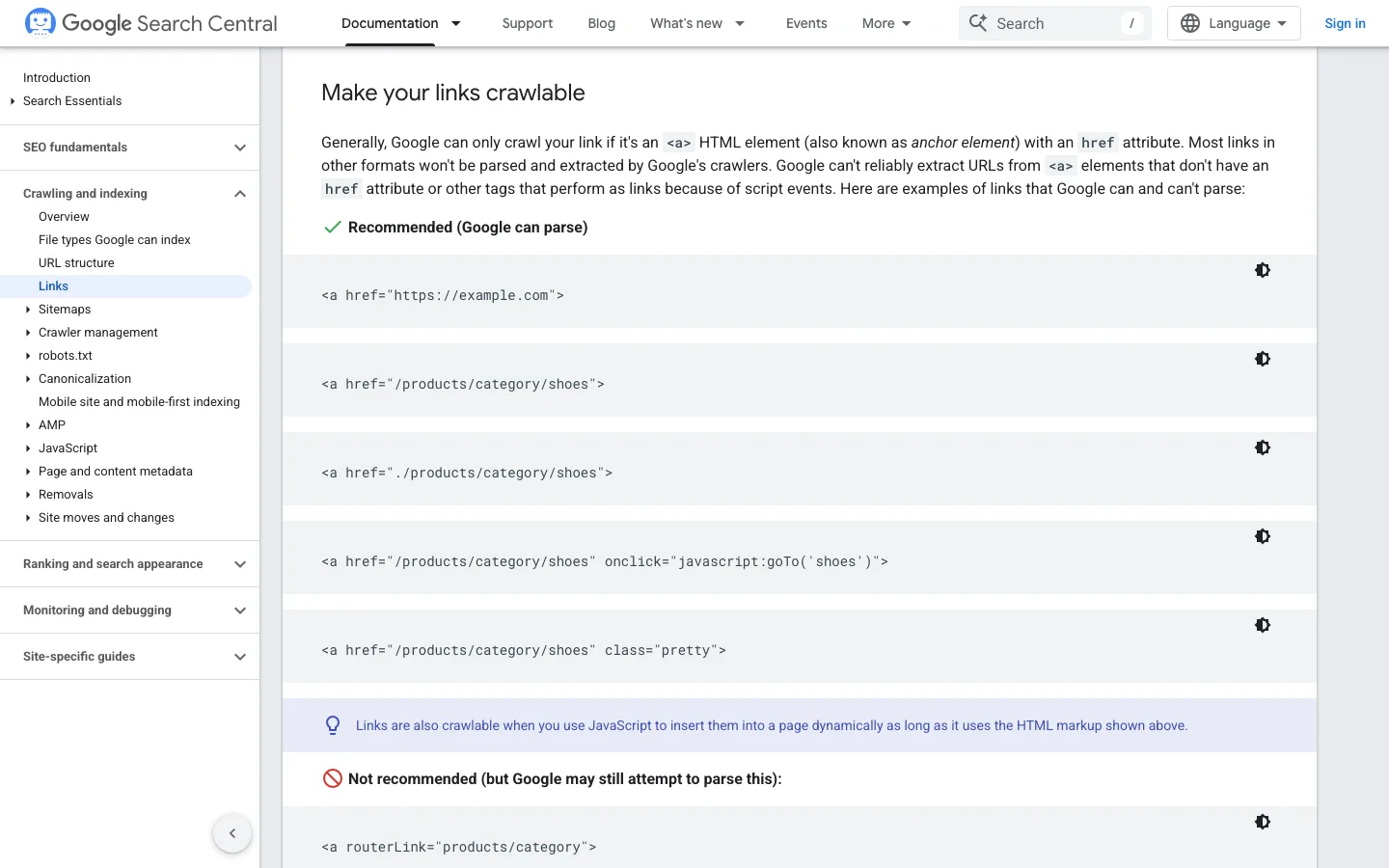
The screenshot above shows the part of Google's guide that explains which link formats can be crawled and which ones cannot.
An internal link connects two pages on the same site. An external link points from your site to a page on a different domain. A backlink is the same external link seen from the other side: another website links to a page on your site. You control internal links completely, you choose which outbound links to add, and you earn backlinks only when other people decide to link to you.
Internal links are the most direct lever for site structure. They help readers move from a general page to a specific one and help crawlers reach deeper pages. A clear network of links is the foundation of a topical map, which groups related pages so that each one supports the others. For the steps to plan this network, read how to plan an internal linking strategy.
Link equity, often called authority, is the value that passes from one page to another through a link. Pages that receive links from relevant sources can pass more of that value onward. Inside your own site, a strong page can lift a newer or less visible page by linking to it, while a page with no internal links receives little from the rest of the site.
Equity is not a fixed amount that splits evenly between links. Google does not publish how it weighs individual links, so treat equity as a useful model rather than a measurement. The practical rule is to link where a reader would naturally want to go next, and to make sure the important pages of your site receive links from several places.
An outbound link points from your page to another site. Linking to reputable sources supports your claims and gives readers a way to check them. Google asks site owners to mark paid placements with the sponsored value and user-generated links, such as comments and forum posts, with the ugc value. Regular editorial links need no attribute at all.
Google's guide to qualifying outbound links explains each value and when to combine them. Only link to pages that genuinely support the sentence where the link appears, because a link placed to fill space does not help the reader and weakens the page.
Anchor text is the phrase a reader clicks. Google's documentation says that good anchor text is descriptive, reasonably concise, and relevant to the page it sits on, and it advises against generic phrases such as "click here". Anchor text tells both readers and engines what the destination is about, so it is worth choosing with care. Read the anchor text guide for examples of exact, partial, and descriptive anchors. Sorank's free Internal Link Analyzer shows how the internal links of a page are spread and which anchors are repeated.
Tip
Vary your anchors across the site, but keep them honest. Use the exact term once in a while, a partial phrase in other places, and a descriptive sentence fragment where it reads naturally.
Links shape three things at once: discovery, structure, and trust. They help engines crawl and index your pages, they communicate which pages are important, and they transfer authority that influences rankings. Few other elements of a page affect so many parts of search at the same time, which is why both internal linking and link earning belong in any serious plan.
The same logic applies to generative AI. AI assistants draw on pages they can reach, read, and trust. A well-linked page with clear, descriptive anchors is easier for both search engines and AI systems to understand, and it sits inside a network that shows how its topic connects to the rest of your site. This is central to AI citation optimization, where the goal is to be the source an assistant chooses to reference.
A link is the basic building block of the web and one of the clearest signals in search. It moves readers, guides crawlers, defines site structure, and passes the authority that helps content rank. Internal links organize and strengthen your own site, outbound links support your claims, and backlinks show that others find your content worth referencing.
Sources
An internal link connects two pages on your own site. An external link points from your site to a different domain. A backlink is the reverse: another website links to your page. Internal links organize your site, outbound links cite sources, and backlinks show that others find your content worth referencing.
Link equity, often called authority, is the value passed from one page to another through a link. It flows along links, so a strong page can route value to newer or less visible pages on your site, and other sites can pass value to you through backlinks.
Yes. Links still help search engines and AI systems discover and understand pages. Clear internal linking shows how your pages relate, and relevant backlinks signal that others trust your content, which supports your visibility in AI answers.
 “I tested Sorank on a real client site and it's insane. It does everything an agency would bill you $1500 a month for. It's going into production on that client now.”

 Guillaume Guersanguersanguillaume.com“We are an Ads agency and we wanted to get our SEO back on track once and for all. Sorank gave us a clear view of our site, helped us prioritize optimizations, and properly structure our content. The tool is easy to use, well designed for a team, and very practical for centralizing tracking without having to juggle multiple platforms. A very solid foundation to start fresh with our SEO.”
 Gaspard MadouiAds Agency
 “I just let the Sorank software do its thing, and now my DR is 25 and my page is ranking higher.”
 Lucas Flandrefoundertrace.fr“I specialized in GEO thanks to Sorank. The GEO Leaderboard allows me to show my clients their position vs competitors on ChatGPT. It’s a real commercial differentiator.”
 MélanieSEO Freelance“Great service, works well for our website and helps us understand how to improve it to rank better on Google and elsewhere. Congrats, keep going, I recommend it.”
 Hugo T.E-commerce merchant



















