
Preferences
Privacy is important to us, so you have the option of disabling certain types of storage that may not be necessary for the basic functioning of the website. Blocking categories may impact your experience on the website. More information
Privacy is important to us, so you have the option of disabling certain types of storage that may not be necessary for the basic functioning of the website. Blocking categories may impact your experience on the website. More information

Information gain measures how much new information a page adds beyond what users have already seen. Learn how to add it to your content for SEO and GEO.








Founder Sorank, 7+ years in SEO.
Summary
Information gain is a measure of how much new information a page adds beyond what a user has already seen. Google describes an information gain score for documents of interest in a patent, and it matches Google's advice to publish original information, research, and analysis. Content that restates the top results adds little gain.
Want to go further? Ask
Information gain is the idea that a page should be judged by what it adds to the results that already exist, not only by its quality on its own. A page that repeats the top results offers little gain. A page that brings original data, a firsthand test, or a sharper angle offers a lot. The term comes from a Google patent, and it has become a practical test for content that has to stand out in search and in AI answers.
Search results and AI answers both have reason to prefer sources that add something new, because a page that only rephrases other pages gives the reader nothing they could not find elsewhere. Thinking in these terms helps you decide what to write before you write it. The concept also sits close to semantic search, where systems compare meanings rather than exact wording.
In search, information gain measures the additional information a document contains beyond what the user has already read. The higher the gain, the more a page moves the reader forward instead of repeating what they know. Two articles can use different words and still say the same thing, so wording alone does not create gain. The substance does.
The term is not the same as the machine learning measure with the same name, which is used to choose the splits in decision trees. In SEO, it describes how new a document is compared with the documents a user has already seen.
The concept comes from a Google patent on contextual estimation of link information gain, number US11354342B2. The application was filed on October 18, 2018, and the patent was granted on June 7, 2022, to Google LLC. Its abstract describes determining an information gain score for documents of interest to the user, then presenting information from those documents based on that score.
A patent describes a method, not proof that the method runs in live ranking. Treat it as a sign of what Google has explored, and build your content on the public guidance Google does publish.
Google does not name information gain in its public documentation, so the honest position is that the mechanism is plausible but unverified. The principle still lines up with Google's guidance. Its helpful content documentation asks whether a page provides "original information, reporting, research, or analysis" and whether it provides "substantial value when compared to other pages in search results." Those are the same questions information gain asks.
Length is not novelty. The skyscraper approach, which makes a slightly longer version of the top result, can add words without adding information, and a system that rewards novelty would not reward that. Information gain rewards content that gives the reader something the current results lack, such as original data, firsthand experience, or a fresh angle, whatever the word count.
Google's guidance on AI-generated content makes a similar point from another side. It describes unhelpful pages as having "little to no effort, little to no originality, and little to no added value", and it warns that using generative AI tools to generate many pages without adding value for users may violate its spam policies. Read the guidance on using generative AI content before you scale any content process.
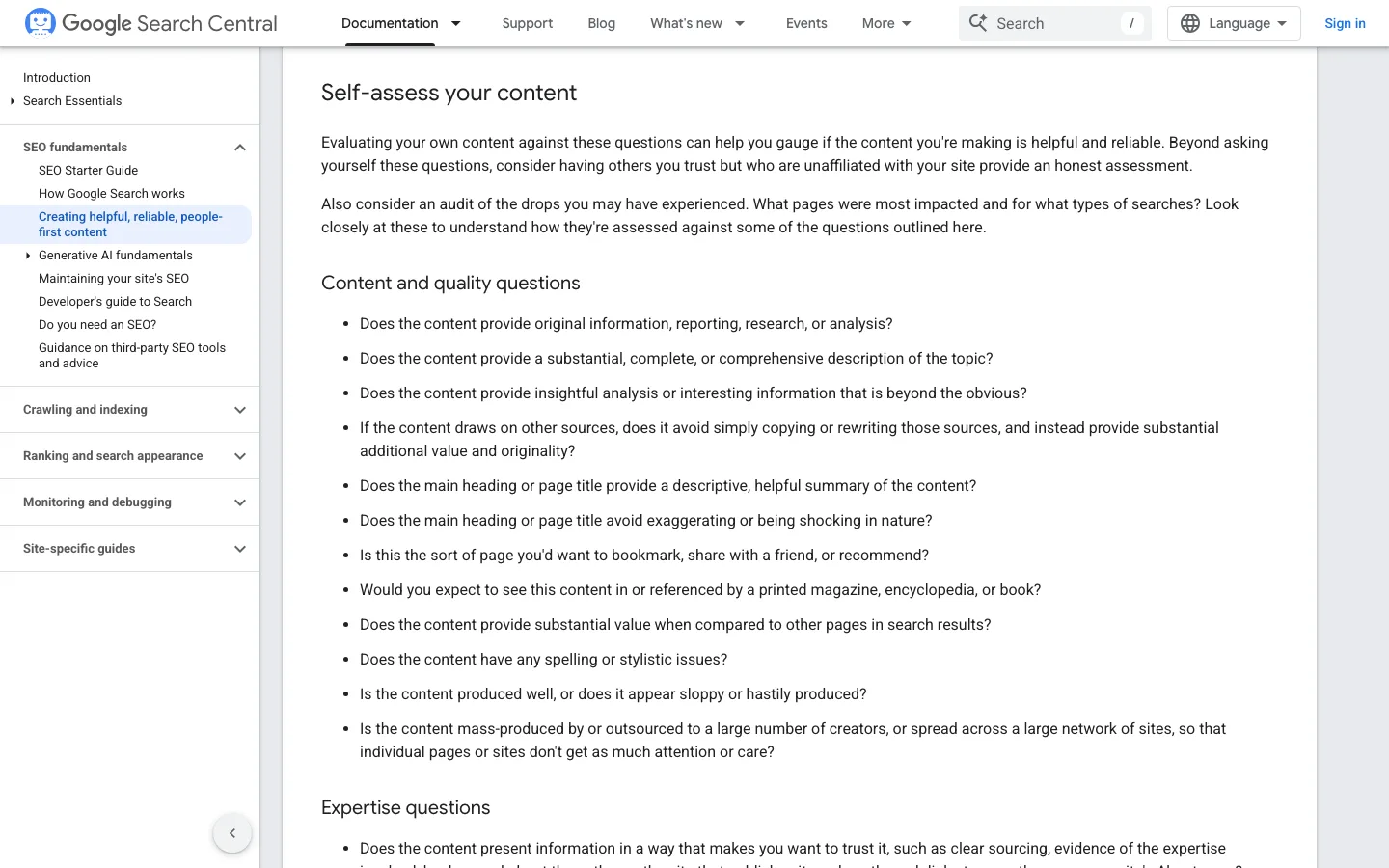
Start before you write. Open the top results for your query and list what they all say. Then ask what none of them say. Google's self-assessment questions give a clear test: does the page offer "insightful analysis or interesting information that is beyond the obvious"? That line is your target.
Then build the gain from sources competitors cannot copy:
The research step starts with the questions buyers ask, which Sorank's keyword research helps you map. The LV3D case study shows the principle in practice. Sorank studied the keywords buyers use and what AI tools recommend in the sector, then published articles based on LV3D's own expertise. The case study reports Google clicks per day rising from about 240 to over 1000. It does not isolate information gain as a cause, so read those figures as the result of a content program, not as proof of one mechanism.
Plan content gap analysis into the brief, so each page starts with the points the current results leave out.
For SEO, information gain changes the goal from matching competitors to surpassing them. A page that only restates the consensus gives search engines little reason to rank it above the pages it copies. For GEO, the link is direct. AI systems combine many sources into one answer, so a page that adds a fact, figure, or view that no other source has gives them a reason to cite it. That is why the principle matters for AI search visibility.
Information gain measures how much a page adds beyond what the reader already knows. It comes from a Google patent that describes a score for documents of interest, and it matches Google's public call for original information and analysis. Build each page around what competitors cannot copy, and check your draft against the top results before you publish. Sorank's keyword research helps you find the questions to answer first.
Sources
Google does not name information gain as a ranking factor in its public documentation. The concept comes from a Google patent, and a granted patent describes a method rather than proof that it runs in live ranking. The safe approach is to follow Google's public guidance on original information and analysis.
Length is not novelty. Adding words that restate the top results adds no new information, while original data, firsthand experience, or a fresh angle adds gain whatever the word count.
Check the top results first and list what they all say. Then add what none of them say, such as your own data, firsthand testing, expert commentary, and original examples that competitors cannot copy.
 “I tested Sorank on a real client site and it's insane. It does everything an agency would bill you $1500 a month for. It's going into production on that client now.”

 Guillaume Guersanguersanguillaume.com“We are an Ads agency and we wanted to get our SEO back on track once and for all. Sorank gave us a clear view of our site, helped us prioritize optimizations, and properly structure our content. The tool is easy to use, well designed for a team, and very practical for centralizing tracking without having to juggle multiple platforms. A very solid foundation to start fresh with our SEO.”
 Gaspard MadouiAds Agency
 “I just let the Sorank software do its thing, and now my DR is 25 and my page is ranking higher.”
 Lucas Flandrefoundertrace.fr“I specialized in GEO thanks to Sorank. The GEO Leaderboard allows me to show my clients their position vs competitors on ChatGPT. It’s a real commercial differentiator.”
 MélanieSEO Freelance“Great service, works well for our website and helps us understand how to improve it to rank better on Google and elsewhere. Congrats, keep going, I recommend it.”
 Hugo T.E-commerce merchant



















