
Preferences
Privacy is important to us, so you have the option of disabling certain types of storage that may not be necessary for the basic functioning of the website. Blocking categories may impact your experience on the website. More information
Privacy is important to us, so you have the option of disabling certain types of storage that may not be necessary for the basic functioning of the website. Blocking categories may impact your experience on the website. More information

Dwell time is how long a searcher stays on your page after a click from search before returning. Learn what it signals, how to measure it and improve it.








Founder Sorank, 7+ years in SEO.
Summary
Dwell time is the length of time a searcher spends on a web page after clicking it in search results, measured until they return to those results. It is a proxy for whether the page satisfied the query that brought the visitor there.
Want to go further? Ask
Dwell time is the amount of time a visitor stays on a page after clicking through from a search engine results page, measured until they go back to those results. It sits between the click and the return to search. SEO professionals use it as a practical hint about whether a page answered the question behind the search. Because it is tied to a query, it says more about relevance than a general traffic metric, although it is never a perfect reading of satisfaction.
The term is often confused with bounce rate and time on page, and the confusion matters. Google's public documentation does not present dwell time as a ranking factor, and most analytics tools do not report it directly. Knowing what it measures, and what it cannot measure, keeps you focused on engagement that improves the page instead of chasing a number.
Dwell time starts when a searcher lands on your page from a results page and ends when they click back to those results. A long dwell time suggests the reader found the content worth reading. A very short visit, often called a quick return to search, can suggest the page did not match what the searcher expected, although that is not always the case: a fast answer that solves the problem is a success.
Dwell time only covers search traffic. It is not a general measure of how long visitors stay, because it describes the round trip between a results page and your content. That focus makes it useful as a relevance signal, since it reflects how a searcher reacted to one specific query.
Three metrics are easy to mix up. Bounce rate is the share of visits that view one page and leave without any further interaction. A bounce can still be a success, because someone who reads a full guide, gets the answer, and leaves without clicking anything still counts as a bounce. Time on page, or average engagement time in current analytics, measures how long visitors spend on a page across all traffic sources, not only search.
Dwell time is narrower than both. It counts only visits that started in search, and it ends when the visitor returns to the results. For that reason, many practitioners see it as a more focused view of satisfaction than raw bounce rate, but it still depends on what the reader was trying to do.
Google's public documentation does not name dwell time as a ranking factor, so its role is unproven. Google's guidance on creating helpful, people-first content asks whether a reader will leave with a satisfying experience, and whether they still need to search again for better information. Those are the qualities that tend to keep people on a page after a click.
The safest reading is that dwell time may reflect quality that search engines reward in other ways. It is not a single number you can raise to climb the results. Treat it as evidence about the page, not as a lever on its own.
No analytics tool reports dwell time as a single named metric, so practitioners rely on proxies. In Google Analytics, the closest figure is average engagement time, which Google defines as the average time your website was in focus in a user's browser. Google's help page on the engagement report gives the formula: the total time the site was in focus across all sessions, divided by the total number of active users. You can filter the report to organic search traffic to get a view closer to search visits.
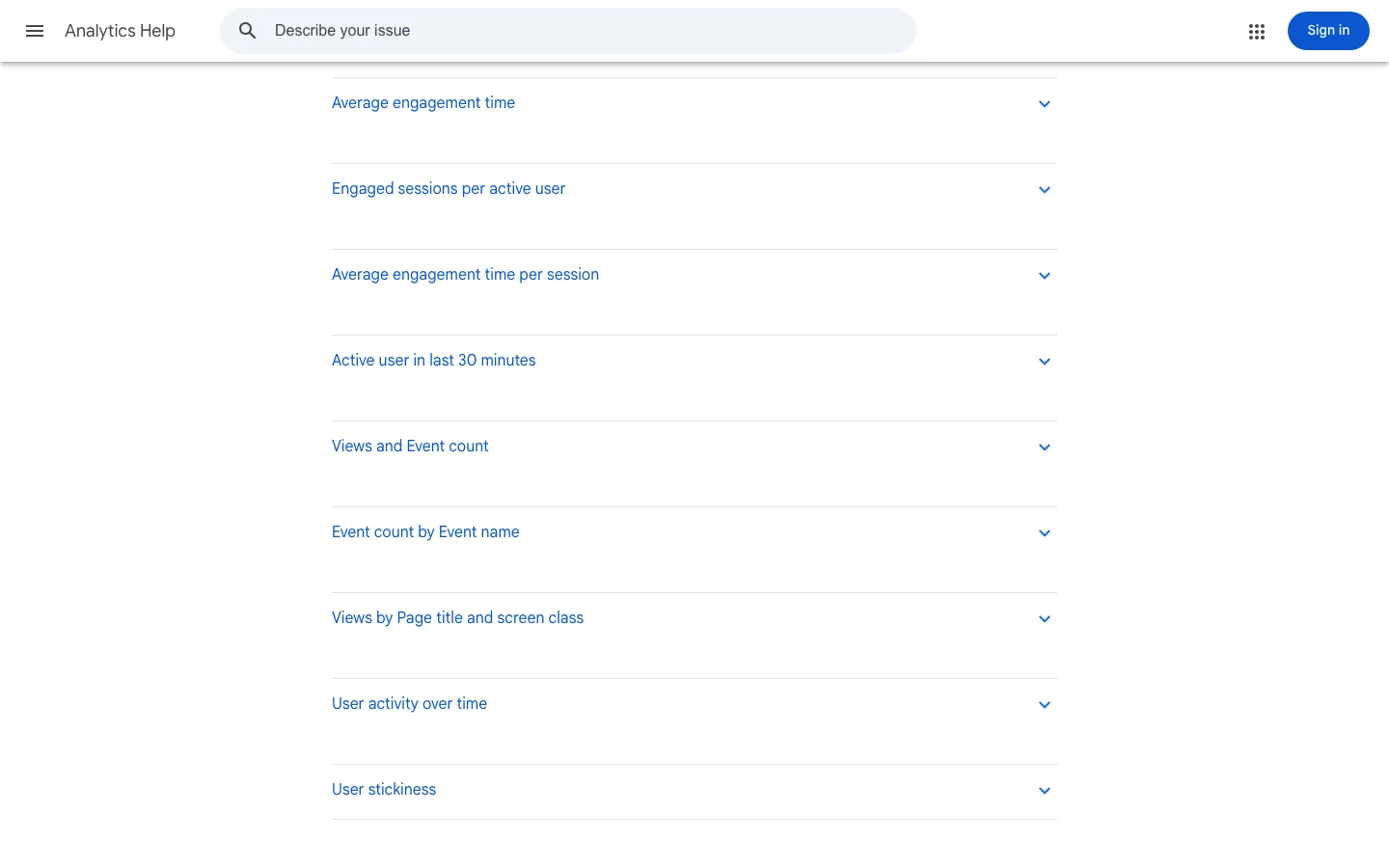
The limitation matters. Average engagement time does not stop at the moment a visitor returns to the results, and it cannot tell a confused reader from a satisfied one. Use it as a directional indicator, not a precise score.
Start by matching search intent precisely, so the page delivers what the title and snippet promised. A page that promises a comparison should compare, and a tool page should show the tool. Open with a direct answer, then give a clear preview of what the reader will find below. Avoid clickbait, because a title that promises more than the page delivers produces exactly the quick return that weakens the signal.
Next, format the page for scanning. Use descriptive subheadings, short paragraphs, lists where they help, and visuals that support the text. Make sure the page loads quickly and works well on phones, because slow or awkward pages cause early exits. Add internal links that give an engaged reader a natural next step, such as a related definition or a deeper guide, instead of a dead end. Good user experience and clear structure do most of this work.
There is no universal benchmark. A good dwell time depends on the topic, the content type, the query, and what readers expect. A quick reference answer that resolves a question in seconds can be a complete success, while a long guide may rightly hold attention for several minutes. Compare a page with similar pages on your own site and track it over time, rather than with a figure from another niche.
A short visit is only a problem when it signals that the visitor did not find what they came for. Read the page alongside other signals, such as click-through rate from search, before deciding that a page needs work.
The most common mistake is optimizing the metric itself. Adding padding, pop-ups, or extra scrolling to keep visitors longer usually makes the page worse and does not answer the query better. A second mistake is treating every short visit as a failure, when a fast answer may be exactly what the searcher wanted. A third is ignoring search intent and trying to win attention with a broad, unfocused article.
Teams also compare dwell time across unrelated pages. A product page, a glossary definition, and a long tutorial serve different intents, so their figures should not be ranked against one another. Avoid chasing one number when the better goal is a page that a searcher finishes with a clear answer.
Whether or not dwell time is a direct ranking factor, it reflects something real: whether the page satisfied the searcher. Pages that hold attention usually match the query, answer it thoroughly, and read well. Those are the qualities search engines aim to reward, so optimizing for genuine engagement lines your work up with the goals of the algorithm.
For generative engine optimization, the link is indirect but useful. The clarity, depth, and structure that keep human readers engaged also make content easier for AI systems to parse and cite. A page built around a direct answer, supported by helpful content and clear sections, tends to serve both readers and AI answers well. Sorank helps teams plan these pages with its keyword research tools, which show the questions a page should answer.
Dwell time measures how long a searcher stays with your content before returning to the results, which makes it a useful, if imperfect, proxy for satisfaction. It differs from bounce rate and time on page, and Google's public documentation does not present it as a ranking factor. The reliable path is to match search intent, structure pages for scanning, keep them fast and easy to use, and give readers a logical next step. For more on what makes a page worth finishing, read our guide on content that converts.
Sources
Bounce rate is the share of visits that view one page and leave without any further interaction, regardless of how long they stayed. Dwell time measures only search visits, from the click until the visitor returns to the results, so it is tied to one query.
Google's public documentation does not name dwell time as a ranking factor. Its guidance on helpful content asks whether a reader leaves satisfied, which is the quality dwell time may reflect indirectly, so treat it as evidence about the page rather than a lever.
Match the search intent, deliver what the title promised, and structure the page for scanning. Make it fast and easy to use on phones, then add internal links that give engaged readers a logical next step.
 “I tested Sorank on a real client site and it's insane. It does everything an agency would bill you $1500 a month for. It's going into production on that client now.”

 Guillaume Guersanguersanguillaume.com“We are an Ads agency and we wanted to get our SEO back on track once and for all. Sorank gave us a clear view of our site, helped us prioritize optimizations, and properly structure our content. The tool is easy to use, well designed for a team, and very practical for centralizing tracking without having to juggle multiple platforms. A very solid foundation to start fresh with our SEO.”
 Gaspard MadouiAds Agency
 “I just let the Sorank software do its thing, and now my DR is 25 and my page is ranking higher.”
 Lucas Flandrefoundertrace.fr“I specialized in GEO thanks to Sorank. The GEO Leaderboard allows me to show my clients their position vs competitors on ChatGPT. It’s a real commercial differentiator.”
 MélanieSEO Freelance“Great service, works well for our website and helps us understand how to improve it to rank better on Google and elsewhere. Congrats, keep going, I recommend it.”
 Hugo T.E-commerce merchant



















