
Preferences
Privacy is important to us, so you have the option of disabling certain types of storage that may not be necessary for the basic functioning of the website. Blocking categories may impact your experience on the website. More information
Privacy is important to us, so you have the option of disabling certain types of storage that may not be necessary for the basic functioning of the website. Blocking categories may impact your experience on the website. More information

Model Context Protocol (MCP) is the open standard that connects AI assistants to tools and data. How it works, who governs it and why it matters for GEO.







Founder Sorank, 7+ years in SEO.
Summary
Model Context Protocol (MCP) is an open standard that lets AI applications connect to external tools, files, and data sources through one shared interface. Anthropic released it on November 25, 2024, so a developer can build a connector once and reuse it across compatible assistants instead of writing a custom integration for every pairing.
Want to go further? Ask
Model Context Protocol is often compared to a USB-C port for AI. Just as one standard plug lets a laptop connect to many screens and drives, MCP gives an assistant one standard way to reach the systems where its data lives. The official documentation describes it as an open-source standard for connecting AI applications to external systems, such as data sources, tools, and workflows. For anyone working on AI search visibility, it matters because it is part of the plumbing that lets autonomous AI agents reach beyond their training data, fetch fresh information, and act on it.
The Model Context Protocol is an open-source framework that standardizes how AI models exchange data with external tools, systems, and data sources. Before it existed, each assistant needed its own code to reach each system, and every new data source meant another custom integration. MCP replaces that patchwork with one protocol that both sides understand.
The Anthropic launch announcement, published on November 25, 2024, framed the problem as models being cut off from data, trapped behind information silos and legacy systems. It presented MCP as a universal, open standard for connecting AI systems with data sources, replacing fragmented integrations with a single protocol.
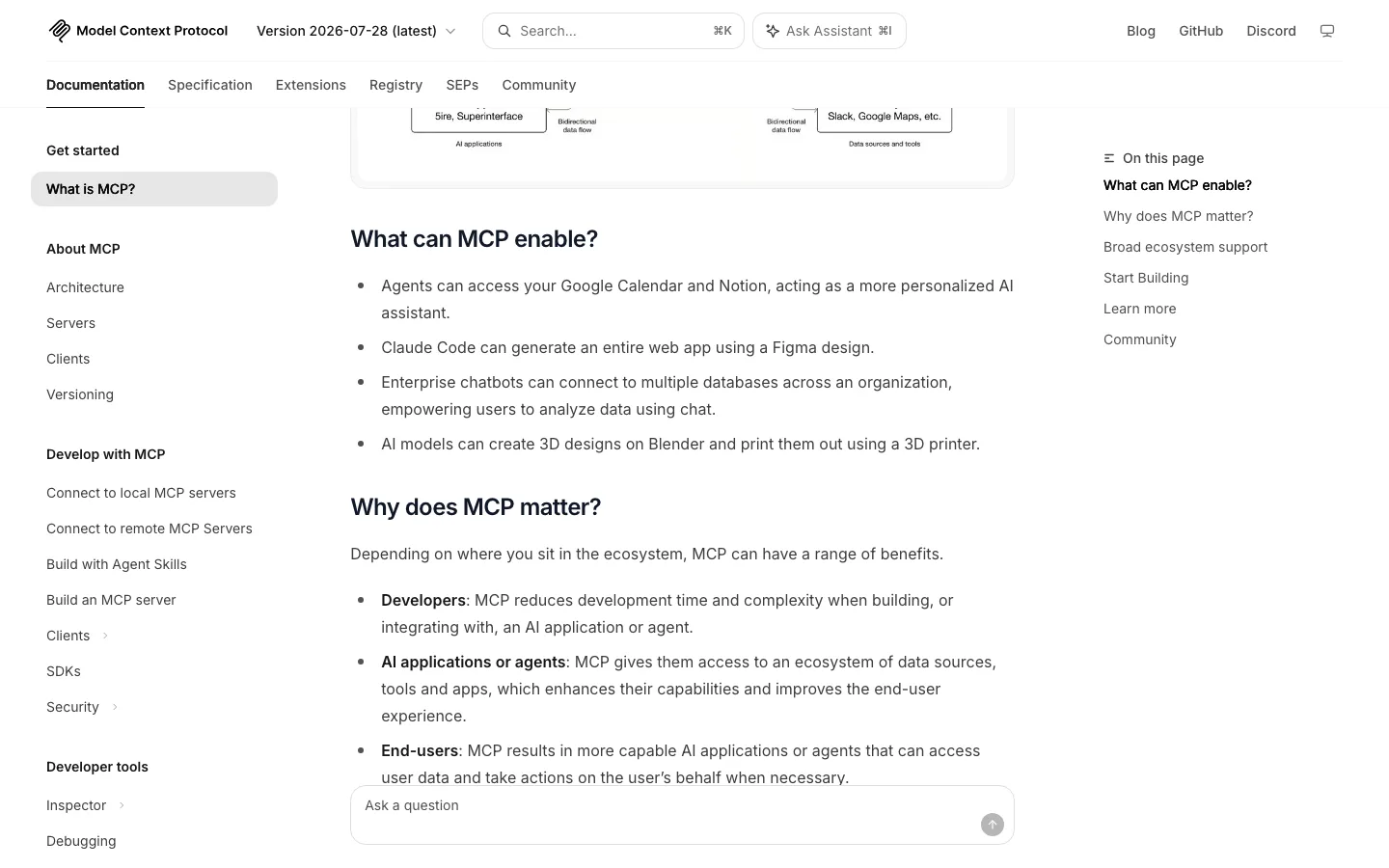
The examples in the official MCP introduction show what this makes possible: an agent that reads a Google Calendar and a Notion workspace, a coding assistant that generates a web app from a Figma design, and an enterprise chatbot that queries several databases at once.
Without a shared standard, connecting N AI assistants to M tools requires a custom connector for each pair. That is N times M pieces of code, which break whenever one side changes and grow with every new assistant and every new system. Maintaining them becomes the main cost, not the AI itself.
MCP changes that arithmetic. Each assistant implements the protocol once, each tool exposes an MCP server once, and any compatible client can use any compatible server. The stated goal is simpler, more reliable access to the data AI systems need, with fewer one-off integrations to maintain.
MCP follows a client-server architecture with three roles. The host is the AI application the user works with, such as Claude Desktop or Claude Code. The host creates one MCP client for each MCP server it connects to, and each client keeps its own dedicated connection. The server exposes capabilities or data, whether that is local files, a database, or a remote software platform. The MCP architecture documentation describes this model in detail.
Messages follow the JSON-RPC format. The transport depends on where the server runs. Local servers usually communicate over standard input and output and typically serve a single client, while remote servers use the Streamable HTTP transport and typically serve many clients.
MCP servers expose their functions through three core primitives. Tools are functions the model can call to take an action, such as running a query or creating a record. Resources are data the application can read, such as documents or database records. Prompts are reusable instruction templates that help a model carry out a specific task in a consistent way.
Newer features extend this set. Sampling lets a server ask the client for a model completion, elicitation lets a server ask the user for input during a task, and roots define which parts of the filesystem a server is allowed to touch. Together, these concepts cover reading data, taking action, and guiding behavior, which is why they recur in larger agentic workflows.
A large language model on its own only knows what was in its training data and what appears in its current context. MCP is one of the bridges that connects a model to current, real-world information. Giving a model reliable access to live tools turns a chat interface into something that can research, retrieve, and act.
This is why MCP is closely tied to the rise of agents. An agent often needs to call several systems in sequence, and doing that through one standard, rather than through many custom integrations, makes multi-step automation easier to build and maintain. Function calling lets a model request an action inside one application. MCP extends the same idea into a shared standard that works across applications and vendors.
MCP was created at Anthropic by engineers David Soria Parra and Justin Spahr-Summers, and the company released it as open source. In December 2025, Anthropic announced that it was donating MCP to the newly formed Agentic AI Foundation under the Linux Foundation, to give the protocol vendor-neutral governance. The MCP project blog is the place to follow governance news.
Support has spread across the industry. The official documentation lists AI assistants such as Claude and ChatGPT, and development tools such as Visual Studio Code and Cursor, as products that support MCP.
Because MCP gives models access to real systems, security matters from the start. For HTTP-based connections, the authorization section of the 2025-06-18 specification describes a protected MCP server that acts as an OAuth 2.1 resource server, which means it accepts access tokens and checks them rather than trusting any caller.
The specification also covers token handling, token audience binding, and the confused deputy problem, where a server is tricked into using its own privileges for someone else. These rules are a baseline, not a guarantee. Each server still has to define what it may read and change, and each client should show the user what an agent is about to do. Human review remains the last safeguard for any action that changes data.
MCP does not crawl your website, and it does not decide whether an assistant cites you. It is infrastructure, not a ranking factor. Its relevance to search is indirect: it is part of how assistants reach live tools, internal knowledge, and external services, which shapes the wider move from ranking pages to being retrieved and referenced by AI systems.
The practical response is to make your content easy to retrieve, quote, and trust. Clear headings, direct answers, and sourced facts help any system that combines information, whether it uses MCP or not. Sorank's AI mention tracking follows how often assistants name your brand when they answer buyer questions, which is the measurement that matters once a model has reached your content. For the wider shift in how search works, the agentic SEO guide explains how agents are changing the way sites get found.
WebMCP is a proposed browser interface that lets a web page publish its own functions as tools that an AI agent can call. Instead of running a separate server, the tools run as JavaScript inside the page a visitor already has open. The public draft from the Web Machine Learning Community Group describes a page as a kind of MCP server whose tools run in the browser, not on a backend.
The two protocols solve different parts of the problem. MCP links an assistant to services through a server, and someone has to build and host that server. WebMCP lets the website describe its own abilities. The main differences are shown below.
| Question | MCP | WebMCP |
|---|---|---|
| Where the tools run | On an MCP server, local or hosted | In the browser, as JavaScript on the page |
| Who builds the tools | The team that builds the connector | The team that owns the website |
| Message format | JSON-RPC messages | Calls to the page's own JavaScript |
| Status | Open standard with vendor-neutral governance | Draft Community Group Report, not a W3C Standard |
Each tool has three parts. The name is how an agent refers to the tool when it calls it. The description explains in plain language what the tool does. The inputSchema is a JSON Schema object that lists the parameters the tool expects. The page registers each tool with a method called registerTool, and the same interface can list and run the registered tools.
Today, an agent that visits a page has to read its HTML or work from screenshots. Google's early preview in Chrome 146 Canary, covered by VentureBeat in February 2026, argues that exposing the page's existing client-side logic can cut the work an agent needs and make its actions more reliable. If your site has a search box, a price calculator, or a booking form, those are the first features to describe as tools.
Tip
Name each tool after the job it does, such as search_products, and write its description the way a buyer would phrase the request. Vague names and generic descriptions give an agent nothing to match against.
Expect the details to change. The WebMCP draft is still a community document, and the early preview required a flag in Chrome 146 Canary. The same coverage says the design assumes a person is present in the browser, so fully autonomous, headless use is not a goal. Test the tools on your own pages now, but do not build a business process that depends on them until stable browsers support the API.
The habit behind good tool descriptions is the same one behind good page structure. Clear labels, direct answers, and facts a system can check help any agent decide what your site offers. For the broader picture, read the guide on how AI agents perceive, reason, and act, and the note on structured content.
The Model Context Protocol is an open standard that lets AI models connect to tools and data through one shared interface, replacing custom integrations with reusable connectors. With its hosts, clients, servers, and three core primitives, it is now a shared standard for assistants and agents. For GEO work, MCP is context worth understanding rather than a lever to pull directly. Focus on clear, sourced, and easy-to-retrieve content, and your pages stay useful to any system that retrieves information, MCP or not.
Sources
Anthropic released MCP as an open-source standard on November 25, 2024, and its engineers David Soria Parra and Justin Spahr-Summers created it. In December 2025, Anthropic announced that it was donating the protocol to the Agentic AI Foundation under the Linux Foundation.
MCP removes the need for a custom connector for every pair of AI assistant and data source. Each assistant implements the protocol once and each tool exposes an MCP server once, so any compatible client can use any compatible server.
Not directly. MCP is infrastructure that lets assistants reach tools and data, not a crawler or a ranking factor. Its relevance is indirect, so the practical response is to keep your content clear, structured, and easy to verify.
 “I tested Sorank on a real client site and it's insane. It does everything an agency would bill you $1500 a month for. It's going into production on that client now.”

 Guillaume Guersanguersanguillaume.com“We are an Ads agency and we wanted to get our SEO back on track once and for all. Sorank gave us a clear view of our site, helped us prioritize optimizations, and properly structure our content. The tool is easy to use, well designed for a team, and very practical for centralizing tracking without having to juggle multiple platforms. A very solid foundation to start fresh with our SEO.”
 Gaspard MadouiAds Agency
 “I just let the Sorank software do its thing, and now my DR is 25 and my page is ranking higher.”
 Lucas Flandrefoundertrace.fr“I specialized in GEO thanks to Sorank. The GEO Leaderboard allows me to show my clients their position vs competitors on ChatGPT. It’s a real commercial differentiator.”
 MélanieSEO Freelance“Great service, works well for our website and helps us understand how to improve it to rank better on Google and elsewhere. Congrats, keep going, I recommend it.”
 Hugo T.E-commerce merchant



















