
Preferences
Privacy is important to us, so you have the option of disabling certain types of storage that may not be necessary for the basic functioning of the website. Blocking categories may impact your experience on the website. More information
Privacy is important to us, so you have the option of disabling certain types of storage that may not be necessary for the basic functioning of the website. Blocking categories may impact your experience on the website. More information

Keywords are the words people type into search engines and AI assistants. Learn the types, how to research them and how they shape SEO and GEO.








Founder Sorank, 7+ years in SEO.
Summary
Keywords are the words and phrases people type or speak into a search engine or an AI assistant to find information. They tell search engines and AI systems what a page is about, so the page can be matched to the queries it should answer.
Want to go further? Ask
Keywords are the terms people use when they look for something online. They are the bridge between what a person wants and the content that answers it. When a page is written around the right keywords, search engines understand its subject and can show it for the queries it is meant to answer.
Keywords sit at the center of most SEO decisions, from site structure to content planning to on-page writing. They matter just as much for generative AI, because the questions people ask AI assistants are keywords too, often longer and more conversational. The systems still need clear signals about a page's topic before they decide which sources to cite.
A keyword is any word or phrase that describes what a page contains and matches what someone is looking for. It can be a single term such as apple pie or a full question such as how to make homemade apple pie. The keyword a page should rank for most is often called the focus keyword or primary keyword.
Keywords work as signals. A search engine reads the words on a page to understand its subject, then compares that subject with the words in a query. When the two match, the page becomes a candidate for the results. The same logic now feeds the AI search systems that read pages to build answers.
Google's SEO Starter Guide advises you to think about the words that a user might search for to find your content. Modern engines do not match words literally. They rely on semantic search to understand meaning, synonyms and context, so a page can rank for terms it never uses word for word.
This is why keyword use today is about topical relevance rather than repetition. Google's spam policies describe keyword stuffing as filling a page with keywords to manipulate rankings, and they flag lists of keywords that appear unnaturally or out of context. The goal is to cover a subject thoroughly, using the focus keyword and its variations where they make sense for a reader.
The same guide notes that Google Search does not use the keywords meta tag. Titles and meta descriptions still matter, because they describe the page to people reading the results.
Keywords are often grouped by length. Short keywords are one or two words, such as apple pie. They have high search volume but broad intent and heavy competition. Long-tail keywords are three or more words, such as best Italian restaurants in New York. They attract fewer searches, but the intent is clearer and the competition is lower, which makes them easier to rank for and more likely to convert.
Keywords also reflect search intent, the reason behind a query. Informational keywords look for knowledge, such as how to bake a cake. Navigational keywords look for a specific site or brand. Commercial keywords compare options before a purchase, and transactional keywords show readiness to buy, such as couches for sale. A page that targets the right words with the wrong intent will not satisfy searchers, so check which pages already rank before you write.
Keyword research is the process of finding the terms worth targeting. It usually starts with a seed idea, then expands with ideas from customers, sales conversations, forums, reviews and competitors. Each term is then judged on search volume, difficulty and business value, and related terms are grouped so one page can cover them.
Search Console is a direct source, because it shows the queries that already bring people to your site. The Search Console performance report shows clicks, impressions, click-through rate and average position, and it can group the data by the search queries users typed.
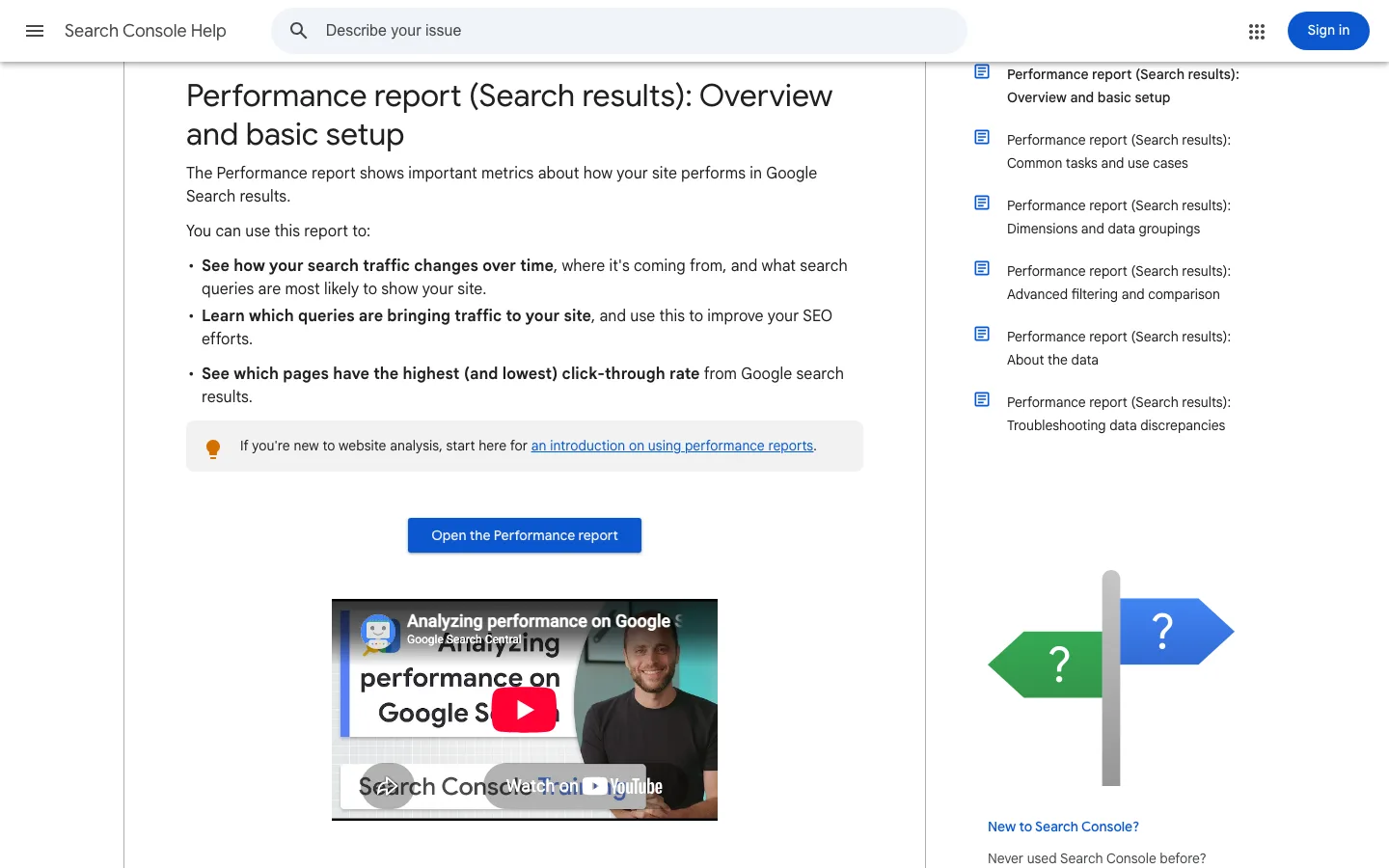
Sorank's keyword research feature reads your Google Search Console queries and the keywords of up to five competitors you choose. It scores each keyword for search volume, difficulty and intent, and it checks new suggestions against your published pages to avoid keyword cannibalization. For a method you can apply step by step, read keyword research for AI search.
Once you have a focus keyword, place it where it supports relevance without forcing it. The main keyword belongs in the title and the H1 heading, and related terms fit naturally in subheadings, the introduction, the body text, image alt text and the URL. The meta description should describe the page clearly for people reading the results.
Write for the reader first. A sentence that repeats a term only to hit a count reads badly and makes the page look like spam. Use the keyword where it helps someone understand the page, and let the surrounding text cover the related questions.
Yes. The prompts people type into ChatGPT, Perplexity and Gemini are keywords, often long and conversational. These assistants read content to assemble an answer and choose the sources they cite. Pages that clearly cover the relevant keywords and sub-questions are more likely to be used in that answer.
This means keyword work now serves two audiences. The topical depth and clarity that earn rankings on Google also help a page get cited in AI answers. Map the questions your audience asks, then answer each one directly near the top of its section.
The classic mistake is keyword stuffing, repeating a term so often that the text reads poorly and looks like spam. Another is targeting only high-volume short keywords and ignoring the long-tail queries that actually convert. A third is mismatched intent, such as writing a guide for a term that people use when they want to buy.
A fourth is putting several unrelated keywords on one page. The page loses focus, and search engines struggle to decide which query it should answer. Give each distinct topic its own page, and keep one primary keyword per page supported by close variations.
Keywords connect what people want with the content that answers them. For SEO, they help search engines match a page to queries. For GEO, the same words tell AI assistants which pages cover a subject well enough to cite. Ignoring them means leaving both channels to chance.
Keywords also show where demand is growing and where a site has gaps, so they guide the content plan itself. A page built on a clear keyword and a clear answer is easier to rank, easier to understand and easier to reuse in an AI answer.
Keywords remain the foundation of search visibility. They turn what people want into signals that search engines and AI systems can act on. The most effective approach combines careful research, intent matching, natural on-page use and genuine depth on each topic. Check the intent behind each term before you write, and the rest of the page will follow.
Sources
Short keywords are one or two words with high search volume but broad intent and strong competition, such as apple pie. Long-tail keywords are three or more words that are more specific, such as how to make homemade apple pie. They attract fewer searches, but their intent is clearer and they are usually easier to rank for.
Focus each page on one primary keyword, then support it with closely related variations and synonyms. Trying to rank one page for many unrelated terms dilutes its focus and confuses search engines. If you have several distinct topics, create a dedicated page for each one.
Yes. The prompts people type into ChatGPT, Perplexity and Gemini are keywords, often long and conversational. Pages that clearly cover the relevant keywords and sub-questions are more likely to be used and cited in AI answers.
 “I tested Sorank on a real client site and it's insane. It does everything an agency would bill you $1500 a month for. It's going into production on that client now.”

 Guillaume Guersanguersanguillaume.com“We are an Ads agency and we wanted to get our SEO back on track once and for all. Sorank gave us a clear view of our site, helped us prioritize optimizations, and properly structure our content. The tool is easy to use, well designed for a team, and very practical for centralizing tracking without having to juggle multiple platforms. A very solid foundation to start fresh with our SEO.”
 Gaspard MadouiAds Agency
 “I just let the Sorank software do its thing, and now my DR is 25 and my page is ranking higher.”
 Lucas Flandrefoundertrace.fr“I specialized in GEO thanks to Sorank. The GEO Leaderboard allows me to show my clients their position vs competitors on ChatGPT. It’s a real commercial differentiator.”
 MélanieSEO Freelance“Great service, works well for our website and helps us understand how to improve it to rank better on Google and elsewhere. Congrats, keep going, I recommend it.”
 Hugo T.E-commerce merchant



















